|
|||||||||||||||||
Heart CareWeight LossFemale HealthMemory Enhancing HerbsDiabetes Natural Remedies Male Sex HealthCancer CareKidney CareStress RelieversJoint PainCholesterol Care Liver CleanseAsthma & Allergy CareDigestion careAcneArthritisAnxietyAnkylosing SpondylitisAnti-AgeingAllergy & Asthma Blood PressureBack Pain ConstipationColon CleanseCervical SpondylitisDiabetes,DetoxDepression Programme Erectile DysfunctionFibroids (Uterine)FibromyalgiaGoutHair Loss ImpotenceJoint Pain Kidney FailureLow ImmunityLow Sperm CountOsteoarthritisOvarian CystsObesity / weight Loss PsoriasisParkinsonismPremature EjaculationRheumatoid ArthritisSex Problems Uric Acid |
Benefits of Arjun Tea
Ingredients in Total Heart Support - Herbs for Cholesterol, Blood Pressure and Heart Problems
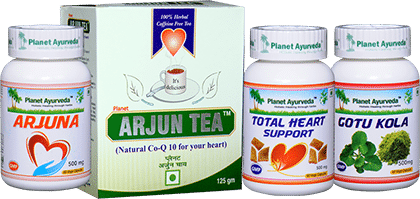
Arjuna (Terminalia arjuna): The bark of this tree is used in Ayurveda for prevention and treatment of many heart problems like angina, coronary artery disease, congestive heart failure, high cholesterol and blood pressure. Extensive research has lead to discovery of cardiac glycosides in the bark and naturally occurring Co-Enzyme Q 10, which is really important nutraceutical for proper functioning of heart muscle. It gives strength to ailing heart and controls the cholesterol levels. Ashwagandha (Withania somnifera): Ashwagandha is also commonly known as ‘Indian ginseng'. It is a unique herb with multiple functions. It contains active components like ‘Withanolides' and ‘Withaferin' which are very beneficial for nervous system. The herb also possesses anti-inflammatory, antitumor, antistress, antioxidant, immunomodulatory, hemopoietic, and rejuvenating properties. It is especially useful in diabetics and blood pressure people as it also controls diabetes and blood pressure. It relieves stress, anxiety and enhances physical and mental performance naturally. Jatamansi (Nordostachys jatamansi): This herb is useful in many illnesses like blood pressure and hysteria. It controls epilepsy, mental disorders. It relieves stress and anxiety. Brahmi (Bacopa monnieri): The herb ‘Brahmi' is used in Ayurveda since ages for loss in memory, lack of concentration, forgetfulness. It increases the retention power as well as recollection. It is very useful in many mental illnesses also. Regular use also helps in stress, anxiety, blood pressure, hallucinations and epilepsy. Regular use of this herb improves mental ability and cognition. Shankhpushpi (Convolvulus pluricaulis): This beautiful white flowered plant really enhances the mind ability to recollect and remember the things in a very effective manner. It relieves mental stress, controls blood pressure and also improves mind's ability. People in India are using this herb for centuries for their children to improve their memory especially during exams.
Arjun Saar is the combination of best herbs described in ancient Ayurvedic texts as the most effective treatment for blood pressure and heart problems. Arjun Saar is the safest choice to the problems like hypertension, high cholesterol, fatigue, blocked coronary arteries. It tones up and strengthens heart muscle and arterial system . It is a best combination to take care of above mentioned problems and that too without any side effects. Addition of each herb in Arjun Saar has a specific purpose and the one who uses it regularly can definitely realize its benefits. Benefits of Arjun Saar
Medicinal Properties of Amla: Amla is perhaps the single most often mentioned herb in “Charak Samhita”. The fruit is has the highest content of vitamin C of any natural occurring substances in nature. Amla is most useful treatment of ulcers and hyperacidity. Amla builds immune system to fight against all kind of viruses like that of Hepatitis, AIDS, Influenza and many others.
Safe Shopping
Uses of Arjun tea, Total Heart Support and Arjun Saar (Heart Rejuvenation Pack) used together -
The following clinical study depicts the role of Arjuna on its effect on cholesterol levelsJAIPUR, India--Researchers here compared the effects of Terminalia Arjuna tree bark with the heart-health benefits of vitamin E in a study published in February's The Journal of the Association of Physicians of India (49:231-5, 2001). In the one-month study, researchers reviewed 105 patients with coronary heart disease, none of whom were on lipid-lowering drugs. At baseline, total cholesterol, triglycerides, lipid peroxidation and HDL and LDL cholesterol were measured. Divided into three groups, group one received a placebo, group two received 400 IU of vitamin E per day and group three received 500 mg of finely pulverized bark powder. No significant changes were found in the placebo or vitamin E groups for total, HDL and LDL cholesterol levels, nor in triglyceride levels. However, in the tree bark group, total and LDL cholesterol were significantly lowered. Notably, lipid peroxidation decreased most significantly in the vitamin E users. The researchers, based at the Monilek Hospital and Research Center here, concluded that Terminalia Arjuna tree bark powder proved to have a significant cholesterol lowering effect.
Bharani A, Ahirwar LK, Jain N. Indian Heart J 2004;56:123-128. BACKGROUND: Smoking, largely through increased oxidative stress, causes endothelial dysfunction which is an early key event in atherosclerosis. Smoking cessation and antioxidant vitamin therapy are shown to have beneficial role by restoring altered endothelial physiology. The present study was aimed to determine whether Terminalia arjuna, an Indian medicinal plant with potent antioxidant constituents, would improve endothelial dysfunction in smokers. METHODS AND RESULTS: Eighteen healthy male smokers (age 28.16+/-9.45 years) and equal number of age-matched non-smoker controls participated in the study. The baseline brachial artery reactivity studies were performed using high frequency ultrasound according to standard protocol under identical conditions to determine endothelium-dependent, flow-mediated dilation and endothelium-independent nitroglycerine-mediated dilation. The two groups were matched regarding age, body mass index, blood pressure, serum cholesterol, mean resting vessel diameters and post-occlusion flow velocities (all p = NS). While flow-mediated dilation was significantly impaired amongst smokers compared to controls (4.71+/-2.22 v. 11.75+/-5.94%, p <0.005), the nitroglycerine-mediated dilation was similar in the two groups (20.35+/-3.89 v. 19.68+/-3.74%, p = NS). Subsequently the smokers were given Terminalia arjuna (500 mg q8h) or matching placebo randomly in a double blind cross-over design for two weeks each, followed by repetition of brachial artery reactivity studies to determine various parameters including flow-mediated dilation after each period. There was no significant difference as regards vessel diameter and flow velocities between the two therapies. However, the flow-mediated dilation showed significant improvement from baseline values after Terrminalia arjuna therapy but not with placebo (9.31+/-3.74 v. 5.17+/-2.42%. p <0.005). CONCLUSIONS: Smokers have impaired endothelium-dependent but normal endothelium-independent vasodilation as determined by brachial artery reactivity studies. Further, Terrminalia arjuna therapy for two weeks leads to significant regression of this endothelial abnormality amongst smokers.
Terminalia arjuna is an important cardiotonic plant described in the Ayurveda, the ancient Indian medical science. It is also believed to have the ability to cure hepatic, urogenital, venereal and viral diseases. An attempt is made here to analyse the available drug recipes using this plant from Sanskrit literature in the light of modern scientific knowledge. The chemistry and pharmacology of T. arjuna are also discussed, and areas of future investigations are identified.
The effect of bark powder of Terminalia arjuna, an indigenous drug, on anginal frequency, blood pressure, body mass index, blood sugar, cholesterol and HDL-cholesterol was studied in 15 stable (Group A) and 5 unstable (Group B) angina patients before and 3 months after T. arjuna therapy. Tread mill test (TMT) and echocardiographic left ventricular ejection fraction was evaluated in some cases. There was 50% reduction in anginal episodes in Group A cases (P < 0.01). TMT performance improved from moderate to mild changes in 5 patients and one with mild changes became negative for ischemia. The time to the onset of angina and appearance of ST-T changes on TMT after T. arjuna was delayed significantly. However, in patients with unstable angina there was an insignificant reduction in anginal frequency. These patients also needed diltiazem, B-blockers and nitroglycerine in addition to T. arjuna. The drug lowered systolic blood pressure and body mass index to a significant level (p < 0.05) and increased HDL-cholesterol only slightly along with marginal improvement in left ventricular ejection fraction in stable angina patients. There were no deleterious effects on liver or kidney functions. Our results suggest that monotherapy with T. arjuna is fairly effective in patients with symptoms of stable angina pectoris. However, it has a limited role in unstable angina.
The leaves, twigs, stem and bark of T. arjuna were analysed for their protein, phenol, tannin, nitrate, oxalate in addition to vitamin C, anthocyanin and chlorophyll in the leaves. The variation of some of these parameters in the leaves with season and leaf position was also studied. The time course changes in amino acids and protein during seed germination in T. arjuna, showed initial decrease in protein followed by increase at subsequent stages. The seeds contain high level of serine (21.7%) and glutamic acid (22.6%) the later decreased as the germination progressed. After 30 days seeds showed higher amounts of serine (26.0%), valine (2.8%), proline (10.6%), methionine (3.4%), histidine (5.6%) and lysine (7.4%) while threonine, glutamic acid, tyrosine and arginine were in lower amounts than that of initial stage at 0 day. Arjuna (TA) can help lower Cholesterol as much as 64% - After only 30 days, people taking TA saw their LDL levels plummet by an average of 25.6%. After 60 days, in animal studies lab subjects with extremely high blood fats, LDL levels dropped from 493 to 162. That's a whopping 64 percent drop. Plus, HDL cholesterol (the good stuff) actually increased. Reduces angina episodes much better than nitroglycerin - More than 6.2 million Americans suffer from angina right now and most are probably taking nitroglycerin pills for it. But over time nitroglycerin can become less effective. Big problem. So researchers decided to test the herb Arjuna against nitroglycerin. It worked better in every study. In one study, angina episodes were cut in half by the Arjuna, with none of the nasty side effects. Plus, TA can be used as long as you like, without fear it'll stop working. It's been shown to help reverse hardening of the arteries - Here's the most shocking fact of all: Although most Western doctors still haven't heard of it, Arjuna has been used by herbal healers in India to treat heart trouble for an incredible 2,700 years. Nearly three millennia!
BACKGROUND: Terminalia arjuna, an Indian medicinal plant, has been reported to have beneficial effects in patients with ischemic heart disease in a number of small, open studies. The need for a double-blind, randomized, placebo-controlled study with adequate sample size has long been felt. The bark extract (IPC-53) contains acids (arjunic acid, terminic acid), glycosides (arjunetin arjunosides I-IV), strong antioxidants (flavones, tannins, oligomeric proanthocyanidins), minerals, etc. and exhibits antifailure and anti-ischemic properties. METHODS AND RESULTS: Fifty-eight males with chronic stable angina (NYHA class II-III) with evidence of provocable ischemia on treadmill exercise test received Terminalia arjuna (500 mg 8 hourly), isosorbide mononitrate (40 mg/daily) or a matching placebo for one week each, separated by a wash-out period of at least three days in a randomized, double-blind, crossover design. They underwent clinical, biochemical and treadmill exercise evaluation at the end of each therapy which were compared during the three therapy periods. Terminalia arjuna therapy was associated with significant decrease in the frequency of angina and need for isosorbide dinitrate (5.69+/6.91 mg/week v. 18.22+/-9.29 mg/week during placebo therapy, p<0.005). The treadmill exercise test parameters improved significantly during therapy with Terminalia arjuna compared to those with placebo. The total duration of exercise increased (6.14+/-2.51 min v. 4.76+/-2.38 min, p<0.005), maximal ST depression during the longest equivalent stages of submaximal exercise decreased (1.41+/-0.55 mm v. 2.21+/-0.56 mm, p<0.005), time to recovery decreased (6.49+/-2.37 rain v. 9.27+/3.39 min, p<0.005) and higher double products were achieved (25.75+/-4.8 1x10(3) v. 23.11+/-4.83x10(3), p<0.005) during Terminalia arjuna therapy. Similar improvements in clinical and treadmill exercise test parameters were observed with isosorbide mononitrate compared to placebo therapy. No significant differences were observed in clinical or treadmill exercise test parameters when Terminalia arjuna and isosorbide mononitrate therapies were compared. No significant untoward effects were reported during Terminalia arjuna therapy. CONCLUSIONS: Terminalia arjuna bark extract, 500 mg 8 hourly, given to patients with stable angina with provocable ischemia on treadmill exercise, led to improvement in clinical and treadmill exercise parameters as compared to placebo therapy. These benefits were similar to those observed with isosorbide mononitrate (40 mg/day) therapy and the extract was well tolerated. Limitations of this study include applicability of the results to only men with chronic stable angina but not necessarily to women, as they were not studied.
Dwivedi S, Aggarwal A, Agarwal MR Rajpal S. Int J Cardiol 2005;100:507-508. The bark powder of Terminalia arjuna, an indigenous plant has been found to have antianginal, decongestive and hypolipidemic effect. We planned a study to evaluate the role of T. arjuna in ischemic mitral regurgitation (IMR) following acute myocardial infarction (AMI). 40 patients with fresh AMI showing IMR were randomly divided into 2 groups of 20 each. They were given placebo or 500 mg of T. arjuna in addition to anti-ischemic treatment. After 1 and 3 months of follow up, patients receiving adjuvant T. arjuna showed significant decrease in IMR, improvement in E/A ratio and considerable reduction in anginal frequency.
|
|
|
![]()
|
|||||||||||||||||||||||||||||||||||||||||||||||||||||||||||||||||||||||||||||||||||||||||||||||||||||||||||||||||||||||||||||||||||||||||||||||||||||||||||||