
What are Kidney Stones?
It is a condition in which hard masses of crystals having varied constitution develop in the cortex of the kidney tissues and result in the formation of kidney stones.
Some people have a natural tendency to develop renal stones while in others, it may be a result of a dietary imperfection.
Types of Kidney Stones
There are broadly four types of kidney stones depending upon their chemical constitution.
These are as follows:-
- Calcium stones – These are mainly of two types namely, calcium oxalate and calcium phosphate stones. Out of these oxalate stones are more common. Calcium stones are the most common types of renal stones to occur.
- Uric acid stones – These are formed due to the crystallization of uric acid in the urine. A diet rich in proteins is considered to be a predisposing factor for the development of this condition.
- Struvite stones – These occur as a result of some kidney infection.
- Cysteine stones – These occur due to a genetic disorder which allows for the passage of cysteine in urine. This cysteine when leaks through the urine forming crystals which settle down in the form of kidney stones.
- Other kidney stones – Apart from the above four common types of kidney stones there are many other varieties of kidney stones that occur rarely in a few individuals.
What are the Risk Factors for Developing Renal Stones?
- Family history of the disease
- Dehydration or taking inadequate amounts of water or necessary fluids for a prolonged period of time.
- Diet rich in sodium, protein and sugar, greatly increases the chances of developing many types of kidney stones.
- Obesity
- Digestive problems
- Medical conditions like Urinary tract infections, hyperparathyroidism, cystinuria and renal tubular acidosis.
Does Diet Help in case of Kidney Stones?
Renal stones or kidney stones are usually formed by the crystallization of the waste products that are the remnants of the food we eat.
So, basically, what food we eat is directly related to the risk involved in the development of kidney stone and also the type of renal stone which is most likely to develop.
What Kind of Dietary Changes can Help a Case of Kidney Stones?
People need to increase their fluid intake, especially water to help in flushing out the stones and clearing the blockages caused by them.
Diet should have a limitation of sodium, calcium in case of calcium stones, oxalates in case of oxalate stones, cysteine in case of cysteine stones etc.
Limiting animal protein in diet is also very important for the maintenance of health and wellbeing
People with calcium stones need to take good quality natural supplements to naturally support healthy blood calcium levels.
Spinach, rhubarb, nuts and wheat bran are to be avoided in case of oxalate stones.
How does Fluid intake Influence the Formation of Kidney Stones?
It is a very important factor that can help to naturally prevent or eliminate the stone crystals from the urinary system.
Such patients are usually asked to drink as much of water as they can so that the crystals flush out along with urine.
Soda is one fluid that should not be used for increasing the intake of total fluids by the body. Besides this, orange juice and lemonades also come in handy for the management of kidney stones.
How to Prevent Kidney Stones?
The key points to remember for managing kidney stone problems are:-
- Diet which should be devoid of the substances that cause formation of the kidney stones
- Adequate fluid intake, it may vary from person to person depending upon his or her capacity.
- Limiting animal proteins and sodium in diet.
- Taking healthy calcium supplements to prevent hypocalcaemia in case of calcium stones.
Should Calcium Intake be Limited in Case of Calcium Stones?
Calcium does not lead to the formation of calcium stones. It is the oxalate and phosphate in food that binds to the dietary calcium in the intestines, leading to the formation of oxalate and phosphate stones.
It is therefore, very important to maintain a sufficient dietary intake of natural calcium in an amount of 800 mg per day. A cup of low fat milk or orange juice, mushrooms are some of the natural sources of calcium in diet.
Does Exercising Help in Preventing Kidney Stones?
Exercise is very important not only to prevent kidney stones but also to manage the overall health and fitness of the body. Exercise helps to maintain blood pressure levels and reduces the risk of developing renal stones manifolds.
Herbal Remedies for Kidney Stones
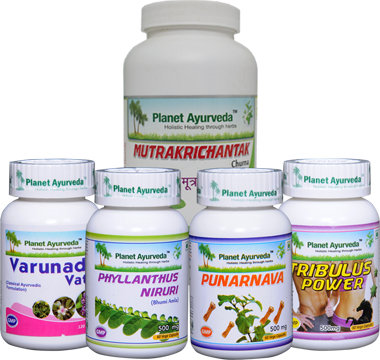
Planet Ayurveda offers Stone Crusher Pack for the treatment of kidney stones. Herbal remedies in this pack holds a complementary approach in the management as well as prevention of kidney stones.
Dosage
- Varunadi Vati – 2 tablets twice daily with warm water.
- Phyllanthus Niruri – 1 capsule twice daily with warm water.
- Punarnava Capsules – 1 capsule twice daily with warm water.
- Tribulus Power – 1 capsule twice daily with warm water.
- Mutrakrichantak Churna – 1 teaspoonful twice daily with warm water and for best result Boil 1 Teaspoonful in 400ml water until it remains 50-60ml. Filter the preparation with a regular tea strainer and drink. You should use this once in morning 45min. after breakfast and similarly in evening 45min. after dinner. Prepare fresh every time as per this.
Products Description
1. Varunadi Vati
Varunadi Vati is a classical herbal formulation that helps in getting rid of renal stones and relieves the pain caused by these stones. This helps in dissolving the stones completely and also helps in passing the stones naturally through urine by interfering with the creation of oxalate-type kidney stones. It also helps in reducing the toxin load from the kidneys.
2. Phyllanthus Niruri
Planet Ayurveda’s Phyllanthus niruri capsules are prepared from the standardized extract of the whole plant Bhumyamalaki. This herb is known as "Stone Breaker" in Ayurveda. This plant has been used for urinary calculi since ages. It reduces the risk of stones in individuals. Therefore, these capsules are very effective for the patients of kidney stones.
3. Punarnava Capsules
Punarnava Capsules by Planet Ayurveda are prepared from the standardized extract of the herb Boerhavia diffusa. This herb is an effective diuretic and helps in flushing out the kidney stones and also helps in reducing swelling. These capsules are also very effective in relieving pain associated with kidney stones.
4. Tribulus Power
Tribulus Power Capsules of Planet Ayurveda are prepared using the standardized extract of the herb Tribulus terrestris. Tribulus terrestris is an herb which is diuretic and antiurolithiatic in nature. These capsules are very effective in the treatment of kidney stones as they produce inhibitory effect toward calcium oxalate crystallization.
5. Mutrakrichantak Churna
Mutrakrichantak Churna by Planet Ayurveda is a unique herbal formulation which consists of dried herbs that are used in dissolving kidney stones naturally. All the herbs used in Mutrakrichantak Churna are anti-oxidant in nature and provide relief in all kidney related problems such as infections, kidney failure etc.
To buy Stone Crusher Pack, please visit store.planetayurveda.com/products/stone-crusher-pack