


Aβ42/Aβ40 Ratio Test – Procedure, Results Interpretation, Uses, Indications & Ayurvedic Support
Abstract
In the silent architecture of the mind, a microscopic drift begins—the slow accumulation of amyloid "snow." Alzheimer’s isn’t just memory loss; it is a gradual eclipse of the self. Within this neurological twilight, the Aβ42/Aβ40 ratio acts as a molecular compass. While individual proteins whisper of aging, their ratio screams of the coming storm. By measuring the precarious balance between these toxic and benign fragments, we map the invisible geography of neurodegeneration. This ratio is the early lighthouse, piercing the cognitive fog to signal a path toward intervention before the inner landscape is entirely rewritten in white. Let’s discuss it in detail!
Introduction
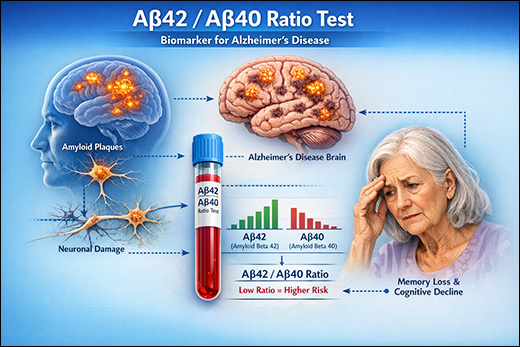
The Aβ42/Aβ40 ratio test measures the proportion of two forms of amyloid-beta protein—Aβ42 and Aβ40—in blood or cerebrospinal fluid. These peptides are central to the pathology of Alzheimer’s disease. Aβ42 is more prone to aggregation and plaque formation in the brain, while Aβ40 is more abundant but less likely to clump. When Aβ42 levels decrease relative to Aβ40, it may indicate amyloid deposition in brain tissue. Clinically, this ratio improves diagnostic accuracy compared to measuring Aβ42 alone, as it reduces variability due to individual differences in total amyloid production. Its scope includes early detection of Alzheimer’s pathology, risk assessment in mild cognitive impairment (MCI), and monitoring disease progression or therapeutic response. Increasingly, blood-based assays are making this test more accessible and useful for large-scale screening and preventive neurology.
How To Do This Aβ42/Aβ40 Ratio Test?
- Patient Preparation – No special fasting is usually required (follow lab instructions if specified).
- Sample Collection
- Blood Test: Venous blood is drawn from the arm.
- CSF Test: Lumbar puncture is performed under sterile conditions to collect cerebrospinal fluid.
- Sample Processing – The collected sample is centrifuged (for blood) and stored at controlled temperature to preserve amyloid proteins.
- Laboratory Analysis – Aβ42 and Aβ40 levels are measured using immunoassay (ELISA) or mass spectrometry.
- Ratio Calculation – Aβ42 concentration is divided by Aβ40 concentration to obtain the ratio.
- Result Interpretation – A lower ratio may indicate amyloid plaque deposition and is used in the assessment of Alzheimer’s disease.
Results Interpretation
1. The Low Ratio (The “Positive” Result)
A ratio below the established laboratory cutoff (e.g., $< 0.160$) suggests an increased likelihood of amyloid plaque deposition in the brain.
As Aβ42 clumps together into plaques, it gets "trapped" in the brain tissue. Consequently, there is less of it circulating in the cerebrospinal fluid (CSF) or blood, causing the ratio to drop. This is highly indicative of Alzheimer’s pathology, often appearing years before the first "Where are my keys?" moment.
2. The High/Normal Ratio (The “Negative” Result)
A ratio above the cutoff suggests that amyloid is moving freely and not accumulating into toxic structures. A healthy clearance system keeps these proteins in balance. Cognitive symptoms may be due to other factors (vascular issues, B12 deficiency, or depression) rather than Alzheimer’s.
Indications Of Aβ42/Aβ40 Ratio
The Aβ42/Aβ40 ratio is indicated when a "clinical fog" obscures the diagnosis. It is primarily used to:
- Confirm Alzheimer’s: Differentiating AD from other dementias (like Frontotemporal or Vascular).
- Early Detection: Identifying pathology in "young-onset" cases (under 65) or mild cognitive impairment.
- Treatment Gatekeeping: Mandatory to qualify for new anti-amyloid infusion therapies (e.g., Lecanemab).
- Rule Out "Mimics": Ensuring symptoms aren’t actually caused by depression, B12 deficiency, or sleep apnea.
How Medhya Rasayan’s In Ayurveda Helps In Improving Aβ42/Aβ40 Ratio Test!
While Medhya Rasayanas (nootropic rejuvenators) are ancient Ayurvedic formulations, modern pharmacology is beginning to validate how they might literally "clean up" the molecules measured in the Aβ42/Aβ40 test. In the context of the Aβ42/Aβ40 ratio, these herbs act as molecular detergents and shields. Here is how they influence the test results:
1. Enhancing Amyloid Clearance (Raising the Ratio)
As we discussed, a low ratio is bad because Aβ42 is "stuck" in the brain. Medhya Rasayanas like Brahmi (Bacopa monnieri) and Guduchi have shown potential to activate Microglia. These are the brain’s "trash collectors." By stimulating these cells, Medhya Rasayanas help clear Aβ42 from the brain tissue back into the fluid (CSF/Blood). This could theoretically increase the Aβ42 levels in the fluid, improving (raising) the Aβ42/Aβ40 ratio.
2. Inhibiting “Seed” Formation (Anti-Aggregation)
Aβ42 is dangerous because it is "sticky." Compounds in Shankhapushpi and Mandukaparni interfere with the way Aβ42 proteins "hold hands" to form toxic plaques. If the proteins cannot aggregate (clump), they remain as monomers that are easily measured and cleared, preventing the "drop" in the ratio that signals Alzheimer’s.
3. Protecting the “Biological Fire” (Secretase Modulation)
The ratio is determined by how the body cuts a larger precursor protein. Herbs like Ashwagandha may influence the enzymes (Alpha-secretase) that cut the protein into “good” fragments rather than the “bad” Aβ42 fragments. By shifting production toward the safer Aβ40 or other non-toxic forms, the Rasayanas help maintain a healthy, high ratio.
Medhya Rasyans (Nervine Tonic)!
1. Brahmi (Bacopa monnieri)
Known as the premier “Herb of Grace,” Brahmi is a cooling Rasayana that balances all three Doshas. It enhances Dhi (acquisition), Dhriti (retention), and Smriti (recall). By clearing the “dampness” of Ama from the brain’s channels, it ensures the smooth flow of Prana and prevents the mental “clouding” caused by toxic buildup. It contains bioactive bacosides. Research suggests these compounds help maintain a healthy Aβ42/Aβ40 ratio by reducing the endogenous production of amyloid-beta. It interferes with the enzymes (BACE1) that “cut” the proteins into the toxic 42-amino acid length, thereby preventing the initial formation of plaques.
2. Mandukaparni (Centella asiatica)
This herb is a specific rejuvenative for the Majja Dhatu (nervous tissue). It improves microcirculation in the brain, ensuring that “Ojas” reaches the deepest tissues to prevent the “drying” (Vata) that leads to cognitive decline. It is considered a Srotovishodhana herb, meaning it “scours” the micro-channels of the mind. It contains asiaticosides. These have been shown to reduce Amyloid-beta induced neurotoxicity by protecting the synapses. Studies indicate it can help prevent the “seeding” of Aβ42, the stickier form of the protein, helping to keep the ratio within a normal, healthy range.
3. Shankhapushpi (Convolvulus pluricaulis)
It is considered as the most potent herb for Medha (intellect). It is “Sheeta” (cooling) and specifically stabilizes the Prana Vayu. It acts as a psychotropic herb that settles the mind, preventing the “agitation” that leads to the premature “burning out” of brain cells. It works by increasing levels of Brain-Derived Neurotrophic Factor (BDNF). In the context of the amyloid ratio, BDNF-rich environments are more resilient to the toxic effects of a low Aβ42/Aβ40 ratio. It provides a neuroprotective buffer that allows neurons to communicate even when amyloid levels begin to shift.
4. Yashtimadhu (Glycyrrhiza glabra)
This sweet root nourishes the Majja tissues and acts as a Vayasthapana (anti-aging) agent. It is used to “unblock” the channels of cognition and provide a soothing coating to the nervous system, protecting it from the “corrosive” effects of chronic mental stress.It contains liquiritigenin. Modern studies demonstrate that this compound inhibits the inflammatory response of microglia to amyloid plaques. By quieting this “brain fire,” it prevents the brain from overreacting to a dropping Aβ42/Aβ40 ratio, which typically accelerates the disease.
5. Tagar (Valeriana wallichii)
Tagar is a potent Vata-Hara (Vata-destroyer) and Nidrajanana (sleep-inducing) herb. It clears restlessness from the mind and removes "Avarana" (blockages) in the nervous pathways, allowing for deep, restorative rest that preserves the brain’s "Tejas" (radiance). It contains valerenic acid, which promotes deep NREM sleep. This is the stage where the Glymphatic System is most active. Scientific research shows that during this "brain wash," the Aβ42/Aβ40 ratio is balanced by physically flushing out the "sticky" Aβ42 proteins into the blood circulation to be cleared by the body.
Conclusion
At last it can be concluded that the convergence of ancient Ayurvedic wisdom and modern molecular diagnostics marks a new era in neuroprotection. While the Aβ42/Aβ40 ratio tests provide the "liquid biopsy" needed for objective, early-stage detection, Medhya Rasayana herbs offer a systemic strategy for brain resilience. By utilizing herbs like Brahmi to inhibit protein aggregation and Tagar to optimize glymphatic waste clearance during sleep, we transition from passive observation to active prevention. Ultimately, bridging the global detection gap with scalable blood tests allows for earlier intervention, where the "cleansing" and "nourishing" principles of Ayurveda can most effectively preserve the brain’s vital essence.