


Ananaas / Pineapple / Ananas Comosus – Medicinal Properties, Benefits & Dosage
Abstract
Ananas comosus, commonly known as pineapple, is a tropical fruit plant widely valued for its nutritional and medicinal importance. It has traditionally been used to support digestion, stimulate appetite, and improve metabolic activity. Pineapple contains the bioactive enzyme bromelain, which exhibits proteolytic, anti-inflammatory, digestive, and anti-edematous properties. Modern scientific studies highlight its antioxidant, immunomodulatory, wound-healing, and anti-inflammatory effects. The fruit is a rich source of vitamin C, manganese, dietary fiber, and polyphenolic compounds, contributing to immune support, tissue repair, and overall health maintenance. Due to its broad therapeutic potential, Ananas comosus serves as an important functional food with applications in both traditional medicine and contemporary nutritional science.
Classical Reference Of Pineapple (Ananas Comosus)
Bhavprakash Nighantu Parishisht Varga Page no. 791
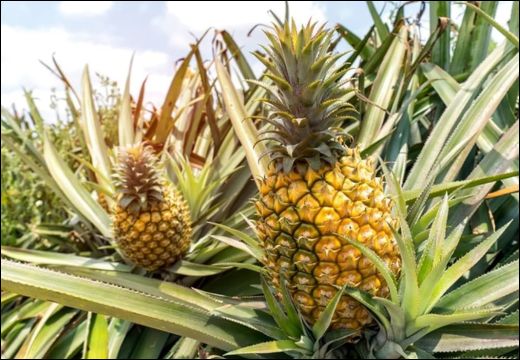
Scientific Classification Of Pineapple (Ananas Comosus)
- Kingdom: Plantae
- Subkingdom: Tracheobionta (Vascular plants)
- Superdivision: Spermatophyta (Seed plants)
- Division: Magnoliophyta (Angiosperms)
- Class: Liliopsida (Monocotyledons)
- Subclass: Commelinidae
- Order: Poales
- Family: Bromeliaceae
- Genus: Ananas
- Species: Ananas comosus
Synonyms Of Pineapple (Ananas Comosus)
- Ananasa / Ananaasa: The classical name used for pineapple in Ayurvedic literature, directly referring to the plant and its fruit.
- Bahupatra: Meaning: “A plant with many leaves,” indicating the dense rosette arrangement of pineapple leaves.
- Kantaphala: “Spiny or thorny fruit,” describing the rough, pointed surface of the pineapple fruit.
- Amlaphala: “Sour-tasting fruit,” referring to the characteristic acidic taste of pineapple.
- Ananasa Phala: “Fruit of the Ananasa plant,” a descriptive term used in classical texts.
Vernacular Names Of Pineapple (Ananas Comosus)
- English: Pineapple
- Hindi: Ananas
- Sanskrit: Ananasa
- Marathi: Ananas
- Gujarati: Ananas
- Bengali: Anaras
- Tamil: Annasi Pazham
- Telugu: Anasa Pandu
- Kannada: Ananas
- Malayalam: Kaitha Chakka
- Urdu: Ananas
- Punjabi: Ananas
- Oriya (Odia): Sapuri Anaras
- Assamese: Anaros
- Nepali: Bhui Katahar
Habitat Of Pineapple (Ananas Comosus)
- Native Region: Ananas comosus is native to South America, particularly Brazil, Paraguay, and northern Argentina, where it grows naturally in tropical environments.
- Geographical Distribution: The plant is widely cultivated across tropical and subtropical regions of the world, including Asia, Africa, Central America, and the Pacific Islands.
- Climatic Requirements: Pineapple grows best in warm and humid climates with an optimal temperature range of 18–32°C. It requires adequate sunlight and does not tolerate frost.
- Soil Preferences: The plant prefers well-drained sandy loam to lateritic soils rich in organic matter. Mildly acidic soils (pH 4.5–6.5) are considered ideal for its growth.
- Rainfall and Water Requirements: Moderate and well-distributed rainfall is suitable for pineapple cultivation. Waterlogging is unfavorable, as it adversely affects root development.
- Cultivation in India: In India, pineapple is extensively cultivated in Assam, West Bengal, Kerala, Karnataka, Tripura, Meghalaya, and Andhra Pradesh, where climatic and soil conditions are favorable.
Morphology Of Pineapple (Ananas Comosus)
1. Habit
Ananas comosus is a perennial, herbaceous plant with a short, stout stem forming a compact basal rosette. The plant generally attains a height of 1–1.5 meters.
2. Root
The root system is fibrous and adventitious, arising from the basal portion of the stem. Roots are shallow and primarily adapted for efficient absorption in well-drained soils.
3. Stem
The stem is short, thick, and unbranched, remaining mostly underground or at the soil surface. It serves as the central axis bearing leaves, flowers, and the fruit.
4. Leaves
Leaves are long, narrow, stiff, and sword-shaped, arranged spirally in a dense rosette. They measure 50–100 cm in length, with spiny or serrated margins and a thick, waxy cuticle that reduces water loss.
5. Inflorescence
The inflorescence is a terminal spike, consisting of numerous closely packed flowers borne on a thick peduncle. Each flower is subtended by a bract.
6. Flowers
Flowers are bisexual, typically purple to reddish, and arranged spirally on the inflorescence axis. They possess three sepals, three petals, six stamens, and an inferior ovary.
7. Fruit
The fruit is a multiple or composite fruit (sorosis) formed by the fusion of berries along with the axis and bracts. It is cylindrical to ovoid, covered with hexagonal markings, and crowned with a leafy tuft.
8. Seeds
Seeds are rarely formed in cultivated varieties due to vegetative propagation and lack of effective pollination.
Classical Categorisation Of Pineapple (Ananas Comosus)
- Bhavprakash Nighantu: Parishisht Varga
Ayurvedic Properties Of Pineapple (Ananas Comosus)
- Rasa (Taste): Madhur (Sweet), Amla (Sour)
- Guna (Properties): Guru (Heavy To Digest), Snigdha (Unctuous)
- Veerya (Potency): Sheeta (Cold)
- Vipaka (Post Digestion Effect): Madhur (Sweet)
Action On Tridosha Of Pineapple (Ananas Comosus)
Pineapple (Ananas comosus) is Vata-shamaka, Pitta-shamaka, and Kapha-vardhaka in its overall action on Tridosha.
Therapeutic Indications Of Pineapple (Ananas Comosus)
- Indigestion (Dyspepsia)
- Constipation
- Inflammatory disorders
- Osteoarthritis
- Sinusitis
- Post-surgical edema
- Immune-related weakness
- Oxidative stress–related disorders
- Cardiovascular disorders
- Hyperlipidemia
- Diabetes mellitus
- Polycystic Ovary Syndrome (PCOS)
Systemic Actions Of Pineapple (Ananas Comosus)
- Gastrointestinal system: Improves digestion, enhances protein breakdown, and supports bowel regularity
- Musculoskeletal system: Reduces inflammation, pain, and swelling.
- Immune system: Modulates immune response and provides antioxidant support.
- Integumentary system: Promotes wound healing and tissue repair.
- Cardiovascular system: Supports vascular health and reduces oxidative stress.
- Metabolic system: Aids metabolic activity and helps counter oxidative damage.
Chemical Composition Of Pineapple (Ananas Comosus)
1. Bromelain
Anti-inflammatory, proteolytic enzyme; supports digestion, reduces edema, promotes wound healing
2. Vitamin C (Ascorbic Acid)
Antioxidant; boosts immunity, aids collagen synthesis and tissue repair
3. Dietary Fiber
Improves digestion, supports bowel regularity, helps lipid and glucose metabolism
4. Phenolic Compounds (Chlorogenic Acid, Caffeic Acid, Ferulic Acid)
Antioxidant and anti-inflammatory activity
5. Flavonoids (Quercetin Derivatives, Epicatechin)
Antioxidant, vascular protective, anti-ulcer potential
6. Organic Acids (Citric Acid, Malic Acid)
Enhances digestion, improves mineral absorption
7. Potassium
Supports cardiovascular health and electrolyte balance
8. Magnesium
Aids enzymatic reactions, muscle and nerve function
9. Calcium
Supports bone health and cellular functions
10. B-Complex Vitamins (B1, B2, B3, B5, B6)
Support energy metabolism and nervous system function
11. Natural Sugars (Glucose, Fructose, Sucrose)
Provide quick energy and nutritional support
Practical Uses / Health Benefits Of Pineapple (Ananas Comosus)
- Supports digestion and improves protein metabolism
- Helps reduce inflammation, pain, and swelling
- Aids in wound healing and tissue repair
- Enhances immune function due to antioxidant activity
- Acts as a natural anti-edematous agent
- Supports cardiovascular and vascular health
- Helps relieve sinus congestion
- Provides antioxidant protection against oxidative stress
- Supports metabolic activity and energy production
- Promotes bowel regularity and gut health
Parts(s) Used Of Pineapple (Ananas Comosus)
- Fruit
- Stem
- Juice
- Leaves
- Peel (rind)
Dosage Of Pineapple (Ananas Comosus)
- Fresh fruit: 50–100 g per day
- Fresh juice: 20–40 ml per day
- Dried powder (fruit): 3–6 g per day
Home Remedies With Pineapple (Ananas Comosus)
- For Itching and Skin Disorders (like Lichen Planus) : Water prepared by boiling pineapple leaves can be used to wash affected skin areas. Regular external use may help calm irritation, burning sensation, and persistent itching.
- For Cough and Mucus Accumulation : Juice extracted from pineapple leaves, when mixed with a small amount of honey and black pepper, can be taken to loosen phlegm and provide relief in cough and chest congestion.
- For Jaundice and Liver Support : Fresh pineapple fruit juice is traditionally consumed to improve appetite and support liver function during jaundice. It helps stimulate digestion and reduces weakness.
- For Menstrual Irregularities : In folk practices, pineapple leaf juice combined with a small quantity of Vacha (Acorus calamus) powder is used to help normalize delayed or irregular menstruation.
- For Pinworm-Related Anal Itching : A mild mixture of pineapple leaf juice with a pinch of mustard powder is sometimes used to reduce itching around the anal region caused by pinworms, especially in children.
- Digestive Aid : Eat 2–3 fresh pineapple slices daily to improve digestion and reduce bloating.
- Constipation Relief : Drink a glass of fresh pineapple juice daily to support regular bowel movements.
- Sore Throat Relief : Chew small pineapple pieces or drink juice to soothe throat irritation.
- Cold and Flu Support : Consume pineapple juice 1–2 times a day to boost immunity.
- Joint Pain / Arthritis Relief : Eat pineapple or drink juice regularly to reduce inflammation and joint stiffness.
- Weight Management / Detox : Start the day with pineapple juice or smoothie to support metabolism and detoxification.
- Mouth Ulcer Relief : Rinse mouth with diluted pineapple juice to calm ulcers and aid healing.
- Blood Pressure Support : Regular consumption of pineapple helps maintain healthy blood pressure due to its potassium content.
Research On Pineapple (Ananas Comosus)
- Anti-Inflammatory and Antioxidant Effects : Bromelain, the proteolytic enzyme in pineapple, has been shown to reduce inflammation and oxidative stress. It modulates inflammatory pathways and scavenges free radicals, supporting tissue health and recovery.
- Cardiovascular Support : Experimental studies suggest bromelain may improve blood flow, reduce vascular inflammation, and help maintain healthy arteries, indicating potential cardiovascular benefits.
- Anticancer Potential : Preclinical research indicates that pineapple bromelain can slow tumor growth, reduce metastasis, and influence immune and inflammatory mechanisms associated with cancer progression.
- Antimicrobial and Wound Healing Properties : Pineapple extracts, including leaves and stem derivatives, exhibit antimicrobial activity and promote wound healing, aiding in the removal of damaged tissue and prevention of infections.
- Protection Against Oxidative Stress: Animal studies have shown that pineapple extracts protect tissues, such as testes, from oxidative damage caused by toxins, highlighting its antioxidant potential.
- Nutritional and Health Benefits : Pineapple is rich in vitamins, minerals, and dietary fiber, contributing to digestion, immune support, and overall metabolic health.
- By-Product Applications : Pineapple peels and cores contain phenolic compounds and fiber. Research shows they can be used in functional foods for antioxidant and digestive benefits.
- Clinical Uses of Bromelain Supplements : Bromelain derived from pineapple stems is used to reduce postoperative swelling, aid burn recovery through debridement, and support anti-inflammatory therapy. Evidence varies with condition and dosage.
Conclusion
Pineapple (Ananas comosus) is a nutritionally rich and medicinally valuable tropical fruit with diverse therapeutic potential. Its fruit, stem, juice, leaves, and peel contain bioactive compounds such as bromelain, vitamin C, dietary fiber, phenolics, flavonoids, and essential minerals, which contribute to digestive support, anti-inflammatory, antioxidant, immunomodulatory, and wound-healing effects. Pineapple demonstrates benefits in managing digestive disorders, inflammatory conditions, cardiovascular health, oxidative stress, and metabolic support. Traditional home remedies utilize various parts for skin, liver, respiratory, and menstrual health. Scientific research, especially on bromelain, supports its clinical use in reducing edema, aiding wound debridement, and modulating inflammation. Overall, Ananas comosus serves as a functional food bridging traditional practices with modern medicinal applications.