


Auditory Brainstem Response (ABR/BERA) Test – Procedure, Interpretation, Uses, Advantages & Ayurvedic Insight
Abstract
Auditory Brainstem Response (ABR), also known as Brainstem Evoked Response Audiometry (BERA), is a non-invasive neurophysiological test used to evaluate the auditory pathway from the inner ear to the brainstem. It measures electrical activity generated by the auditory nerve and brainstem in response to sound stimulation. This test is highly valuable in assessing hearing ability, diagnosing neurological disorders, and screening hearing in newborns and infants. ABR/BERA is widely used in cases where behavioural hearing tests are not possible or reliable. It provides objective information about hearing sensitivity and neural conduction. Unlike conventional audiometry, it does not require active patient participation, making it the “gold standard” for neonatal hearing screening and the diagnosis of retrocochlear pathologies.
Introduction
Hearing is not merely a function of the ears, it is a complex sequence of electrical events that terminates in the brain. While a standard hearing test tells us if a person can hear, the Auditory Brainstem Response (ABR) tells us how the signal travels from the inner ear to the brainstem. The auditory system involves several structures, including the outer ear, middle ear, inner ear, auditory nerve, and brainstem. When sound enters the ear, it is converted into electrical impulses by the cochlea and transmitted to the brain through neural pathways. ABR records these electrical responses and helps determine whether the auditory system is functioning properly. Since its clinical introduction, ABR has revolutionised the detection of hearing loss in infants and the identification of acoustic neuromas (benign tumours on the auditory nerve). Because the test bypasses the patient’s cognitive response, it offers an “unbiased” view of the auditory system’s hardware, ensuring that even those who cannot speak or follow instructions receive an accurate diagnosis.
Scientific Principle Behind The Test
The scientific foundation of ABR is rooted in Bioelectric Evoked Potentials and Time-Locked Latency.
- Electrogenesis When a “click” or “tone burst” enters the ear, it triggers the hair cells in the cochlea. These cells convert mechanical energy into electrical impulses.
- Neural Conduction These impulses travel along the auditory nerve (Cranial Nerve VIII) through a series of relay stations in the brainstem: the Cochlear Nucleus, Superior Olivary Complex, and Lateral Lemniscus.
- Far-Field Recording Although these electrical events happen deep within the head, they create minute voltage fluctuations that can be picked up by sensitive electrodes on the scalp.
- Vertex-Positive Waves The ABR consists of a series of 5 to 7 characteristic waves (labelled I through VII) that occur within the first 10 milliseconds following the sound stimulus. Each wave corresponds to a specific anatomical location in the auditory pathway.
Key Components Of The Test
A standard BERA setup includes:
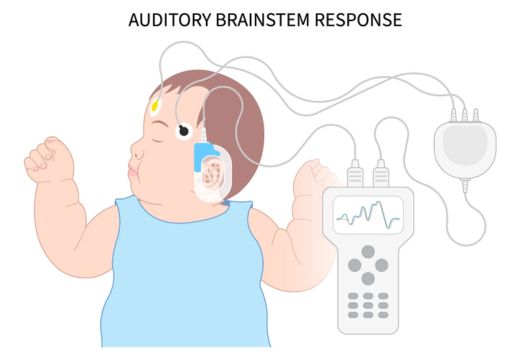
- Transducers High-fidelity insert earphones or headphones that deliver the sound stimulus (clicks or tone pips).
- Surface Electrodes Small metallic discs placed on the forehead (vertex) and behind the ears (mastoid process) or on the earlobes.
- Differential Amplifier Because brainstem signals are incredibly faint (measured in nanovolts), the amplifier magnifies the signal while filtering out “noise” like muscle tension or electrical interference.
- Signal Averager A computer system that repeats the sound stimulus thousands of times and averages the responses to produce a clear, readable waveform.
What Is The Procedure?
The BERA procedure is painless and typically takes 45 to 60 minutes.
- Preparation The skin on the forehead and behind the ears is cleaned to ensure low electrical impedance. Electrodes are then attached with conductive paste.
- Patient State The patient must be extremely still and quiet. Infants are usually tested while sleeping naturally, whereas adults are asked to relax in a reclined chair with their eyes closed. In some pediatric cases, mild sedation may be required.
- Stimulation The computer sends a series of rapid “clicks” (usually 11 to 33 per second) through the earphones.
- Threshold Seeking The audiologist gradually decreases the volume of the clicks to find the lowest level at which Wave V (the most robust wave) can still be identified. This level approximates the patient’s physical hearing threshold.
Interpretation Of The Test
Interpretation focuses on two primary metrics: Absolute Latency (the timing of each wave) and Interpeak Latency (the time interval between waves).
- Wave I Represents the distal portion of the auditory nerve.
- Wave III Represents the Superior Olivary Complex in the lower brainstem.
- Wave V Represents the Inferior Colliculus in the midbrain. This is the most clinically significant wave.
- Normal Interpretation All waves appear within the expected time windows (e.g., Wave V usually appears around 5.5 to 6.0 milliseconds at high intensities).
- Abnormal Interpretation
- Delayed Wave V: Suggests a conductive hearing loss or a problem in the brainstem.
- Prolonged I-V Interpeak Latency: A classic sign of a Retrocochlear Lesion (like an acoustic neuroma) or demyelinating disease.
- Absent Waves: Suggests profound sensorineural hearing loss or significant neural dysfunction.
Health Issues Where Auditory Brainstem Response (ABR/BERA) Is Advised
ABR is a versatile tool used in several critical scenarios:
- Newborn Hearing Screening: To identify congenital hearing loss immediately after birth.
- Diagnostic Audiometry for Infants: To determine the degree and type of hearing loss when behavioural tests are impossible.
- Acoustic Neuroma Detection: Identifying tumours that press against the auditory nerve.
- Auditory Neuropathy Spectrum Disorder (ANSD): A condition where the ear “hears” normally, but the signal becomes disorganised as it travels to the brain.
- Intraoperative Monitoring: Protecting the auditory nerve during brain surgeries.
- Malingering Assessment: To objectively confirm hearing levels in legal or insurance cases.
Factors Affecting The Results Of Auditory Brainstem Response (ABR/BERA)
- Excessive Movement Muscle activity (EMG) is much stronger than brainstem signals. If a patient is restless, the “noise” will drown out the “signal.”
- Body Temperature Hypothermia can significantly delay the latencies of the waves.
- Age Infants have naturally longer latencies because their nerves are not yet fully myelinated.
- Electrical Interference Proximity to large medical machines can create interference in the recordings.
Advantages Of The Test
- Objectivity It does not require the patient to respond. This makes it infallible against subjective error.
- Anatomical Localisation It tells the doctor exactly where the problem is (nerve vs. brainstem).
- Early Intervention Allows for the fitting of hearing aids or cochlear implants in babies as young as a few months old.
Ayurveda Insight
In Ayurveda, the sense of hearing is governed by Akasha (the space element) and is primarily the domain of Prana Vayu (the life force governing movement and conduction) and Tarpaka Kapha (the nourishing fluid).
- Shabda-Vaha Srotas (Channels for Hearing): The auditory pathway is a specialised Srotas (channel). ABR identifies a Sanga (obstruction) in the flow of Shabda (sound) through the nervous tissue.
- Prana Vayu (The Life Force Governing Movement And Conduction) And Conduction: The movement of the electrical impulse in the BERA test is a function of Prana Vayu (the life force governing movement and conduction). A delay in latency is seen as a Vata imbalance, where the “movement” of the signal is hindered by dryness or obstruction in the nerves.
- Majja Dhatu (Nervous System And Bone Marrow): The auditory nerve and brainstem are part of the Majja Dhatu (nervous system and bone marrow). A healthy, well-nourished nerve requires strong Majja Dhatu (nervous system and bone marrow) support.
Herbs Used For The Ear
1. Amla (Emblica officinalis)
Amla is described in Ayurveda as a Rasayana (rejuvenative tonic) that nourishes Shrotrendriya (organ of hearing) and balances Pitta Dosha (heat energy) involved in auditory sensitivity. It helps maintain proper nourishment of Rakta Dhatu (blood tissue), which supports microcirculation to inner ear structures. Amla also helps reduce burning sensation and inflammatory changes affecting auditory pathways. From a modern perspective, Amla contains vitamin C, emblicanin A & B, and flavonoids that provide antioxidant protection to cochlear hair cells. These compounds help protect inner ear structures from oxidative stress and noise-induced damage. Amla also supports vascular health, which helps maintain proper oxygen supply to auditory tissues.
2. Brahmi (Bacopa monnieri)
Brahmi is considered Medhya Rasayana (brain and nerve rejuvenator) in Ayurveda and supports Prana Vata (neural regulation energy) involved in auditory signal transmission. It nourishes Majja Dhatu (nervous tissue) and helps strengthen auditory nerve function. Brahmi also supports Indriya Bala (sensory strength), helping maintain auditory clarity. From a modern viewpoint, Brahmi contains bacosides A and B, which help improve neural conduction and protect auditory neurons. These compounds support synaptic communication within auditory pathways. Brahmi also exhibits neuroprotective and antioxidant properties that help maintain auditory processing and reduce neural fatigue.
3. Ashwagandha (Withania somnifera)
Ashwagandha is known in Ayurveda as Balya (strength-promoting herb) and Rasayana (rejuvenative tonic) that supports Vata Dosha (movement and nerve energy) affecting hearing function. It nourishes Majja Dhatu (nervous tissue) and helps improve auditory nerve strength. Ashwagandha also supports stress-related hearing disturbances by stabilising nervous system function. From a modern perspective, Ashwagandha contains withanolides and sitoindosides that exhibit neuroprotective effects on auditory pathways. These compounds help reduce oxidative stress and support cochlear nerve function. Ashwagandha also helps improve blood circulation to the inner ear structures.
4. Guggul (Commiphora mukul)
Guggul is described in Ayurveda as Shothahara (anti-inflammatory) and Srotoshodhaka (channel-clearing herb) that supports auditory pathways and ear health. It helps balance Vata and Kapha Dosha (movement and fluid energy), affecting hearing clarity. Guggul supports proper circulation to the auditory tissues and helps maintain ear function. From a modern perspective, Guggul contains guggulsterones and essential oils that exhibit anti-inflammatory and antioxidant properties. These compounds help protect auditory nerve tissues and reduce inflammatory changes in the inner ear. Guggul also supports microcirculation and helps maintain auditory sensitivity.
Conclusion
Auditory Brainstem Response (ABR/BERA) is a masterclass in objective diagnostics. By capturing the minute electrical whispers of the brainstem, it ensures that hearing loss is never a “hidden” disability, even in those who cannot speak for themselves. Whether it is used to give a newborn a head start in life or to detect a complex neurological tumour, ABR remains a fundamental bridge between the physics of sound and the biology of the brain. Integrating this scientific precision with Ayurvedic nerve-nourishing principles offers a holistic path toward auditory health.