


Ayurveda & Modern Diet Concepts – Recommended Calories, Essential Nutrients, Role of Balanced Diet & Nutrition
Abstract
This article provides a comprehensive understanding of foods, food groups, essential nutrients, and the concept of a balanced diet, emphasizing their role in health maintenance and disease prevention. From a modern nutritional perspective, it explains how carbohydrates, proteins, fats, vitamins, minerals, and water work together to sustain life.
From an Ayurvedic viewpoint, this knowledge aligns closely with the principles of Ahara (diet) and Agni (digestive and metabolic fire). Ayurveda considers Ahara as one of the three pillars of life (Trayopastambha) and emphasizes that proper digestion through balanced Agni is essential for nourishment of tissues (Dhatus) and maintenance of health. The chapter as a whole highlights that wholesome, balanced, and appropriately consumed food supports vitality, immunity, and longevity, reflecting both classical Ayurvedic wisdom and modern nutritional science.
Recommended Calories for Indians – Adults
| Group | Particulars | K Calories |
|---|---|---|
| Man | Sedentary work | 2350 |
| Man | Moderate work | 2700 |
| Man | Heavy work | 3200 |
| Woman | Sedentary work | 1800 |
| Woman | Moderate work | 2100 |
| Woman | Heavy work | 2450 |
| Woman | Pregnancy | +300 |
| Woman | Lactation (0–6 months) | +550 |
| Woman | Lactation (6–12 months) | +400 |
Recommended Calories for Indians – Infants & Children
| Group | Particulars | K Calories |
|---|---|---|
| Infants | 0–6 months | 118 / kg |
| Infants | 6–12 months | 108 / kg |
| Children | 1–3 years | 1125 |
| Children | 4–6 years | 1600 |
| Boys | 7–9 years | 1925 |
| Boys | 10–12 years | 2150 |
| Boys | 13–15 years | 2400 |
| Boys | 16–18 years | 2600 |
| Girls | 10–12 years | 1950 |
| Girls | 13–15 years | 2050 |
| Girls | 16–18 years | 2050 |
Role Of Diet & Nutrition
Diet plays a vital role in the maintenance of good health and in the prevention and treatment of disease. The human body builds up and maintains healthy cells, tissues, glands and organs only with the help of various nutrients. The body cannot perform any of its functions – be they metabolic, hormonal, mental, physical or chemical – without specific nutrients. The food, which provides these nutrients, is thus one of the most essential factors in building and maintaining health.
Nutrition, which depends on food, is also of utmost importance in the management of diseases. The primary cause of disease is a weakened organism or lowered resistance in the body, arising from the adoption of a faulty nutritional pattern. There is an elaborate healing mechanism within the body but it can perform its function only if it is abundantly supplied with all the essential nutritional factors.
Diet & Lifestyle Guide backed by Ayurveda for particular health problems can also be checked here:
https://www.planetayurveda.com/diet-chart/
Essential Nutrients
Human cells need at least 45 chemical components and elements. Each of these 45 substances, called essential nutrients, must be present in adequate diets. The list of these nutrients includes oxygen and water. The other 43 essential nutrients are classified into five main groups, namely carbohydrates, fats, proteins, minerals and vitamins. All 45 of these nutrients are vitally important and they work together. Therefore, the absence of any of them will result in disease and eventually in death.
Research has shown that almost all varieties of disease can be produced by an undersupply of various nutrients. These nutritional deficiencies occur on account of various factors, including the harvesting and consumption of vegetables and fruits, the chemicals used in bleaching, flavouring, colouring and preserving foods, and the chemical fertilizers, fungicides, insecticides and sprays used for treating the soil.
A Balanced Diet
Research has also shown that diseases produced by combinations of deficiencies can be corrected when all the nutrients are supplied, provided irreparable damage has not been done. A well-balanced and correct diet is thus of utmost importance for the maintenance of good health and the healing of diseases. Such diet obviously should be made up of foods, which in combination would supply all the essential nutrients.
It has been found that a diet which contains liberal quantities of (i) seeds, nuts and grains, (ii) vegetables and (iii) fruits would provide adequate amounts of the entire essential nutrient. These foods have therefore been aptly called basic food groups and the diet containing these food groups as optimum diet for vigour and vitality. It is described herein in brief:
1. Seeds, Nuts And Grains
These are the most important and the most potent of all foods. They contain the germ, the reproductive power that is of vital importance for the lives of human beings and their health. They are valuable sources of essential unsaturated fatty acids, lecithin, most of the B vitamins, vitamin C and minerals and they supply the necessary bulk in the diet. They also contain auxones, the natural substances that play an important role in the rejuvenation of cells and prevention of premature ageing.
2. Vegetables
They are extremely rich sources of minerals, enzymes and vitamins. Faulty cooking and prolonged careless storage, however, destroys these valuable nutrients. Most of the vegetables are therefore best consumed in their natural raw state in the form of salads. There are different kinds of vegetables. They may be edible roots, stems, leaves, fruits and seeds. Each of these groups contributes to the diet in its own way.
3. Fruits
Like vegetables, fruits are excellent sources of minerals, vitamins and enzymes. They are easily digested and exercise a cleansing effect on the blood and digestive tract. They contain high alkalinizing properties, a high percentage of proteins and fats. Their organic acid and high sugar content have immediate refreshing effects. Fruits are at their best when eaten in the raw and ripe states. They are most beneficial when taken as a separate meal by themselves, preferably for breakfast in the morning.
Special Foods
The three basic health-building foods mentioned above should be supplemented with certain special foods such as milk, vegetable oils and honey.
- Milk is an excellent food. The Best way to take milk is in its sourced form, which is yogurt and cottage cheese. Sourced milk is superior to sweet milk as it is in a predigested form and more easily assimilated.
- High quality unrefined vegetable oils should be added to the diet. They are rich in unsaturated fatty acids, vitamin C and F and lecithin. The average daily amount should not exceed two tablespoons.
- Honey too, is an ideal food. It helps increase calcium retention in the system, prevents nutritional anemia, besides being beneficial in kidney and liver disorders, colds, poor circulation and complexion problems.
A diet of the three basic food groups, supplemented with the special foods mentioned above, will ensure a complete and adequate supply of all the vital nutrients needed for health, vitality and prevention of diseases. It is not necessary to include animal protein like egg, fish or meat in this basic diet, as animal protein has a detrimental effect on the healing processes. A high animal protein is harmful to health and may cause many of our common ailments.
A balanced diet can be defined as one, which contains the various groups of foodstuffs such as energy yielding foods (carbohydrates, fats), body-building foods (protein, minerals), and protective foods (vitamins) in correct proportions. So that an individual is assured of obtaining the minimum requirements of all the nutrients. The components of a balanced diet will differ according to age, sex, physical activity, economic status, occupation and the physiological state like pregnancy, lactation etc. The total energy cost of an expectant mother or the pensioner enjoying a leisurely retirement life and the athlete who burns up lots of calories are poles apart in the energy requirements. But all need a balanced intake of nutrients to remain healthy.
There are no good or bad foods or good or bad diets. All foods contain different levels of nutrients but no single food can provide all the vitamins and minerals our bodies need in the right amounts. To maintain good health and to function efficiently our bodies need proteins, carbohydrates, fats, vitamins and minerals. Our body also needs plenty of water. We must drink 1.5–2 litres of fluid daily to maintain healthy kidneys and prevent urinary infection. The body needs extra fluid when energy expenditure is high and also in hot weather. Water is required in large amounts to regulate body processes such as digestion, excretion, and maintenance of the body temperature and the electrolyte balance.
The simple dietary modifications, which people can adopt using the balanced diet chart or food guide pyramid can help to reduce the risk of heart diseases and other diet related conditions such as diabetes mellitus and some forms of cancer.
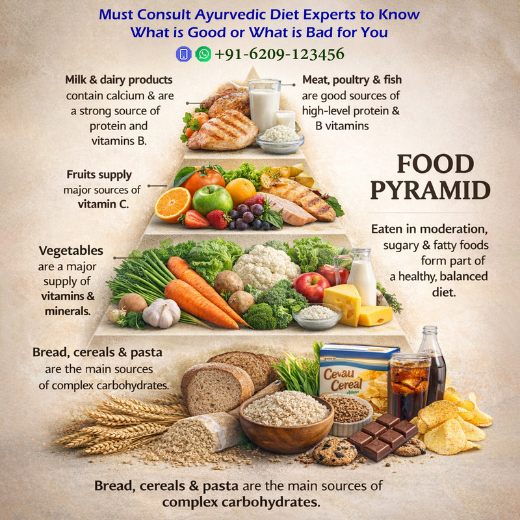
Group 1. Cereal Grains And Products
Foods such as rice, wheat, jowar, bajra, ragi etc are in this group. These supply energy or calories, protein, invisible fats. These foods also contribute iron, thiamine, riboflavin, folic acid and fibre.
Group 2. Pulses And Legumes
The foodstuffs in this group are pulses and legumes (eg beans, soya beans, peas, Rajmah, Bengal grams etc). It provides energy, protein, invisible fat, Vitamin B1, Vitamin B2, folic acid, calcium, iron and fibres.
Group 3. Milk, Nuts And Meat Products
They include milk, curd, skimmed milk, cheese, almonds, groundnuts, chicken, meat, liver, egg, fish and other flesh foods. All these foodstuffs supply mainly protein, fat, calcium and vitamin B2.
Group 4. Fruits And Vegetables
These include green leafy vegetables, yellow or orange fruits and vegetables such as papaya, mango, carrots, tomato, pumpkin, stems, leaves and flowers of plants, ladies finger, brinjals, bittergourds and other gourds, cabbage, cauliflower, drumsticks. Fruits such as amla, lemons, orange are rich in minerals and vitamins, especially vitamin C and calcium, iron and folic acid. They also contribute half of vitamin A requirement. Other major nutrients are invisible fat, vitamin B2 and fibre. They provide variety in taste and texture and furnish roughage in the diet.
Group 5. Fats And Sugars
All these foodstuffs supply energy or calories — vegetable oils, vanaspati, ghee, cream, sugar and jaggery. This group constitutes about 1/6th of the energy value of the diet and provides essential fatty acids, but does not add appreciably to the protein, mineral or vitamin adequately. Oils should be used sparingly in the diet. They add taste and flavour to the food. In India, commonly available cooking oils include mustard oil, coconut oil, gingelly oil, groundnut oil, palmolein oil, and sunflower oil.
Conclusion
People eat large amounts of foods but still they suffer from malnutrition because they are consuming an unbalanced diet. Eating too much or unbalanced diets such as more of complex carbohydrates and fats can lead to obesity and therefore increase the risk of serious conditions such as high blood pressure, heart disease, diabetes mellitus.
Diets containing foodstuffs drawn from each of the food groups supply all essential nutrients in adequate amounts and keep a majority of individuals consuming them in a good state of health. Even though the recommended balance of foods applies to most people of all ethnic origins and those who are overweight, few individual variations can be there. Infants under two years of age for example should be given milk products, which is not skimmed. They also need more dairy foods than adults. But between the ages of two and five children make a gradual transition on to family foods — the balanced diet chart or food pyramid begin to apply. People with special dietary needs and those under medical supervision should check with their doctor or nutritionist to see if this balance of foods is suited to them.
Vitamin and mineral supplements are no substitutes for good eating habits. The majority of people will meet all their nutritional requirements by following the basic guidelines outlined in the balanced diet chart or food pyramid.