


Thorny Bamboo / Vansh / Bambusa arundinacea Willd. / Bambusa bambos – Ayurvedic Uses & Benefits
Abstract
Bambusa arundinacea Willd., commonly known as thorny bamboo or Indian thorny bamboo, is a tall, woody grass widely distributed across the Indian subcontinent. In Ayurveda, it is valued for its diverse medicinal uses, especially in the treatment of respiratory, urinary, reproductive, and musculoskeletal disorders. The plant yields a siliceous exudate known as vanshlochan, which is used therapeutically. It also provides several bioactive compounds with antioxidant, anti-inflammatory, and demulcent properties. Traditionally, its different parts like leaves, shoots, and resin have been used in folk medicine for their curative effects.
Introduction
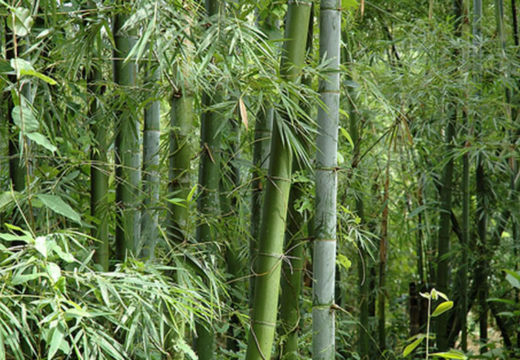
Bambusa arundinacea Willd., belonging to the family Gramineae (Poaceae), is a highly esteemed medicinal plant in Ayurveda, commonly known as Bamboo. It is a tall tree found widely across moist regions of India, as well as in countries like Sri Lanka, Malaya, Peru, and Myanmar. Traditionally, it is known as Vansha or Vanshlochan in Sanskrit. The plant is used for treating respiratory ailments, bone disorders, and reproductive issues. Its siliceous exudate (vanshlochan), collected from culm internodes, is valued as a tonic and cooling agent. Various parts, such as the leaves, shoots, roots, and seeds, are credited with anti-inflammatory, antidiabetic, anti-ulcer, antioxidant, and emmenagogue properties. It is rich in bioactive compounds like silica, amino acids, vitamins, and enzymes, and it supports multiple healing mechanisms. Modern pharmacological research continues to validate its classical applications in holistic medicine.
Scientific Classification
- Kingdom: Plantae
- Clade: Angiosperms
- Clade: Monocots
- Order: Poales
- Family: Poaceae (Gramineae)
- Genus: Bambusa
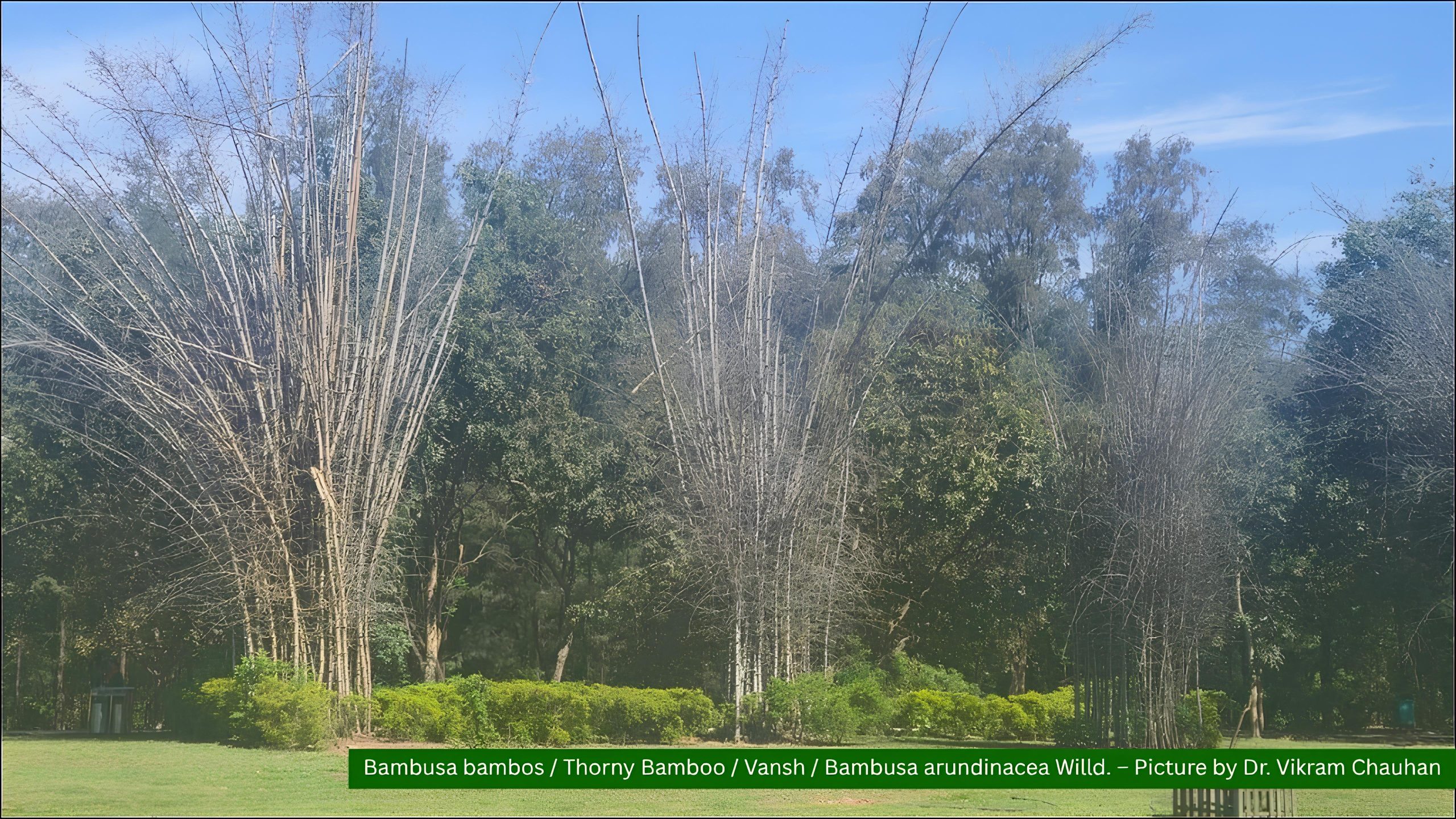
- Species: Bambusa arundinacea Willd., Bambusa bambos
Synonyms
- Vansharocana – Improves taste and removes bad smell.
- Tuga – Destroys laghutva (lightness or feeling of emptiness).
- Shubha – Indicates good qualities.
- Yavaphala – Fruits resemble Yava (barley).
- Tvakkshiri – Latex looks like milk.
- Vanshakarpura – Looks like karpura (camphor).
- Truna Dhwaja / Trunadvaja – Considered superior among all grasses.
- Shataparva – Has 100 or more than 100 nodes or leaves.
- Yavaphala – (Repeated) Fruits shaped like barley.
- Keecaka – A poetic or classical name for bamboo.
- Maskara – Another synonym or name.
- Suparva – Indicates well-jointed or well-segmented.
- Venu – A common classical name for bamboo.
- Trinaketu – The flag of grasses or chief among them.
- Shabdamala – Produces sound; may refer to rustling or usage in instruments.
- Tvaksara – Refers to the qualities related to the bark or outer surface.
- Karmara – Possibly linked with utility in craftsmanship or mechanical use.
- Tvacisara / Tvachisaraka – Essence of the bark.
- Tejana – Possibly indicates sharpness or energy.
- Baddha Dalaya – With joined or fixed branches.
- Karmuka – Bow-like or used in making bows.
Vernacular Names
- Gujarati: Toncor, Wans, Vanskapur, Vas-nu-mitha
- English: Bamboo, Bamboo manna, Giant Thorny Bamboo
- Hindi: Bans-lochana, Banskapur, Vanoo, Banz
- Bengali: Bans-Kapur, Baans, Baansh, Baroowa Bans
- Sanskrit: Vanshalochana, Venulavanam
- Arabic: Tabashir
- Marathi: Bansa, Baambii, Bansamitha
- Tamil: Munga-luppa, Mullumangila, Mulmunkil, Mungil
- Telugu: Veduruppu, Mulkas Veduru, Mullu Veduru
- Malayalam: Moleuppa
- Kannada: Bidaruppu, Tavakshira
- Burmese: Vd-chha, Vathega-kiyo, Vasan, Vathe gasu
- Unani: Tabashir, Tawashir
Habitat
Bamboo is commonly found throughout the moist regions of India, especially along riverbanks, up to an altitude of 1250 meters. In Central and South India, it grows up to 1100 meters on the Nilgiri hills. It is also widely cultivated in parts of North-West India and Bengal. This species of bamboo is not limited to India alone. It also occurs naturally in countries like Sri Lanka, Malaya, Peru, and Myanmar (Burma). Its adaptability makes it a prominent plant across tropical and subtropical regions.
Morphology
Bamboo is a thorny tree with multiple stems arising in tufts from a stout rootstock, growing up to 30 meters in height. The culms are 15–18 cm thick with prominent nodes; the lower nodes bear horizontal, nearly naked shoots armed with 2–3 stout, recurved spines. Internodes measure up to 45 cm in length. Leaves are linear or linear-lanceolate, measuring 17.5–20.5 × 2–2.5 cm, with a stiff tip, glabrous or slightly hairy undersurface, scabrous margins, ciliate base, and a narrow midrib. The leaf sheath ends in a thick callus with shortly bristly auricles. The inflorescence forms an enormous panicle that often covers the entire stem. The caryopsis (grain) is oblong, 5–8 mm long, and grooved on one side. Flowering and fruiting occur once in a lifetime, typically between September and May.
Inside thick and strong bamboo, and particularly in the large, hollow varieties of hill bamboo known as Najla bamboo, when the white sap dries and solidifies into stone-like pieces, it is called Vanshlochan (bamboo silica). This is found only in the female species of bamboo. When bamboo is cut open, sometimes this substance is obtained from inside. It is said that when rainwater during the Swati Nakshatra (a specific constellation period) falls inside the bamboo, Vanshlochan is formed.
Classical Categorisation
- According to Bhavaprakasha Nighantu – Haritakyadi Varga
- According to Dhanvantari Nighantu – Shatapushpadi Varga
- According to Kaiyadeva Nighantu – Aushadhi Varga
- According to Raj Nighantu – Pippalyadi Varga
Ancient Verses
वंशः सरो हिमः स्वादुः कषायो बस्तिशोधनः ।
छेदनः कफपित्तघ्नः कुष्ठास्त्रव्रणशोथजित् ॥
(Bhavprakash Nighantu Haritakyadi and Guduchyadi Varga 154)
According to the above shloka, Vansh has laxative properties, cold potency, astringent and sweet taste. It helps in cleansing the bladder, breaks down the tissue or part of the body into small pieces (Chedana) and helps in balancing Kapha and Pitta dosha. It is effective in the management of skin disorders, bleeding disorders, wounds and inflammation.
Ayurvedic Properties
- Taste (Rasa) – Sweet (Swadu), Astringent (Kashaya)
- Potency (Veerya) – Cold Potency (Sheet)
- Post-digestion Effect (Vipaka) – Sweet (Madhur)
- Effect on Tridosha – Balances Pitta and Kapha Dosha
Therapeutic Properties
- Pittasra / Raktapitta – Bleeding disorders such as nasal bleeding, heavy menstrual bleeding (menorrhagia), and other hemorrhagic conditions.
- Kustha – Various types of chronic skin diseases and dermatological disorders.
- Sopha – Inflammatory conditions, including swelling and oedema.
- Vrana – Ulcers, wounds, and other non-healing lesions.
- Mutrakrcchra – Difficulty in urination, painful micturition, and urinary retention.
- Prameha – Disorders of the urinary system, including diabetes mellitus and other metabolic conditions.
- Arsa – Haemorrhoids or piles (both bleeding and non-bleeding types).
- Daha – Burning sensations in various conditions such as gastritis, neuropathies, burning eyes, and urinary tract discomfort.
- Asra – Blood-related disorders, including abscesses, skin diseases, and bleeding conditions like menorrhagia and epistaxis (nasal bleeding).
- Sopha – (Repeated) Refers to inflammatory swellings, oedema, and localised or systemic inflammation.
Systemic Actions
1. Externally
The root is used for cosmetic purposes and is beneficial in managing skin disorders and alopecia (hair loss). Leaf buds have anti-inflammatory properties and aid in quick wound healing.
2. Internally Uses
Digestive System
Acts as a digestive stimulant and carminative. The fruit exhibits anthelmintic activity, helping eliminate intestinal parasites. Leaf buds are useful in conditions like indigestion and helminthiasis. Vanshalochana is particularly effective in relieving vomiting, diarrhoea, and excessive thirst.
Respiratory System
Assists in the expulsion of vitiated Kapha dosha. Indicated in respiratory issues such as cough, bronchitis, and tuberculosis.
Reproductive System
Leaf decoction is prescribed for amenorrhea, dysmenorrhea, and in postpartum care.
Excretory System
Vanshalochana and Vansha moola promote diuresis, hence are useful in dysuria and urinary tract infections (UTIs). Conversely, the fruit reduces urinary output and is recommended in the management of diabetes.
Tapakrama (Fever Management)
Acts as a Jvaraghna (antipyretic), particularly beneficial in chronic fevers (Jirna Jwara) and tubercular fevers (Kshaya Jwara).
Satmikarana (Rejuvenation and Nourishment)
Vanshalochana serves as a strength-promoting (Balya) and nourishing (Brimhana) agent, helpful in general debility. The fruit has scraping (Lekhaneeya) and anti-poisonous (Vishaghna) effects, making it valuable in treating obesity and animal poisoning.
Chemical Composition
1. Silicious Material
Found at the bud junction.
2. Shoots
- Oxalic acid
- Reducing sugars
- Resins
- Hydrogen cyanide (HCN)
- Benzoic acid
- Diferuloyl arabinoxylan hexasaccharide
- Diferuloyl oligosaccharide
- Taxiphyllin
- Adenine-(1′R,2′R,3′R)
- Cyclic butanetetraol carbonate
- β-carboline
- Megastigmane glycosides
- 12 nucleosides
- Carbohydrates
3. Seeds
- Arginine
- Cysteine
- Histidine
- Isoleucine
- Leucine
- Lysine
- Methionine
- Phenylalanine
- Threonine
- Valine
- Tyrosine
- Niacin
- Riboflavin
- Thiamine
4. Leaves
- Protein
- Glutelin
- Lysine
- Methionine
- Betain
- Choline
- Urease
- Nuclease
- Proteolytic enzymes
5. Other Reported Compounds
- Silica
- Choline
- Betain
- Albuminoids
- Cynogenetic glycosides
- Acetylcholine (notably in high amounts)
Modern Overview
For Respiratory Issues
Bambusa arundinacea (Vanshlochan) plays an important role in managing respiratory diseases due to its unique blend of bioactive compounds. The silica (silicon dioxide) present in Vanshlochan acts as a natural anti-tussive, soothing the respiratory tract and reducing cough by calming irritation in the mucous membranes. Flavonoids provide strong antioxidant and anti-inflammatory actions, which help in reducing airway inflammation and protecting the lungs from oxidative stress. The fatty acids present in the leaves and shoots add antimicrobial activity, preventing infections that often aggravate respiratory problems. Vitamins such as B1, B2, and B3 support energy metabolism, which is crucial for maintaining overall vitality during illness. Additionally, amino acids like histidine, lysine, and leucine aid tissue repair and strengthen the immune system, helping the body recover faster.
For Urinary Issues
Bambusa arundinacea, widely used in traditional medicine, is believed to support urinary health through its diuretic and astringent properties. The presence of flavonoids, phenolics, and tannins exhibits antioxidant, anti-inflammatory, and astringent effects, reducing inflammation and soothing urinary tissues. These compounds help promote healing and prevent infections.
For Digestive Issues
Bambusa arundinacea supports digestive health through alkaloids, flavonoids, phenolics, and fatty acids in its shoots and leaves. These compounds enhance intestinal motility and relieve constipation while providing anti-inflammatory and antioxidant support for a healthy gut environment.
Practical Uses
- A paste prepared from the root of bamboo is applied externally over eczema and dark skin discolouration.
- Tender bamboo shoots are ground into a paste and applied over ringworm and pigmentation issues.
- The dried resin known as Vanshalochana is powdered and mixed with honey for cough, cold, and fever.
- Vanshalochana mixed with hot water or buttermilk manages indigestion, diarrhoea, and nausea.
- A paste of bamboo shoots or tender buds is applied externally for wound healing.
- A decoction of bamboo leaves is used for dysmenorrhea, menstrual cramps, and postnatal uterine strength.
- A root decoction counteracts dog or scorpion bites.
- Bamboo seeds are used in diabetes management as food.
- Tender leaf decoction expels intestinal worms.
- For pain associated with piles, medicated oil and bamboo decoction are used externally.
- Tender leaves are used in hemoptysis, leprosy, fever, and intestinal worms in children.
- The juice from shoots is applied to worm-infested wounds.
- The paste from bamboo nodes is applied for joint pain.
- The seeds are consumed as a substitute for rice.
- The juice of its flowers is used as ear drops in earache (Karnashoola) and partial deafness.
Special Note
The genuine Vanshlochan is whitish with a bluish tinge, non-fibrous, and becomes transparent in water. Most market varieties today are synthetic imitations, often blue-tinted crystals. Genuine Vanshlochan was historically imported from Java and Singapore. Apart from Vanshlochan, other bamboo parts like shoots, leaves, nodes, seeds, and roots are also medicinally valuable.
Part Used
- Root
- Leaves
- Fruits
Dosage
- Decoction – 50–100 ml
- Powder – ½–2 gm
Ayurvedic Medicines
- Shukra Vallabh Ras
- Taalishadi Churna
- Sitopladi Churna
Planet Ayurveda Medicines
- Kaas-har Churna
- Shukra Vallabh Ras
- Vikramprash
- Maha Sudarshan Kwath
- Sitopladi Churna
- Taalishadi Churna
Conclusion
Bambusa arundinacea Willd., commonly known as thorny bamboo, is a highly valued plant in Ayurveda. Every part of this plant, including the root, shoots, leaves, and Vanshalochana, has significant medicinal value. It is beneficial in respiratory, digestive, skin, and inflammatory conditions. Rich in silica, flavonoids, and essential minerals, it provides anti-inflammatory, antioxidant, antimicrobial, and wound-healing effects.