


What Are Caco-2 Cells and Why Are They Important in Drug Research?
Caco-2 Cells: An In Vitro Model for Intestinal Drug Absorption and Permeability Studies
Abstract
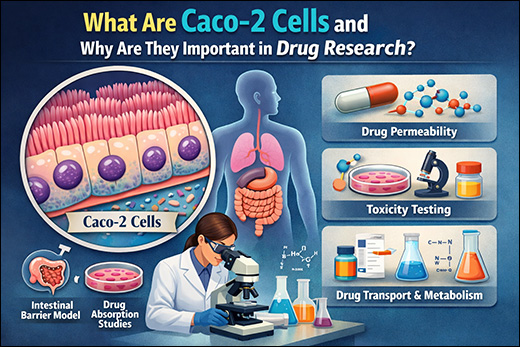
The Caco-2 cell line, derived from a human colorectal adenocarcinoma, is the pharmaceutical industry’s gold standard for modeling the intestinal barrier. Although they originate from colon tissue, these cells possess the unique ability to spontaneously differentiate into a polarized monolayer that structurally and functionally resembles the enterocytes of the small intestine. When cultured on semi-permeable membranes, they develop a brush border of microvilli and form robust tight junctions, creating a selective physical barrier. Beyond their physical structure, Caco-2 cells express a wide array of phase II metabolic enzymes and membrane transporters, such as P-glycoprotein (P-gp). This makes them an essential tool for predicting oral drug bioavailability, as researchers can measure how effectively compounds move from the apical (lumen) side to the basolateral (blood) side. While they do not account for the complex mucus layer or blood flow found in vivo, their consistency and predictive power remain unmatched for screening drug permeability and investigating active transport mechanisms during early-stage drug development.
Origin And Biological Characteristics Of The Caco-2 Cell Line
The Caco-2 cell line was originally isolated in the late 1970s by Dr. Jorgen Fogh at the Sloan-Kettering Institute for Cancer Research. While derived from a human colorectal adenocarcinoma (large intestine), these cells possess a unique biological "plasticity." Upon reaching confluence—the point where they cover the growth surface entirely—they undergo a spontaneous process of differentiation over a 21-day period. This transition allows them to shift from a cancerous phenotype into a highly organized monolayer that functionally mimics the absorptive enterocytes of the human small intestine.
Biologically, Caco-2 cells are characterized by their polarized morphology. This includes an apical membrane featuring a well-developed brush border of microvilli and a basolateral membrane. A defining feature of this cell line is the formation of tight junctions (measured via Transepithelial Electrical Resistance, or TEER), which restrict the movement of molecules between cells. Furthermore, they express essential intestinal enzymes—such as alkaline phosphatase and sucrase-isomaltase—and a suite of transport proteins like P-glycoprotein (P-gp) and BCRP. This combination of physical barrier properties and active biochemical machinery makes them the premier model for studying how the human body absorbs nutrients and pharmaceuticals.
Differentiation And Formation Of Intestinal-Like Monolayers
Once Caco-2 cells fill their growth container, they stop dividing and begin a 21-day "transformation" into a functional intestinal barrier. This process is called differentiation, where they transition from simple cancer cells into a structured, polarized monolayer.
Key Structural Changes
- Polarity: The cells develop a "top" (apical) side facing the intestinal lumen and a "bottom" (basolateral) side facing the blood.
- Microvilli: The apical surface grows a "brush border" of tiny hair-like projections that increase surface area for absorption.
- Tight Junctions: The cells "zipper" together using specialized proteins, creating a nearly leak-proof seal that forces substances to pass through the cells rather than between them.
Why Does It Matters!
This 3-week process is essential because it builds the physical and chemical barrier needed to test drugs. Researchers measure the "tightness" of this seal using a TEER (Transepithelial Electrical Resistance) test; a high electrical resistance confirms the monolayer is ready for use.
Mechanism of Drug Transport Across Caco-2 Cells
Think of a Caco-2 cell layer as a smart filter that decides what gets from your "gut" into your "blood." Drugs cross this filter in four simple ways:
- The Direct Path (Transcellular)- Small, oily drugs simply dissolve right through the cell’s "skin" (the membrane). This is the most common way medicines get into your system.
- The Narrow Gap (Paracellular)- Tiny, water-soluble molecules try to squeeze through the microscopic spaces between the cells. Because Caco-2 cells are "zipped" together very tightly, only the smallest molecules can fit.
- The Escorted Entry (Carrier-Mediated)- Some drugs look like "food" (like vitamins or amino acids). Special reporter proteins on the cell surface recognize them and pull them inside.
- The "Bouncer" System (Efflux)- This is a defense move. Even if a drug gets inside the cell, "bouncer" proteins like P-gp can spot it and pump it right back out into the gut before it can reach your blood.
How Do We Measure It?
To see if a drug is successful, scientists use a simple formula to find the Permeability (Papp).Papp = Amount of drug that is crossed divided by Time×Surface Area×Starting Amount A high Papp score means the drug is "good" at getting through the barrier.
Role Of Caco-2 Cells In Nutraceutical And Herbal Bioavailability Studies
Beyond pharmaceutical drugs, Caco-2 cells are the preferred model for testing nutraceuticals (like vitamins and minerals) and herbal extracts (like turmeric or green tea). Because these natural compounds are often complex mixtures, scientists use the cell monolayer to see which specific parts of a plant extract actually make it into the human bloodstream.
Testing Bioavailability
Many herbal supplements have a "bioavailability problem," meaning you eat them, but they never leave your gut. Caco-2 studies help identify:
- Absorption Rates: How much of a nutrient, like Vitamin $B_{12}$, actually passes through the cells.
- Stability: Whether the digestive enzymes produced by the Caco-2 cells break down the herbal compound before it can be absorbed.
- Synergy: Scientists can test if taking two nutrients together (like Piperine from black pepper with Curcumin from turmeric) helps "trick" the cells into absorbing more.
Safety And Interactions
Caco-2 cells also act as an early warning system. They help determine if a high dose of a supplement is toxic to the intestinal lining or if a herbal remedy might block a transporter, accidentally stopping a life-saving prescription drug from being absorbed. This makes them essential for ensuring that "natural" products are both effective and safe for the gut.
Limitations And Challenges Of In Vitro Intestinal Model
Even though Caco-2 cells are the "gold standard," they aren’t a perfect replica of a real human gut. Here are the main reasons why lab results can sometimes differ from what happens in your body:
1. No “Slimy” Protection
A real human intestine is coated in a thick layer of mucus produced by specialized "Goblet" cells. Caco-2 cells don’t make this mucus, so they are "naked." This can make some oily drugs look like they absorb faster in the lab than they actually do in a person.
2. The Seal is Too Tight
Caco-2 cells "zipper" together much more tightly than the cells in your actual small intestine. Because of this, the lab model often underestimates how much of a medicine can squeeze through the tiny gaps between cells.
3. Overactive “Bouncers”
Since these are technically cancer cells, they often produce way too many P-gp "bouncer" proteins. These proteins kick drugs out of the cell before they can be absorbed. This can make a perfectly good medicine look like it won’t work just because the lab cells are being "too defensive."
4. No Blood Flow
In your body, blood is constantly moving, which helps "pull" the medicine through the intestinal wall. In a plastic lab dish, the liquid just sits there, which doesn’t perfectly mimic how your body processes a pill.
Regulatory Relevance And Predictive Value In Oral Drug Development
Because they are so reliable, Caco-2 cells are officially recognized by global health authorities like the FDA (U.S.) and EMA (Europe). They are used as a legal "shortcut" in drug development to save time, money, and animal lives.
The Biopharmaceutics Classification System (BCS)
The FDA uses Caco-2 data to help group drugs into four classes based on how well they dissolve and how easily they pass through the gut.
- Class 1 (High Solubility, High Permeability): These are the "gold medal" drugs.
- Biowaivers: If a drug is Class 1, regulators may grant a "biowaiver." This means the company can skip expensive human trials for generic versions because the Caco-2 test already proved the drug absorbs perfectly.
Real-World Predictive Value
How well do these lab cells predict what happens in a human?
- High Accuracy: For drugs that pass directly through cells (passive diffusion), Caco-2 results match human data about 80-90% of the time.
- Safety Screening: They are used early in development to "kill" bad drug candidates. If a drug can’t pass through a Caco-2 layer, it likely won’t work as a pill, allowing scientists to stop wasting money on it immediately.
How Caco-2 Tests Bring Ayurveda To The Global Market?
Modern Ayurvedic formulations are increasingly being validated through Caco-2 cell testing to bridge the gap between ancient tradition and global pharmaceutical standards. By passing these rigorous permeability tests, researchers can scientifically prove that active herbal compounds—like Curcumin from Turmeric or Withanolides from Ashwagandha—actually cross the intestinal barrier and enter the bloodstream. This data allows "Phytopharmaceuticals" and traditional recipes to gain regulatory credibility, enabling them to enter international markets with "Clinically Validated" labels. Ultimately, Caco-2 testing confirms that Ayurvedic "bio-enhancers" (like Trikatu or Ghee) effectively "open the door" for medicinal herbs, ensuring that these natural remedies are as bioavailable and reliable as modern synthetic drugs.
Conclusion
At last it can be concluded that Caco-2 cells are the most trusted "lab-grown gut" for scientists worldwide. They provide a fast, cost-effective, and accurate way to see if a medicine—whether a modern drug or an ancient Ayurvedic herb—can actually get into the human body. By mimicking the structure and "bouncers" of the small intestine, these cells act as a vital filter that separates successful treatments from those that simply won’t work. While they aren’t a perfect human replica, their ability to provide a measurable "Permeability Score" makes them an essential bridge between a laboratory idea and a real-world cure. They ensure that the products hitting the market are not just safe, but truly effective.