


Arhar / Tur Dal / Pigeon Pea / Red Gram / Cajanus Indicus – Medicinal Properties, Benefits & Dosage
Abstract
Arhar (Cajanus indicus), commonly known as Tur Dal, Pigeon Pea, or Red Gram, is a nutritionally rich legume widely consumed across India and other tropical regions. It serves as an important dietary source of plant-based protein, complex carbohydrates, dietary fiber, vitamins, and essential minerals such as iron, potassium, magnesium, and phosphorus. In Ayurveda, Arhar is described as Balya (strength-promoting), Brimhana (nourishing), and Agnivardhaka (digestive stimulant) when used appropriately. Modern scientific studies highlight its antioxidant, anti-inflammatory, hypolipidemic, and glycemic-regulating potential, supporting its role in metabolic health. Additionally, bioactive compounds present in Cajanus indicus contribute to immune support and gut health. Due to its combined nutritional, therapeutic, and agronomic value, Arhar remains a staple pulse with significant relevance in both traditional medicine and contemporary nutrition science.
Classical Reference Of Arhar (Cajanus Indicus)
Bhavprakash Nighantu Dhanya Varga Page No. 635
Scientific Classification Of Arhar (Cajanus Indicus)
- Kingdom: Plantae
- Subkingdom: Tracheobionta (Vascular plants)
- Superdivision: Spermatophyta (Seed-bearing plants)
- Division: Magnoliophyta (Angiosperms)
- Class: Magnoliopsida (Dicotyledons)
- Order: Fabales
- Family: Fabaceae (Leguminosae)
- Subfamily: Faboideae (Papilionoideae)
- Genus: Cajanus
- Species: Cajanus cajan
Vernacular Names Of Arhar (Cajanus Indicus)
- Sanskrit: Adhaki, Tuvari, Arhar
- Hindi: Arhar, Toor, Tur Dal
- English: Pigeon Pea, Red Gram, Congo Pea
- Marathi: Tur, Tuar
- Gujarati: Tuver, Tur
- Bengali: Arhar, Tur
- Tamil: Thuvarai, Thovarai
- Telugu: Kandulu, Kandi Pappu
- Kannada: Togari Bele
- Malayalam: Thuvara Parippu
- Punjabi: Arhar Dal
- Urdu: Arhar Dal
- Odia (Oriya): Harada Dal
- Assamese: Rahar Dal
Habitat Of Arhar (Cajanus Indicus)
Geographical Distribution : Arhar (Cajanus indicus) is believed to have originated in the Indian subcontinent and is presently cultivated throughout tropical and subtropical regions of the world. Botanical and agronomic literature documents its widespread distribution across South Asia, Southeast Asia, sub-Saharan Africa, Central America, and parts of South America. India represents the primary center of cultivation and genetic diversity, contributing the largest share of global pigeon pea production.
Climatic Requirements : Arhar is a warm-season legume adapted to tropical and semi-tropical climates. Experimental agronomy studies indicate that the crop grows optimally at temperatures ranging from 18 °C to 35 °C. It is well adapted to monsoon-based rainfall patterns and shows considerable tolerance to drought due to its deep taproot system. Excessive frost, prolonged low temperatures, and waterlogging are unfavorable for its growth and productivity.
Soil Preferences : Research-based soil studies report that Cajanus indicus grows best in well-drained loamy, sandy-loam, red, black cotton, and alluvial soils with moderate fertility. The ideal soil pH ranges between 6.5 and 7.5. Although the plant exhibits moderate tolerance to slightly saline and marginal soils, poorly drained and highly acidic soils adversely affect root development and nitrogen fixation.
Altitude Range : Agricultural and floristic records indicate that Arhar is cultivated from sea level up to approximately 1400–1500 meters above mean sea level. Its adaptability across plains, plateaus, and lower hill regions contributes to its extensive cultivation range.
Ecological And Agricultural Habitat : Arhar is predominantly grown under rainfed conditions and is frequently cultivated as a sole crop or in intercropping systems with cereals such as sorghum, pearl millet, maize, or cotton. The plant forms a symbiotic association with Rhizobium species, enabling biological nitrogen fixation, which improves soil fertility and supports sustainable cropping systems. Due to these ecological advantages, pigeon pea is considered an important crop in dryland and sustainable agriculture.
Morphology Of Arhar (Cajanus Indicus)
Habit : Arhar (Cajanus indicus) is an erect, perennial or short-lived woody shrub, though it is commonly cultivated as an annual crop. Morphological and agronomic studies describe the plant as moderately branched, with a height ranging from 1 to 4 meters depending on cultivar, soil fertility, and climatic conditions.
Root System : The plant possesses a well-developed taproot system with numerous lateral roots. The taproot penetrates deep into the soil, contributing to drought tolerance. Root nodules formed by symbiotic Rhizobium species are commonly observed, facilitating biological nitrogen fixation.
Stem : The stem is stout, woody at the base, and green to purplish when young, becoming more lignified with maturity. It is cylindrical, pubescent to slightly hairy, and profusely branched in the upper portions, as described in botanical and crop morphology studies.
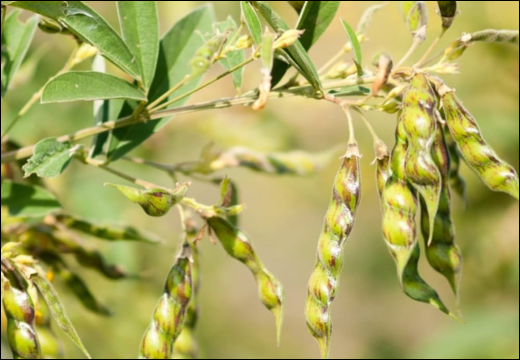
Leaves : Leaves are alternate, trifoliate, and long-petiolate. Each leaflet is ovate to lanceolate, measuring approximately 5–10 cm in length, with an entire margin and acute to acuminate apex. The upper surface is dark green, while the lower surface is paler and covered with fine hairs, a characteristic feature noted in taxonomic descriptions.
Inflorescence : The inflorescence is axillary and racemose, bearing several flowers arranged along a slender axis. Flowering occurs sequentially, contributing to extended pod formation.
Flowers : Flowers are typical papilionaceous, bisexual, and zygomorphic. They are yellow to reddish-yellow, sometimes streaked with purple or red markings. The calyx is campanulate with five lobes, while the corolla consists of a standard, wings, and keel. Ten stamens are diadelphous (9+1), and the ovary is superior and pubescent.
Fruit (Pod) : The fruit is a flattened, oblong-linear legume (pod), measuring about 5–9 cm in length. Pods are slightly constricted between seeds, green when immature, and turn brown on maturity. Each pod typically contains 2–9 seeds.
Seeds : Seeds are globose to oval and vary in color from cream, yellow, red, brown, to mottled depending on the variety. The seed coat is smooth and hard, enclosing two large cotyledons rich in protein and carbohydrates.
Classical Categorisation Of Arhar (Cajanus Indicus)
Bhavprakash Nighantu: Dhanya Varga
Dhanwanthari Nighantu: Suvarnadi Varga
Raj Nighantu: Shalyadi Varga
Ancient Verses For Arhar (Cajanus Indicus)
1. Verse No. 1
आढकी तुवरी तुल्या करवीरभुजा तथा।
वृत्तबीजा पीतपुष्पा श्वेता रक्ताऽसिता त्रिधा॥
आढकी कफपित्तघ्नी किञ्चिन्मारुतकोपनी।
कषाया स्वादुसंग्राही कटुपाका हिमा लघुः॥
मेदःश्लेष्मास्रपित्तेषु हिता लेपोपसेकयोः।
Dhanwanthari Nighantu Suvarnadi Varga Verse No. 82-83
Verse Interpretation
- Names: The pulse is commonly known as Pigeon Pea or Arhar/Toor dal.
- Appearance: It has round seeds and yellow flowers.
- Varieties: There are three main types based on seed color: white, red, and black.
- Effect on Body Humors: It effectively reduces kapha and pitta dosha and slightly increases Vata.
- Taste and Digestion: It has an astringent and sweet taste. It is light to digest and has a cooling effect on the body.
- Action: It acts as an absorbent, meaning it helps in binding stool and is useful for managing loose motions.
- Weight Management: It is beneficial for reducing excess body fat and managing obesity.
- Respiratory & Blood Health: It helps clear excess mucus and treats bleeding disorders caused by internal body heat.
- External Use: It can be used as a topical paste or a medicated wash to treat skin conditions and inflammations.
2. Verse No. 2
आढकी तुवरी चापि सा प्रोक्ता शणपुष्पिका॥
आढकी तुवरा रूक्षा मधुरा शीतला लघुः।
ग्राहिणी वातजननी वर्ण्या पित्तकफास्त्रजित्॥
Bhavprakash Nighantu Dhanya Varga Verse no. 51-52
Verse Interpretation
Synonyms
- Adhaki: Signifies a plant that is nutritionally rich or abundant.
- Tuvari: Refers to its astringent taste and its ability to bind or “stop” the bowels.
- Shanapushpika: Describes the plant as having yellow flowers that resemble those of the sunn hemp.
Properties
Arhar is astringent and sweet in taste, dry, cooling, light, absorbent, and Vata-increasing; it improves skin complexion and alleviates Pitta, Kapha, and blood-related disorders.
3. Verse No. 3
आढकी तुवरी वर्य्या करवीरभुजा तथा।
वृत्तबीजा पीतपुष्पा श्वेता रक्ताऽसिता त्रिधा ॥
आढकी तु कषाया च मधुरा कफपित्तजित्।
ईषद्वातकरा रुच्या विदला गुरुग्राहिका ॥
सा च श्वेता दोषदात्री तु रक्ता रुच्या बल्या पित्ततापादिहन्त्री ।
सा श्यामा चेद्दीपनी पित्तदाहध्वंसा बल्याऽऽढकीयूषमुक्तम् ॥
Raj Nighantu Shalyadi Varga Verse no. 100-102
Verse Interpretation
Synonyms And Physical Traits
- Adhaki: The primary name for Pigeon Pea.
- Tuvari: Referring to its astringent taste.
- Varyya: Meaning “excellent” or “choice” among pulses.
- Karvirabhuja: Having branches/leaves resembling the Karvira (Oleander) plant.
- Vrittabeeja: Round-seeded.
- Peetapushpa: Yellow-flowered.
- Tri-vidha: Exists in three types (White, Red, and Black).
Taste
Astringent and Sweet.
Dosha Action
Balances Kapha and Pitta; slightly increases Vata.
Effect
Enhances taste (Ruchya), heavy to digest (Guru), and has an absorbent/constipating action (Grahika).
Variety-Specific Benefits
- White Variety: Generally causes a slight imbalance in Doshas compared to the others.
- Red Variety: Improves appetite, provides strength, and cures diseases caused by excessive Pitta (heat).
- Black Variety: Stimulates digestion (Deepani), destroys internal burning sensations, and provides physical strength.
Ayurvedic Properties Of Arhar (Cajanus Indicus)
- Rasa (Taste): Kashaya (Astringent), Madhura (Sweet)
- Guna (Qualities): Ruksha (Dry), Laghu (Light to digest)
- Veerya (Potency): Sheeta (Cold)
- Vipaka (Post-digestive effect): Katu (Pungent)
Action On Tridosha Of Arhar (Cajanus Indicus)
Arhar (Cajanus indicus) is mainly Kapha-Pitta shamaka due to its Kashaya Rasa and Sheeta Veerya, while its Ruksha Guna and Katu Vipaka may increase Vata if taken in excess.
Therapeutic Indications Of Arhar (Cajanus Indicus)
- Diabetes (Prameha)
- Vatarakta (Gout)
- Obesity (Sthaulya)
- Raktapitta (Bleeding disorders)
- Ulcerative colitis
- Liver diseases (Yakrit Vikara)
- Autoimmune hepatitis
- Jaundice (Kamala)
- Anemia (Pandu Roga)
Systemic Actions Of Arhar (Cajanus Indicus)
- Digestive system: Deepana (Appetizer), Grahi (Absorbent), Ruchya (Improves taste and digestion)
- Metabolic system: Pramehahara (Anti-diabetic), Sthaulyahara (Anti-obesity)
- Circulatory & blood system: Raktapittashamaka (Controls bleeding disorders), Raktashodhaka (Blood purifier)
- Hepatobiliary system: Yakrituttejaka (Liver stimulant), Yakritrakshaka (Hepatoprotective), Kamalahara (Useful in jaundice)
- Excretory system: Aampachaka (Digestive of toxins), Vishaghna (Detoxifying)
- Immune system: Krimighna (Anti-parasitic), Pratiraksha Santulaka (Immune modulator)
Chemical Composition Of Arhar (Cajanus Indicus)
- Flavonoids (Cajanol, Genistein, Apigenin, Luteolin): Antioxidant, anti-diabetic, anti-inflammatory, hepatoprotective
- Isoflavonoids (Cajanin, Biochanin A): Anti-diabetic, estrogen-modulating, metabolic regulatory
- Phenolic compounds (Tannins, Phenolic acids): Antioxidant, astringent, anti-ulcer, anti-inflammatory
- Saponins: Hypolipidemic, immunomodulatory, anti-inflammatory
- Alkaloids (trace amounts): Digestive stimulant, anti-parasitic
- Proteins & Amino acids (Lysine, Leucine, Arginine): Nutritional support, tissue repair, metabolic support
- Dietary Fiber: Glycemic control, gut health support, anti-obesity
- Minerals (Iron, Calcium, Magnesium, Potassium, Phosphorus): Hematinic, bone health support, electrolyte balance
Practical Uses / Health Benefits Of Arhar (Cajanus Indicus)
- Supports blood sugar regulation and is beneficial in diabetes (Prameha).
- Helps in weight management by improving metabolism and reducing excess Kapha.
- Promotes digestive health, improves appetite, and supports bowel regulation.
- Aids in liver protection and detoxification, useful in jaundice and hepatic disorders.
- Helps control inflammatory and bleeding disorders such as Raktapitta.
- Supports cardiovascular health by improving lipid metabolism.
- Enhances gut health due to high fiber and Grahi action.
- Provides nutritional support in anemia (Pandu) due to iron and protein content.
- Exhibits antioxidant and immune-supportive properties.
Part(s) Used Of Arhar (Cajanus Indicus)
- Seeds
- Roots
- Leaves
Dosage Of Arhar (Cajanus Indicus)
- Seeds: 25–50 g per day (as cooked food), depending on digestive capacity
- Seed powder: 3–6 g once or twice daily with warm water
- Leaf decoction: 20–40 ml once daily
- Root decoction: 20–30 ml once daily
Home Remedies With Arhar (Cajanus Indicus)
- Antidote for Respiratory Distress (Hiccups): A specialized medicated smoke (Dhuma Varti) can be used to treat persistent hiccups resulting from toxicity. By inhaling the fumes of an incense stick prepared from Brihati, Kantakari, and Red Gram leaves, the respiratory spasms are calmed.
- Natural Detoxification and Laxative: The liquid extract, either as a fresh juice or a boiled decoction of Red Gram leaves serves as a gentle laxative. This preparation is frequently utilized to assist the body in flushing out toxins and managing symptoms of intoxication.
- Treatment for Oral Sores (Stomatitis): For those suffering from mouth ulcers, painful inflammations, or general oral discomfort, a topical paste made from crushed Red Gram leaves can be applied directly to the affected areas to accelerate healing and provide relief.
- Support for Maternal Lactation: To encourage milk production in nursing mothers, a warm poultice can be crafted using both the leaves and seeds of the pigeon pea plant. Applying this mass to the breasts is a traditional method used to naturally stimulate lactation.
Classical Products With Arhar (Cajanus Indicus)
- Kankayan Vati
- Maha Panchgavya Ghrit
Research On Arhar (Cajanus Indicus)
- Anti-Diabetic Activity: Experimental studies demonstrate that Arhar helps regulate blood glucose levels by improving insulin sensitivity and carbohydrate metabolism. These findings support its traditional use in managing Prameha (diabetes).
- Antioxidant and Anti-Inflammatory Effects: In-vitro and in-vivo research confirms strong antioxidant potential of Arhar, helping neutralize free radicals. Anti-inflammatory activity has been observed through suppression of inflammatory mediators, validating its use in inflammatory disorders.
- Hepatoprotective Properties: Several studies have shown that Arhar extracts protect liver cells from toxin-induced damage. This hepatoprotective action supports its use in conditions like jaundice, hepatitis, and other liver disorders.
- Antimicrobial and Immune-Modulatory Actions: Research indicates that Arhar exhibits antimicrobial activity against pathogenic bacteria and also supports immune balance, contributing to its role in systemic infections and immune-related conditions.
- Metabolic and Cardioprotective Effects: Studies suggest that Arhar helps improve lipid metabolism, reduce oxidative stress, and support cardiovascular health, making it beneficial in obesity and metabolic syndrome.
- Validation of Ayurvedic Use: Modern scientific evidence strongly correlates with classical Ayurvedic descriptions of Arhar as Kapha-Pitta shamaka, Deepana, and Grahi, confirming its therapeutic relevance in digestive, metabolic, and systemic disorders.
Conclusion
Arhar (Cajanus indicus) stands as a nutritionally valuable and therapeutically significant pulse with deep roots in both Ayurveda and modern science. Classical Ayurvedic texts describe it as Kapha–Pitta shamaka with Deepana, Grahi, and Balya properties, supporting its use in digestive, metabolic, and blood-related disorders. Contemporary research further validates these traditional claims by demonstrating its anti-diabetic, antioxidant, anti-inflammatory, hepatoprotective, and cardiometabolic benefits, largely attributed to its rich phytochemical profile. Its adaptability, ecological benefits through nitrogen fixation, and wide dietary acceptance enhance its agronomic importance. Thus, Arhar represents an excellent example of a functional food that bridges traditional wisdom and evidence-based nutrition, making it highly relevant in preventive healthcare and sustainable dietary practices.