

Why Your Doctor Recommends Electronystagmography (ENG) Test? Everything You Should Know
Abstract
Imagine a world where the horizon refuses to hold still—a sudden, violent mutiny of space where the floor becomes a wave and the sky a spinning top. This is the realm of vertigo and dizziness, an internal "tempest in a teapot" where the delicate architecture of the inner ear loses its rhythm with the earth’s gravity. It is a ghost in the machine, a sensory hallucination that leaves the sufferer shipwrecked in a stationary room. To map this invisible storm, we turn to Electronystagmography (ENG). If vertigo is a chaotic language of the nerves, the ENG is its ultimate translator. Electronystagmography (ENG) is a test used to understand this problem. It records involuntary eye movements (nystagmus) using small electrodes placed around the eyes. Since eye movements are closely linked to balance function, ENG helps detect whether the issue is in the inner ear or the brain. So let’s discuss this test in detail!
Introduction
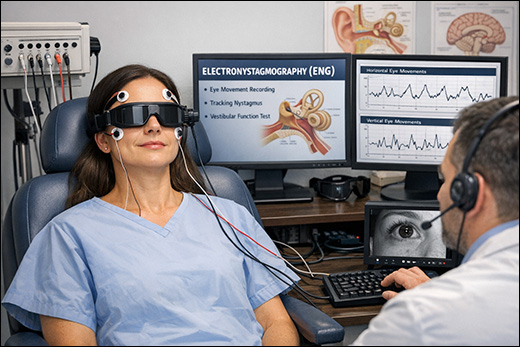
Electronystagmography (ENG) is a specialized diagnostic suite used to evaluate the vestibular system, which is the sensory system responsible for providing our brain with information about motion, head position, and spatial orientation. The test operates on the principle of the corneoretinal potential, utilizing the eye as a battery where the cornea is positive and the retina is negative. By placing electrodes on the skin around the eyes, clinicians can record involuntary eye movements known as nystagmus. This recording is vital because the vestibular system and the eye muscles are linked via the vestibulo-ocular reflex; therefore, abnormal eye movements can pinpoint whether a patient’s vertigo or balance disorder stems from a peripheral inner ear issue or a central nervous system pathology. During the procedure, the patient undergoes oculomotor tracking, positional changes, and caloric stimulation (using air or water) to determine the symmetry and functionality of the balance organs.
How To Do This Electronystagmography (ENG)?
Performing an Electronystagmography (ENG) involves a series of sub-tests designed to "stress" the balance system and record the resulting eye movements. Because the test relies on electrical signals from your skin, proper preparation is the first and most critical step.
1. Patient Preparation
Before the test begins, the skin around the eyes is cleaned thoroughly with an abrasive pad or alcohol to ensure low electrical resistance.
- Electrode Placement: Small silver/silver-chloride electrodes are taped to the skin: one at the outer corner of each eye (to record horizontal movement) and one above and below one eye (to record vertical movement). A ground electrode is usually placed on the forehead.
- Calibration: You will be asked to follow a light or a finger with your eyes to calibrate the equipment, ensuring the electrical signal matches the actual degree of eye movement.
2. The Three Phases of Testing
Once calibrated, the clinician proceeds through three distinct stages:
|
Phase |
What You Do |
What It Measures |
|
Oculomotor |
Following a moving light or dots on a screen (tracking, jumping, or staring). |
How well the brain and eye muscles coordinate movement. |
|
Positional |
Moving your head or body into specific positions (e.g., lying back quickly). |
If certain physical orientations trigger vertigo or nystagmus. |
|
Caloric |
Lying still while warm or cool water (or air) is gently circulated in the ear canal. |
The individual "strength" of each inner ear’s balance sensor. |
3. The Caloric Reflex (The Core Test)
This is often considered the most important part of the ENG. By changing the temperature in the ear canal, the clinician creates a convection current in the inner ear fluid.
- The Sensation: This usually induces a brief, controlled bout of vertigo (dizziness).
- The Goal: If one ear responds significantly less than the other, it indicates a vestibular weakness on that side.
Important Safety Note – Patients are usually required to fast for several hours before the test and must avoid caffeine, alcohol, and certain medications (like anti-vertigo or sedative drugs) for 24–48 hours, as these can suppress the vestibular system and skew the results.
Results
1. Interpreting Abnormal Patterns
|
Finding |
What it Likely Means |
Common Causes |
|
No response in one ear |
Significant damage to the inner ear or the vestibular nerve on that side. |
Vestibular neuritis, Meniere’s disease, or Labyrinthitis. |
|
Direction-Changing Nystagmus |
If eye movement changes direction based on where you look. |
Often indicates a Central issue (brainstem or cerebellum). |
|
Ocular Dysmetria |
Eyes "overshoot" or "undershoot" the target during tracking. |
Potential neurological or brain-related coordination issues. |
|
Positional Nystagmus |
Eye movements only occur when your head is in a specific spot. |
Benign Paroxysmal Positional Vertigo (BPPV). |
2. Peripheral Vs. Central
Peripheral: If the nystagmus can be "suppressed" by focusing your eyes on a fixed point, it usually points to an inner ear problem.
Central: If you cannot stop the involuntary movement by focusing on a target, it suggests the issue is located within the brain’s balance control centers.
What Nerves Does An ENG Evaluate?
Electronystagmography (ENG) assesses involuntary eye movements (nystagmus) to evaluate the integrity of specific cranial nerves involved in eye coordination and balance. It primarily helps assess the function of the following four cranial nerves:
- Oculomotor Nerve (Cranial Nerve III): Controls most eye movements and pupil responses, coordinating communication between the eye muscles and brain.
- Trochlear Nerve (Cranial Nerve IV): Assists in downward and inward eye movements, helping you focus and look toward the nose.
- Abducens Nerve (Cranial Nerve VI): Enables outward horizontal eye movement, allowing you to look away from the nose.
- Vestibular Nerve (part of Cranial Nerve VIII): Connects the inner ear to the brain and plays a vital role in balance and spatial orientation.
When Is An ENG Recommended?
A healthcare provider may suggest ENG if you experience symptoms such as:
- Persistent dizziness
- Balance disturbances
- Vertigo (spinning sensation)
- Unexplained hearing changes
ENG is also valuable in diagnosing or monitoring conditions like:
- Acoustic neuroma
- Benign paroxysmal positional vertigo
- Labyrinthitis
- Vestibular neuritis
- Ménière’s disease
- Usher syndrome
Overall, ENG plays a crucial role in identifying whether symptoms originate from the inner ear or the central nervous system, guiding accurate diagnosis and treatment planning.
Ayurveda’s View
From an Ayurvedic perspective, the symptoms that necessitate an Electronystagmography (ENG)—such as vertigo, dizziness, and loss of balance—are primarily understood through the framework of Brahma (vertigo) and an imbalance of the Vata Dosha within the head and sensory pathways. While modern medicine uses the ENG to electrically monitor the cranial nerves (III, IV, VI, and VIII), Ayurveda identifies these disturbances as a breakdown in the Srotas (channels) and a movement of aggravated Vata and Pitta. Specifically, an excess of the air and ether elements leads to the instability and "spinning" sensation that an ENG records as nystagmus, while Pitta involvement may add symptoms of fainting or heat. Furthermore, although the ENG focuses on the physical Vestibular Nerve, Ayurveda views the ear as a primary seat of Vata and the Shravanendriya (sensory faculty of hearing and balance). Rather than just looking for electrical signals, the Ayurvedic view considers these balance issues as Avarana (blockages) in the flow of Prana (life force) to the sensory organs, necessitating treatments that stabilize the nervous system and clear the energetic channels. Since the symptoms tested by an ENG—like nystagmus and vertigo (Bhrama)—are viewed as "movement in the immobile" (excessive Vata), VataShamak (Vata-pacifying) herbs are used to ground the nervous system and stabilize the inner ear.
1. Ashwagandha (Withania somnifera)
Ashwagandha (Withania somnifera), Known as a premier Rasayana, it specifically balances Vata and Kapha. It nourishes the Majja Dhatu (Nervous tissue), providing "grounding" energy to counter the airy instability of Bhrama (Vertigo). It is a powerful adaptogen containing withanolides that modulate the HPA axis and GABAergic signaling. By reducing cortisol and enhancing GABA receptor sensitivity, it stabilizes the nervous system. It strengthens the vestibular nerve and reduces postural sway. By calming hyper-excitability in the brain, it helps suppress the erratic signals that lead to nystagmus and lightheadedness.
2. Jatamansi (Nardostachys jatamansi)
A potent Nidrajanana (Sleep-inducing) and Manasadosha-hara herb. It is "Sheetal" (Cooling) and balances all three Doshas, particularly calming the Prana Vayu in the head.It contains jatamansone and sesquiterpenes that exert neuroprotective and anticonvulsant effects. It increases levels of neurotransmitters like serotonin and dopamine in the brain. Jatamansi is excellent for Central Nystagmus. It "quiets" the brainstem and cerebellum, reducing the intensity of spinning sensations and helping the brain process spatial orientation more accurately.
3. Rasna (Pluchea lanceolata)
Recognized as the best herb for Vata-vyadhi (Vata disorders). It acts as an Amapachana, clearing toxic blockages (Avarana) from the Srotas (Channels) of the ear and head. It is rich in quercetin and flavonoids, it has massive anti-inflammatory and analgesic properties. It specifically targets inflammation in peripheral tissues and nerves. It is highly effective for Vestibular Neuritis. By reducing inflammation around the eighth cranial nerve, it restores the clear transmission of balance signals from the inner ear to the brain, resolving vertigo at its physical source.
4. Guggulu (Commiphora mukul)
A powerful Srotoshodhana (Channel cleanser). It scrapes away Ama (Toxins) and carries other herbs deep into the Asthi (bone) and Majja (nerve) tissues. It contains guggulsterones which regulate lipid metabolism and reduce systemic inflammation. It improves micro-circulation and has antioxidant effects on neural pathways. Often used in formulas like Yograj Guggulu, it improves blood flow to the labyrinth. By clearing "blockages" in the tiny vessels of the inner ear, it helps maintain the health of the semicircular canals, reducing nystagmus triggered by movement.
5. Garlic (Lashuna)
A "Ushna" (Hot) herb that is extremely effective against Vata. It is called "Rasona" and is used to treat Karna-roga (ear diseases) by piercing through deep-seated coldness and stagnation.Containsallicin, which has potent vasodilator and antimicrobial properties. It enhances peripheral blood flow and protects against oxidative stress in the auditory-vestibular system. In cases of Ménière’s disease, garlic helps regulate fluid pressure and circulation in the inner ear. Better circulation ensures that the hair cells provide accurate "Balance data" to the brain, preventing dizzy spells.
6. Guduchi (Tinospora cordifolia)
Known as Amrita, it is a "Tridosha Shamaka." It strengthens the body’s immune response while cooling the Pitta that often causes "burning" vertigo or fainting. It contains tinosporine and alkaloids that act as immunomodulators and neuroprotectors. It scavenges free radicals that damage the delicate nerves and sensory epithelium of the inner ear. It is vital for recovering from Labyrinthitis. By clearing the "heat" of infection and protecting the Vestibular nerve from permanent damage, it helps the body regain its equilibrium and stops the involuntary eye drifting of nystagmus.
7. Brahmi (Bacopa monnieri)
The ultimate Medhya Rasayana (Brain tonic). It harmonizes the relationship between the Indriyas (senses) and the Mana (Mind), specifically targeting the "Central" control centers of the head. This Contains bacosides that repair damaged neurons and improve synaptic transmission. It enhances the rate at which the nervous system communicates. Brahmi improves the Vestibulo-Ocular Reflex (VOR). By strengthening the Oculomotor nerves, it helps the eyes stay fixed on a target during head movement, directly treating the root cause of nystagmus and "visual" vertigo.
Conclusion
In a nutshell, it can be said that Electronystagmography (ENG) is a valuable diagnostic tool for evaluating balance and dizziness disorders. By carefully recording involuntary eye movements, it provides important information about the functioning of the inner ear and related neurological pathways. ENG helps differentiate between peripheral vestibular problems and central nervous system causes, allowing clinicians to plan appropriate treatment strategies. Although mild dizziness may occur during testing, the procedure is generally safe and well tolerated. Overall, ENG plays a crucial role in identifying the root cause of vertigo and imbalance, supporting accurate diagnosis, timely intervention, and improved quality of life for patients experiencing balance disturbances.