


Ficus religiosa / Peepal / Bodhi Tree / Ashvattha – Medicinal Properties, Benefits & Dosage
Abstract
Peepal, botanically known as Ficus religiosa, is one of the most sacred and therapeutically significant trees described in Ayurveda. Known as Ashvattha, it holds immense spiritual as well as medicinal importance. This tree is widely recognized for its Raktaprasadana (blood purifying), Shothahara (anti-inflammatory), Vranaropana (wound healing), and Pittashamaka (Pitta pacifying) properties. Various parts of the tree such as bark, leaves, fruits, roots, and latex are extensively used in Ayurvedic medicine. Its cooling nature makes it particularly useful in managing bleeding disorders, diarrhea, respiratory disorders, skin diseases, and urinary disorders. Due to its wide range of applications and strong therapeutic actions, Peepal is considered a valuable medicinal tree in both classical and modern herbal medicine.
Classical Reference Of Peepal (Ficus religiosa)
Bhavprakash Nighantu Vatadi Varga Page No. 502
Scientific Classification Of Peepal (Ficus religiosa)
- Kingdom: Plantae
- Division: Angiosperms
- Class: Eudicots
- Order: Rosales
- Family: Moraceae
- Genus: Ficus
- Species: religiosa
Synonyms Of Peepal (Ficus religiosa)
- Bodhidru: The tree of enlightenment, named after Lord Buddha’s realization.
- Pippala: The traditional name signifying a tree that nourishes or sustains life.
- Ashvattha: The “unstable” tree, symbolizing the ever-changing nature of the world.
- Chalapatra: The tree with moving leaves that flutter even in a light breeze.
- Gajashana: A favorite food source for elephants, who eat its leaves and bark.
- Keshavavaas: The abode of Lord Vishnu (Keshav)
- Chalapatra: One having ever-moving or trembling leaves
- Pavitraka: The purifier or a tree that is inherently sacred
- Mangalya: Auspicious or a bringer of good fortune
- Syamala: Dark-colored or having a deep green hue
- Ashvattha: That which does not remain the same tomorrow (symbolizing the changing universe)
- Bodhivriksha: The tree of enlightenment or perfect wisdom
- Gajashana: As its leaves and bark are favorite food for elephants
- Shrimaan: Possessed of fortune, beauty, or divine grace
- Kshiradruma: A milky tree that produces latex when cut
- Vipra: Wise or Brahmin-like due to its spiritual significance
- Shubhada: The bestower of auspiciousness and blessings
- Syamalacchada: Having a canopy of dark-colored or dense green leaves
- Guhyapatra: One whose fruit is hidden or covered by its leaves
- Sevya: Worthy of service, honor, or being resorted to for shade
- Satya: The true one or representing eternal reality
- Sucidruma: A pure or holy tree
- Achyutavasa: This translates to the abode of the Imperishable, specifically referring to the tree as the home of Lord Vishnu.
- Yajnika: This means associated with sacrifice, referring to the use of its wood in sacred fire rituals and ceremonies.
- Gajabhakshaka: This translates to elephant eater, because elephants are very fond of eating the leaves and branches of this tree.
- Shriman: This means majestic, prosperous, or dignified.
- Pippala: The traditional name, which refers to the tree as a provider of nourishment.
- Guhya-pushpa: This translates to hidden flower. It refers to the botanical fact that the flowers of the Peepal are located inside the fruit and cannot be seen from the outside.
- Caitya-druma: This means shrine tree, referring to trees that are treated as sacred altars or planted near religious monuments.
- Dharma-vriksha: This means the tree of righteousness, symbolizing the support of moral and cosmic law.
Vernacular Names Of Peepal (Ficus religiosa)
- Sanskrit: Ashvattha, Pippala
- Hindi: Peepal
- Punjabi: Peepal
- Bengali: Ashwattha
- Gujarati: Piplo
- Marathi: Pimpal
- Tamil: Arasu
- Telugu: Ravi Chettu
- English: Sacred Fig Tree
- Latin Name: Ficus religiosa
Habitat & Distribution Of Peepal (Ficus religiosa)
- Native Origin: Peepal (Ficus religiosa) is considered indigenous to the Indian subcontinent and nearby regions of South and Southeast Asia. It naturally occurs in countries such as India, Nepal, Bangladesh, Pakistan, Sri Lanka, Myanmar, and Thailand. In its native habitat, the tree commonly develops in tropical and subtropical climates where warmth and moderate humidity support its steady growth. It is frequently seen growing both in natural ecosystems and in human-inhabited areas due to its cultural and medicinal significance.
- Global Distribution: Although originally native to Asia, Peepal has gradually spread to many parts of the world because of its ornamental beauty, religious importance, and medicinal value. It is now cultivated in several tropical and warm temperate regions, including parts of Africa, the Middle East, China, and certain regions of the Americas. Due to its strong adaptability and resilience, the tree has successfully established itself in many new environments beyond its original geographical range.
- Distribution in India: Within India, Peepal is widely distributed across various ecological regions. It is commonly found in plains, foothill regions, and rural as well as urban settings. The tree frequently grows in temple courtyards, village surroundings, roadside plantations, agricultural boundaries, and forest margins. It is also observed in sub-Himalayan regions and can grow at elevations ranging from lowland plains to moderate altitudes, particularly in areas that receive sufficient sunlight and seasonal rainfall.
- Climatic Requirements: Peepal demonstrates remarkable tolerance to different environmental conditions and can grow successfully in diverse climates.
- Temperature: The tree thrives in warm conditions and can tolerate a broad temperature range, from relatively cool winters to hot summer climates.
- Rainfall: Moderate rainfall supports healthy growth, although the tree is capable of surviving in areas with seasonal dry periods.
- Altitude: Peepal grows from low-lying plains to moderately elevated regions, making it suitable for a wide range of geographical zones.
- Soil Preference: It adapts well to multiple soil types, including sandy, loamy, and alluvial soils. Well-drained soil supports optimal growth, though the tree is also capable of growing in shallow soils and rocky areas.
- Ecological Adaptability: One of the most notable characteristics of Peepal is its exceptional ecological adaptability. The tree possesses a strong root system that enables it to establish itself in challenging environments, including rocky surfaces, wall crevices, and urban structures. Its ability to survive under varied climatic and soil conditions contributes to its widespread presence across different landscapes. This resilience makes Peepal a common and sustainable species in both natural forests and cultivated environments.
Morphology Of Peepal (Ficus religiosa)
Tree (Habit)
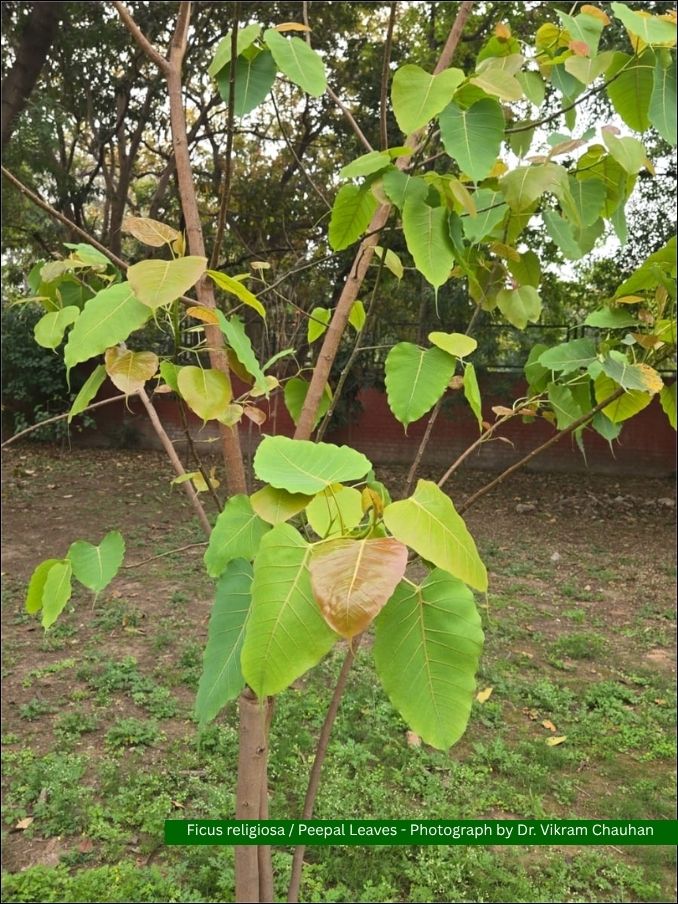
Ficus religiosa is a large, perennial, deciduous to semi-evergreen tree belonging to the family Moraceae. Under favorable climatic and soil conditions, the tree typically attains a height of 20–30 meters, although older specimens may grow even taller. It develops a thick, cylindrical trunk that supports numerous widely spreading branches, forming a broad and dense canopy. The bark is generally grey to greyish-brown in color. In younger trees, the bark surface remains relatively smooth, whereas in mature trees it becomes slightly rough and fissured. The tree possesses a strong root system that allows it to survive in diverse environments. In early stages of growth, the plant may sometimes exhibit epiphytic behavior, germinating in crevices of other trees, walls, or rocky surfaces before establishing roots in the soil.
Leaves
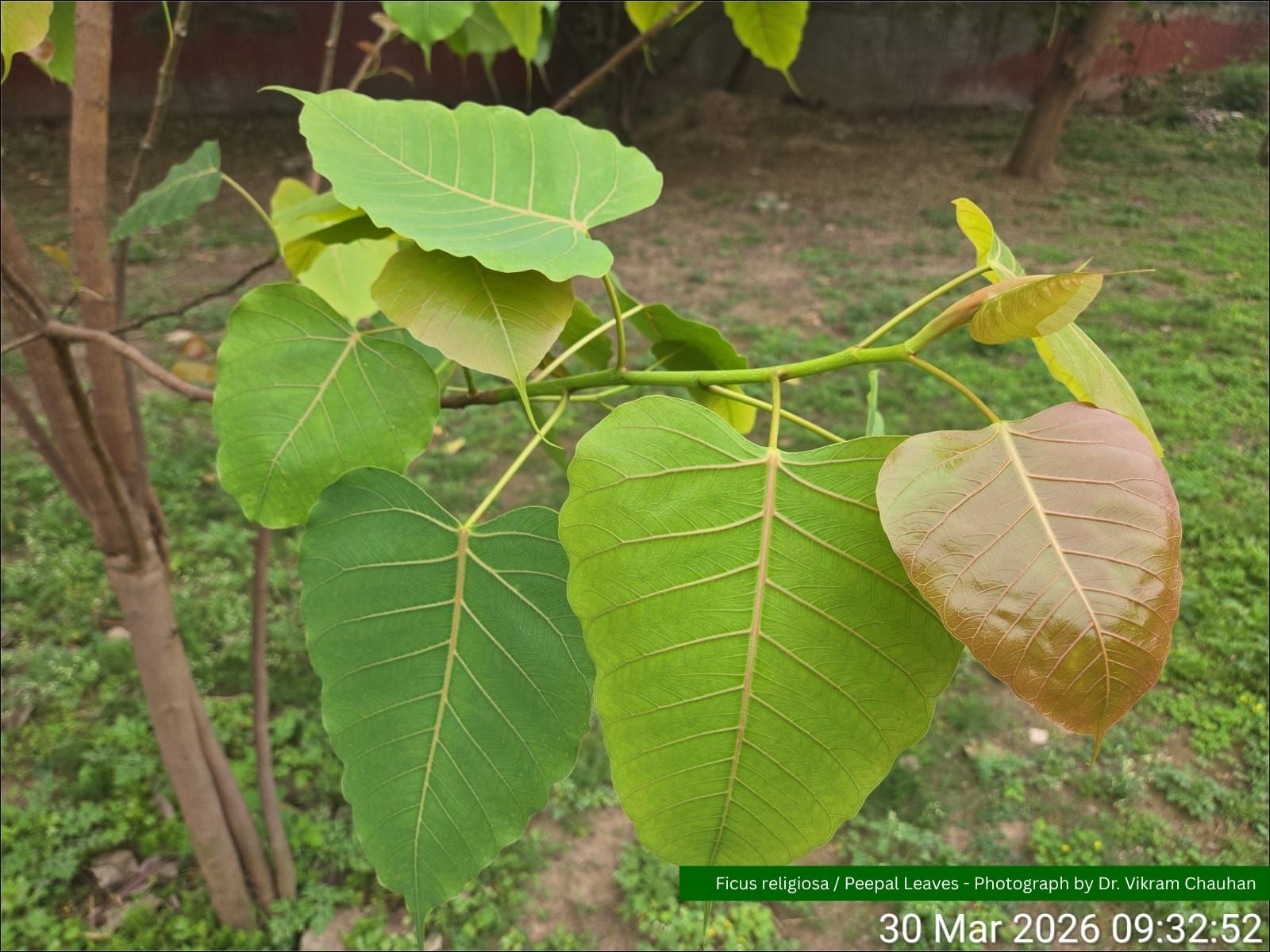
Leaves of Ficus religiosa are simple, alternate, and spirally arranged along the branches. They are cordate (heart-shaped) with a distinct elongated tapering tip, commonly referred to as a drip tip, which helps in the rapid removal of water from the leaf surface during rainfall. The lamina usually measures 10–18 cm in length, while the petiole is long, slender, and flexible, generally measuring 7–10 cm, allowing the leaves to move freely in the wind. The surface of the leaves is smooth, glossy, and bright green, with clearly visible venation. Each leaf possesses a prominent central midrib with 5–9 pairs of lateral veins, forming a fine reticulate venation pattern that supports efficient transport of water and nutrients.
Leaf Development And Ageing Stages Of Ficus religiosa
The leaves of Ficus religiosa exhibit distinct stages of development and ageing that reflect their physiological maturation. Newly emerging leaves are typically pinkish, reddish, or copper-colored, due to the presence of protective pigments that help shield young tissues from environmental stress. As the leaves expand, chlorophyll synthesis increases, causing a gradual transformation into light green and later into deep glossy green when fully mature. Fully developed leaves become slightly leathery and durable, enabling them to withstand environmental variations such as wind and sunlight exposure. With increasing age, the leaves undergo senescence, during which they may turn yellowish as chlorophyll content decreases. Eventually, the aged leaves dry and fall off naturally, completing the cycle of growth and renewal. This sequential transition from young to mature to ageing leaves is a characteristic feature of healthy foliage development in Ficus religiosa.
Flowers
The flowers of Ficus religiosa are minute, inconspicuous, and unisexual, and they are enclosed within a specialized structure known as a syconium, which is characteristic of plants belonging to the genus Ficus. Unlike typical flowers, they are not externally visible because they develop inside this hollow receptacle. Male and female flowers are usually present within the same syconium. Pollination occurs through a specialized biological relationship with fig wasps, which enter the syconium through a small natural opening called the ostiole. This mutualistic pollination mechanism is essential for the successful development of fruits.
Fruits
The fruits of Ficus religiosa are small, globose structures commonly referred to as figs. They are typically 1–1.5 cm in diameter and occur either singly or in pairs in the axils of leaves. Initially, the fruits are green in color and gradually turn purple to dark violet or black when fully mature. The fruit wall becomes soft upon ripening, enclosing numerous minute seeds within the fleshy structure. Mature fruits serve as an important source of nourishment for birds and small animals, contributing to ecological balance and biodiversity.
Seeds
Seeds of Ficus religiosa are very small, numerous, and light in weight, enclosed within the fleshy fruit. Seed dispersal mainly occurs through birds and other frugivorous animals, which consume the fruits and later excrete the seeds at distant locations. This method of dispersal enables the plant to grow in a wide variety of habitats, including rocky areas, cracks in walls, old buildings, and other unusual surfaces. The ability to establish in such environments contributes significantly to the widespread distribution and adaptability of the species.
Classical Categorisation Of Peepal (Ficus religiosa)
- Bhavprakash Nighantu: Vatadi Varga
- Raj Nighantu: Amradi Varga
- Dhanwanthari Nighantu: Amradi Varga
Ancient Verses For Peepal (Ficus religiosa)
Verse No. 1
बोधिद्रुः पिप्पलोऽश्वत्थश्चलपत्रो गजाशनः ।
पिप्पलो दुर्जरः शीतः पित्तश्लेष्मव्रणास्त्रजित् ।
गुरुस्तुवरको रूक्षो वर्ण्यो योनिविशोधनः ॥
Bhavprakash Nighantu Vatadi Varga Verse No. 3
Verse Interpretation
1. Synonyms Of Peepal
- Bodhidru: The tree of enlightenment, named after Lord Buddha’s realization.
- Pippala: The traditional name signifying a tree that nourishes or sustains life.
- Ashvattha: The “unstable” tree, symbolizing the ever-changing nature of the world.
- Chalapatra: The tree with moving leaves that flutter even in a light breeze.
- Gajashana: A favorite food source for elephants, who eat its leaves and bark.
2. Properties Of Peepal
Peepal has an astringent taste and is heavy and slightly difficult to digest. It has drying properties and helps improve skin complexion. It also helps clean and support vaginal health. Additionally, it is useful in reducing excess Pitta and Kapha doshas, and helps in the healing of wounds and management of blood-related disorders.
Verse No. 2
पिप्पलः केशववासश्चलपत्रः पवित्रकः ।
मङ्गल्यः श्यामलोऽश्वत्थो बोधिवृक्षो गजाशनः ॥
श्रीमान् क्षीरद्रुमो विप्रः शुभदः श्यामळच्छदः ।
पिप्पलो गुह्यपत्रस्तु सेव्यः सत्यः शुचिद्रुमः ॥
Dhanwanthari Nighantu Amradi Varga Verse No. 71-72
Verse Interpretation
3. Synonyms Of Peepal
- Keshavavaas: The abode of Lord Vishnu (Keshav)
- Chalapatra: One having ever-moving or trembling leaves
- Pavitraka: The purifier or a tree that is inherently sacred
- Mangalya: Auspicious or a bringer of good fortune
- Syamala: Dark-colored or having a deep green hue
- Ashvattha: That which does not remain the same tomorrow (symbolizing the changing universe)
- Bodhivriksha: The tree of enlightenment or perfect wisdom
- Gajashana: As its leaves and bark are favorite food for elephants
- Shrimaan: Possessed of fortune, beauty, or divine grace
- Kshiradruma: A milky tree that produces latex when cut
- Vipra: Wise or Brahmin-like due to its spiritual significance
- Shubhada: The bestower of auspiciousness and blessings
- Syamalacchada: Having a canopy of dark-colored or dense green leaves
- Guhyapatra: One whose fruit is hidden or covered by its leaves
- Sevya: Worthy of service, honor, or being resorted to for shade
- Satya: The true one or representing eternal reality
- Sucidruma: A pure or holy tree
Verse No. 3
चैत्यद्रुमो धर्मवृक्ष: चन्द्रकरमिताह्वय: ।
अश्वत्थोऽपि स्मृतस्तद्वद् रक्तपित्तकफापह: ॥
Dhanwanthari Nighantu Amradi Varga Verse No. 73
Verse Interpretation
This herb possesses cooling, astringent, and drying properties and acts as a natural agent to stop bleeding. It helps relieve excessive thirst, controls vomiting, supports recovery in conditions like stroke or sudden loss of consciousness, and is beneficial in disorders associated with abnormal bleeding tendencies.
Verse No. 4
अश्वत्थश्चाच्युतावासश्चलपत्रः पवित्रकः ।
शुभदो बोधिवृक्षश्च याज्ञिको गजभक्षकः ।।
श्रीमान् क्षीरद्रुमो विप्रो मङ्गल्यः श्यामलश्च सः ।
पिप्पलो गुह्यपुष्पश्व सेव्यः सत्यः शुचिद्रुमः ।
चैत्यद्रुमो धर्मवृक्षो ज्ञेयो विंशतिसंज्ञकः ।।
पिप्पलः सुमधुरस्तु कषायः शीतलश्च कफपित्तविनाशी ।
रक्तदाहशमनः स हि सद्यो योनिदोषहरणः किल पक्वः ।।
अश्वत्थवृक्षस्य फलानि पक्वान्यतीवहृद्यानि च शीतलानि ।
कुर्वन्ति पित्तास्त्रविषार्त्तिदाहं विच्छर्दिशोषारुचिदोषनाशम् ।।
Raj Nighantu Amradi Varga Verse No. 192-195
Verse Interpretation
4. Synonyms Of Peepal
- Ashvattha: This name means “that which does not remain the same tomorrow,” representing the ever-changing nature of the universe. It also means “the place where horses are tied.”
- Achyutavasa: This translates to “the abode of the Imperishable,” specifically referring to the tree as the home of Lord Vishnu.
- Chalapatra: This means “moving leaves.” It describes the tree’s famous trait where its leaves tremble and rustle even when there is no wind.
- Pavitraka: This simply means “the purifier” or “the holy one.”
- Shubhada: This name means “the giver of auspiciousness” or “the bringer of good fortune.”
- Bodhivriksha: This means “the tree of enlightenment,” as it is the species under which Buddha attained spiritual awakening.
- Yajnika: This means “associated with sacrifice,” referring to the use of its wood in sacred fire rituals and ceremonies.
- Gajabhakshaka: This translates to “elephant eater,” because elephants are very fond of eating the leaves and branches of this tree.
- Shriman: This means “majestic,” “prosperous,” or “dignified.”
- Kshira-druma: This means “milk tree,” referring to the milky white sap (latex) that flows when the leaves or bark are cut.
- Vipra: This means “wise” or “sage-like,” treating the tree as a learned entity among plants.
- Mangalya: This means “auspicious” or “the bringer of happiness and success.”
- Shyamala: This means “dark” or “dusky,” referring to the deep green color of the leaves or the dark shade the tree provides.
- Pippala: The traditional name, which refers to the tree as a provider of nourishment.
- Guhya-pushpa: This translates to “hidden flower.” It refers to the botanical fact that the flowers of the Peepal are located inside the fruit and cannot be seen from the outside.
- Sevya: This means “worthy of service” or “deserving of being worshipped.”
- Satya: This means “truth,” symbolizing the tree as an eternal witness to reality.
- Shuci-druma: This means “the pure tree” or “the clean tree.”
- Caitya-druma: This means “shrine tree,” referring to trees that are treated as sacred altars or planted near religious monuments.
- Dharma-vriksha: This means “the tree of righteousness,” symbolizing the support of moral and cosmic law.
Ayurvedic Properties Of Peepal (Ficus Religiosa)
- Rasa (Taste): Kashaya (Astringent), Madhura (Sweet)
- Guna (Qualities): Guru (Heavy for digestion), Ruksha (Dry in nature)
- Vipaka: Katu (Undergoes Pungent taste after digestion)
- Veerya (Potency): Sheeta (Cold)
- Karma (Actions): Kaphapitta shamaka (reduces vitiated kapha and pitta dosha)
Properties Of Peepal
Pippal possesses a sweet and astringent taste with a cooling nature. It helps in balancing kapha and pitta doshas. It is beneficial in managing disorders related to rakta dosha and also helps reduce burning sensations. The ripe fruit is especially effective in providing quick relief from vaginal discomfort. The mature fruits of the pippala tree act as a cooling cardiac tonic. They are useful in relieving pain associated with pitta, rakta, and toxic conditions. These fruits also help in managing symptoms such as burning sensation, vomiting, weakness, and loss of appetite.
Action On Tridosha Of Peepal (Ficus Religiosa)
It is Kapha-pitta Shamaka
Therapeutic Indications Of Peepal (Ficus Religiosa)
- Bleeding Disorders (Raktapitta)
- Bleeding Piles (Raktarsha)
- Diarrhea (Atisara)
- Dysentery (Pravahika)
- Cough (Kasa)
- Asthma (Shwasa)
- Burning Sensation (Daha)
- Skin Diseases (Kushta)
- Wounds and Ulcers (Vrana)
- Mouth Ulcers (Mukha Paka)
- Excessive Thirst (Trishna)
- Vomiting (Chhardi)
- Urinary Disorders (Mutrakricchra)
- Heavy Menstrual Bleeding (Asrigdara)
- Inflammatory Conditions (Shotha)
- Blood Disorders (Rakta Dushti)
- Loss of Appetite (Agnimandya / Aruchi)
- Burning Syndrome due to Pitta aggravation
- Vaginal Disorders (Yoniroga)
- Fever with Burning Sensation (Jwara with Daha)
Systemic Actions Of Peepal (Ficus Religiosa)
- Digestive System: Peepal helps in improving appetite and digestion. It reduces burning sensation in the stomach and is beneficial in conditions like vomiting, anorexia, and general weakness.
- Circulatory System: It acts as a mild cardiac tonic and supports heart function. It also helps in purifying the blood and managing disorders associated with rakta (blood) imbalance.
- Respiratory System: Peepal is useful in balancing kapha, thereby helping in respiratory issues like cough and mild congestion.
- Reproductive System: It provides relief in vaginal discomfort and helps manage disorders of the reproductive tract due to its cooling and soothing properties.
- Excretory System: It aids in detoxification and helps the body eliminate toxins effectively.
- Integumentary System (Skin): Due to its cooling nature, it helps reduce burning sensation and supports skin health in conditions associated with excess heat.
Chemical Composition Of Peepal (Ficus Religiosa)
- Quercetin (Flavonoid): Strong antioxidant; helps reduce inflammation and protects cells from damage.
- Kaempferol (Flavonoid): Exhibits anti-inflammatory, anticancer, and cardioprotective effects.
- Myricetin (Flavonoid): Supports antidiabetic and antioxidant activity.
- Tannins: Provide astringent action; useful in wound healing, diarrhea, and infections.
- β-sitosterol (Phytosterol): Helps in lowering cholesterol and supports heart health.
- Bergapten & Psoralen (Furanocoumarins): Useful in skin disorders like vitiligo and psoriasis (photosensitizing action).
- Saponins: Possess anti-inflammatory and immune-boosting properties.
- Phenolic Compounds: Act as powerful antioxidants and protect against oxidative stress.
- Alkaloids: Contribute to antimicrobial and therapeutic effects.
- Terpenoids: Help in reducing inflammation and fighting infections.
Practical Uses / Health Benefits Of Peepal (Ficus Religiosa)
- Improves digestion and increases appetite; helps relieve acidity, vomiting, and diarrhea
- Supports blood purification and detoxification; beneficial in blood-related disorders
- Helps manage cough, asthma, and mild respiratory congestion
- Useful in skin conditions like wounds, ulcers, and itching due to antimicrobial action
- Assists in regulating blood sugar levels and supports diabetes management
- Acts as a mild cardiac tonic and supports heart health
- Reduces inflammation, swelling, and pain
- Helps relieve vaginal discomfort and supports reproductive health
- Promotes faster wound healing
- Provides antioxidant support, boosts immunity, and reduces burning sensation
- Helps maintain balance of pitta and kapha doshas
Home Remedies With Peepal (Ficus Religiosa)
- A decoction prepared from Peepal stem bark is commonly used for cleansing wounds. About 50 g of bark is boiled in 500 ml water until it reduces to half. The lukewarm liquid is used to wash wounds, helping in both infected and non-infected cases and promoting faster healing.
- Fresh tender shoots of Peepal can be crushed into a fine paste and kept in the mouth for a few minutes. This is useful in relieving mouth ulcers and inflammation of the oral cavity.
- The fine powder of Peepal root bark is applied externally over oozing skin lesions to reduce discharge and aid drying. The same powder, when taken internally in small doses with honey, may support healing in skin disorders associated with secretion.
- Fresh latex obtained from the tree can be applied to affected skin areas. It is traditionally used in conditions like eczema and may help reduce discoloration and pigmentation.
- For leucorrhoea, a small quantity of fresh latex (around 1–2 ml) mixed with milk is traditionally consumed on an empty stomach. It is believed to help in managing chronic white discharge when used consistently.
- Powder made from Peepal seeds can be mixed with wheat flour and prepared as chapati using ghee (without salt). Cooking it over Peepal leaves and giving it regularly is traditionally believed to help children with stammering.
- Peepal leaf juice or decoction is sometimes used to help manage mild constipation and improve bowel movement.
- Bark decoction is also used as a gargle in gum problems and bad breath due to its astringent and antimicrobial properties.
- Dried fruit powder may be taken in small quantities to support respiratory health and relieve cough.
- Leaf paste is sometimes applied over inflammatory swellings to reduce pain and inflammation.
- Peepal bark or leaf preparations are also traditionally used to help control excessive bleeding due to their astringent nature.
Part(s) Used Of Peepal (Ficus Religiosa)
- Stem bark
- Root bark
- Leaves (tender and mature)
- Fruits (ripe and unripe)
- Seeds
- Latex (milky sap)
- Roots
Dosage Of Peepal (Ficus Religiosa)
- Bark powder (Churna): 3–6 g per day
- Bark decoction (Kwath): 30–50 ml per day (in divided doses)
- Leaf juice (Swarasa): 10–20 ml per day
- Fruit powder: 3–5 g per day
- Seed powder: 2–3 g per day
Classical Products With Peepal (Ficus Religiosa)
- Nalpamaradi tailam
- Mahatriphala Ghrit
- Arimedadi tailam
- Sarivadyasava
- Panchavalkaladi tailam
Planet Ayurveda Products With Peepal (Ficus Religiosa)
Research On Peepal (Ficus Religiosa)
- Antioxidant Activity: Studies indicate that Peepal possesses strong antioxidant properties, which help neutralize free radicals and protect the body from oxidative stress and cellular damage.
- Anti-inflammatory Effects: Experimental research supports its role in reducing inflammation, making it useful in conditions involving swelling and pain.
- Antidiabetic Activity: Scientific investigations have shown that Peepal extracts can help lower blood glucose levels and improve overall metabolic function.
- Antimicrobial Properties: Various studies demonstrate that Peepal has antibacterial and antifungal effects, supporting its traditional use in treating infections and wounds.
- Wound Healing Activity: Research findings suggest that Peepal promotes faster healing of wounds by enhancing tissue repair and reducing microbial growth.
- Gastroprotective and Antiulcer Activity: Peepal has been found to protect the gastric lining and reduce ulcer formation, helping in managing acidity and stomach disorders.
- Neuroprotective Effects: Some studies indicate its beneficial effects on the nervous system, including possible anticonvulsant and brain-protective actions.
- Cardioprotective Activity: Research suggests that Peepal may help in maintaining heart health by reducing cholesterol levels and improving circulation.
- Immunomodulatory and Anticancer Potential: Preliminary studies show that Peepal may enhance immune response and exhibit activity against abnormal cell growth.
Conclusion
Peepal (Ficus religiosa) is a highly valuable medicinal tree with deep roots in Ayurvedic tradition and growing support from modern research. Its diverse phytochemical composition contributes to multiple therapeutic actions, including antioxidant, anti-inflammatory, antimicrobial, and wound healing effects. Various parts of the plant such as bark, leaves, fruits, roots, and latex—are used to manage a wide range of conditions such as digestive disorders, respiratory issues, skin diseases, and blood-related ailments. Its cooling and astringent properties make it especially useful in pitta and kapha imbalances. In addition to its medicinal benefits, Peepal holds great cultural and spiritual importance.
Was this Page Helpful?