


Gandha Prasarini (Paederia foetida) – Properties, Benefits & Dosage
Gandha Prasarini Description
Gandha Prasarini (Paederia foetida) is an important Ayurvedic medicinal herb. The word meaning of Gandha Prasarini in Sanskrit is – it spreads a bad smell! It is a unique feature of this herb. Gandha means smell and prasarini means spreading.
It contains various chemical constituents like essential oil (methyl mercaptan, Linalool), Iridoid glucosides (Asperuloside, paederoside and scandoside, triterpenoids and saponins Ursolic acid, epifriedelinol, friedelin, sitosterol, stigmasterol and campesterol), Quinones (Embelin), Alkaloids, fatty acids (capric, lauric, myristic, arachidic and palmitic acids), Valine, Tyrosine, Histidine carotene and Vitamin C.
It has various therapeutic properties like Anti-inflammatory, Anti-Oxidant, Anti-Bacterial, Antihelminthic and Anti-Hyperglycemic. Because of its different properties it is used in treatment of different ailments like rheumatism, paralysis, abscesses, gout, diarrhea, dysentery, infertility, colic and flatulence.
Its different parts are used in different Ayurvedic Preparations. Its leaves are used against herpes infection, roots are used for relieving pain in the chest or liver, inflammation of spleen and also used as emetic.
About Gandha Prasarini Plant
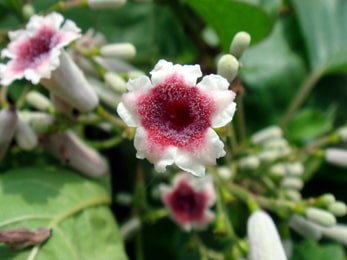
Gandha Prasarini (Paederia foetida) is a climber plant which has ovate to lanceolate leaves. Gandha Prasarini leaves are around 5 cm long and 2.5 cm in width. The leaves are also membranous and have long petioles. Gandha Prasarini flowers are found in scorpiod cymes and are purple or violet in color. Gandha Prasarini roots are cylindrical or sub cylindrical and compressed on both sides, with an outer surface covered in root scars. The fruits are compressed, ellipsoid, red or black in color. It is fibrous, the exterior is brownish and the internal color is light brown, with a bitter taste.
Gandha Prasarini Classification
- Kingdom: Plantae
- Order: Gentianales
- Family: Rubiaceae
- Genus: Paederia
- Species: Foetida
Habitat
It is found in the Himalayas from Dehradun eastwards, up to an altitude of 1800 m above sea level. It is also found in Bihar, Orissa, Bengal and Assam.
Gandha Prasarini Names
- Botanical name – Paederia foetida
- Hindi Name – Gandhaprasarani or Pasaran
- English Name – Chinese flower
- Sanskrit Name – Prasarini, Gandhpatra
- Telugu Name – Takkeda, Savirel
- Bengali Name – Gandhabhaduliya, Gandhabhadule, Gandal
- Marathi Name – Hiran- vel, Hiranvel, Haranvel
- Gujrati Name – Gandhana, Prasarini
- Tamil Name – Pinarisangai, Mudiyar, Kundal
- Assamese name Gujarati Name – Gandhana, Prasarini
- Kannada Name – Hesarani, Prasarini bail
- Malayalam Name – Tala nili
- Punjabi Name – Prasarini
- Oriya Name – Suprasara
Ayurvedic Properties of Gandha Prasarini
| Hindi / Sanskrit | English | ||
| Rasa | Tikta | Taste | Bitter |
| Guna | Guru, Sara | Physical Property | Heavy, Flowing |
| Virya | Ushna | Potency | Hot |
| Vipaka | Katu | Taste conversion after digestion | Pungent |
Gandha Prasarini Effects On Doshas
It manages Kapha and Vata doshas.
Classical Categorization
| Charaka Samhita | Sushrut Samhita | Vagbhata |
|
NIL |
NIL |
NIL |
Ancient Verse About Paederia foetida

The Bhavprakash nighantu, edition of 2010: verse 234-235, page no-424-425.
It states that properties and names of Gandha prasarini – Prasarini, Rajbala, Bhadraparani, Pratanini, Saarini, Sarini, Bhadra, Bala and Kattamabhra are the synonyms of Prasarini.
It is bitter in taste and heavy in nature. It is hot in potency.
It possesses aphrodisiac properties and helps enhance strength and immunity (Balya). It is beneficial for wound healing and bone repair (Sandhanakara). Additionally, it helps balance the Vata and Kapha doshas and manage their related disorders.
Reference
The Bhavprakash Nighantu with elaborated Hindi commentary by Padmashri prof. K.C. Chunekar, edited by Dr. G.S. Pandey: edition of 1998: verse 234-235, page no-424-425.
Practical Uses & Benefits Of Paederia foetida
- Anti-inflammatory activity: It has anti-inflammatory properties and is useful in the treatment of edema and all other inflammatory conditions.
- Anti-arthritic activity: It is very useful in the treatment of joint problems like arthritis and joint pain, gout etc.
- It is useful to balance the vata and kapha doshas in the body and their related disorders.
- It also has aphrodisiac properties and improves the semen quality. It has Anthelmintic activity also.
- It helps to relieve abdominal pain and bloating.
- It acts as immunity enhancer and provides strength to the body against various infections as an immunity enhancer and provides strength
- It is also used to stimulate the central nervous system.
- It is also used in the treatment of fever.
- It also has diuretic properties.
- Its fruits are used to relieve toothache.
- It has hepato-protective and antispasmodic activity.
- Its oil is very beneficial in various joint disorders.
- Most of the massage oils used for Vata balancing contain this herb as an essential ingredient. On external use, this herb relieves pain, inflammation and stiffness.
Part Used
Root, Leaf
Dosage
- Infusion: 12-24 ml
- Fresh Juice: 10-20 ml
- Decoction: 50-100ml
- Powder: 2-4 g