


Hepatopulmonary Syndrome (HPS) – Causes, Symptoms, Treatment & Herbal Remedies
Abstract
Vascular changes in the body are closely linked to the normal functioning of both the liver and the lungs. The liver plays a key role in regulating blood flow, filtering toxins and maintaining vascular balance while the lungs depend on well regulated blood vessels for efficient oxygen exchange. When chronic liver disease develops this balance is disturbed leading to abnormal dilation of blood vessels, especially within the lungs. These liver related vascular alterations interfere with normal pulmonary circulation and oxygen transfer. Over time this progressive interaction between liver dysfunction and pulmonary vascular changes gives rise to a distinct clinical condition known as Hepatopulmonary Syndrome (HPS). So what exactly is HPS and how does it affect our body? Let’s learn about this.
Introduction
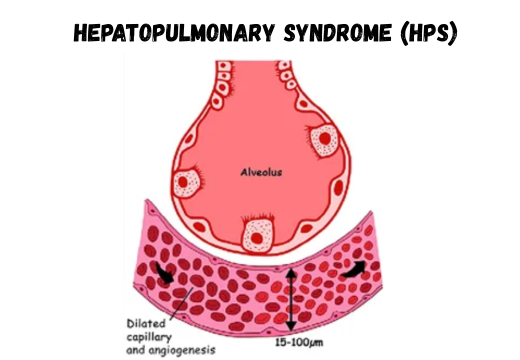
Hepatopulmonary Syndrome (HPS) is a complex medical condition characterized by the coexistence of chronic liver disease, intrapulmonary vascular dilations and impaired oxygenation. It is a serious yet under-recognized complication. Its early diagnosis is essential, as it significantly increases morbidity and mortality if left untreated. Unlike primary lung diseases, the lungs in HPS are structurally normal, but their function becomes compromised due to vascular changes. Patients often experience progressive shortness of breath that worsens on standing, a feature that distinguishes it from many other respiratory disorders.
Causes
Its exact etiology is multifactorial. It develops as a complication of chronic liver disease. There are various conditions that can lead to this like Chronic Liver Disease, Portal hypertension, Viral hepatitis (Hepatitis B and C), Biliary cirrhosis and cholestatic liver disorders, etc.
Pathophysiology
It develops due to chronic liver disease leading to intrapulmonary vascular dilatation and abnormal blood flow within the lungs. Impaired liver function causes excess production and reduced clearance of vasodilators like nitric oxide, resulting in widening of pulmonary capillaries and formation of arteriovenous shunts. This leads to ventilation–perfusion mismatch and diffusion defects, preventing proper oxygen exchange. Consequently, arterial hypoxemia occurs, which worsens in the upright position due to increased blood flow to dilated basal lung vessels.
Over time, persistent hypoxia contributes to cyanosis, digital clubbing and polycythemia, reflecting chronic systemic adaptation.
Symptoms
- Progressive shortness of breath, which often starts insidiously and worsens over time
- Fatigue, weakness
- Reduced exercise tolerance
- Dizziness, palpitations or headaches
- Cyanosis, particularly of lips and fingertips
- Worsening breathlessness in upright posture (platypnea)
Signs
- Cyanosis
- Digital clubbing
- Spider angiomas
- Decrease in oxygen saturation on standing compared to the supine position
- Signs of chronic liver disease such as jaundice, ascites, hepatosplenomegaly and muscle wasting
Diagnosis
- Diagnosis of Hepatopulmonary Syndrome requires confirmation of three key components that are liver disease, impaired oxygenation, and intrapulmonary vascular dilatation
- Arterial Blood Gas (ABG) Analysis
- Contrast Enhanced Echocardiography
- Lung Perfusion Scan
Treatment
As per modern science its management primarily focuses on supportive care and definitive correction of the underlying liver disease, with liver transplantation being the only established therapy that reliably improves hypoxemia and survival. Supplemental oxygen is used to alleviate severe hypoxemia.
Ayurvedic Overview
In Ayurveda, it is a tridhoshaja condition which can be understood as a systemic disorder involving Yakrit (liver) and Prana Vaha Srotas (respiratory channels). In the initial stages Pitta dushti (Vitiation of pitta) results in Yakrit Dushti leading to impaired Rakta Shodhana (blood purification) and circulation. It further vitiates Kapha Dosha resulting in accumulation of Sleshma (mucus) obstructing Pranavaha Srotas (respiratory channels) along with Vata vitiation causing Shwasa (dyspnea) and oxygenation defects. All this affects the functioning of the liver and the whole body leading to the symptoms. Ayurvedic interventions which include Panchakarma therapies, internal herbal formulations and strict dietary regimens are very helpful in treating such patients.
Shodhana Chikitsa (Purification Therapies)
- Virechana (therapeutic purgation) eliminates excess Pitta and toxins from the liver and gallbladder.
- Basti (medicated enema) nourishes the colon and liver while promoting detoxification.
- Panchakarma therapies like Abhyanga (oil massage) and Swedana (steam therapy) enhance digestion and metabolism.
Herbs Used
Some of the herbs that are used in this syndrome are Bhumi Amla (Phyllanthus niruri), Kutki (Picrorhiza kurroa), Guduchi (Tinospora cordifolia), Punarnava (Boerrhavia diffusa) and many others.
Herbal Remedies for Hepatopulmonary Syndrome by Planet Ayurveda
Planet Ayurveda is a well known Ayurvedic healthcare company based in India, dedicated to providing authentic, natural and holistic health solutions. Planet Ayurveda focuses on classical Ayurvedic principles combined with modern quality standards. All formulations are prepared using pure herbs without chemicals, preservatives, artificial colors, yeast or additives, ensuring safety and effectiveness. Planet Ayurveda’s formulations aim to support Yakrit (liver) detoxification, Rakta shodhana (blood purification), Srotas shodhana (microcirculation correction) and Pitta and Kapha balance for the management of hepatopulmonary syndrome.
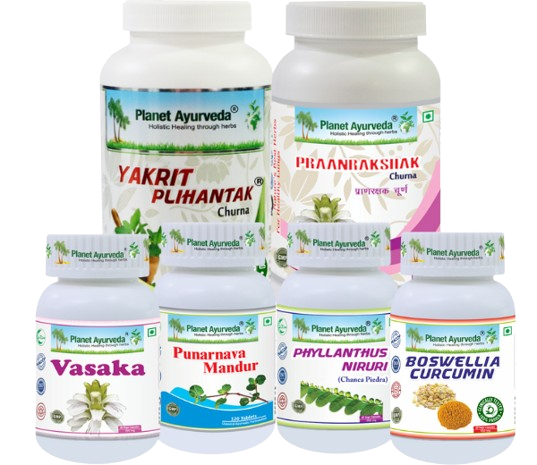
- Yakrit Plihantak Churna
- Phyllanthus Niruri
- Punarnava Mandur
- Praanrakshak Churna
- Boswellia Curcumin
- Vasaka Capsules
1. Yakrit Plihantak Churna
It is a research based clinically tested product of Planet Ayurveda. It is in powder form and contains Bhumi Amla (Phyllanthus niruri), Kalmegh (Andrographis paniculata), Katuki (Picrorhiza kurroa), Bhringraj (Eclipta alba), Sharpunkha (Tephrosia purpurea), and others. This formulation exhibits hepatoprotective, laxative, appetizer, and carminative properties, promoting liver repair, normalizing SGOT/SGPT levels and alleviating symptoms such as ascites, poor digestion and general liver weakness. It pacifies Pitta and Kapha Dosha, improves Agni (digestive fire) and supports proper Rakta (blood) and Meda (fat) metabolism thereby enhancing overall liver function and detoxification.
Dosage : 1 tsp twice a day after meals with plain water.
2. Phyllanthus Niruri
It is a capsule formulation of Planet Ayurveda which contains the standardized extract of Bhumi amla (Phyllanthus niruri). It has Tikta (bitter) taste, Laghu (light) and Pitta and Kapha pacifying properties. It enhances liver enzyme function and supports bilirubin metabolism and cholestasis resolution.
Dosage : 2 capsules twice daily with plain water after meals.
3. Punarnava Mandur
It is a classical Ayurvedic tablet formulation prepared by Planet Ayurveda which contains Punarnava (Boerrhavia diffusa), Mandur Bhasma (Ferric oxide calx), Haritaki (Terminalia chebula), Haridra (Curcuma longa) and others. It supports liver detoxification, reduces hepatic congestion and rejuvenates liver tissues. It also helps reduce fluid retention and mild ascites, while improving the quality of Rasa (vital fluid) and Rakta Dhatu (blood tissue). These actions collectively help alleviate symptoms associated with liver dysfunction and related systemic complications.
Dosage : 2 tablets twice a day with plain water after meals.
4. Praanrakshak Churna
It is a powder formulation of Planet Ayurveda which contains Shirish (Albizia lebbeck), Vasa (Adhatoda vasica), Dalchini (Cinnamomum zeylanica) and many others. It helps in strengthening respiratory function, improving oxygenation and supporting overall immunity. It helps to normalise Prana Vayu (a type of Vata Dosha governing the lungs and respiration), promoting optimal oxygen levels in the body and enhancing lung efficiency.
Dosage : 1 tsp twice daily with warm water after meals.
5. Boswellia Curcumin
It is a capsule formulation of Planet Ayurveda which contains standardized extracts of Shallaki (Boswellia serrata) and Haridra (Curcuma longa). It helps in pacifying Pitta and Vata Doshas and reduces hepatic inflammation, prevents fibrosis and supports detoxification of liver tissues. It strengthens the liver’s Shodhana (tissue purification) and supports Srotoshodhana (clearing of channels), thereby enhancing tissue regeneration and maintaining healthy liver function.
Dosage : 1 capsule twice daily with plain water after meals.
6. Vasaka Capsules
It is a capsule formulation of Planet Ayurveda which contains standardized extract of Vasa (Adhatoda vasica). It helps in pacifying Vata and Kapha and removes obstructions from Raktavahi Srotas (blood carrying channels), thus improving microcirculation and reducing congestion. It is also known for its bronchodilatory, expectorant and hepatoprotective properties. It strengthens Pranavaha Srotas (respiratory channels), supporting optimal oxygen transport and tissue nourishment, which helps maintain healthy lungs and systemic circulation.
Dosage : 2 capsules twice daily with plain water after meals.
Conclusion
Hepatopulmonary Syndrome (HPS) is a serious condition characterized by abnormal pulmonary vasodilation in patients with chronic liver disease, leading to hypoxemia and impaired oxygenation. Modern medicine focuses on supportive care, oxygen therapy and liver transplantation as definitive treatment. Ayurveda complements this by targeting root dosha imbalances, primarily aggravated Pitta and Ama (metabolic toxins) accumulation, via Panchakarma detoxification like Virechana (purgation) for toxin elimination, Basti (medicated enema) for nourishment and the use of hepatoprotective herbs to regenerate liver tissue, enhance bile flow and reduce inflammation along with Rasayana therapies for holistic rejuvenation. This integrative approach supports liver and lung function and improves overall quality of life.