


Herpes on Foot (Herpetic Whitlow) – Causes, Symptoms, Treatment & Herbal Remedies
Abstract
Imagine a small, painful blister appearing unexpectedly on your foot, making every step a reminder of its presence. This is the hallmark of Herpetic Whitlow, a viral infection caused by the herpes simplex virus. Though more commonly seen on fingers, its appearance on the foot is often misdiagnosed as it is usually misinterpreted as minor injuries or fungal infections thus leading to its delayed care. Let’s learn more about it.

Introduction
Herpes on the foot is clinically referred to as Herpetic Whitlow. It is a painful viral infection primarily caused by the Herpes Simplex Virus (HSV-1 or HSV-2). While commonly associated with fingers and hands, HSV can affect the feet leading to blistering, swelling and discomfort. This condition is often misdiagnosed due to its resemblance to bacterial infections or fungal disorders.
Risk Factors
- Immunocompromised conditions.
- Diabetes mellitus or peripheral vascular disease.
- Frequent exposure to HSV infected individuals (healthcare professionals, caregivers).
Causes
HSV-1 (oral herpes source) or HSV-2 (genital) enters via microcuts, nail bites or contact with infected fluids. The virus penetrates the epithelium and replicates within keratinocytes leading to vesicular eruptions through cell lysis. Viral particles travel to the dorsal root ganglia where they remain dormant until reactivated by stress. This inflammation attracts T-cells resulting in edema and lymphangitis. Vesicles merge, ulcerate and eventually crust over within 2–3 weeks. Spread to the toes is usually due to sharing footwear or occlusive shoes that trap moisture, extending viral shedding.
Symptoms
- Intense pain or burning sensation.
- Tingling or itching at the site of infection.
- Swelling and redness around the affected area.
- Fever or malaise in severe cases.
Signs
- Grouped vesicles on an erythematous base usually present on toes or plantar surface.
- Vesicles may merge together forming bullous lesions.
- Tenderness, warmth and localized edema.
- Lymphadenopathy in regional lymph nodes.
- Secondary signs of infection like pus formation if bacterial superinfection occurs.
Diagnosis
- By clinical findings
- Tzanck smears which shows multinucleated giant cells
- Polymerase Chain Reaction (PCR) which detects HSV DNA with high sensitivity.
Treatment
Modern treatment includes:
- Oral or topical anti virals
- NSAIDs like ibuprofen or acetaminophen for pain relief
- Cold compresses to reduce swelling
- Proper wound care
Ayurvedic Overview
As per ayurveda, it can be understood as a Shopha (swelling) or a vrana (vrana ) resulting from an Agantuka (external) cause in this case it may be the entry of the Herpes Simplex Virus through minor abrasions on the foot. This viral entry akin to Krimi (microbes) or external toxins initially vitiates Pitta dosha through contact with contaminated sources. Aggravated Pitta dosha due to its Ushna (hot) and Drava (liquid) qualities enters Raktavaha srotas (blood carrying channels) causing Rakta dushti (vitiation of blood) which is manifested as redness, burning and vesicular eruptions around the nail bed and this rapid Pitta spread can obstructs local channels where Vata dosha lodges and leads to pain, throbbing and dryness.
It can also be correlated with Kunakha or Visarp Roga also according to different perspectives.
Ayurvedic Management
Ayurvedic management focuses on:
- Shodhana therapy: Blood purification through Panchakarma (Raktamokshana) to remove the vitiated dosha and rakta (blood).
- Shamana therapy: Pacification of Pitta and Vata using herbs, formulations and dietary modifications.
1. Neem
Neem or Azadirachta indica has anti viral and anti-inflammatory properties that help heal vesicles and prevent secondary infection.
2. Haridra
Curcuma longa helps to promote wound healing, calming Pitta dosha and Rakta (blood) vitiation and acts as a natural antiseptic.
3. Tulsi
Ocimum sanctum enhances immunity and combats viral replication.
4. Aloe Vera
It reduces inflammation, itching and accelerates healing of vesicles.
Immune modulation using rasayana herbs (Rejuvenating Herbs) to prevent recurrence.
Some Remedies That Can Be Used In It
- Applying a clean cold compress over the affected area helps reduce burning sensation, swelling and pain.
- Fresh Aloe vera gel applied gently over intact vesicles soothes inflammation, itching and redness.
- A mild paste prepared using turmeric powder and clean water or coconut oil can be applied around the affected area.
- Washing the affected foot with lukewarm neem leaf decoction
- Avoid excessive walking, tight footwear or friction over the lesion.
- Keeping the area clean, dry and covered prevents irritation and promotes faster recovery.
Herbal Remedies For Herpes On Foot By Planet Ayurveda
Planet Ayurveda is a well known Ayurvedic healthcare company dedicated to providing authentic, GMP certified and 100% herbal formulations based on classical Ayurvedic texts and modern quality standards. The formulations are free from steroids, chemicals, preservatives, artificial colors and additives ensuring safety for long term use. Few of the products that be effectively used in Herpetic Whitlow are:
Product List
- Phyllanthus Niruri
- Kaishore Guggul
- Curcumin Capsules
- Pitta Balance
- Gleaming Skin, Hair, Nails Formula
- Vran Rakshas Tel
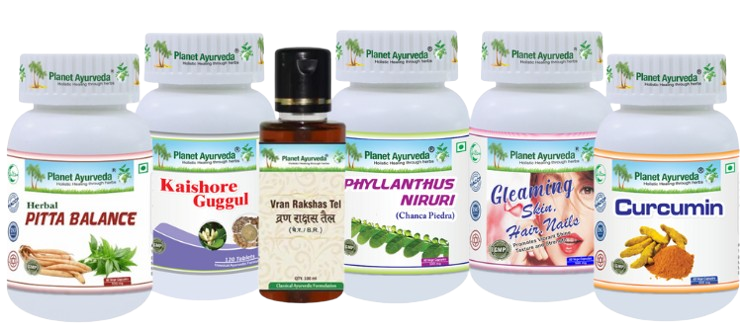
Product Description
1. Phyllanthus Niruri
It is a capsule formulation of Planet Ayurveda which contains standardised extract of the Bhumi amla (Phyllanthus niruri). It is highly beneficial due to its antiviral properties inhibiting replication of the virus. Its Rakta shodhana (blood purifying) and Krimighna (antimicrobial) properties help counter Agantuka (external) causes and reduce local inflammation.
Dosage : 1 capsule twice daily with plain water after meals.
2. Kaishore Guggul
It is a classical ayurvedic tablet formulation prepared by Planet Ayurveda which consists of Guggul (Commiphora mukul), Guduchi (Tinospora cordifolia), amalaki (Phyllanthus emblica ), etc. It acts as a potent Rakta shodaka (blood purifier) thus clearing Pittaja toxins from channels to reduce vesicular inflammation, burning and suppuration around the nail bed. Its Tikta (bitter) and Kashaya (astringent) rasa (taste) and lekhana (scraping) action eliminates vitiated Pitta and Rakta dhatu impurities.
Dosage : 2 tablets twice daily with plain water after meals.
3. Curcumin Capsules
It is a capsule formulation of Planet Ayurveda which contains standardised extract of the Haridra (Curcuma longa). It exhibits broad spectrum anti viral activity and interferes with viral entry into host cells and suppresses viral replication.
Dosage : 1 capsule twice daily with plain water after meals.
4. Pitta Balance
It is a capsule formulation of Planet Ayurveda which consists of Akik Pishti (Agate compound), Mukta pishti (Calcium compound from pearls), Giloy (Tinospora cordifolia), etc. It has cooling, anti-inflammatory and Rakta shodhaka (blood purifying) properties that helps to calm aggravated Pitta and it reduces local inflammation and burning sensations while its blood purifying action supports healthier skin tissue and faster lesion healing.
Dosage : 1 capsule twice daily with plain water after meals.
5. Gleaming Skin, Hair, Nails Formula
It is a capsule formulation of Planet Ayurveda which consists of Manjishtha (Rubia cordifolia), Pitt papada (Fumaria officinalis), Ghritkumari (Aloe barbadensis) and sariva (Hemidesmus indicus). It can be effectively used due to Rakta Shodhana (blood purification), Pitta Shamana (pacification) and Rasayana karma (rejuvenating action). By improving skin tissue nutrition (Twak dhatu poshana) and enhancing local and systemic immunity making it very useful in the recovery phase.
Dosage : 2 Capsules twice daily with plain water after meals.
6. Vran Rakshas Tel
It is a classical oil formulation prepared by Planet Ayurveda which consists of Mustard oil, Parad (Purified mercury), Gandhak (Purified sulphur), Vatsnabh (Aconitum ferox), and many others. It is very useful in management of infected, painful and non healing wounds. It helps in the Rakta shodhana (blood purification) at the local tissue level, pacifies aggravated doshas and aids faster healing without excessive scarring.
Dosage : It should be taken in a sufficient quantity and applied locally on a clean and dry area.
Conclusion
Herpes on the foot (Herpetic Whitlow) is a painful, viral condition that requires accurate diagnosis and timely management to prevent complications. Conventional therapy with antiviral medications and supportive care effectively manages acute episodes. Ayurvedic treatment manages it by focusing on Rakta (blood) and Pitta balancing, wound healing, immunity enhancement and lifestyle modifications. Herbs like Neem (Azadirachta indica), Haridra (Curcuma longa), Tulsi (Ocimum sanctum), etc. offer antiviral, anti-inflammatory and healing properties while formulations such as topical pastes and immune boosting Rasayanas help in recovery. Incorporating proper foot hygiene, dietary regulation, stress management and protective measures can significantly reduce recurrence, ensuring long term foot health and comfort.