


Nerium Oleander / Nerium indicum / Nerium odorum Aiton / Kaner / Karavira – Medicinal Properties, Benefits & Dosage
Description of Plant
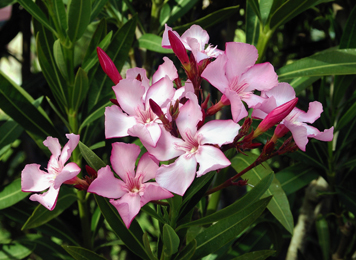
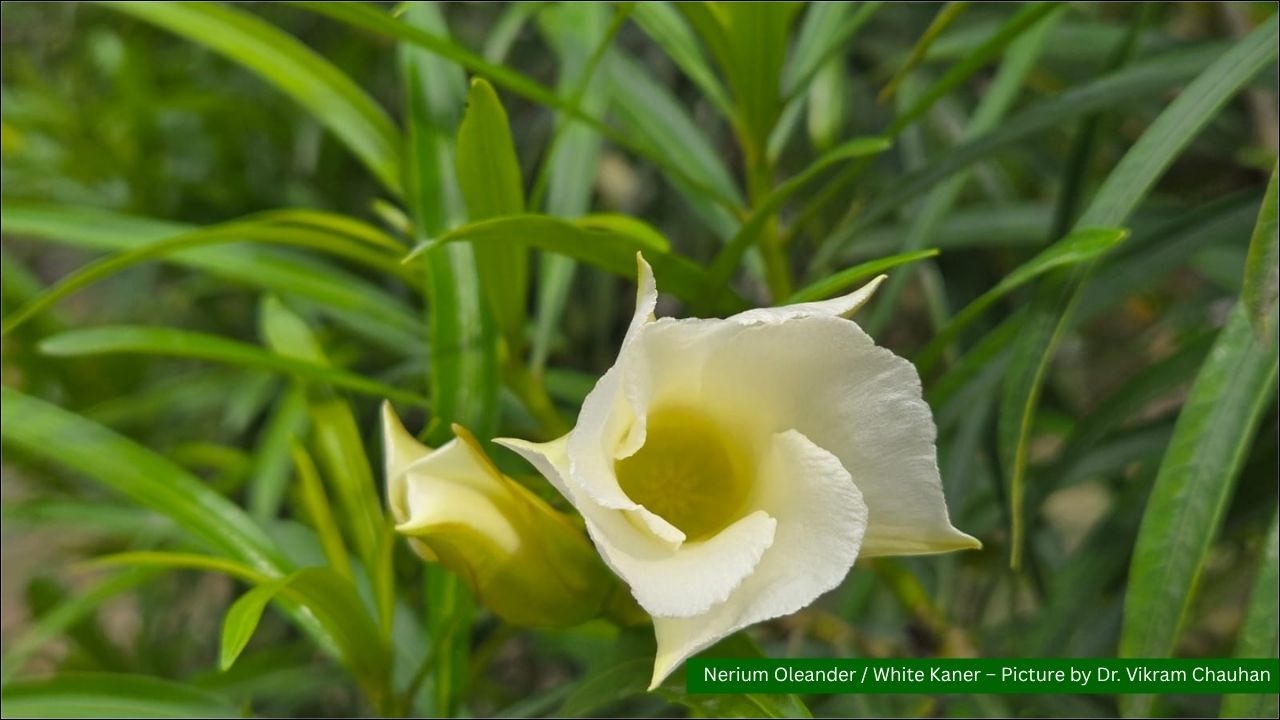
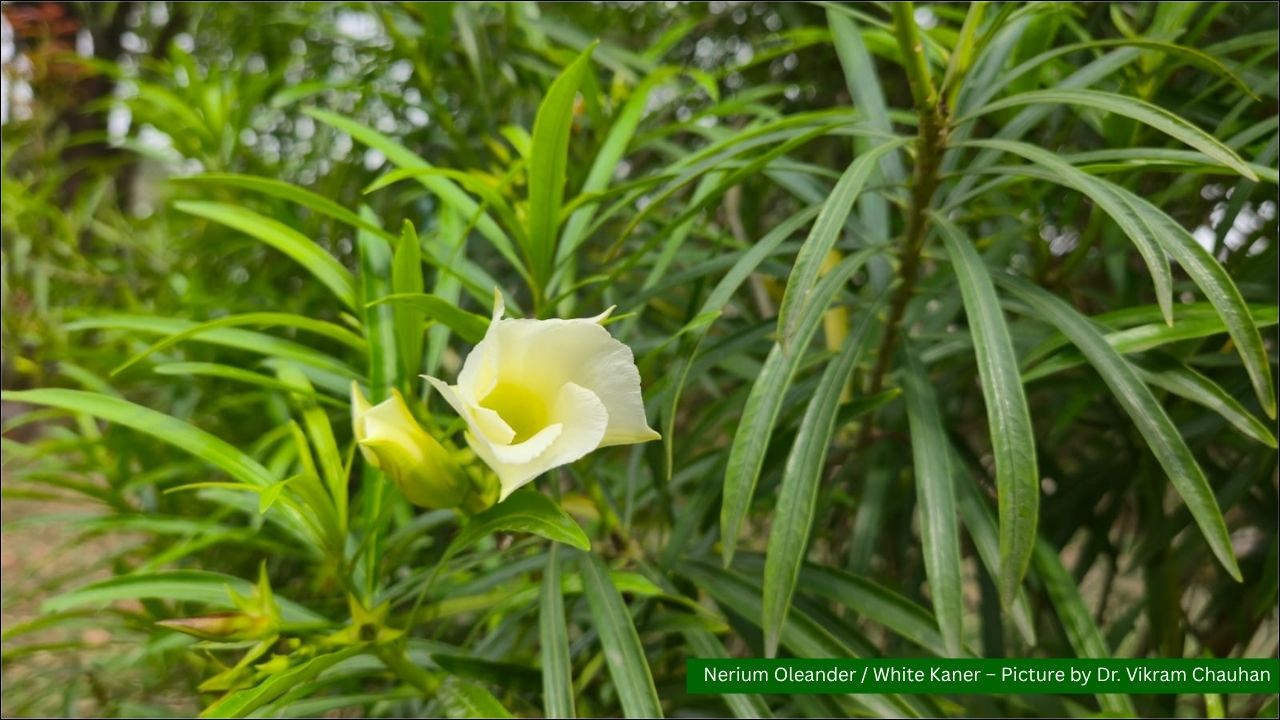
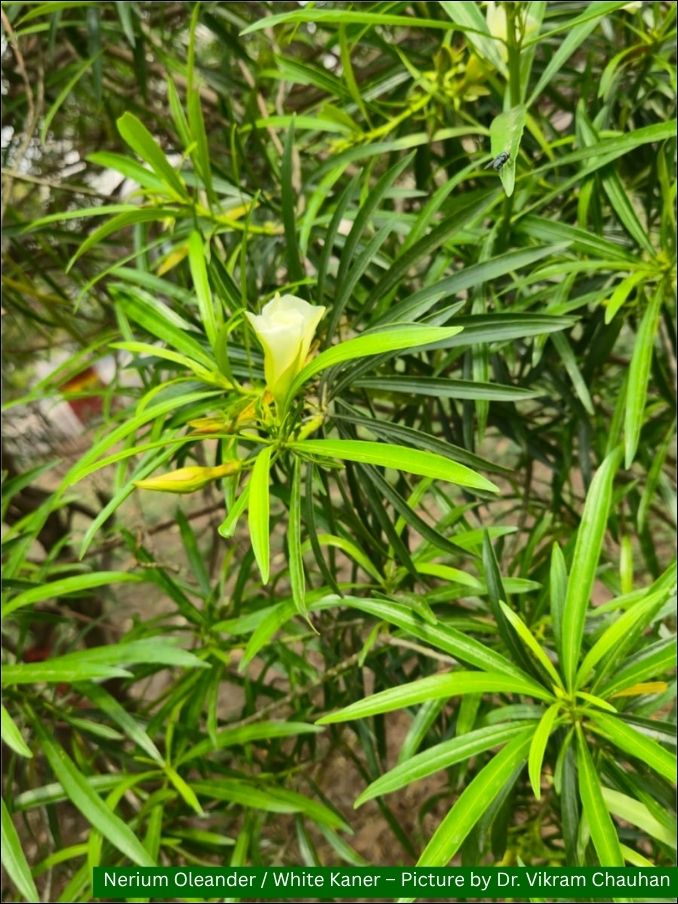
Karavira is a large glabrous evergreen shrub with white latex. Karavira consists of various types based on the color of flowers as Red, Yellow, White, etc.
Leaves of this plant are thick and long. In red colored flowers leaves are dark green and in white colored flowers they are light green in color. They are about 17 cm in length and 1-3 cm in width.
Fruits are cylindrical with Red and White varieties about 4 to 6 inches in length with many seeds. The fruit of the Yellow variety is round and light red colored (unripe) or grey (ripened fruit) and has 2 seeds of light yellow color. It is poisonous.
The root system of this herbal plant is highly branched. The roots are of grayish color having long irregular streaks.
Stem is grayish or grayish green in color and is branched, with similar types of streaks on the bark surface.
Bark is soft and is of Silvery grey white color.
General Description
Karavira (Nerium indicum / Nerium oleander) is a toxic yet medicinally valuable herbal plant used in Ayurveda. Despite its poisonous nature, it has therapeutic applications when used with caution and in prescribed forms. External application of Karavira is indicated in the treatment of bites from poisonous insects and certain skin conditions. In classical Ayurvedic texts, Karavira is also used in the management of functional heart disorders, cardiac insufficiency, and various skin diseases. The plant’s stem, leaves, and flowers are known to contain cardiac glycosides, which are potent bioactive compounds responsible for both its toxic and therapeutic effects. The leaves of Karavira contain cardioactive glycosides such as oleandrin, neriodin, adynerin, and β-D-diginoside, along with other cardiotonic compounds including ursolic acid and a flavonoid similar to rutin
Roots, bark and seeds consists of neriodorin, nerioderin, karabin, odorin and other cardio active glycosides. The root-bark is reported to contain α-amyrin, β-sitosterol, kaempferol and odoroside B, 4-hydroxy- and 2, 4-dihydroxy acetophenones.
Classical References Of Nerium Oleander / Nerium Indicum / Nerium Odorum Aiton / Kaner / Karavira
- Bhavprakash Nighantu Guduchyadi varga
- Raj Nighantu Karviradi varga
Scientific Classification Of Nerium Oleander / Nerium Indicum / Nerium Odorum Aiton / Kaner / Karavira
- Kingdom: Plantae – Plants
- Subkingdom: Tracheobionta – Vascular plants
- Superdivision: Spermatophyta – Seed plants
- Division: Magnoliophyta – Flowering plants (Angiosperms)
- Class: Magnoliopsida – Dicotyledons
- Subclass: Asteridae
- Order: Gentianales
- Family: Apocynaceae – Oleander family
- Genus: Nerium
- Species: Nerium indicum Mill. (often synonymized with Nerium oleander L.)
Synonym Of Nerium Oleander / Nerium Indicum / Nerium Odorum Aiton / Kaner / Karavira
- Asvamaraka – “Horse killer”; indicates the plant is toxic to horses
- Hayamara – “Destroyer of horses”; refers to the poisonous nature for horses
- Hayamaraka – “That which kills horses”; denotes strong toxicity
- Chandataka – “Fierce or violent acting”; indicates powerful medicinal action
- Pratihara – “That which obstructs”; refers to blocking or counteracting effects
- Abjabijabhruta – “Seeds resembling lotus seeds”; describes seed appearance
- Shwetapushpak – “White-flowered plant”; refers to white colored flowers
- Ashvaghna – “Harmful to horses”; denotes poisonous nature to animals
- Goripushpa – “White or pale flowered”; describes flower colour
- Ashvanashak – “Destroyer of horses”; indicates toxic property
- Ashvamarak – “Horse killer”; another synonym highlighting toxicity
- Divyapushpa – “Divine flower”; refers to attractive or sacred-looking flowers
Vernacular Names Of Nerium Oleander / Nerium Indicum / Nerium Odorum Aiton / Kaner / Karavira
- Hindi Name – Kaner, Kanail
- Telugu Name- Erra Ganneru, Jannerat
- English Name – Indian Oleander
- Punjabi – Kanir
- Bengali Name – Karavi
- Marati Name – Kanher
- Kannada – Kanagilu, Kharjahar, Kanigale, Kanagile
- Assamese – Diflee, Sammulhimar
- Gujarati Name – Kaner, Karena
- Tamil Name – Alari
- Urdu Name – Kaner
- China Name – Kiah chuh-au
- Arabian Name – Sammul hibar
- Farsi name – Kharjahara
Habitat Of Nerium Oleander / Nerium Indicum / Nerium Odorum Aiton / Kaner / Karavira
This Herbal plant is usually cultivated as an ornamental shrub in gardens throughout India. It is found growing in the Himalayas from Nepal westwards to Kashmir up to 1,950m and in upper Gangetic plain and Madhya Pradesh. Also found in Uttar Pradesh, Punjab, Balochistan, south India, China and Japan.
It is found on the road sides and grown in the fences in Southern India. Its flowers are used to worship God.
Morphology Of Nerium Oleander / Nerium Indicum / Nerium Odorum Aiton / Kaner / Karavira
Karavira (Oleander) is a large evergreen, glabrous shrub or small tree belonging to the Apocynaceae family, growing up to about 3–5 meters in height and containing characteristic milky latex. The stem is erect and branched, forming a dense ornamental plant commonly cultivated in gardens, parks, temples, and residential areas. Leaves are simple, linear-lanceolate, thick, leathery, and dark green with a shiny upper surface and prominent midrib, usually arranged in whorls. The flowers are fragrant and borne in terminal clusters, varying in colour such as red, pink, rose, white, and yellow depending on the species, with Nerium indicum producing pink and white flowers and Thevetia peruviana bearing yellow flowers. The fruit consists of cylindrical, rigid follicles measuring about 15–23 cm in length, containing small brown seeds tipped with a tuft of silky hairs aiding in wind dispersal. Flowering and fruiting occur almost throughout the year, with peak season mainly from April to June, and the entire plant, particularly the roots, is considered highly toxic.
Varieties Of Nerium Oleander / Nerium Indicum / Nerium Odorum Aiton / Kaner / Karavira
Thevetia neriifolia Juss. and Nerium indicum (a synonym of Nerium oleander ) are two medicinal plants belonging to the Apocynaceae family. All the properties of Thevetia neriifolia are similar to Nerium indicum. It is commonly known as yellow oleander or lucky nut, is a small evergreen tree characterised by narrow, lance-shaped leaves and bright yellow, trumpet-shaped flowers.
Classical Categorisation Of Nerium Oleander / Nerium Indicum / Nerium Odorum Aiton / Kaner / Karavira
- According to Charaka Samhita: Kusthaghna (Herbs useful in treating skin diseases), Tiktaskandha (Group of bitter-tasting herbs)
- According to Sushruta Samhita: Laksadi, Shiro Virechana (herbs used for cleansing the head region)
- According to Dhanwantari Nighantu: Karaviradi Varga
- According to Bhavprakash Nighantu: Guduchyadi varga
- According to Raj Nighantu: Karaviradi varga
Ancient Verse Of Nerium Oleander / Nerium Indicum / Nerium Odorum Aiton / Kaner / Karavira

The Bhavprakash nighantu edition of 1998: verse 82-84 page no-314-316.
Name and properties of white and red Karavira (Kaner) – Karavir, Svetapushpa, Satakumbha, aswamaraka are Sanskrit name of White Kaner.
Sanskrit names of Red Kaner are Raktapushpa, chandata, and laguda.
Both red and white Kaner varieties have bitter, pungent and astringent taste. These are helpful in healing of wounds and also helpful in Leprosy, Skin Infections, itching and worms. It acts as a poison in overdose and when impure.
करवीरो महावीरो हयमारोऽश्वमारकः ।
हयघ्नः प्रतिहासश्च शतकुन्दोऽश्वरोधकः ॥
हयारिर्वीरकः कुन्दः शकुन्दः श्वेतपुष्पकः ।
अश्वान्तकस्तथाऽश्वघ्नो नखराह्वोऽश्वनाशकः ॥
स्थलकुमुदः प्रोक्तो दिव्यपुष्पो हरप्रियः ।
गौरीपुष्पः सिद्धपुष्पशिखराह्वः प्रकीर्तितः ॥
करवीरः कटुस्तीक्ष्णः कुष्ठकण्डूतिनाशनः ।
व्रणार्त्तिविषविस्फोटशमनोऽभ्यन्तप्रदः ॥
(Raj Nighantu Karviradi varga 10-13)
These shlokas describe the various synonyms, characteristics, and medicinal properties of the white variety of Karavira. Names such as Hayamara, Ashvamaraka, Hayaghna, and Ashvantaka translate to “horse-killer,” indicating the plant’s strong toxic nature, especially to animals. Other names like Shvetapushpaka and Shatakunda refer to its physical features, particularly its white flowers and profuse blooming, while titles such as Mahavira and Divya Pushpa highlight its significance and beauty. The plant is also considered sacred, with names like Harapriya and Gauri Pushpa suggesting its association with Lord Shiva and Goddess Gauri, and Sthalabja Kumuda comparing its flowers to the beauty of a lotus. In terms of medicinal properties, Karavira is described as pungent and sharp in nature, and when used externally, it is beneficial in managing skin disorders, relieving itching, promoting wound healing, and helping reduce localised poison effects and inflammatory skin eruptions.
करवीरोऽश्वहाऽश्वघ्नो हयमारोऽश्वमारकः ।
श्वेतकुन्दः श्वेतपुष्पः प्रतिहासोऽश्वमोहकः ॥
द्वितीयो रक्तपुष्पश्व चण्डको लगुडस्तथा ।
चण्डातको गुल्मकश्व प्रचण्डः करवीरकः ॥
करवीरः कटुस्तिक्तो वीर्ये चोष्णो ज्वरापहः ।
चक्षुष्यः कुष्ठकण्डूघ्नः प्रलेपाद्विषमन्यथा ॥
करवीरः कटुस्तिक्तो वीर्ये चोष्णो ज्वरापहः ।
चक्षुष्यः कुष्ठकण्डूघ्नः प्रलेपाद्विषमन्यथा ॥
(Dhanwantari Nighantu Karviradi varga 1-3)
These verses describe the synonyms, varieties, and therapeutic properties of Karavira (Oleander). The white variety is known by names such as Ashvaha, Ashvaghna, Hayamara, and Ashvamaraka, which translate to “horse-killer,” indicating its toxic nature, especially to animals. Names like Shvetakunda and Shvetapushpa highlight its white flowers, while Pratihasa refers to its bright and attractive appearance during blooming. The second variety mentioned is the red-flowered type, known as Rakta Pushpa, with synonyms including Chandaka, Laguda, Chandataka, and Prachanda, suggesting its strong and intense nature and comparatively potent properties. The plant is described as having a pungent and bitter taste with hot potency, and is traditionally used in managing fever and supporting eye health. When applied externally as a paste, it is beneficial for skin diseases and itching, though it is considered poisonous if used internally without proper purification.
Systemic Actions Of Nerium Oleander / Nerium Indicum / Nerium Odorum Aiton / Kaner / Karavira
External Uses
- Useful in skin disorders, wounds, and syphilis. Leaf juice is also beneficial in certain eye disorders.
Internal Uses
- Digestive system – Acts as a carminative and digestive; helpful in loss of appetite, constipation, and abdominal disorders.
- Respiratory system – Leaf ash is used in breathing difficulties, particularly those associated with circulatory problems.
- Excretory system – Supports kidney circulation and is indicated in dysuria and urinary calculi.
- Circulatory system – Exhibits action similar to Digitalis; beneficial in oedema caused by poor circulation.
- Skin – Promotes sweating and is helpful in managing various skin disorders.
- Tapakrama – Especially indicated in Vishama Jwara; should not be administered on an empty stomach.
- Satmikarana – Considered a highly poisonous herb and should be used with caution.
Ayurvedic Properties Of Nerium Oleander / Nerium Indicum / Nerium Odorum Aiton / Kaner / Karavira
| Hindi / Sanskrit | English | ||
| Rasa | Katu, Tikta | Taste | Pungent, Bitter |
| Guna | Laghu, Rooksha | Physical Property | Light, Dry |
| Virya | Ushna | Potency | Hot |
| Vipaka | Katu | Metabolic Property (After Digestion) | Pungent |
Effects on Doshas
It balances Kapha and Vata.
Properties and Practical Uses Of Nerium Oleander / Nerium Indicum / Nerium Odorum Aiton / Kaner / Karavira
Nerium indicum has so many medicinal properties as bitter, acrid, anthelmintic, adaptogenic, analgesic, aphrodisiac anticancer:, anti-inflammatory: stomachic, febrifuge, diuretic astringent, emetic, expectorant, cardio tonic, anticancer etc.
It is an efficient useful treatment in conditions like snake bites, ulcers, cardiac diseases, asthma, renal and vesical calculi, chronic stomach diseases, skin related problems, joint pains, leprosy, cancer, etc.
- It can act as an abortifacient: causing abortion.
- It is good for relieving pain.
- It is also useful in prevention or treatment of cancer.
- It benefits in reduction of inflammation.
- It also acts as an antibacterial, antiseptic agent.
- It also provides relief as it is a good antiulcer.
- It has a Bradycardic effect as it can slow the heart rate.
- It has effects as a CNS Depressant which slows brain activity.
- It can induce vomiting required in certain cases.
- It is an Emmenagogue which can stimulate or increase menstrual flow.
- It is a good fungicide, insecticide, larvicide, parasiticide, and rodenticide.
Chemical Composition Of Nerium Oleander / Nerium Indicum / Nerium Odorum Aiton / Kaner / Karavira
- Cardiac Glycosides (Cardenolides): Oleandrin, Neriin, Odoroside A–H, Nerizoside, Neritaloside, Digitoxigenin, Kaneroside, Neriumoside, Gentiobiosyl-oleandrin, Alpha-L-oleandroside-5α-adynerin
- Triterpenoids / Steroids: Ursolic acid, Oleandric acid, Alpha-amyrin, Phytosterols
- Flavonoids / Phenolic Compounds: Rutin, Kaempferol, Catechin, Epicatechin, Cinnamic acid, Chlorogenic acid, Phenolic compounds, Tannins
- Polysaccharides: Arabinose, Galactose, Galacturonic acid, Rhamnose
- Fatty Acids and Vitamins: Oleic acid, Linolenic acid, Palmitic acid, Tocopherols (Vitamin E)
- Volatile Compounds: d-Limonene
- Root Bark Constituents: Plumericin, Alpha-amyrin, Beta-sitosterol, Kaempferol, Odorosides A-H
- Leaf Constituents: Kaneroside, Neriumoside, Digitoxigenin, Alpha-L-oleandroside-5α-adynerin, Gentiobiosyl-oleandrin, Odoroside A, Oleandrin
Actions And Properties Of Various Chemical Constituents Of Nerium Oleander / Nerium Indicum / Nerium Odorum Aiton / Kaner / Karavira
1. For Skin Problems
Nerium oleander contains various bioactive compounds in its leaves and roots that contribute to its traditional use in managing skin disorders such as eczema, psoriasis, acne, leprosy, and infections. Triterpenoids like oleanolic acid and ursolic acid help protect skin cells, reduce inflammation, and promote wound healing by supporting connective tissue. Cardiac glycosides such as oleandrin and neriin exhibit antimicrobial, antiviral, and anti-inflammatory actions, helping control infection and irritation in skin conditions. Phenolic compounds, including cinnamic acid, catechin, epicatechin, and chlorogenic acid, provide antioxidant protection and reduce oxidative stress in damaged skin. Steroidal glycosides like nerizoside and odoroside support the management of scaly skin diseases, scabies, and skin growths. Kaempferol further enhances anti-inflammatory effects by reducing nitric oxide production, while polysaccharides assist in re-epithelialization and faster skin repair, thereby improving overall skin health.
2. For Eyes
Cardiac glycosides such as oleandrin, neriin, and odorosides show biological activity that may help reduce inflammation and microbial growth under controlled conditions. Triterpenoids like ursolic acid and oleanolic acid provide antioxidant protection and help reduce oxidative stress affecting eye tissues. Flavonoids, including rutin and kaempferol, further support eye health by neutralising free radicals and reducing inflammatory responses. These combined actions may theoretically support eye tissue protection and reduce irritation; however, direct exposure to the plant sap or extracts can cause severe ocular damage such as keratitis, uveitis, and even permanent vision loss.
Part Used Of Nerium Oleander / Nerium Indicum / Nerium Odorum Aiton / Kaner / Karavira
Root/ root bark
Dosage Of Nerium Oleander / Nerium Indicum / Nerium Odorum Aiton / Kaner / Karavira
Powder : 30-125 mg per day, it is the maximum dose.
Conclusion
Karavira (Nerium oleander) is an important medicinal plant described in Ayurveda for its potent therapeutic properties, especially in skin disorders, wounds, itching, and certain inflammatory conditions. It possesses a pungent, bitter taste and hot potency, contributing to its cleansing, antimicrobial, and detoxifying actions. The plant contains various bioactive compounds such as cardiac glycosides, flavonoids, triterpenoids, and phenolic compounds, which support its medicinal value. Due to its strong nature, it is mainly preferred for external applications in traditional medicine. Overall, Karavira is a powerful but potentially beneficial herb that offers significant medicinal benefits when used cautiously and appropriately. Due to its toxic nature, it should be taken under the supervision of an Ayurveda expert.
Cautions
- This herb is a cardiac toxic therefore it should not be used without the advice of a doctor.
- It is not safe for children so keep this herb out of sight and reach of children.
- It is also not safe in case of pregnant and lactating mothers and even for external application.
- Accidental oral intake may result in severe poisonous symptoms.