


Odina wodier Roxb./ Lannea coromandelica (Houtt.) Merrill./ Jingini – Medicinal Properties, Benefits & Dosage
Abstract
Lannea coromandelica (Indian Ash Tree) is a fast-growing, deciduous tropical tree widely distributed across South and Southeast Asia, including forested and isolated regions of India, particularly in the southern parts. It is an important medicinal plant in indigenous and traditional systems of medicine, where it is used for the management of inflammation, pain, diarrhoea, and infectious disorders. Phytochemical studies have revealed that the presence of bioactive constituents such as quercetin-3-arabinoside, ellagic acid, and neutral gum polysaccharides contributes to its therapeutic efficacy. The stem bark exhibits significant antimicrobial and analgesic activities, underscoring the medicinal value of this species belonging to the family Anacardiaceae.
Classical References Of Odina Wodier Roxb./ Lannea Coromandelica (Houtt.) Merrill./ Jingini
- Bhavprakash Nighantu Vatadi varga
Scientific Classification Of Odina Wodier Roxb./ Lannea Coromandelica (Houtt.) Merrill./ Jingini
- Kingdom: Plantae
- Phylum: Magnoliophyta
- Class: Spermatophyta
- Subclass: Rosids
- Order: Sapindales
- Family: Anacardiaceae
- Genus: Lannea
- Species: Lannea coromandelica
Synonym Of Odina Wodier Roxb./ Lannea Coromandelica (Houtt.) Merrill./ Jingini
- Jingini / Jhingi / Jhinghini – Common regional names used in different parts of India, mainly referring to the tree found in forested areas.
- Suniryasa – Indicates the presence of resin or gum exudate from the plant.
- Pramodini – “That which gives joy or relief,” suggesting its soothing and therapeutic properties.
- Jhilli – A local folk name, often associated with the tree’s bark or texture.
- Modaki – Refers to the clustered or rounded nature of its flowers or inflorescence.
- Gudamanjari – “Sweet or resinous flower cluster,” highlighting the aromatic or gum-producing character.
- Jaatasara – “Rich in essence or extract,” pointing to its medicinal potency.
- Kalusha – Suggests a dark or rough appearance, commonly linked with the bark.
- Manjari – Denotes a flower cluster or inflorescence.
- Kamamanjari – “Attractive or pleasing flower cluster,” implying ornamental value.
- Parvatiya – Indicates its occurrence in hilly or mountainous regions.
- Madanamanjari – “Delightful or enchanting flower cluster,” reflecting its aesthetic and medicinal appeal.
Vernacular Names Of Odina Wodier Roxb./ Lannea Coromandelica (Houtt.) Merrill./ Jingini
- Sanskrit: Jingini, Jhingini
- English: Indian Ash Tree, Moya, Wodier
- Hindi: Mohin, Jingana, Jingan, Jingini
- Marathi: Moi, Mui, Shimati, Shemat, Shinti
- Gujarati: Mavedi, Shimpati
- Konkani: Moi
- Kannada: Udi Mara, Godda, Guvina, Guratika
- Bengali: Jiol
- Punjabi: Jhingan, Kambal, Kamlai, Kembel
- Telugu: Gampena, Oddimaanu, Ajasrngi
- Tamil: Oti, Kalasan
- Malayalam: Otiyan-maram
- Oriya (Odia): Indramai, Moi
- Manipuri: Aaman
- Coorg: Goddana-mara
- Assamese: Jia
- Nepali: Halonre, Thulo Dabdabe
- Pakistani (Regional): Kembal
Habitat Of Odina Wodier Roxb./ Lannea Coromandelica (Houtt.) Merrill./ Jingini
Lannea coromandelica is a deciduous tree indigenous to South and Southeast Asia, with a wide geographical distribution across countries such as India, Bangladesh, China, Nepal, Sri Lanka, Pakistan, Malaysia, Myanmar, Thailand, and Vietnam. It is also found in several specific regions, including the Andaman Islands, Assam, Cambodia, Guangdong, Guangxi, Hainan, Laos, and Yunnan.
Morphology Of Odina Wodier Roxb./ Lannea Coromandelica (Houtt.) Merrill./ Jingini
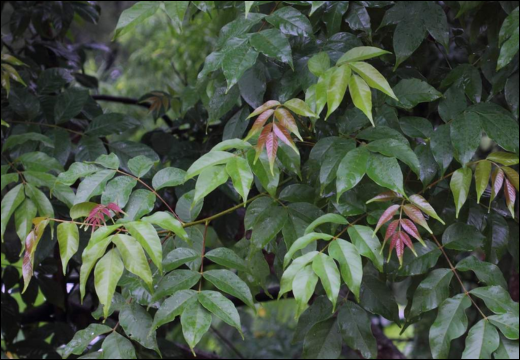
The plant is a medium-sized tree, usually attaining a height of about 5–14 m, and is easily recognised by its grayish-white bark and stout branchlets densely covered with rust-colored stellate hairs. The leaves are odd-pinnate and typically crowded at the tips of branchlets, ranging from 10 to 33 cm in length. They commonly bear 7–9 pairs of ovate leaflets, though the number may vary from 5 to 11 pairs, arranged along the rachis with cylindrical petioles sparsely clothed in similar stellate hairs. Flowers are small, yellow to purplish, and occur in terminal racemes that may be branched or unbranched. The fruit is an ovate, slightly compressed drupe that turns purplish-red on maturity, measuring about 6–10 mm in length and nearly 5 mm in width, and becomes glabrous when fully ripe.
Classical Categorisation Of Odina Wodier Roxb./ Lannea Coromandelica (Houtt.) Merrill./ Jingini
- According to Kaiyadeva Nighantu: Aushadhi Varga
- According to Bhavprakash Nighantu: Vatadi varga
- According to Shodala Nighantu: Amradi varga
Ancient Verse Of Odina Wodier Roxb./ Lannea Coromandelica (Houtt.) Merrill./ Jingini
जिङ्गिनी झिङ्गिनी झिङ्गी सुनिर्यासा प्रमोदिनी ॥
जिङ्गिनी मधुरा सोष्णा कषाया योनिशोधिनी।
कटुका व्रणहृद्रोगवातातीसारहृत् पटुः ॥
(Bhavprakash Nighantu Vatadi varga 42-43)
The Sanskrit synonyms of Jingini include Jingini, Jhingani, Jhingi, Suniryasa, and Pramodini. Jingini possesses sweet, pungent, astringent tastes and has a hot potency. It acts as a vaginal cleanser and is beneficial in the management of wounds, heart disorders, vitiated Vata, and diarrhoea.
Ayurvedic Properties Of Odina Wodier Roxb./ Lannea Coromandelica (Houtt.) Merrill./ Jingini
- Taste (Rasa)- Pungent (Katu), Sweet (Madhur), Astringent (Kashaya)
- Potency (Veerya)- Hot Potency (Usna)
- Post-digestion effect (Vipaka)- Katu (Pungent)
- Effect on tridosha– Balances Vata dosha
Therapeutic Indications Of Odina Wodier Roxb./ Lannea Coromandelica (Houtt.) Merrill./ Jingini
- Yonishodhani – Helps in cleansing the female reproductive tract and managing infections
- Vrana – Useful in the healing of wounds
- Hridroga – Beneficial in heart-related disorders
- Atisara – Helps in the management of diarrhoea
- Excess thirst – Aids in relieving abnormal or excessive thirst
- Anti-inflammatory – Reduces inflammation and associated swelling
- Toothache – Helps in alleviating dental pain
- Cough – Useful in managing cough and related respiratory discomfort
Systemic Actions Of Odina Wodier Roxb./ Lannea Coromandelica (Houtt.) Merrill./ Jingini
External Uses
- Its leaves are used for the management of inflammation. The bark juice is used for the management of wounds.
Internal Uses
- Digestive System – It is used for the management of diarrhoea, excess thirst and toothache.
- Respiratory System – Useful in cough and throat laxity.
- Reproductive System – It helps in cleansing the female reproductive tract and managing infections.
Chemical Composition Of Odina Wodier Roxb./ Lannea Coromandelica (Houtt.) Merrill./ Jingini
- Primary Phytochemical Groups: Carbohydrates (gums), proteins, glycosides, terpenoids, polyphenols, flavonoids, tannins, sterols, and fatty acids.
- Bark Constituents: Rich in terpenoids and flavonoids; contains condensed tannins (catechin, epicatechin), proanthocyanidins, phenolic acids (gallic acid, protocatechuic acid), triterpenoids (oleanolic acid), sterol esters (β-sitosteryl-3β-glucopyranoside-6′-O-palmitate), aralia cerebroside, and myricadiol.
- Leaf Constituents: Abundant in flavonol glycosides such as quercetin-3-α-arabinoside, isoquercetin, catechin, leucocyanidin, leucodelphinidin, gallic acid, and ellagic acid.
- Flower Constituents: Source of flavonoid glycosides, including quercetin derivatives and β-sitosterol.
- Gum (Jeol gum): Composed mainly of neutral and acidic polysaccharides containing L-arabinose, D-galactose, and D-galacturonic acid, along with aldobiouronic acids and methylated sugar derivatives.
- Root and Heartwood: Contain steroidal and triterpenoid compounds such as lanosterol and cluytyl ferulate.
- Phenolic Compounds: Include epicatechin, gallic acid, methyl gallate, protocatechuic acid, isovanillin, chlorogenic acid, caffeic acid, trans-cinnamic acid, and p-hydroxybenzoic acid ethyl ester.
- Sterols and Triterpenes: β-sitosterol, phytosterol esters, myricadiol, and oleanolic acid are widely distributed across plant parts.
- Bioactive Profile: Around 36 compounds have been isolated, exhibiting antioxidant, anti-inflammatory, antimicrobial, hepatoprotective, antidiabetic, and anticancer activities.
Actions And Properties Of Various Chemical Constituents Of Odina Wodier Roxb./ Lannea Coromandelica (Houtt.) Merrill./ Jingini
For The Female Reproductive System
Odina wodier Roxb. (syn. Lannea coromandelica), commonly known as Indian Ash Tree or Jingini, is used for managing vaginal disorders such as infections, leucorrhoea, and genital wounds. Its therapeutic action on the female reproductive system is attributed to a rich phytochemical profile dominated by tannins, flavonoids, phenolic acids, and phytosterols. Condensed tannins and polyphenols present in the bark exert strong antimicrobial, astringent, and anti-inflammatory effects, helping to control infections and reduce excessive vaginal discharge. Flavonoids such as quercetin, myricetin, and their glycosides contribute to anti-inflammatory and analgesic actions, thereby relieving pain and irritation. Phenolic acids, including gallic, chlorogenic, and caffeic acids, further enhance antimicrobial and wound-healing activity. Phytosterols like β-sitosterol support tissue repair, while p-hydroxybenzoic acid ethyl ester may provide mild estrogenic support, collectively explaining the plant’s effectiveness in maintaining reproductive tract health.
Cytotoxic Activity
Lannea coromandelica (Houtt.) Merr., also known as Odina wodier Roxb., is valued for its notable anti-cancer and cytotoxic potential, particularly from its bark and leaves. These effects are largely attributed to a rich composition of polyphenols, flavonoids, tannins, triterpenoids, and sterols. Flavonoids such as quercetin and its glycosides, along with gallic acid, methyl gallate, catechins, and epigallocatechin-3-gallate, act as strong antioxidants that neutralise reactive oxygen species and limit oxidative DNA damage. Triterpenoids like oleanolic acid and myricadiol further contribute by suppressing inflammation and supporting chemopreventive activity. The extracts exhibit direct cytotoxicity against cancer cell lines by inducing apoptosis, as evidenced by nuclear changes and apoptotic body formation. Additionally, inhibition of pro-inflammatory mediators and activation of MAPK/NRF2-HO-1 signalling enhance cellular detoxification and reduce tumour-promoting inflammation, collectively explaining the plant’s role in cancer management.
For Heart Problems
Lannea coromandelica (Houtt.) Merr. (syn. Odina wodier Roxb.), commonly known as the Indian Ash Tree or Jhingan, is valued for managing cardiovascular and related metabolic disorders. Its bark and leaves are rich in bioactive phytochemicals such as polyphenols, flavonoids, tannins, triterpenoids, sterols, and phenolic acids. Compounds including quercetin and its glycosides, gallic acid, epigallocatechin-3-gallate, epicatechin gallate, and β-sitosterol contribute to strong antioxidant, anti-inflammatory, and lipid-regulating activities. The extracts scavenge free radicals and induce the NRF2–HO-1 pathway, protecting cardiac tissues from oxidative stress. Additionally, hypolipidemic effects help reduce cholesterol, triglycerides, LDL, and VLDL while improving HDL levels. Mild hypotensive and anti-inflammatory actions further support vascular health, collectively explaining the plant’s cardioprotective role.
Practical Uses / Health Benefits Of Odina Wodier Roxb./ Lannea Coromandelica (Houtt.) Merrill./ Jingini
- Oral Decoction: Bark decoction taken internally helps relieve excessive thirst and diarrhoea.
- Oral/Gargle Use: Gargling with bark decoction alleviates sore throat, cough, and toothache.
- Wound Healing: Bark juice or oil prepared from bark decoction is applied externally to cuts, chronic wounds, and ulcers to promote healing and prevent infection.
- Swelling & Inflammation: Boiled leaves are applied as a poultice to reduce swellings.
- Muscle Sprain: Gum (Jingini) mixed with coconut water is applied externally to sprains.
- Skin Disorders: Bark is used by traditional communities (Poraja people) to treat skin diseases.
- Digestive Issues: Resin and leaf/bark extracts are used to manage diarrhoea and hematochizia (blood in stools).
- Pain Relief: Stem bark paste or gum applied externally helps alleviate body aches and localised pain; gum soaked in water and applied on painful areas is also used.
- Fractures & Bleeding: Bark serves as a bandage for fractures; crushed inner bark juice is applied to cuts to stop bleeding and prevent tetanus.
- Emetic Use: The juice of green branches is used as an emetic in cases of coma caused by narcotics.
Parts Used Of Odina Wodier Roxb./ Lannea Coromandelica (Houtt.) Merrill./ Jingini
- Bark
- Gum
- Leaves
Conclusion
Lannea coromandelica (Houtt.) Merr., also known as Odina wodier or the Indian Ash Tree, is a versatile medicinal plant with wide-ranging therapeutic applications in traditional medicine. Its bark, leaves, gum, and roots are rich in bioactive compounds, including flavonoids, polyphenols, tannins, triterpenoids, sterols, and phenolic acids, which contribute to its antioxidant, anti-inflammatory, antimicrobial, and cytotoxic activities. The plant is traditionally used for managing female reproductive disorders, cardiovascular problems, digestive issues, wounds, skin diseases, pain, and infections. Modern pharmacological studies support many of these uses, highlighting its potential in cardioprotection, anticancer activity, and antimicrobial therapy. Overall, Lannea coromandelica represents a significant ethnomedicinal resource with promising applications in both traditional and modern healthcare systems.
Frequently Asked Questions (FAQ’s)
Q1: What Are The Medicinal Uses Of Lannea Coromandelica?
It is used to treat female reproductive disorders, cardiovascular problems, diarrhoea, wounds, skin diseases, pain, infections, and inflammation.
Q2: What Is The Common Name Of Lannea Coromandelica?
Indian Ash Tree or Jingini.
Q3: What Are The Uses Of Lannea Coromandelica?
It is used for wound healing, managing diarrhoea, cough, toothache, muscle sprains, skin disorders, and as an antioxidant and anti-inflammatory agent.
Q4: What Is The English Name Of Lannea Coromandelica?
Indian Ash Tree or Wodier.
Q5: What Are The Benefits Of Lannea Coromandelica?
It provides antioxidant, anti-inflammatory, antimicrobial, cardioprotective, anticancer, analgesic, and wound-healing benefits.
Q6: What Is The Tamil Name Of Lannea Coromandelica?
Oti or Kalasan.
Q7: What Is The Family Name Of Lannea Coromandelica?
Anacardiaceae.