

Nerve Conduction Study (NCS) Test – Procedure, Indications, Results & Ayurvedic Treatment for Nerve Disorders
Abstract
The central nervous system remains a sequestered cathedral of silver-threaded impulses, shielded by the vigilant blood-brain barrier. Yet, when neurological storms gather—be it the cellular mutiny of Multiple Sclerosis or the toxic infiltration of bacterial pathogens—this sanctuary becomes a site of biochemical upheaval. Cerebrospinal fluid (CSF) serves as the liquid archive of these silent crises. Through the art of the lumbar puncture, we siphon a sapphire-clear map of the brain’s hidden topography. By decoding protein surges and glucose depletions, we unmask the ghosts of neurodegeneration and infection, transforming microscopic whispers into a definitive diagnostic clarion call.Let’s discuss in detail!
Abstract
The human nervous system is a breathtaking bio-electrical network, a complex web of “living wires” that translates every thought into action and every touch into a memory. It is the silent architect of our existence, governing everything from the rhythmic beat of the heart to the precision of a pianist’s fingers. When this system falters, the world grows quiet, numb, or painfully distorted. Nerve Conduction Studies (NCS) emerge as the essential diagnostic bridge in these moments of dysfunction. By measuring the hidden electrical language of the body, an NCS acts as a definitive “circuit check,” transforming vague symptoms into actionable data. It provides the clarity needed to pinpoint damage, offering a vital roadmap for healing and restoring the body’s internal symphony. Let’s discuss in detail!
Introduction
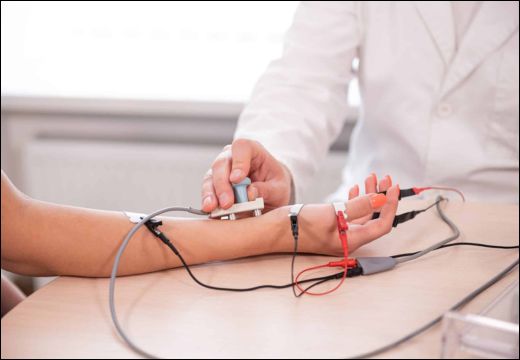
A Nerve Conduction Study (NCS) is a diagnostic medical test used to evaluate how effectively and quickly electrical signals travel through your peripheral nervous system. It is primarily used to identify nerve damage or dysfunction, helping doctors distinguish between disorders of the nerve fibers and those affecting the myelin sheath (the protective coating around nerves).During the procedure, small electrodes are placed on the skin over specific nerves. A mild electrical pulse is administered to stimulate the nerve, and the resulting activity is recorded by another electrode further down the path. By measuring the latency (speed) and amplitude (strength) of the signal, specialists can pinpoint the exact location and severity of issues like trapped nerves, compression, or systemic diseases.
What Happens During The Procedure?
During the procedure, you will typically be asked to sit or lie down in a comfortable position. The test is non-invasive and does not involve any needles (unlike the EMG portion that often follows). Here is what you can expect step-by-step:
1. Preparation
The technician or doctor will clean the skin area being tested to ensure good contact. You should avoid wearing lotions or oils on the day of the test, as these can interfere with the electrical signals.
2. Attaching Electrodes
Small metal discs (recording electrodes) are attached to your skin over the nerve or the muscle it controls using a mild adhesive or conductive paste.
3. The Stimulation
The doctor uses a handheld “stimulator” to send a brief, mild electrical pulse to the nerve. This is the part people often worry about, but it is generally described as:
- A quick “static shock” sensation (like touching a doorknob).
- A sudden, involuntary muscle twitch or “thumping” feeling.
- Mild tingling that lasts only for a fraction of a second.
4. Data Collection
The recording electrodes pick up the signal as it travels. A computer measures the distance between electrodes and the time it took for the signal to travel, calculating the “conduction velocity.”
Indications Of Nerve Conduction Study
- Peripheral Neuropathy- Especially in conditions like diabetes, nutritional deficiencies, or toxin exposure.
- Entrapment Neuropathies Such as Carpal Tunnel Syndrome and Cubital Tunnel Syndrome
- Radiculopathy like Cervical or lumbar nerve root compression (often combined with EMG).
- Guillain-Barré Syndrome (GBS) for detecting demyelination.
- Motor Neuron Disease Such as Amyotrophic Lateral Sclerosis
- Myasthenic Disorders- Including Myasthenia Gravis (with repetitive stimulation tests).
- Unexplained Symptoms
- Numbness
- Tingling
- Burning sensation
- Muscle weakness
- Muscle wasting
- Traumatic Nerve Injury To assess severity and recovery after nerve damage.
- Pre- and Post-Surgical Evaluation To evaluate nerve function before or after procedures.
Results Interpretation
Interpreting the results of a Nerve Conduction Study (NCS) involves looking at how fast and how strong the electrical signals are. Specialists primarily focus on three key measurements:
1. Conduction Velocity (Speed)
This measures how fast the electrical impulse travels along the nerve.
- Normal: The signal moves at a standard expected speed (usually 50–60 meters per second in the arms).
- Abnormal (Slow): Often indicates damage to the myelin sheath (the insulation around the nerve). This is common in conditions like Carpal Tunnel Syndrome or Guillain-Barré.
2. Amplitude (Strength)
This measures the size or “voltage” of the signal that reaches the recording electrode.
- Normal: A strong, robust wave is recorded.
- Abnormal (Low): Suggests that some of the nerve fibers (axons) are damaged or dead, or the muscle isn’t responding. This is typical of axonal loss, often seen in advanced diabetes or severe trauma.
3. Latency (Delay)
This is the time it takes for the signal to start moving after the stimulus is given.
- Increased Latency: If there is a long delay before the signal starts, it usually means there is a “bottleneck” or compression at the specific site being stimulated.
Ayurveda View
In Ayurveda, nerve-related functions and their disorders are primarily governed by Vata Dosha, specifically the sub-dosha Prana Vayu (responsible for sensory inputs) and Vyana Vayu (responsible for circulation and motor movement). Nerves are conceptualized as Majjavaha Srotas (channels of marrow and nervous tissue). Ayurveda views nerve dysfunction not just as a mechanical “pinch” or electrical delay, but as an imbalance caused by:
- Vata Vyadhi: An aggravation of the air and space elements, leading to dryness or depletion (Dhatu Kshaya) in the nerve sheath.
- Avarana: A blockage where another dosha (like Kapha or Pitta) or toxins (Ama) obstruct the natural flow of Vata, causing “short circuits” or numbness.
While a Nerve Conduction Study (NCS) measures the electrical output, Ayurveda focuses on restoring the Snigdha (unctuous/oily) quality to the nerves through therapies like Abhyanga (medicated oil massage), Basti (medicated enemas), and herbs like Ashwagandha and Brahmi to nourish the nervous system. Herbs that helps in improving Nerve functions are as follows-
Herbs That Help In Improving Nerve Functions
1. Ashwagandha (Withania somnifera)
Known as a Balya (strength-giver) and Rasayana, it nourishes the Majja Dhatu (nerve tissue). It specifically pacifies Vata, the dosha responsible for the electrical impulses of the nervous system. By providing “grounding” energy, it prevents the “drying out” of nerve fibers, which Ayurveda sees as the root of numbness and tremors. It contains withanolides, which act as potent neuroprotective agents. Research suggests Ashwagandha promotes neurite outgrowth—the regeneration of the “arms” of nerve cells (axons and dendrites). It also reduces cortisol, protecting nerves from stress-induced oxidative damage and potentially slowing the progression of neurodegenerative diseases
2. Brahmi (Bacopa monnieri)
Classified as a Medhya Rasayana, Brahmi is the premier herb for “clearing the channels.” It balances the Sadhaka Pitta (the fire of the mind) and Prana Vayu. It is used to “cool” inflamed nerves and restore the smooth flow of signals through the Srotas (channels), making it ideal for nerve-related pain or mental exhaustion. The active compounds, bacosides, facilitate the repair of damaged neurons by enhancing kinase activity. This leads to improved synaptic transmission—the speed at which a signal jumps from one nerve to the next. It is scientifically noted for its ability to increase cerebral blood flow and protect against DNA damage in neural cells
3. Shankhpushpi (Convolvulus pluricaulis)
This herb is valued for its Nidra-janak (sleep-promoting) and Majja-shoshaka (nerve-balancing) properties. It works primarily on the Manovaha Srotas (channels of the mind and nerves), reducing the “hyper-excitability” of Vata. It acts as a buffer, ensuring that the nervous system does not become “over-stimulated” or fatigued. It contains alkaloids like shankhpushpine which have demonstrated anti-convulsant and anti-anxiety effects. It works by modulating the production of GABA, a neurotransmitter that inhibits overactive nerve firing. This makes it highly effective for managing nerve disorders characterized by twitching, spasms, or chronic neural tension.
4. Jyotishmati (Celastrus paniculatus)
Also called the “Intellect Tree,” it is a powerful Ushna (heating) herb. Because of its sharp and penetrating (Tikshna) qualities, it is used to “pierce” through Ama (toxins) and Kapha blockages that cause nerve stagnation and loss of sensation. It “ignites” the nerves, restoring dormant or sluggish motor functions. Scientific studies focus on its intense antioxidant capacity. It protects the brain and peripheral nerves from lipid peroxidation (the “rusting” of fats that make up the nerve’s protective myelin sheath). Its “heating” effect translates to improved peripheral circulation, ensuring that damaged nerves receive the oxygen and nutrients required for self-repair.
5. Guggul (Commiphora mukul)
Guggul is the ultimate Lekhaniya (scraping) herb. Its primary role is to “scrape away” Ama (toxic buildup) and Medas (excess fat/congestion) that obstruct the flow of Vata in the nerves. It is the “obstruction remover” of Ayurveda, specifically indicated for conditions like Sciatica (Gridhrasi) where a physical blockage or inflammation is pinching a nerve. It contains guggulsterones, which are potent anti-inflammatory compounds. Scientifically, it works by inhibiting NF-kappaB, a protein complex that controls cytokine production and inflammation. By reducing the swelling of tissues surrounding a nerve, it relieves mechanical pressure and improves the “conduction” environment for the nerve fibers.
6. Vacha (Acorus calamus)
Vacha translates to “speech,” reflecting its power over the tongue and motor nerves. It has a Tikshna (sharp) and Ushna (heating) potency. It is used to “wake up” the nervous system, clearing the Srotas (channels) of dampness and congestion. It is particularly valued for restoring sensation in cases of numbness or “sluggish” nerve response. The active component, alpha-asarone, has been studied for its neuroprotective and anti-convulsant properties. It acts as a sodium-channel blocker in a way that stabilizes nerve membranes. Research suggests it helps in maintaining the integrity of the blood-brain barrier and peripheral nerve endings, ensuring that electrical signals remain clear and undistorted.
7. Dashmool (The “Ten Roots” Formula)
Dashmool is not a single herb but a legendary synergy of ten roots. It is the gold standard for treating severe Vata imbalances. It works as a profound Vata-Hara (Vata-destroyer), targeting the entire nervous system from the brain to the toes. It provides deep “unctuousness” to the nerves, preventing the brittle, dry state that leads to nerve degeneration. This complex formula provides a broad spectrum of phytosterols and flavonoids. Scientifically, it acts as a peripheral analgesic and anti-inflammatory powerhouse. It modulates the inflammatory response at the nerve root level. Because it contains ten different plants, it offers a multi-target approach, improving micro-circulation to the nerves while simultaneously calming the overactive pain receptors (nociceptors).
Conclusion
In conclusion, the health of our nervous system is a delicate balance between structural integrity and electrical efficiency. While a Nerve Conduction Study (NCS) provides the essential “diagnostic map” by pinpointing physical damage and measuring signal speed, Ayurveda offers the “restorative fuel” to heal those very pathways. By integrating the objective precision of modern testing with the profound, nourishing power of herbs like Ashwagandha, Brahmi, and Dashmool, we can move beyond mere symptom management toward true neural regeneration. This holistic approach ensures that the body’s internal symphony remains in harmony, restoring both sensation and strength to our “living wires.”