


Ophiorrhiza Mungos Linn. / Sarpakshi / Gandhanakuli / Polygonum Plebejum R. Br. – Ayurvedic Properties, Indications, Uses, Benefits & Dosage
Abstract
Ophiorrhiza mungos L., an Ayurvedic herb belonging to the family Rubiaceae, is commonly known as the “Mongoose plant.” It holds ethnobotanical significance due to the presence of camptothecin, a potent natural bioactive compound. The genus Ophiorrhiza is recognised as a valuable natural source of camptothecin with diverse biological activities. Camptothecin is a cytotoxic quinoline indole alkaloid that serves as a precursor for important anticancer drugs such as irinotecan and topotecan. O. mungos contains comparatively high levels of this compound, enhancing its medicinal importance. Despite its therapeutic potential, the plant is currently considered endangered, highlighting the need for conservation and further research.
Classical References Of Ophiorrhiza Mungos Linn./ Sarpakshi/ Gandhanakuli
Bhavprakash Nighantu Guduchyadi varga
Scientific Classification Of Ophiorrhiza Mungos Linn./ Sarpakshi/ Gandhanakuli
- Kingdom: Plantae
- Order: Gentianales
- Family: Rubiaceae
- Genus: Ophiorrhiza
- Species: Ophiorrhiza mungos L.
Synonym Of Ophiorrhiza Mungos Linn./ Sarpakshi/ Gandhanakuli
- Gandali – Refers to a plant with a noticeable odour or medicinal aroma.
- Nadikalaapaka – Indicates a plant growing near streams or water channels.
- Kshirapushpika – Means “milky-flowered,” suggesting whitish flowers or latex presence.
- Sukshmapatratara – Describes the plant having very small or fine leaves.
- Mahasughada – Implies strong fragrance or notable medicinal potency.
- Suvaha – Suggests good therapeutic action or easy absorption in the body.
- Gandanakuli – Traditionally linked with mongoose association or snake-bite relevance.
- Nakuleshta – Means “liked by mongoose,” reflecting folklore about snake protection.
- Chatraki – Indicates umbrella-like spreading growth or canopy form.
- Vishamardini – Means “destroyer of poison,” especially used in toxic conditions.
- Phanihantri – Literally “snake destroyer,” highlighting anti-venom reputation.
- Nakuladya – Associated with the mongoose or its protective symbolism.
- Ahimardini – Means “subduer of snakes/poison.”
- Mahahiganda – Refers to strong anti-toxic or medicinal odour properties.
- Ahilata – Suggests a creeping plant associated with snake habitats.
Vernacular Names Of Ophiorrhiza Mungos Linn./ Sarpakshi/ Gandhanakuli
- English: Indian Snake Root, Mongoose Plant
- Sanskrit: Sarpakshi, Sarpari
- Hindi: Sarhati
- Tamil: Kirippuntu, Kirippurantan
- Kannada: Garuda Paathaala, Bili Garuda Paathaala, Patalagaruda
- Telugu: Sarpaakshi Chettu, Sarpaari Chettu
- Malayalam: Avlipori, Chembajarinjil, Pera-aratha
- Marathi: Mungusvela, Nagvelli
- Bengali: Gandha-nakuli, Sarpakshi
- Kuki: Chak-lambi
- Malay (Malaysia): Pokok Sumpu Badak
- Tagalog (Philippines): Payang-payang-gubat
- Bagobo (Philippines): Kayotimokan
- Bikol (Philippines): Lumai
Habitat Of Ophiorrhiza Mungos Linn./ Sarpakshi/ Gandhanakuli
Ophiorrhiza mungos Linn. commonly grows in moist, shady, and humid environments, particularly in the undergrowth of tropical forests. It is often found on forest floors, near stream banks, and in lowland or mountainous forest regions where humidity remains high. The plant is widely distributed across India, especially in the Western Ghats, North-Eastern regions, and the Andaman and Nicobar Islands, and also occurs in other tropical parts of Asia, including Sri Lanka and nearby islands.
Morphology Of Ophiorrhiza Mungos Linn./ Sarpakshi/ Gandhanakuli
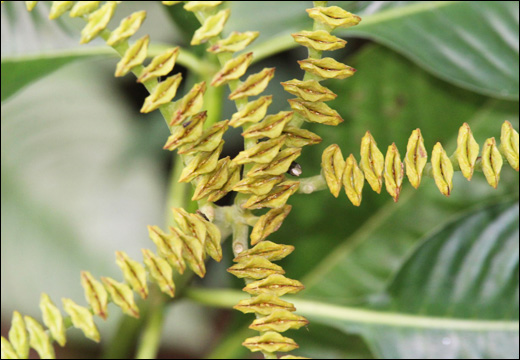
Ophiorrhiza mungos Linn. (family Rubiaceae) is a perennial herbaceous plant or sub-shrub, usually erect or sometimes slightly spreading, commonly growing up to about 30 cm–1 m in height in tropical regions. The stem is slender, smooth, green to brownish-green, often somewhat succulent and occasionally woody at the base. Leaves are simple, opposite, elliptic-lanceolate to ovate, typically 5–15 cm long with short petioles, entire margins, acuminate apex, and attenuated base; interpetiolar stipules are present and persistent, a characteristic feature of the Rubiaceae family. The inflorescence consists of terminal or axillary cymes that may appear dense and slightly hairy. Flowers are small, tubular or funnel-shaped, usually white or greenish-white (sometimes tinged with purple), with a 5-lobed corolla and very short calyx teeth. The fruit is a small, laterally compressed, bilobed capsule that splits loculicidally when mature, containing numerous minute, angular or rhomboid seeds. The root system is generally stout, woody, and brownish, often spreading in moist forest soils.
Special Note
Specifically, Sarpakshi is not considered a completely well-defined or undisputed drug. Among the substances taken under the name Rasna, some scholars have identified Ophiorrhiza mungos as Sarpakshi, while others have considered Polygonum plebejum to be Sarpakshi. The terms Sarpakshi and Meenakshi are also mentioned as synonyms of Durva. Dalhana, in Kalpasthana Chapter 6, described it as “Raktapushpa, well-known in the eastern regions,” and in Chapter 8–117 as “Lohitapushpa, a variety of Shankhapushpi.” This suggests a red-flowered variety of Shankhapushpi (Convolvulus pluricaulis) found in eastern India. Some scholars have also described it along with Bengali Brahmi.
Classical Categorisation Of Ophiorrhiza Mungos Linn./ Sarpakshi/ Gandhanakuli
- According to Kaiyadeva Nighantu: Aushadhi Varga
- According to Bhavprakash Nighantu: Guduchyadi varga
- According to Raj Nighantu: Mulakadi varga
- According to Dhanvantari Nighantu: Karveeradi Varga
- According to Shodala Nighantu: Karveeradi Varga
Ancient Verse Of Ophiorrhiza Mungos Linn./ Sarpakshi/ Gandhanakuli
सर्पाक्षी स्यात्तु गण्डाली तथा नाडीकलापकः ॥
सर्पाक्षी कटुका तिक्ता सोष्णा कृमिनिकृन्तनी ।
वृश्चिकोन्दुरुसर्पाणां विषघ्नी व्रणरोपिणी ॥ (Bhavprakash Nighantu Guduchyadi varga 267-268)
According to the above shloka, Sarpakshi is also known by the names Gandali and Nadikalaapaka. It possesses pungent (Katu) and bitter (Tikta) taste, with hot potency (Ushna Virya). It is considered helpful in wound healing, acts as an anthelmintic (destroys worms), and is traditionally believed to help neutralise poisons from scorpions, rodents, and snakes.
अन्या महासुगन्धा च सुवहा गन्धनाकुली ।
सर्पाक्षी नकुलेष्टा च च्छत्राकी विषमर्दिनी ॥
सर्पाक्षी कटुका तिक्ता तथा च कृमिरोगजित् ।
वृश्चिकोद्भवसर्पादिविषघ्नी व्रणरोपणी ॥ (Dhanvantari Nighantu Karveeradi varga 93-94)
According to the above shloka, Sarpakshi is known by various synonyms such as Mahasugandha, Suvaha, Gandhanakuli, Sarpakshi, Nakulesta, Chatraki, and Vishamardini. It is described as having a pungent and bitter taste with important therapeutic properties, including anthelmintic and styptic actions. Traditionally, it is also considered beneficial in the management of scorpion stings and snake poisoning.
Ayurvedic Properties Of Ophiorrhiza Mungos Linn./ Sarpakshi/ Gandhanakuli
- Taste (Rasa)– Bitter (Tikta), Pungent (Katu)
- Potency (Veerya)- Hot Potency (Usna)
Therapeutic Indications Of Ophiorrhiza Mungos Linn./ Sarpakshi/ Gandhanakuli
- Krimi: Worm infestation or infection
- Visha: Toxic condition or poisoning
- Scorpion Bite: used in managing scorpion stings
- Rat Bite: for toxic bite conditions
- Snake Bite: helpful in snake poisoning
- Wound/Ulcer: Used for wound healing and ulcer management
Systemic Actions Of Ophiorrhiza Mungos Linn./ Sarpakshi/ Gandhanakuli
- Digestive System: It is effective in the management of indigestion and diarrhoea.
Chemical Composition Of Ophiorrhiza Mungos Linn./ Sarpakshi/ Gandhanakuli
- Alkaloids: Camptothecin (major anticancer alkaloid), 10-methoxycamptothecin, pumiloside, harman, tetrahydroalastonine, bracteatine, blumeanine, strictosidinic acid, lyalosidic acid.
- Flavonoids: Luteolin and luteolin-7-O-glucoside (reported antioxidant, anti-inflammatory, and protective properties).
- Phytosterols: Including β-sitosterol found in leaves.
- Carbohydrates, Fixed Oils & Fats: General biochemical constituents.
- Hydrocyanic Acid: Reported in leaves and stems.
- Resin & Starch: Roots contain starch and light brown resin.
Actions And Properties Of Various Chemical Constituents Of Ophiorrhiza Mungos Linn./ Sarpakshi/ Gandhanakuli
Cytotoxic Activity
Ophiorrhiza mungos is known for its significant anticancer potential mainly due to the presence of the monoterpene indole alkaloid camptothecin (CPT), a potent cytotoxic compound found in comparatively high amounts in its roots and aerial parts. This plant and its varieties, such as O. mungos var. angustifolia, are considered sustainable natural sources of CPT. Camptothecin acts by inhibiting the DNA topoisomerase-I enzyme, thereby interfering with DNA replication and ultimately suppressing cancer cell growth. Its derivatives, including irinotecan and topotecan, are widely used in modern chemotherapy for conditions like ovarian and lung cancers. Other constituents, such as 10-methoxycamptothecin, luteolin-7-O-glucoside, contribute to anticancer, antioxidant, and chemopreventive activities. These compounds primarily work by blocking DNA replication in rapidly dividing cancer cells through inhibition of topoisomerase-I. This disruption causes DNA damage and triggers apoptosis (programmed cell death). Antioxidant flavonoids help reduce oxidative stress, which is linked to cancer progression. Certain alkaloids also scavenge reactive oxygen species and may slow tumour growth.
Anthelmintic Activity
Ophiorrhiza mungos is recognised for its anthelmintic potential due to the presence of diverse phytochemicals, particularly the alkaloid camptothecin, along with other alkaloids, glycosides, flavonoids, and triterpenes. Camptothecin, mainly found in roots and leaves, exhibits cytotoxic and antiparasitic properties that may help control worm infestations. Other alkaloids such as tetrahydroalastonine, bracteatine, and strictosidinic acid are also believed to support antiparasitic activity. Flavonoids like luteolin-7-O-glucoside contribute antioxidant and anti-inflammatory effects, while traces of hydrocyanic acid in leaves and stems may enhance anthelmintic action. These compounds are thought to interfere with parasite metabolism, inhibit their growth, and create unfavourable conditions for their survival. They may also reduce inflammation caused by infestation and support intestinal health. Together, these actions explain the traditional use of Ophiorrhiza mungos in managing worm infestations.
Antivenom Activity
Ophiorrhiza mungos (Indian Snake Root) is used for managing snake, scorpion, and rat poisoning due to its rich phytochemical content, especially camptothecin and related indole alkaloids, along with phenolics, flavonoids, tannins, and saponins. These compounds exhibit anti-inflammatory, antioxidant, and toxin-neutralising properties that support their ethnomedicinal importance. Camptothecin-type alkaloids are considered major contributors to anti-venom activity, while phenolic compounds and flavonoids help reduce oxidative stress caused by toxins. Some studies suggest that root extracts may inhibit venom enzymes such as proteases and phospholipases, thereby reducing tissue damage. Traditionally, fresh root paste has been applied externally for bites and stings to ease pain and inflammation. Tannins may act as astringents to counter toxic effects locally, while saponins provide soothing support to affected tissues. Overall, these combined actions explain its traditional role in poison management.
Practical Uses / Health Benefits Of Ophiorrhiza Mungos Linn./ Sarpakshi/ Gandhanakuli
- Decoction of roots, leaves, and bark is traditionally used as a stomachic to improve digestion.
- Plant decoction is taken in indigestion, diarrhoea, and to enhance appetite.
- Leaf paste is applied externally for dressing wounds, ulcers, and skin eruptions.
- Bruised roots are used as a topical application for cutaneous disorders.
- Root preparations are traditionally used in toxic bites such as snake, scorpion, and rat bites.
- The whole plant is used traditionally as a bitter tonic in some folk practices.
- Flowers are sometimes used traditionally as a stimulant and cardiac tonic in rheumatic conditions.
- Root preparations have been mentioned in traditional medicine for conditions like cancer and leprosy.
Parts Used Of Ophiorrhiza Mungos Linn./ Sarpakshi/ Gandhanakuli
- Root
- Leaves
- Bark
Conclusion
Ophiorrhiza mungos is an important medicinal herb of the Rubiaceae family valued in traditional Ayurveda and ethnomedicine for its diverse therapeutic properties. It contains significant bioactive compounds, particularly camptothecin and other alkaloids, which contribute to its anticancer, antiparasitic, anti-inflammatory, and anti-venom potential. Traditionally, it has been used for managing poisonings, worm infestations, digestive disorders, wounds, and various chronic ailments. Despite its medicinal importance, the plant is considered endangered in some regions, highlighting the need for conservation and further scientific research. Overall, Ophiorrhiza mungos holds promising pharmacological potential with both traditional and modern medicinal relevance.
Frequently Asked Questions (FAQ’s)
1. What are the uses of Ophiorrhiza mungos?
It is traditionally used for managing snake/scorpion bites, worm infestations, wounds, digestive issues, and for its potential anticancer properties.
2. What is the common name of Ophiorrhiza mungos?
Its common names include Mongoose Plant and Indian Snake Root.
3. What is the Tamil name of Ophiorrhiza mungos?
The Tamil name is Kirippuntu or Kirippurantan.
4. What is the Malayalam name of Ophiorrhiza mungos?
It is known as Avlipori or Chembajarinjil in Malayalam.
5. What is the family name of Ophiorrhiza mungos?
It belongs to the Rubiaceae family.