


Osteoma – Causes, Symptoms, Treatment & Herbal Remedies
Abstract
Non-malignant bone lesions constitute an important group of skeletal disorders characterized by slow growth, localized behavior, and absence of metastatic potential. These conditions arise from abnormalities in bone remodeling, maturation, or reactive processes rather than uncontrolled malignant transformation. Benign bone tumors often remain asymptomatic and are frequently detected incidentally during imaging for unrelated conditions, although larger lesions may cause pain, deformity, or functional limitation due to local pressure effects. Among these, osteoma is composed of well-differentiated mature bone and most commonly involves the craniofacial skeleton. In this article we shall discuss Osteoma in detail and the management of the same in the modern medicinal system and Indian traditional medicinal system of Ayurveda.
Introduction
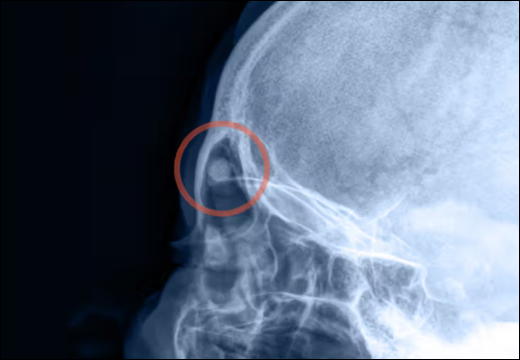
An osteoma is a benign (noncancerous) bone tumor characterized by the growth of mature bone tissue. It typically arises on the surface or within the bone and demonstrates extremely slow expansion over time. While osteomas can occur anywhere in the skeleton, they are most commonly detected in the craniofacial bones, especially the skull and paranasal sinuses. Unlike malignant bone tumors, osteomas do not metastasize or invade surrounding structures aggressively, but they can sometimes produce symptoms depending on their size and location.
Epidemiology And Classification
Osteomas are relatively rare tumors among all benign bone lesions. They are more frequently seen in adults, often identified incidentally during radiographic imaging for unrelated conditions. Craniofacial osteomas are particularly well documented, accounting for a significant proportion of benign neoplasms in this region.
Based on anatomical location and origin, osteomas are classified into three major types:
- Peripheral Osteoma: Arises from the periosteum (outer bone layer) and grows outward.
- Central Osteoma: Originates from the endosteum (inner bone surface).
- Extraskeletal Osteoma: Develops within soft tissues rather than within bone itself.
Microscopically, osteomas may be composed of dense compact bone, spongy cancellous bone, or a mixture of both.
Clinical Features
Most osteomas are asymptomatic, meaning they cause no symptoms and are discovered incidentally on X-rays or CT scans. When osteomas reach a size or location that impinges on adjacent structures, clinical features depend on the affected area:
- Craniofacial Osteomas: As these grow in the skull or paranasal sinuses, they may lead to facial pain, sinus obstruction, headache, or ocular symptoms such as pressure or proptosis (forward displacement of the eye).
- Mandibular Osteomas: Growths in the jawbone may cause difficulty opening the mouth or facial asymmetry.
- Temporal/Mastoid Osteomas: Lesions in or around the ear region can lead to cosmetic deformity, hearing difficulties, or local discomfort.
- Extraskeletal Osteomas: Rare lesions can present as firm masses beneath the skin, occasionally producing discomfort due to size or pressure effects.
Because most lesions are slow growing, symptoms — if present — often develop gradually over months or years.
Diagnostic Evaluation
Imaging
- X-Ray
- Computed Tomography (CT)
- Magnetic Resonance Imaging (MRI)
- Histopathology
Management And Treatment
The treatment strategy for osteoma depends on symptoms, location, and potential complications:
Conservative Management
- Asymptomatic Osteomas: Small lesions that do not cause pain or functional problems are often observed with periodic imaging. No active treatment is required unless changes occur.
- Symptom Monitoring: Follow-up scans every 6–12 months may be appropriate to monitor slow growth.
Surgical Intervention
Surgical removal is recommended when the osteoma:
- Causes pain or functional impairment (e.g., difficulty chewing, blocked sinuses).
- Leads to cosmetic deformities (e.g., visible skull/jaw prominences).
- Is positioned where it compresses adjacent nerves or important structures.
Ayurvedic Perspective On Osteoma
In Ayurveda, osteoma does not appear as a direct disease entity; however, its clinical presentation can be understood through the principles of Asthi-gata Vikara, Granthi, and Asthi Vriddhi. Osteoma is a benign, slow-growing, hard bony mass, most often painless and localized, which aligns closely with Kapha-dominant pathology involving Asthi Dhatu (bone tissue). The stable, dense, immobile, and gradually enlarging nature of the lesion reflects classical Kapha attributes, while associated stiffness or functional limitation indicates secondary Vata involvement.
Dosha Involvement
The primary Dosha involved in osteoma is Kapha, which governs structure, solidity, and tissue growth. When Kapha becomes excessive or localized, it promotes abnormal accumulation of tissue, resulting in hard nodular growths. Vata Dosha, which controls movement and tissue metabolism, becomes disturbed due to obstruction caused by Kapha, leading to improper bone remodeling. Pitta Dosha generally plays a minimal role, but when involved, it may contribute to mild inflammation or irritation around the lesion.
Thus, osteoma can be understood as a Kapha-Vata predominant Asthi disorder, with Kapha initiating abnormal growth.
Dhatu And Srotas Pathology
Osteoma primarily affects Asthi Dhatu (bone tissue), whose normal function is to provide structure, strength, and protection. Improper nourishment or metabolic imbalance at the Asthi level leads to excessive and unregulated bone formation. The condition may also involve Mamsa Dhatu when surrounding soft tissues are compressed.
From a Srotas perspective, Asthi Vaha Srotas are affected due to Srotorodha (channel obstruction) caused by Kapha accumulation and Ama deposition. This obstruction disrupts normal bone metabolism, allowing localized overgrowth rather than uniform remodeling.
Role Of Agni And Ama
A key Ayurvedic factor in the development of osteoma is Mandagni (low digestive and tissue metabolic fire). When Agni is impaired, digestion and assimilation become incomplete, leading to the formation of Ama, a toxic by-product of faulty metabolism. Ama has a heavy, sticky, and obstructive nature, similar to Kapha, and tends to accumulate in structurally dense tissues such as bone. Over time, Ama lodged in Asthi Dhatu contributes to abnormal growths like Granthi.
Samprapti (Pathogenesis)
The Ayurvedic pathogenesis of osteoma begins with chronic Kapha aggravation due to improper diet, sedentary habits, or metabolic weakness. Kapha accumulates in Asthi Dhatu and obstructs Asthi Vaha Srotas. Vata, unable to move freely due to this obstruction, becomes vitiated and fails to regulate bone metabolism. Simultaneously, Ama deposition further impairs tissue metabolism. This triad of Kapha accumulation, Vata dysfunction, and Ama involvement results in a slow-growing, hard, localized bony mass, characteristic of osteoma.
Clinical Correlation With Ayurvedic Lakshanas
Clinically, osteoma exhibits features consistent with Kapha-dominant Granthi (nodules). The swelling is hard, immobile, painless, and gradually increasing in size. When located near joints or functionally important areas, Vata involvement manifests as stiffness, restricted movement, or discomfort. Systemic symptoms are usually absent, reflecting the localized nature of the pathology.
Ayurvedic Approach To Management
Ayurvedic management of osteoma focuses on Dosha pacification, correction of Agni, elimination of Ama, and normalization of Asthi Dhatu metabolism. Since osteomas are benign and slow-growing, the emphasis is placed on conservative, supportive therapy unless functional impairment exists.
Internal herbal therapy aims to pacify Kapha and Vata while strengthening Asthi Dhatu (bone tissue). Herbs such as Guggulu (Commiphora mukul) are traditionally used for their Kapha-reducing and Granthi-resolving properties. Ashwagandha (Withania somnifera) supports bone metabolism and counters Vata imbalance. Haridra (Curcuma longa) helps reduce localized stagnation and inflammation, while Eranda (Ricinus communis) supports channel cleansing and Vata regulation.
External therapies play a supportive role by improving local circulation and reducing stiffness. Abhyanga with Vata-Kapha pacifying oils, followed by gentle fomentation, helps maintain tissue flexibility and prevents secondary Vata complications. In cases of systemic Vata involvement, Basti therapy is considered the most effective Panchakarma intervention, as it directly regulates Vata and improves Dhatu nourishment. In this condition vaman (medicated emesis) is also indicated.
Dietary and Lifestyle Considerations
Dietary regulation is essential in preventing further Kapha accumulation. Light, warm, and easily digestible foods are recommended, while heavy, oily, cold, and processed foods are discouraged. Maintaining regular digestion, avoiding overeating, and incorporating mild physical activity help preserve normal tissue metabolism. Avoidance of repeated trauma to the affected area is also advised.
Herbal Remedies For Osteoma By Planet Ayurveda
Planet Ayurveda is a well-known Ayurvedic healthcare brand dedicated to promoting natural healing through authentic, herbal-based formulations rooted in classical Ayurvedic principles. The organization focuses on combining traditional wisdom with modern quality standards to develop products that support holistic wellness and long-term health. Emphasis is placed on the use of pure, plant-based ingredients, free from harmful chemicals, preservatives, and additives. Planet Ayurveda follows a patient-centered approach, aiming to address the root cause of health concerns by balancing Doshas and strengthening bodily systems. Its range of herbal formulations is widely used for preventive care as well as supportive management of chronic health conditions. Planet Ayurveda is pleased to express its list of products that are effective in the management of Osteoma.
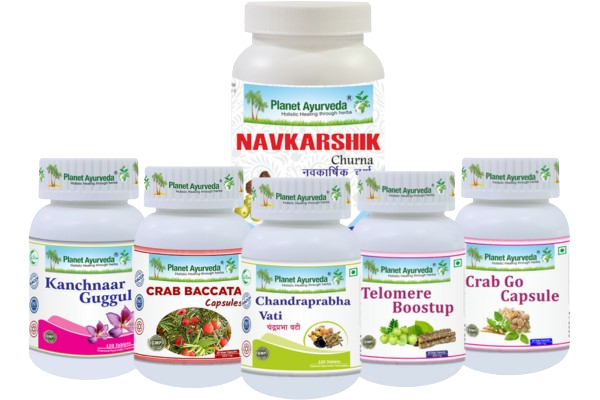
Product List
- Kanchnaar Guggul
- Crab Baccata Capsules
- Crab Go Capsule
- Chandraprabha Vati
- Telomere Boostup
- Navkarshik Churna
1. Kanchnaar Guggul
Kanchnaar Guggul is a classical ayurvedic medicine with main herbs Kanchnar (Bauhinia variegata) and Guggulu (Commiphora mukul) in it. The herbs are known for anti-inflammatory, antioxidant, and antiproliferative properties, which are relevant to managing abnormal tissue growths. Commiphora mukul resin contains compounds such as guggulsterones, terpenoids, and phenolic constituents that demonstrate anti-inflammatory effects by inhibiting lipid peroxidation and cyclooxygenase activity, which helps reduce chronic inflammation and tissue irritation. These actions are beneficial in conditions with localized growth or congestion of tissues. Altogether, Kanchnaar Guggulu exhibits cytotoxic and antiproliferative activity by inhibiting cell division and cell proliferation, effects attributed to its flavonoids and phenolic compounds, supporting its traditional use in managing various tumors and nodular lesions. Kanchnaar Guggul is one of the best herbal medicines that is really effective in the management of Osteoma.
Dosage : Two tablets twice a day.
2. Crab Baccata Capsules
Crab Baccata Capsules are a product of Planet Ayurveda derived from Taxus baccata, a herb valued for its anti-inflammatory and tissue-normalizing properties. The herb contains active compounds such as taxol (paclitaxel), which modern research has shown to influence cell division and promote healthy tissue regulation. Its anti-inflammatory effects help reduce localized tissue congestion and support normal bone metabolism. It is used to manage conditions associated with Kapha accumulation and channel obstruction, which conceptually corresponds to slow-growing bony nodules like osteoma. By balancing Doshas and improving tissue circulation, Crab Baccata Capsules serve as a supportive therapy in the holistic management of osteoma.
Dosage : One capsule twice a day.
3. Crab Go Capsule
Crab Go Capsule is an Ayurvedic formulation designed by Planet Ayurveda to support healthy tissue function and manage uncontrolled tissue growth. It contains herbal ingredients such as ashwagandha (Withania somnifera), shatavari (Asparagus racemosus), giloy (Tinospora cordifolia), tulsi (Ocimum tenuiflorum), haridra (Curcuma longa) and others. These ingredients help balance Kapha and Vata doshas, reduce tissue congestion, and promote normal bone metabolism. These herbs are known for their anti-inflammatory, detoxifying, and tissue-regulating properties, which assist in improving circulation and clearing stagnation in deep tissues, a concept important in Ayurveda for managing Asthi Granthi (bone nodules). By supporting the body’s natural metabolic and regenerative processes, Crab Go Capsule serves as a supportive therapy for maintaining bone health and controlling abnormal localized growths.
Dosage : Two capsules twice a day.
4. Chandraprabha Vati
Chandraprabha Vati is a classical Ayurvedic formulation known for its detoxifying, anti-inflammatory, and tissue-regulating properties. The product has a number of ingredients such as haridra (Curcuma longa), chavya (Piper chaba), Shilajit (Asphaltum), Karpoor (Cinnamomum camphora), Vacha (Acorus calamus), Mustak (Cyperus rotundus), Vidanga (Embelia ribes), pippali (Piper longum), dalchini (Cinnamomum zeylanicum), Shunthi (Zingiber officinalis) and others. In the context of osteoma, Chandraprabha Vati helps reduce Kapha accumulation and Ama (toxic metabolic by-products), supporting proper tissue metabolism and circulation in the bone and surrounding areas. Its combination of herbal and mineral ingredients works synergistically to maintain Dosha balance, improve detoxification, and aid in the management of localized swelling and stiffness associated with slow-growing bony growths. As a result, it serves as a supportive therapy in the holistic management of osteoma.
Dosage : Two tablets twice a day.
5. Telomere Boostup
Telomere Boostup is an Ayurvedic herbal formulation designed by Planet Ayurveda to support cellular health, tissue regeneration, and healthy aging. The formulation is enriched with herbs such as ashwagandha (Withania somnifera), grapeseed (Vitis vinifera), amla (Emblica officinale), shigru (Moringa oleifera) and others. In the management of osteoma, this formulation helps enhance cellular metabolism and maintain the integrity of bone tissue. By promoting antioxidant activity and reducing oxidative stress at the cellular level, Telomere Boostup assists in stalling abnormal tissue accumulation and supporting normal bone remodeling. Its properties help balance Doshas, improve circulation, and strengthen Asthi Dhatu (bone tissue), making it a valuable supportive therapy in holistic osteoma management.
Dosage : One capsule twice a day.
6. Navkarshik Churna
Navkarshik Churna is a product of Planet Ayurveda. It is renowned for its detoxifying and Kapha-balancing properties. In the management of osteoma, it helps eliminate Ama (toxic metabolic by-products) from the body and improves circulation in deep tissues, which supports normal bone metabolism. Its ingredients namely manjishtha (Rubia cordifolia), kutki (Picrorrhiza kurroa), daruhaldi (Berberis aristata), giloy (Tinospora cordifolia), neem (Azadirachta indica), vacha (Acorus calamus) and others possess anti-inflammatory, blood-purifying, and tissue-regulating effects, aiding in the reduction of congestion and stagnation that contribute to abnormal tissue accumulation. By promoting systemic detoxification and maintaining Dosha balance, Navkarshik Churna acts as a supportive therapy in the holistic management of osteoma.
Dosage : Half tsp twice a day.
Conclusion
Osteoma is a benign, slow-growing bone tumor with an excellent prognosis, often requiring minimal intervention unless it leads to functional impairment or cosmetic concerns. Accurate diagnosis through imaging and careful clinical monitoring remain the cornerstone of modern management, with surgical excision reserved for symptomatic cases. From an Ayurvedic standpoint, osteoma can be understood as a Kapha-Vata predominant Asthi-gata Granthi, arising due to impaired Agni, Ama accumulation, and obstruction of Asthi Vaha Srotas. Ayurveda emphasizes a holistic approach that focuses on correcting underlying Dosha imbalance, improving digestion and tissue metabolism, and supporting Asthi Dhatu health through herbal formulations, Panchakarma therapies, and lifestyle modifications. The integrative use of classical Ayurvedic remedies alongside modern diagnostic and surgical practices offers a comprehensive and patient-centered strategy, aiming not only at symptom control but also at long-term stabilization and overall skeletal well-being. Planet Ayurveda’s above-mentioned products are indeed helpful in the management of Osteoma.