


Pinus longifolia Roxb./ Pinus roxburghii Sarg./ Saral/ Chir Pine/ Long Leaved Pine/ Oleo-resin of Pinus longifolia/ Oleo-resin of Pine/ Saral Niryasa – Medicinal Properties, Benefits & Dosage
Abstract
Pinus roxburghii Sarg. (family Pinaceae), commonly known as chir pine, is a tall, evergreen conifer native to the Himalayan region, extending from northern Pakistan and Afghanistan through northern India, Nepal, and Bhutan. The species typically grows at lower Himalayan elevations between 500 and 2000 meters, occasionally reaching up to 2300 meters. It is characterised by a broad, spreading crown and exhibits uniform morphological features across its geographical range, indicating low variability. Chir pine is closely related to Pinus canariensis, Pinus brutia, and Pinus pinaster. The tree yields a clear, pungent oleo-resin upon tapping, from which turpentine oil and rosin (colophony) are obtained through distillation. These products have significant industrial applications, including use in the manufacture of fireworks, insecticides, disinfectants, lubricants, hair-fixing agents, and nail-polishing preparations. In addition to its economic importance, P. roxburghii is also cultivated as an ornamental species.
Classical References Of Pinus Longifolia Roxb./ Pinus Roxburghii Sarg./ Saral/ Chir Pine/ Long Leaved Pine
- Bhavprakash Nighantu Karpooradi varga
- Raj Nighantu Chandanadi varga
Scientific Classification Of Pinus Longifolia Roxb./ Pinus Roxburghii Sarg./ Saral/ Chir Pine/ Long Leaved Pine
- Kingdom: Plantae
- Division: Pinophyta
- Class: Pinopsida
- Order: Pinales
- Family: Pinaceae
- Genus: Pinus
- Species: roxburghii
- Binomial Name: Pinus roxburghii Sarg.
Other Botanical / Synonym Names
- Pinus longifolia Roxb.
Synonym Of Pinus Longifolia Roxb./ Pinus Roxburghii Sarg./ Saral/ Chir Pine/ Long Leaved Pine
- Pita Vruksha – Refers to the yellow-colored heartwood.
- Peetadaru – Means yellow wood, indicating timber colour.
- Siddadaru – Denotes wood considered medicinally effective.
- Maricha Patraka / Maarichapatraka – Indicates a pepper-like aroma of leaves or resin.
- Deepa Vruksha – Suggests a tree that burns well and gives light, used as fuel.
- Uchrita – Describes the tall and upright growth of the tree.
- Cheeda – Regional North Indian name for chir pine.
- Kalidruma – Refers to the dark appearance of the trunk.
- Nameru – Indicates hard, strong wood.
- Nandana – Implies an ornamental and pleasing tree.
- Suradaru / Sudaru – Means excellent or superior quality wood.
- Surabhi Daruka – Refers to the pleasant aromatic nature of the wood or resin.
- Pootidaru – Indicates the strong, penetrating odour of the stem.
- Pooti Kashta – Means wood with a distinct smell.
- Snigdha Daru – Refers to the oily, resin-rich wood.
- Plihari – Indicates usefulness in splenic disorders.
- Shreevas – Refers to fragrant resin exudate.
- Saralsrava – Indicates resin flow from the tree.
- Shreeveshta – Refers to resin-coated bark or wood.
- Vrikshdhoopaka – Indicates use of wood or resin as a fumigant or incense.
Vernacular Names Of Pinus Longifolia Roxb./ Pinus Roxburghii Sarg./ Saral/ Chir Pine/ Long Leaved Pine
- Sanskrit: Bhadradaru, Manojna
- English: Chir Pine, Long-leaved Pine
- Hindi: Chida, Saral, Chil, Chir, Salla
- Bengali: Saralgachha
- Gujarati: Saraladeodara
- Kannada: Sarala
- Malayalam: Charalam, Salla
- Marathi: Chilgoza
- Tamil: Simaidevadari
- Telugu: Devadaru
Habitat Of Pinus Longifolia Roxb./ Pinus Roxburghii Sarg./ Saral/ Chir Pine/ Long Leaved Pine
Chir pine is a tall tree with a broad, spreading crown, naturally distributed across the Himalayan region from Kashmir to Bhutan. It grows predominantly in the outer Himalayan hills, Siwalik ranges, and adjoining valleys at elevations between 450 and 2,400 meters, areas that receive substantial monsoon rainfall. The species adapts fairly well to plains and is occasionally cultivated as an ornamental tree in gardens. Chir pine is the most prominent pine species of the north-western Himalayas and is highly valued for its resin and timber. In India, it is chiefly found in Himachal Pradesh, Jammu & Kashmir, and Uttarakhand.
Morphology Of Pinus Longifolia Roxb./ Pinus Roxburghii Sarg./ Saral/ Chir Pine/ Long Leaved Pine
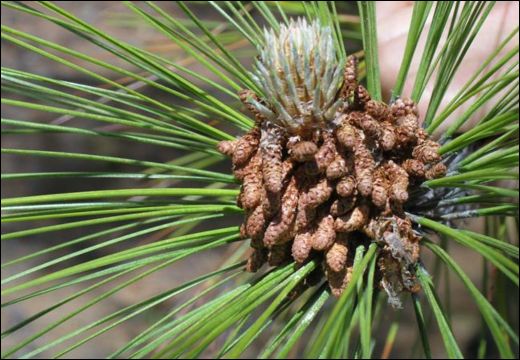
Chir pine is a large, evergreen tree attaining a height of about 30–50 m, with a trunk diameter commonly up to 2 m and occasionally reaching 3 m. The bark is reddish-brown, thick, and deeply fissured near the base, becoming thinner and flaky toward the upper crown. The leaves are needle-like, borne in fascicles of three, very slender, measuring 20–35 cm in length, and show a characteristic yellowish-green colour. The fruit consists of ovoid-conical cones, initially green, measuring 12–24 cm long and 5–8 cm wide at the base when closed, which mature into a glossy chestnut-brown after about 24 months. These cones gradually open over the following year to a width of 9–18 cm, releasing winged seeds that are 8–9 mm long with a wing of about 40 mm, enabling dispersal by wind.
Varieties Of Pinus Longifolia Roxb./ Pinus Roxburghii Sarg./ Saral/ Chir Pine/ Long Leaved Pine
About four to five species of this genus are found in India, among which Pinus excelsa Wall., locally known as Kail in the Garhwal region, and Pinus khasya Royle are the most important. The subspecies Pinus excelsa (commonly called Chil or Kail) occurs at altitudes between 2,000 and 3,000 meters in Uttar Pradesh and Jammu & Kashmir. Its leaves are bluish-green in colour and are arranged in clusters of five to six needles per fascicle. The cones are grouped and cylindrical in shape, and the tips of the seed-bearing scales are not very thickened.
Special Note
From the sapwood of the tree, a resinous exudate oozes out naturally or on injury and solidifies into a substance known as Gandhabiroja. Initially, it appears whitish and semi-fluid, gradually becoming thicker and turning yellow to deep yellow, while remaining sticky, soft, and strongly aromatic; Pinus excelsa yields a smaller quantity of resin, though of superior quality. When Gandhabiroja is heated without water in an upward distillation apparatus, a thick reddish oil called Khattu oil or Satbiroja is obtained, which retains the characteristic aroma of the resin. For internal use, the resin is purified by gently heating it over a vessel containing equal parts of milk and water, allowing the purified resin to drip through a cloth and solidify. Distillation of Gandhabiroja with steam yields a colourless oil known as turpentine oil, with approximately 8 pounds of oil obtained from 56 pounds of resin. The remaining residue after oil extraction is termed resin or colophony, which, on processing with boiling water, forms a dark, honey-like substance known as Gandhabiroja damar, comparable to European Burgundy pitch.
Classical Categorisation Of Pinus Longifolia Roxb./ Pinus Roxburghii Sarg./ Saral/ Chir Pine/ Long Leaved Pine
- According to Charak Samhita: Pureesha Virajaneeya Gana
- According to Sushruta Samhita: Eladi Gana.
- According to Vagbhata: Eladi Gana and Rodhradi Gana.
- According to Bhavaprakash Nighantu: Karpooradi Varga.
- According to Dhanvantari Nighantu: Chandanadi Varga.
- According to Kaiyadeva Nighantu: Aushadhi Varga.
- According to Raj Nighantu: Chandanadi Varga.
Ancient Verse Of Pinus Longifolia Roxb./ Pinus Roxburghii Sarg./ Saral/ Chir Pine/ Long Leaved Pine
सरलः पीतवृक्षः स्यात्तया सुरभिदारुकः।
सरलो मधुरस्तिक्तो कदुपाकरसो लघुः ॥
स्निग्धोष्णः कर्णकण्ठाक्षिरोगरक्षोहरः स्मृतः ।
कफानिलस्वेददाहकासमूर्च्छाव्रणापहः ॥
(Bhavprakash Nighantu Karpooradi Varga 26-27)
Saral (Dhupa), also known as Chir Pine, is referred to by the Sanskrit names Saral, Peetavriksha, and Surabhidayaka. It possesses a sweet and bitter taste, undergoes a pungent taste after digestion, and is light, unctuous, and hot in potency. Saral is beneficial in disorders of the ear, throat, and eyes, and helps alleviate conditions related to microbial afflictions, kapha and vata imbalance, excessive sweating, burning sensation, cough, fainting, and wounds.
सरलः कटुतिक्तोष्णः कफवातविनाशनः ।
त्वग्दोषशोफकण्डूति व्रणघ्नः कोष्ठशुद्धिदः ।।
(Raj Nighantu Chandanadi Varga 39)
According to the above shloka, Saral possesses pungent and bitter properties with hot potency, helps pacify kapha and vata doshas, and is effective in managing skin diseases, itching, swelling, and wounds, while also supporting cleansing of the gastrointestinal tract.
श्रीवेष्टको धूपवृक्षः क्षीरशीर्षः खरद्रुमः ।
श्रीवासः पायसः श्याह्नः क्षीरस्त्रावस्तथा दधि ॥
श्रीवेष्टः स्वादुतिक्तस्तु कषायो व्रणरोपणः ।
कफपित्तास्त्रजान् हन्ति ग्रहघ्नः शीर्षरोगनुत् ॥
(Dhanvantari Nighantu Chandanadi Varga 120-121)
According to the above shloka, the synonyms of Saral are Dhup Vriksha, Kshira Vriksha, Kharadruma, Payasa, Shryahva, Kshirasrava, and Dadhi. The herb has sweet, bitter, and pungent properties, promotes wound healing, pacifies pitta and kapha, and is traditionally used in blood disorders, headache, and conditions attributed to negative or harmful influences.
Ancient Verse Of Oleo-Resin Of Pinus Longifolia/ Oleo-Resin Of Pine/ Saral Niryasa
श्रीवासः सरलस्त्रावः श्रीवेष्टो वृक्षधूपकः।
श्रीवासो मधुरस्तिक्तः स्निग्धोष्णस्तुवरः सरः ॥
पित्तलो वातमूर्द्धाक्षिस्वररोगकफापहः ।
रक्षोघ्नः स्वेददौर्गच्ययूकाकण्डूव्रणप्रणुत् ॥
(Bhavprakash Nighantu Karpooradi Varga 46-47)
According to the above shloka, Saral-niryasa, commonly known as Gandhabiroja (chir pine resin), is known by the Sanskrit names Shrivas, Saralasrava, Shriveshta, and Vrikshadhoopaka. It possesses sweet, bitter, and astringent tastes, is unctuous in nature, and has hot potency with mild laxative action, while tending to increase pitta. Gandhabiroja is traditionally used to alleviate disorders related to vata, as well as diseases of the head, eyes, and voice, and is beneficial in conditions involving kapha, microbial afflictions, foul body odour due to sweating, lice infestation, itching, and wounds.
Ayurvedic Properties Of Pinus Longifolia Roxb./ Pinus Roxburghii Sarg./ Saral/ Chir Pine/ Long Leaved Pine
- Taste (Rasa)– Bitter (Tikta), Sweet (Madhur)
- Physical Property (Guna) – Light (Laghu), Unctuous (Snigdha)
- Potency (Veerya)– Hot Potency (Usna)
- Post-Digestion Effect (Vipaka)– Katu (Pungent)
- Effect On Tridosha– Balance Vata and Kapha dosha
Ayurvedic Properties Of Oleo-Resin Of Pinus Longifolia/ Oleo-Resin Of Pine/ Saral Niryasa
- Taste (Rasa)– Bitter (Tikta), Sweet (Madhur), Astringent (Kashaya)
- Physical Property (Guna) – Unctuous (Snigdha)
- Potency (Veerya)– Hot Potency (Usna)
- Effect On Tridosha– Balances Vata and Kapha dosha and increases Pitta dosha
Therapeutic Indications Of Pinus Longifolia Roxb./ Pinus Roxburghii Sarg./ Saral/ Chir Pine/ Long Leaved Pine
- Karna Roga – Ear disorders
- Kantha Roga – Throat disorders
- Akshi Roga – Eye disorders
- Vrana – Ulcers and wounds
- Sweda – Excessive sweating
- Kasa – Cough and cold
- Srava – Excess discharge from the ear, eyes, or nose
- Svara Bhramsha – Voice disorders or hoarseness
- Tvak Dosha – Skin disorders
- Kandu – Itching, especially around abscesses
Systemic Actions Of Pinus Longifolia Roxb./ Pinus Roxburghii Sarg./ Saral/ Chir Pine/ Long Leaved Pine
External Use
- It exhibits antimicrobial activity, helps cleanse wounds, and promotes faster wound healing.
- External application of its oil mixed with camphor is useful in joint disorders, pulmonary oedema, and related conditions.
- In abdominal distension, the oil can be applied externally, followed by hot water fomentation.
- It is also indicated in bleeding disorders.
Internal Use
Nervous System
- Acts as a nervous system stimulant and is beneficial in osteoarthritic joint pain and other disorders of vata origin.
Digestive System
- Functions as a carminative and digestive, promotes proper movement of doshas, acts as an anthelmintic, and stimulates liver function.
- It is indicated in bloating, constipation, helminthiasis, gall bladder stones, and loss of appetite.
- The oil is particularly effective in tapeworm infestation.
- Oil-based basti (enema) is beneficial in helminthiasis and intestinal obstruction.
- Internal use of the oil is also indicated in bleeding associated with peptic ulcer and dysentery.
Circulatory System
- In smaller doses, it acts as a cardiac stimulant and is useful in controlling bleeding disorders.
Respiratory System
- Helps expel excess kapha, pacifies kapha dosha, improves circulation to the digestive system, and aids in preventing hemoptysis.
- It is indicated in cough, hoarseness of voice, and tuberculosis.
Excretory System
- Promotes urine output and is beneficial in urinary tract infections.
Reproductive System
- Indicated in leucorrhea.
Skin
- Useful in various skin disorders and helps prevent foul body odour.
Chemical Composition of Pinus longifolia Roxb. / Pinus roxburghii Sarg. (Saral / Chir Pine)
Xanthones
- 1,5-Dihydroxy-3,6,7-trimethoxy-8-dimethylallyloxy-xanthone
- 1-Hydroxy-3,6-dimethoxy-2-β-D-glucopyranoxanthone
Monoterpenes
- α-Pinene
- β-Pinene
- δ-3-Carene
- α-Limonene
- α-Phellandrene
- m-Cymene
Sesquiterpenes
- Longifolene
- β-Caryophyllene
- α-Cadinene
Diterpene Resin Acids
- Abietic acid
- Isopimaric acid
- Dehydroabietic acid
Phenolic Compounds
- Ferulic acid
- p-Coumaric acid
Lignans
- Pinoresinol
Alcohols and Ketones
- Borneol
- Longicamphenylone
Fatty Acids
- Palmitic acid
Tannins
- Condensed tannins (7–10% in bark)
Other Compounds
- Longicycline
- β-Longifolene
- 15-Hydroperoxydehydroabietic acid (rosin allergen)
Actions and Properties of Various Chemical Constituents
For ENT Problems
The chemical composition supports its use in ear, nose, and throat disorders due to volatile terpenes such as α-pinene, β-pinene, δ-3-carene, and longifolene, which are major constituents of turpentine oil obtained from the oleoresin. These compounds exhibit antimicrobial, antiseptic, anti-inflammatory, and decongestant actions, helping control infections and reduce inflammation in the respiratory tract. δ-3-Carene relieves nasal and bronchial congestion by reducing mucosal swelling, while α- and β-pinene inhibit microbial growth and ease airway irritation. Longifolene and oxygenated monoterpenes such as borneol enhance analgesic and antiseptic effects, providing relief in throat infections and ear pain. Abietic acid and tannins contribute astringent and healing properties, supporting tissue repair and reducing inflammation. Together, these constituents help loosen mucus, clear airways, suppress infection, and alleviate inflammation.
For Skin Problems
The oleo-resin, essential oil, and bark are rich in bioactive terpenes, resin acids, and phenolic compounds that help manage skin disorders. α-Pinene, β-pinene, δ-3-carene, and longifolene provide antimicrobial, antifungal, and anti-inflammatory actions that control infections, itching, and inflammation. Abietic acid promotes wound healing by stimulating tissue regeneration, while tannins reduce oozing through astringent effects. Additional terpenes like limonene and α-terpineol enhance antibacterial and antifungal protection. These combined actions cleanse wounds, suppress pathogens, reduce irritation, and accelerate healing in conditions such as acne, eczema, psoriasis, scabies, burns, and chronic ulcers.
Anti-Inflammatory and Analgesic Activity
The oleoresin and turpentine oil contain α-pinene, β-pinene, δ-3-carene, longifolene, and abietic acid, which help reduce joint inflammation, swelling, and pain by modulating inflammatory mediators. Bioflavonoids further enhance antioxidant and anti-inflammatory effects, while borneol and related terpenes provide a warming and soothing action. External application improves local blood circulation and eases stiffness. Through circulation-enhancing and inflammation-suppressing mechanisms, it supports relief in arthritis, rheumatism, sciatica, and chronic musculoskeletal pain.
Diaphoretic Activity
The diaphoretic effect is mainly due to volatile oils rich in terpenoids such as α-pinene, β-pinene, δ-3-carene, longifolene, borneol, and camphene. These compounds act as mild stimulants that enhance peripheral circulation, stimulate sweat glands, and dilate superficial blood vessels, leading to increased perspiration. Turpentine oil contains the highest concentration of these active components and is traditionally used to promote sweating, help eliminate toxins, and support relief in febrile and congestive conditions.
Practical Uses / Health Benefits
- Turpentine oil acts as an antibacterial and anticoagulant and helps clean wounds.
- Local application of turpentine oil removes maggots from infected wounds.
- Turpentine oil mixed with camphor relieves chest pain.
- Gandhabiroja resin mixed with castor oil is applied over abscesses.
- In urinary retention, a paste of pippali, pippalimula, Chir pine, and Devadaru is given with honey.
- For intestinal worms, oil prepared with Chir pine is administered orally.
- Wounds are fumigated with heartwoods such as Shrivestaka, Sarjavasa, Chir pine, and Devadaru.
- Earaches are treated with Deepika Taila prepared from Devadaru and Chir pine.
- In indigestion, a decoction with Chir pine, Vacha, and Hingu is given internally.
- In diarrhoea, a mixture of Chir pine and Devadaru is given with warm water.
- For puerperal fever, medicated oil prepared with Chir pine is used for massage.
- Swelling is treated with a paste of Musta, Chir pine, and Devadaru.
- In Vata-Rakta conditions, herbal paste with Chir pine is applied with sesame oil.
- For abdominal distension, Anuvasana Basti is prepared using Chir pine decoction.
- Turpentine oil with castor or sesame oil is applied for sciatica, low back pain, and joint pain.
- Powdered bark is used to treat fever and intestinal worms.
- Bark paste is applied for eczema and ringworm.
- Cold infusion of bark is administered for cough and asthma.
- Turpentine oil drops are applied in the ear canal for ear pain and inflammation.
- Cold infusion of bark is given for diarrhoea and leucorrhea.
- Bark powder with pepper relieves indigestion.
- Turpentine oil improves circulation and relieves abdominal distension.
- In chronic bronchitis, inhalation promotes expectorant and antimicrobial activity.
- In chronic urinary infections, purified resin preparations are administered.
- Turpentine oil enema is beneficial in constipation and intestinal worms.
- External oil application helps rheumatic pain and inflammation.
- Resin ointments are applied for wounds, ulcers, bites, and skin diseases.
- Fumigation of wood or bark promotes healing of ulcers and wounds.
- Oil is applied over the throat for local inflammation relief.
- Resin derivatives are used in medicated ointments for chronic cough and skin disorders.
Parts Used
- Stem powder
- Bark
- Resin
- Oil
Dosage
- Powder 3 g
- Oil 3–10 drops
- Purified Gandhabiroja 1–2 g
Classical Ayurvedic Preparations
- Eladi Oil
- Chandanadi Vati
- Saral Ghan Vati
Formulations Containing Saral
- Telo Extension Capsules
- Chandanadi Vati
- Liv Support Capsules
- Reno Plan Syrup
- Prostate Support Tablets
- Prostate Support Capsules
- Saral Churna
- Ren Plan Capsules
- Saral Ghan Vati
- Pycnopine Capsules
- Zigr Vet Tablet
Conclusion
Pinus longifolia (Saral) is a valuable medicinal tree whose oleoresin, oil, and bark are rich in terpenes, resin acids, and tannins. These bioactive constituents provide antimicrobial, anti-inflammatory, analgesic, diaphoretic, and wound-healing effects. It is widely used to manage respiratory disorders, ENT problems, skin diseases, joint pain, and digestive issues. The resin and oil are especially effective for wound care and abscesses, while bark supports gastrointestinal and dermatological health. Saral remains a versatile herb with broad therapeutic applications in traditional Ayurvedic medicine.
Frequently Asked Questions (FAQ’s)
1. What are the medicinal uses of Pinus longifolia
It is used to treat respiratory disorders, skin diseases, ENT problems, joint pain, digestive issues, wounds, and abscesses.
2. What is the Hindi name of Pinus longifolia
Chida or Saral.
3. What is the English name of Pinus longifolia
Chir Pine or Long-leaved Pine.
4. What are the uses of Pinus longifolia
Its oil, resin, bark, and wood are used for antimicrobial, anti-inflammatory, analgesic, diaphoretic, and wound-healing purposes.
5. What is the common name of Pinus longifolia
Chir Pine.
6. What are the benefits of Pinus longifolia
It helps heal wounds, reduce inflammation, relieve joint pain, treat cough and asthma, improve circulation, and support skin health.
7. What is the other scientific name of Pinus roxburghii
Pinus longifolia.
8. What is the height of Pinus roxburghii
It commonly grows 30–50 meters tall.