


Sheetal Cheeni / Kankol / Tailed Pepper / Piper Cubeba – Medicinal Properties, Benefits & Dosage
Abstract
Sheetal Cheeni (Piper cubeba), commonly known as Cubeb or Tailed Pepper, is a climber belonging to the Piperaceae family. It is a close relative of other Piper species like Piper nigrum and Piper longum. Classical Ayurvedic texts describe Sheetal Cheeni for its Deepana (digestive stimulant), Pachana (digestive), Shoolahara (relief in pain), and Kaphahara (Kapha-pacifying) properties. Traditionally, it is used in digestive disorders such as indigestion, abdominal pain, flatulence, and diarrhea. Due to its Ushna (hot) potency and Tikshna (sharp) nature, Sheetal Cheeni enhances Agni (digestive fire), improves metabolism, and promotes proper assimilation of nutrients. Modern research indicates its potential antimicrobial, antioxidant, and anti-inflammatory properties, aligning with its classical therapeutic applications.
Classical Reference Of Sheetal Cheeni (Piper Cubeba)
Bhavprakash Nighantu Karpooradi Varga Page No. 248
Scientific Classification Of Sheetal Cheeni (Piper Cubeba)
- Kingdom: Plantae
- Clade: Angiosperms
- Clade: Magnoliids
- Order: Piperales
- Family: Piperaceae
- Genus: Piper
- Species: cubeba
Synonyms Of Sheetal Cheeni (Piper Cubeba)
- Kankol: The primary name for the “Tailed Pepper” plant.
- Kolak: Refers to its berry-like or black-pepper-like appearance.
- Koshphal: Literally means “fruit in a pod” or “sheathed fruit,” describing the structure of its seed.
- Kritaphala: Refers to a “useful” or “completed” fruit.
- Katukphala: A fruit characterized by its pungent or bitter taste.
- Churna: Likely refers to its use in powder form or its role in clearing the mouth.
- Kandaphala: A fruit associated with a bulbous or root-like quality.
- Dveepmaricham: Literally “island pepper,” referring to its origin or resemblance to black pepper.
- Madhavochita: A fruit that is “fit for spring” or considered pleasant.
- Kankolakam: The standard medicinal name for the fruit
- Kolakam: Referring to the berrylike shape
- Vidvesyam: Something that is disagreeable or intense in flavor
- Sthulamaricham: Literally means thick pepper
- Karkolam: A phonetic variant of the plants name
- Kankolam: The root name for the Cubeb plant
- Katphalam: A fruit with a sharp or bitter quality
- Maricham: A general term for pepper
Vernacular Names Of Sheetal Cheeni (Piper Cubeba)
- Sanskrit: Sheetal Cheeni, Kubabh
- Hindi: Kabab Cheeni, Kababchini
- English: Cubeb, Tailed Pepper
- Bengali: Kabab Chini
- Gujarati: Kababchini
- Marathi: Kababchini
- Tamil: Kabbam
- Malayalam: Kabbam
- Telugu: Kababchini
Habitat Of Sheetal Cheeni (Piper Cubeba)
- Sheetal Cheeni (Piper cubeba) is a perennial climbing vine naturally found in the humid tropical regions of Southeast Asia, particularly in Indonesia (especially Java and Sumatra). It prefers the warm, moist conditions of tropical rainforests, where high humidity, plentiful rainfall, and stable temperatures support its growth. In these forests, it often climbs on tree trunks or other tall vegetation, making use of vertical structures for support.
- The plant thrives in tropical lowlands and forest edges, where shade and moisture are abundant. It grows best under conditions that supply partial shade rather than direct, intense sunlight, reflecting the understorey environment of dense forests. Temperatures between 20 °C and 35 °C are ideal, while exposure to cold or frost limits its distribution.
- Sheetal Cheeni prefers fertile, well-drained soils rich in organic matter, such as those found in forest floors with abundant humus. These soils retain moisture without becoming waterlogged, which supports healthy root development. Poorly drained or saturated soils can negatively affect the plant’s growth.
- Although native to Southeast Asia, Piper cubeba is also cultivated in other tropical zones, including parts of India and South Asia, where local climates mimic its natural habitat. In cultivation, the plant is usually grown in association with tall trees or trellises that provide the support it needs to climb, similar to its ecological behaviour in the wild.
Morphology Of Sheetal Cheeni (Piper Cubeba)
Plant Habit
Sheetal Cheeni (Piper cubeba) is a perennial woody climber that uses surrounding vegetation or artificial supports to ascend. Its climbing habit allows it to grow upward through adventitious roots that emerge from the stem nodes, anchoring the plant securely as it climbs.
Stem
The stem of Piper cubeba is cylindrical, smooth, and green in young growth, gradually becoming slightly woody and tougher with age. Nodes are prominently visible along the stem, and adventitious roots develop at these points, assisting the vine in attaching to support structures.
Leaves
The leaves of Sheetal Cheeni are simple, alternate, and broadly ovate to lanceolate in shape. They have a pointed apex and entire margins, with a glossy dark green surface. The leaf blades are aromatic when crushed and show a reticulate (net-like) venation pattern. The short petioles support the leaf blades and contribute to the vine’s overall flexibility.
Inflorescence
The flowering structure of Piper cubeba is a slender, spike-like inflorescence typical of the Piperaceae family. Flowers are small, sessile, and densely packed along the spike, lacking prominent petals or sepals. The spikes arise from the leaf axils.
Flowers
Individual flowers are minute and unisexual or bisexual depending on development, usually greenish or dull in colour. They are closely arranged on the spike with minimal floral parts, typical of pepper species.
Fruit
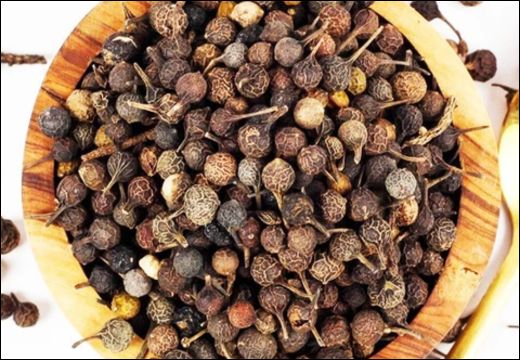
The fruit of Sheetal Cheeni is a small, berry-like drupe that develops on the same spike. At maturity, the drupes become a light brown colour and are aromatic. A unique feature of Piper cubeba fruit is the presence of a long stalk or “tail”, which gives the common name “Tailed Pepper.” The fruit contains several small seeds embedded within.
Seed
Seeds are numerous and tiny, located within each berry-like segment of the fruit spike. They contribute to the plant’s propagation and are sometimes used in medicinal applications when separated from the pericarp.
Root System
Sheetal Cheeni has a fibrous root system with additional adventitious roots that develop along the stems. These roots help with anchorage and absorb nutrients and moisture efficiently.
Classical Categorisation Of Sheetal Cheeni (Piper Cubeba)
- Bhavprakash Nighantu: Karpooradi Varga
- Raj Nighantu: Chandanadi Varga
- Dhanwanthari Nighantu: Chandanadi Varga
Ancient Verses For Sheetal Cheeni (Piper Cubeba)
Verse No. 1
कङ्कोलं कोलकं प्रोक्तं तथा कोषफलं स्मृतम् ।
कङ्कोलं लघु तीक्ष्णोष्णं तिक्तं हृद्यं रुचिप्रदम् ।
आस्यदौर्गन्ध्यहृद्रोगकफवातामयान्ध्यहृत् ॥
Bhavprakash Nighantu Karpooradi Varga Verse No. 116
Verse Interpretation
Synonyms Of Sheetal Cheeni
- Kankol: The primary name for the “Tailed Pepper” plant.
- Kolak: Refers to its berry-like or black-pepper-like appearance.
- Koshphal: Literally means “fruit in a pod” or “sheathed fruit,” describing the structure of its seed.
Properties of Sheetal Cheeni: Sheetalchini is characterized by its Laghu (light to digest) and Tikshna (sharp or penetrating) qualities, which allow it to clear blockages in the body’s channels. It possesses Ushna-Veerya (hot potency) and a Tikta-Rasa (bitter taste), making it highly effective at balancing Kapha and Vata disorders. Beyond its digestive benefits as a Ruchikarak (appetizer), the text highlights its role as Hridya (a cardiac tonic) that supports heart health and its ability to treat Mukh-Durgandh (halitosis or bad breath) and Aandhya (vision-related issues).
Verse No. 2
कङ्कोलकं कृतफलं कोलकं कटुकं फलम् ।
विद्वेष्यं स्थूलमरिचं कल्लोलं माधवोचितम् ।
कङ्कोलं कट्फलं प्रोक्तं मारीचं रुद्रसम्मितम् ॥
कङ्कोलं कटु तिक्तोष्णं वक्त्रजाड्यहरं परम् ।
दीपनं पाचनं रुच्यं कफवातनिकृन्तनम् ॥
Raj Nighantu Chandanadi Varga Verse No. 79-80
Verse Interpretation
Synonyms Of Sheetal Cheeni
- Kankolakam: The standard medicinal name for the fruit
- Kritaphalam: The wellformed or useful fruit
- Kolakam: Referring to the berrylike shape
- Katukaphalam: A fruit with a pungent or biting taste
- Vidvesyam: Something that is disagreeable or intense in flavor
- Sthulamaricham: Literally means thick pepper
- Karkolam: A phonetic variant of the plants name
- Madhavocitam: Something fitting for the spring season or pleasant
- Kankolam: The root name for the Cubeb plant
- Katphalam: A fruit with a sharp or bitter quality
- Maricham: A general term for pepper
Properties of Sheetal Cheeni: Kankola possesses bitter, pungent and hot qualities. This plant serves as an appetizer and a digestive stimulant that acts as a metabolic transformer. Additionally, it helps to alleviate kapha and vata while relieving tastelessness in the mouth.
Verse No. 3
कङ्कोलकं कृतफलं कोलकं कटुकं फलम् ।
चूर्ण वन्दफलं द्वीपमरिचं माधवोचितम् ॥
Dhanwanthari Nighantu Chandanadi Varga Verse No. 35
Verse Interpretation
Synonyms Of Sheetal Cheeni Or Kabab Cheeni
- Kritaphala: Refers to a “useful” or “completed” fruit.
- Kolaka: A name related to the berry-like form of the plant.
- Katukphala: A fruit characterized by its pungent or biting taste.
- Churna: Likely refers to its use in powder form or its role in clearing the mouth.
- Kandaphala: A fruit associated with a bulbous or root-like quality.
- Dveepmaricham: Literally “island pepper,” referring to its origin or resemblance to black pepper.
- Madhavochita: A fruit that is “fit for spring” or considered pleasant.
Verse No. 4
कङ्कोलं कटुतिक्तोष्णं वक्त्रवैरस्यनाशनम् ।
मुखजाड्यहरं रुच्यं वातश्लेष्महरं परम् ॥
Dhanwanthari Nighantu Chandanadi Varga Verse No. 36
Verse Interpretation
Properties Of Sheetal Cheeni
It has a bitter and pungent taste with hot potency. It alleviates dryness of mouth, reduces Vata and Kapha Dosha and consists of appetizing properties.
Special Note On Sheetal Cheeni (Piper Cubeba)
- Some scholars consider Kankol to be of two varieties, Laghu and Brhat (large).
- Sushruta described Katuka in Sushruta Sutra Sthana 46/202.
- Dalhana, without giving his own opinion, identifies it as Lata Kasturi, while Shri Brahmadeva also agrees that Laghu Kankola is Lata Kasturi.
- P. V. Sharma states that Sushruta refers only to Lata Kasturi in Sushruta Sutra Sthana 46/204.
- It was not commonly available in those days and is described as cooling and diuretic in nature.
- It is suggested that Laghu Kakkola or Kankol should be considered synonymous with Katuka (Caraka references: Chikitsa Sthana. 15/132, 16/89; Vimana 7/68 and 7/17).
- Gayadas and Y. N. Sen considers Rohini or Katu Rohini to be Lata Kasturi, while Chakrapani interprets Katukam (Charaka Sutra Sthana. 5/77) as Lata Kasturi.
- According to P. V. Sharma, the substitutes or adulterants of Kankola include Piper crassipes Korth, Piper cannum Blume, Piper baccatum Blume, Piper clusii DC, and Piper guineense DC, which is commonly known as false cubebs from South Africa. The fruits of the fourth and fifth varieties are obtained from the Malay Islands.
Ayurvedic Properties Of Sheetal Cheeni (Piper Cubeba)
- Rasa (Taste): Katu (pungent), Tikta (bitter)
- Guna (Qualities): Laghu (easy to digest and light), Ruksha (dry in nature), and Teekshna (sharp and intense)
- Veerya (Potency): Ushna (Hot)
- Vipaka (Post Digestion Effect): Katu (pungent)
Action On Tridosha Of Sheetal Cheeni (Piper Cubeba)
Kapha-vata Shamaka
Therapeutic Indications Of Sheetal Cheeni (Piper Cubeba)
- Agnimandya (Slow Digestive Fire)
- Ajeerna (Indigestion)
- Adhmana (Bloating)
- Shoola (Abdominal pain)
- Grahani Roga (Malabsorption)
- Aruchi (Loss of appetite)
- Krimi (Worm infestation)
- Kasa (Cough)
- Shwasa (Respiratory disorders)
- Pratishyaya (Rhinitis)
- Mutrakricchra (Dysuria)
- Asyadaurgandhya (Halitosis or Bad breath)
- Hrudroga (Cardiac disorders)
- Loss of Libido
Systemic Actions Of Sheetal Cheeni (Piper Cubeba)
Digestive System
Sheetal Cheeni acts as Deepana and Pachana, enhancing Jatharagni (Digestive Fire) and digesting Ama (Endotoxins). It reduces Kapha accumulation in the Annavaha Srotas (Channels of food transport) and helps relieve Ajeerna (Indigestion), Adhmana (Abdominal distention), and Grahani disorders (IBS or Malabsorption Syndrome). Its Ushna Veerya (hot potency) supports proper digestion and metabolic transformation.
Respiratory System
In the Pranavaha Srotas (Channels of Respiration), it works as a Kaphaghna (eliminates excessive kapha) and Srotoshodhaka dravya (channel cleanser). It helps liquefy and expel excess Kapha, making it beneficial in Kasa (cough) and Kapha-Vata dominant Shwasa (Asthma). Its hot potency clears obstruction and supports free respiration.
Urinary System
Sheetal Cheeni supports the Mutravaha Srotas (Channels of Urine) by promoting urine flow and reducing Shotha (inflammation). It is traditionally indicated in Mutrakricchra (Urinary Obstruction) and urinary disturbances associated with Kapha and Ama (endotoxins) accumulation.
Reproductive System
It supports Shukra Dhatu (Reproductive tissue), especially in Kapha-Vata imbalance. In classical formulations, it shows mild Vrishya action (Aphrodisiac action) and helps maintain reproductive vitality by improving Agni (Digestive fire) and clearing Srotas (channels).
Chemical Composition Of Sheetal Cheeni (Piper Cubeba)
1. Cubebin
Anti-inflammatory, antimicrobial, urinary antiseptic and potential anticancer agent.
2. Hinokinin
Analgesic, anti-inflammatory and antimicrobial compound with immunomodulatory potential.
3. β-Caryophyllene
Anti-inflammatory and analgesic sesquiterpene supporting gut and respiratory health.
4. Sabinene
Antioxidant and antimicrobial monoterpene with mild anti-inflammatory effect.
5. Cubebol
Antimicrobial and expectorant compound beneficial for respiratory and oral health.
6. 1,8-Cineole
Bronchodilator and expectorant useful in cough, bronchitis and sinus congestion.
7. Piperine
Bioavailability enhancer with digestive stimulant and anti-inflammatory activity.
8. Phenolic Compounds (Gallic Acid, Caffeic Acid, Ferulic Acid)
Potent antioxidants protecting against oxidative stress.
Practical Uses / Health Benefits Of Sheetal Cheeni (Piper Cubeba)
- It is used as an antiseptic and primary medicine in chronic gonorrhea. The powder (1–2 g) is given with milk or 250 mg of alum, three times daily. It is also beneficial in cystitis (inflammation of the urinary bladder).
- In disorders of the respiratory system, it acts as an antiseptic and stimulant expectorant. It is prepared in the form of lozenges (like Javitri pills) to be sucked. It is beneficial in throat laxity and swelling. Singers use it to clear the throat. In cough, its powder is licked with honey. Its smoke inhalation is beneficial in asthma.
- Its nasal administration (Nasya) is used to reduce nasal mucus.
- Its oil is used in diseases of the genitourinary system, cystitis, gonorrhea, and chronic gonorrhea. It is administered by preparing an emulsion with sugar or gum, or filled in capsules. In chronic bronchitis, it is added to warm water and the steam is inhaled.
Part(s) Used Of Sheetal Cheeni (Piper Cubeba)
Fruit
Dosage Of Sheetal Cheeni (Piper Cubeba)
- Powder: 1 to 3 gm
- Oil: 1 to 3 drops
Home Remedies Of Sheetal Cheeni (Piper Cubeba)
- The fruits of Piper cubeba (Kankola) are ground into a paste and applied externally over areas affected by swelling and pain to reduce inflammation and discomfort.
- The fruit powder mixed with honey is applied locally on mouth ulcers and inflamed gums to promote healing.
- When 4–5 grams of the fruit powder is taken with honey, it helps relieve cough and sinusitis.
- About 3–5 drops of oil extracted from Kankola, when added to a glass of warm water and consumed, aids in digestion and enhances appetite.
- Intake of the fruit powder mixed with sugar candy and milk is considered beneficial in managing erectile dysfunction.
- A cold infusion prepared from the fruits of Piper cubeba is taken in a dose of 30–40 ml to help relieve dysmenorrhea and difficulty in urination.
- The fruit powder mixed with water and applied externally over the male genital organ is traditionally used to enhance sexual pleasure during intercourse.
Classical Products With Sheetal Cheeni (Piper Cubeba)
- Haritakyadi Rasayanam
- Jeerakarishtam
- Pugakhanda
- Khadiradi Vati
- Drakshasava
- Yograj guggul
- Khadirarisht
- Dashmularisht
- Vasasav
- Chavyakarisht
- Jeerakadyarisht
Planet Ayurveda’s Products With Sheetal Cheeni (Piper Cubeba)
Research On Sheetal Cheeni (Piper Cubeba)
Antimicrobial Activity
Several studies indicate that Piper cubeba essential oil and extracts possess broad antibacterial and antifungal activity against organisms such as Staphylococcus aureus, Escherichia coli, and Candida albicans. These findings support its traditional use in managing infectious conditions.
Anti-Inflammatory And Analgesic Activity
Research suggests that cubeb extracts exhibit anti-inflammatory and analgesic properties by modulating inflammatory mediators and pain pathways. This supports its traditional application in joint discomfort and inflammatory disorders.
Antioxidant Activity
The presence of flavonoids, lignans, and volatile oils contributes to significant antioxidant activity. These constituents demonstrate free radical scavenging potential, helping protect cells from oxidative stress and tissue damage.
Digestive Support
Traditional claims regarding digestive benefits are supported by evidence indicating stimulation of digestive secretions and improvement in gastrointestinal motility. This may help reduce bloating, flatulence, and indigestion.
Anti-Ulcer Activity
Animal-based experimental studies suggest gastroprotective and anti-ulcer effects. These actions may be beneficial in conditions such as gastritis and peptic ulcers by enhancing mucosal defense and reducing gastric irritation.
Conclusion
Sheetal Cheeni (Piper cubeba), also known as Kankol or Tailed Pepper, is a classical Ayurvedic herb with significant digestive, respiratory, and urinary benefits. Described in major Nighantus under Karpooradi Varga and Chandanadi Varga, it is recognized for its Deepana (digestive stimulant), Pachana (digestive/metabolic enhancer), Kaphavata-shamaka (pacifier of Kapha and Vata dosha), and Shoolahara (pain-relieving) properties. Its Ushna Veerya (hot potency) and Tikshna Guna (sharp and penetrating quality) help stimulate Agni (digestive fire), clear Srotas (body channels), and reduce Ama (metabolic toxins), making it valuable in conditions like indigestion, cough, dysuria, and Kapha-Vata disorders. Modern research supports its traditional uses through documented antimicrobial, anti-inflammatory, antioxidant, and gastroprotective activities. The presence of bioactive compounds such as cubebin, piperine, and essential oils further enhances its therapeutic potential. Thus, Sheetal Cheeni remains an important herb bridging classical Ayurvedic wisdom and contemporary scientific validation.