

Polysomnography: Procedure, Clinical Indications, Interpretation of Results, and an Ayurvedic Perspective on Sleep Disorders
Abstract
Sleep disorders are like glitches in your body’s internal clock that turn a peaceful night into a struggle for energy. Instead of waking up refreshed, you feel drained because the natural “architecture” of your rest has been broken. Whether it is Sleep Apnea causing you to gasp for air, Insomnia keeping your mind racing, or Restless Leg Syndrome creating a frantic urge to move, these disruptions prevent you from reaching the deep, restorative sleep your brain needs. Without this vital maintenance, your memory, mood, and health begin to suffer. To fix this, doctors use a Polysomnogram, a specialized sleep study that tracks your brainwaves and oxygen levels. This detailed map allows experts to pinpoint exactly where your sleep cycle is failing, turning the mystery of your exhaustion into a clear plan for recovery. Let’s discuss this in detail!
Introduction
A polysomnogram serves as the gold-standard diagnostic odyssey into the human sleep cycle, transforming the abstract experience of rest into quantifiable data. Conducted within a specialized sleep laboratory, this multi-channel physiological recording captures a high-fidelity “symphony” of the body’s nocturnal activity. By integrating Electroencephalography to map brainwave architecture, Electrooculography to track REM cycles, and Electromyography to monitor muscle atonia, the PSG provides an unfiltered view of the sleeper’s neurological state. Beyond brain activity, the study meticulously logs respiratory effort, pulse oximetry, and cardiac rhythms to detect life-disrupting anomalies like obstructive apnea or periodic limb movements. This scientific deep-dive does more than just observe; it deciphers the hidden friction between biology and behavior. By translating chaotic disruptions into a precise digital map, the Polysomnogram empowers clinicians to move beyond guesswork and engineer a targeted path toward restorative health.
What Happens During The Procedure?
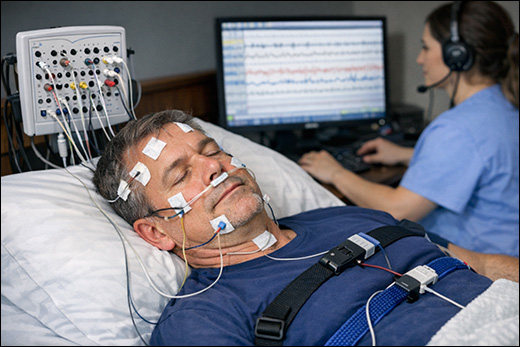
During a Polysomnogram, the goal is to record your body’s physical and neurological activity while you sleep. The procedure typically takes place in a private, hotel-like room within a sleep center, designed to be as comfortable as possible despite the high-tech monitoring.
- Preparation and Hookup– A sleep technician will apply several small sensors (electrodes) to your scalp, temples, chest, and legs using a specialized adhesive. These are connected by long, thin wires to a computer, but they are bundled together so you can still move or turn over in bed.
- Monitoring the "Symphony"– Once you are ready to sleep, the technician moves to a separate control room to monitor a continuous stream of data, including:
- Brainwaves (EEG): To determine which stage of sleep you are in (Light, Deep, or REM).
- Eye Movements (EOG): To identify the onset of dreaming.
- Heart Rate and Breathing: Using chest belts and oximeters to detect drops in oxygen or irregular rhythms.
- Muscle Activity (EMG): To check for teeth grinding or restless leg movements.
- Throughout the Night– The technician observes you via a low-light video camera and a microphone. If a sensor comes loose or if you need to use the restroom, they can assist you immediately. In some cases, if severe Sleep Apnea is detected early in the night, the technician may enter to start a CPAP (Continuous Positive Airway Pressure) trial to see if supplemental air pressure resolves the issue.
- In the morning, the sensors are removed, and you are free to go. The massive amount of data collected—often hundreds of pages of waveforms—is then "scored" by a specialist to create a formal diagnosis.
Results Interpretation
The interpretation of a Polysomnogram is a complex process where a sleep specialist (usually a neurologist or pulmonologist) "scores" the raw data to build a narrative of your night. They look for specific patterns in the waveforms to see if your body is transitioning through the stages of sleep correctly. Key Metrics for Interpretation are:-
- Sleep Architecture: This is a map of your sleep stages (N1, N2, N3, and REM). The specialist checks if you are getting enough Deep Sleep for physical recovery and REM for mental processing.
- Apnea-Hypopnea Index: This is the most critical number for diagnosing Sleep Apnea. It calculates the average number of times your breathing stops or becomes shallow per hour.
- Normal: Less than 5 events per hour.
- Severe: More than 30 events per hour.
- Oxygen Desaturation: They measure how low your blood oxygen levels drop during breathing pauses. Constant drops can strain the heart and brain.
- Sleep Latency: How long it takes you to fall asleep. A very short latency can suggest narcolepsy, while a very long one confirms insomnia.
- Arousal Index: This counts how many times your brain "wakes up" for a few seconds due to noise, movement, or breathing issues, even if you don’t remember it.
The interpretation concludes with a Summary Diagnosis. If the data shows a high AHI, the report will recommend a CPAP machine, if it shows abnormal muscle activity during REM, it might point toward a neurological disorder. It essentially turns a night of “bad sleep” into a mathematical blueprint for a cure.
Indications Of Polysomnogram
- Obstructive Sleep Apnea
- Central Sleep Apnea
- Periodic Limb Movement Disorder
- Narcolepsy
- REM Sleep Behavior Disorder
- Restless Legs Syndrome
- Chronic Insomnia
- Parasomnias
- Sleep-Related Hypoventilation
- Circadian Rhythm Disorders
- Nocturnal Seizures
Ayurveda’s View
In Ayurveda, sleep (Nidra) is revered as one of the three pillars of life (Trayopastambha), essential for ojas (vitality) and body repair. It views sleep disorders not just as mechanical failures, but as imbalances in the three Doshas (biological energies).
- Vata-Induced Insomnia (Anidra): Caused by an overactive mind, anxiety, and dryness. It leads to light, fragmented sleep and difficulty falling asleep due to the "mobile" nature of Vata.
- Pitta-Induced Sleep Issues: Characterized by waking up in the middle of the night (often between 10 PM and 2 AM) with a hot, racing mind or irritability.
- Kapha-Induced Hypersomnia: An excess of heavy, slow energy that leads to oversleeping, lethargy, and feeling unrefreshed despite long hours of rest.
Naturals Herbs To Boost Sleep And Reduces Sleep Disorders
1. Ashwagandha (Withania somnifera)
Known as a premier Rasayana (rejuvenator), Ashwagandha specifically balances Vata Dosha. It nourishes the Majja Dhatu (nervous system), grounding the “airy” instability that causes anxiety and light sleep. It is considered a “building” herb, providing the vital strength (Ojas) needed for the body to feel secure enough to descend into deep rest. This powerful adaptogen works primarily by modulating the HPA axis to lower systemic cortisol levels. It contains triethylene glycol, a compound that promotes non-REM sleep, and withanolides that act as GABAergic agents. By mimicking GABA—the brain’s primary inhibitory neurotransmitter—it quiets overactive neurons. It is clinically effective for stress-induced insomnia, improving both sleep latency and overall sleep quality without morning grogginess.
2. Tagar (Valeriana wallichii)
Tagar is classified as Nidrajanana (sleep-inducing) and Vata-Anulomana (clearing the downward flow of energy). It has a “Tamasic” (heavy/dulling) quality, which is therapeutic for those whose minds are too “Rajasic” (active/restless). It clears Ama (toxins) from the nerves, allowing for a heavier, more grounded state of unconsciousness. Often called “Indian Valerian,” it contains valerenic acids and iridoids that inhibit the breakdown of GABA in the brain. By increasing GABA availability, it acts as a natural sedative that relaxes the central nervous system. Research suggests it is particularly effective for reducing sleep latency—the time it takes to transition from wakefulness to sleep—making it a potent tool for primary insomnia and muscular tension.
3. Jatamansi (Nardostachys jatamansi)
This Himalayan herb is a “Tridoshic” stabilizer, meaning it balances Vata, Pitta, and Kapha simultaneously. It is prized for its “cooling” effect on the brain, specifically targeting Sadhaka Pitta to soothe emotional turbulence and irritability. It is described as a brain tonic that bestows peace and “satva” (clarity) to a chaotic mind. Jatamansi contains sesquiterpenes like jatamansone, which exhibit profound anticonvulsant and neuroprotective activities. It modulates the levels of monoamines, including serotonin and dopamine, which are essential precursors to melatonin production. By stabilizing these neurotransmitters, it helps regulate the circadian rhythm and is highly effective for sleep disorders rooted in chronic anxiety, depression, or emotional trauma.
4. Shankhpushpi (Convolvulus pluricaulis)
Shankhpushpi is a renowned MedhyaRasayana (brain rejuvenator) that specializes in psychotropic healing. It acts as a natural “tranquilizer” by cooling the mental faculties and reducing ManasRoga (mental afflictions). It is traditionally used to “lock” the mind into a state of focus, preventing the wandering thoughts that often lead to sleeplessness. Clinically, it is recognized for its ability to significantly reduce the production of stress hormones like adrenaline and cortisol. It exerts a depressive effect on the Central Nervous System (CNS) by modulating the thyroid and adrenal glands. This reduces “mental noise” and hyper-arousal, making it ideal for those who suffer from psychophysiological insomnia, where the fear of not sleeping creates a cycle of wakefulness.
5. Brahmi (Bacopa monnieri)
Brahmi is the ultimate herb for "Sattva" (purity). It balances Sadhaka Pitta, the sub-dosha responsible for processing emotions and heat in the heart and mind. It helps the mind "digest" the day’s stresses, ensuring that residual emotions do not fragment the sleep cycle. It is unique because it promotes alertness during the day while ensuring deep calm at night. The active bacosides in Brahmi enhance synaptic plasticity and repair damaged neurons. It acts as an anxiolytic by modulating serotonin receptors and increasing GABA levels. During sleep, it supports memory consolidation and enhances the quality of REM sleep. Because it regulates the nervous system rather than just sedating it, it is perfect for long-term management of sleep fragmentation and cognitive fatigue.
6. Vacha (Acorus calamus)
Vacha translates to “speech,” reflecting its ability to clear the channels of the head and throat. It is a “Ushna” (warming) herb that cuts through heavy Kapha and Medas (fatty tissue) that can obstruct breathing. While stimulating in large doses, in micro-doses, it acts as a “grounding” agent that pulls energy away from a hyperactive mind. It contains alpha and beta-asarone, which have demonstrated sedative and muscle-relaxant properties in pharmacological studies. Vacha acts as a mild tranquilizer and has bronchodilatory effects, which are scientifically significant for sleep disorders involving respiratory issues. It helps in calming the “fight or flight” response, making it useful for those whose sleep is interrupted by physical restlessness or mild respiratory congestion.
7. Sarpagandha (Rauwolfia serpentina)
Known as the “insanity herb,” Sarpagandha is a potent, heavy, and cold medicine used for extreme conditions of Vata aggravation. It is a forced sedative used when the mind is in a state of high agitation or “Unmada” (mania). It is considered so powerful that it is used to “anchor” the soul back into the body when it is spinning out of control. This is the botanical source of Reserpine, the first modern antipsychotic and antihypertensive drug. It works by depleting catecholamines (like norepinephrine) from peripheral and central nerve endings. This leads to a significant drop in blood pressure and a deep, heavy sedation of the brain. Due to its potency, it is reserved for refractory insomnia or sleep disorders accompanied by high blood pressure and extreme nervous irritability.
Conclusion
Ultimately, wrestling with sleep disorders is like trying to negotiate with a grumpy toddler. Your brain knows it needs a nap, but it’s too busy throwing a tantrum about a sandwich it ate in 2014. Whether you choose the high-tech "cyborg" route of a Polysomnogram or the botanical embrace of Ashwagandha, the goal is the same: silencing the midnight circus. Don’t let your subconscious script a chaotic ballet when it could be enjoying a peaceful intermission. Invest in your rest now, or continue living as a caffeinated ghost—the choice between a "Symphony of Sleep" and a "Nightmare on Stress Street" is yours.