


Ranunculus sceleratus Linn./ Kandira/ Jaladhaniya – Ayurvedic Uses, Health Benefits, Dosage & Therapeutic Actions
Abstract
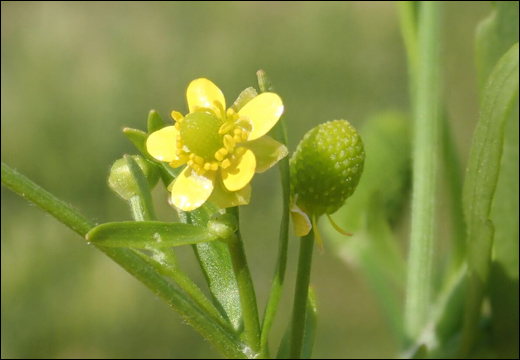
Ranunculus sceleratus L., commonly known as celery-leaved buttercup, is an annual herbaceous plant belonging to the family Ranunculaceae. It typically grows in wet and moist habitats and is native to temperate and boreal regions of North America and Eurasia. The species has also been reported as an invasive weed in parts of northern Africa, Europe, and Asia. Ranunculus sceleratus is characterised by hollow stems, small yellow flowers, and celery-like leaves and is known to be poisonous in nature. Historically, it has been documented among the prominent medicinal herbs in the Shennong Traditional Herbal Scriptures of the Western Han Dynasty, indicating its significance in traditional medicine and folklore despite its toxic properties.
Classical References Of Ranunculus Sceleratus Linn./ Kandira/ Jaladhaniya
- Dhanvantari Nighantu Karveeradi varga
Scientific Classification Of Ranunculus Sceleratus Linn./ Kandira/ Jaladhaniya
- Kingdom: Plantae
- Subkingdom: Viridiplantae
- Infrakingdom: Streptophyta
- Superdivision: Embryophyta
- Division: Tracheophyta
- Subdivision: Spermatophytina
- Class: Magnoliopsida
- Superorder: Ranunculanae
- Order: Ranunculales
- Family: Ranunculaceae
- Genus: Ranunculus
- Species: Ranunculus sceleratus
Synonym Of Ranunculus Sceleratus Linn./ Kandira/ Jaladhaniya
- Toyavalli: A plant that grows near or within water; indicates its preference for moist or aquatic habitats.
- Kanda Katuka: Refers to a pungent or acrid-tasting stem or tuber.
- Nasa Samvedana: Causes irritation or burning sensation in the nose; may induce sneezing on inhalation.
- Sukanda: Possesses a noticeable or strong odour.
- Ugra Kanda: Strong, sharp, or intensely irritating stem or rhizome.
Vernacular Names Of Ranunculus Sceleratus Linn./ Kandira/ Jaladhaniya
- English: Celery-leaved Crowfoot, Celery-leaved Buttercup, Cursed Crowfoot, Cursed Buttercup, Blister Buttercup, Poisonous Buttercup
- European Names: Apio Sardónico, Herbe de Feu, Herbe Sardonique, Mort aux Vaches, Renoncule Scélérate, Sardonia
- Arabic: Kabikaj, Kabikazaz
- Greek: Batrahiyun, Saltin Agharyun
- Persian / Farsi: Karafs Dashti, Mushak
- Hindi: Aglaon, Latukari, Jalbel, Jaldhaniya, Bandhaniya, Paalika, Deva Kandrara, Jal Dhaniya
- Bihari: Palika
- Sanskrit: Nasa Samvedana, Toya Valli, Kandira, Kanda Katuka, Sokadka, Soladana, Latukari, Jaldhariya
- Marathi: Khajako, Llathi, Khajakollathi, Kulaji, Kulagi
- Kumaun / Kumayun: Shim, Sim
- Mundari: Bir Mani
- Manipuri: Lalukaob
- Nepali: Nakkore, Naakure, Shamphu Jhaar, Tharuni
Habitat of Ranunculus Sceleratus Linn./ Kandira/ Jaladhaniya
There are approximately 400 species in this genus, distributed mainly across temperate and cold regions, as well as tropical mountainous areas. Ranunculus sceleratus is believed to be native to northern Africa (including northern Egypt, northern Algeria, Morocco, and Tunisia), North America (covering most parts of the United States), Europe, and Western and Northern Asia (including Afghanistan, Iran, Iraq, Lebanon, Syria, Turkey, Armenia, Azerbaijan, Georgia, Russia, Kazakhstan, Kyrgyzstan, Tajikistan, Turkmenistan, Uzbekistan, Mongolia, China, and Japan). It is also native to the Indian subcontinent, particularly Bhutan, northern India, Nepal, and Pakistan. In India, the plant commonly grows in the plains of northern regions and in the warm valleys of the Himalayas, extending from Kashmir to Assam, up to an altitude of about 1500 meters.
Morphology Of Ranunculus Sceleratus Linn./ Kandira/ Jaladhaniya
Ranunculus sceleratus is an annual, erect herb attaining a height of approximately 20–90 cm, with frequent branching. The leaves are mostly glabrous, bearing small blades that are deeply lobed or divided, and are supported on long petioles. The flowers measure about 5–10 mm in diameter, with five or fewer yellow petals that are only a few millimetres long, along with reflexed sepals. The fruit is an oblong to ovoid achene, measuring 6–9 mm in length, and occurs in clusters of several achenes. The stem is light green, robust, and smooth, while the aerial parts show the presence of abundant trichomes.
Special Note
The generic name Ranunculus is derived from Latin, where rana means frog and unculus means little, collectively translating to “little frog.” This name reflects the plant’s natural preference for moist habitats near water bodies, where it is commonly found in abundance during spring, similar to frogs around streams. In Arabic, the plant is known as Shajr al-Ḍab and Kaf al-Ḍab, names inspired by the shape of its leaves, which resemble the feet and fingers of a hyena. The English name “cursed crowfoot” originates from the resemblance of its leaves to a crow’s foot and from the blister-causing sap exuded by its stem. The Hindi name Jaldhaniya is attributed to the similarity of its leaves to those of coriander (Dhaniya).
Classical Categorisation of Ranunculus Sceleratus Linn./ Kandira/ Jaladhaniya
- According to Dhanvantari Nighantu: Karveeradi Varga
Ancient Verse Of Ranunculus Sceleratus Linn./ Kandira/ Jaladhaniya
काण्डीरः काण्डकटुको नासासंवेदनः पटुः ।
उग्रकाण्डस्तोयवल्ली कारवल्ली सुकाण्डकः ॥ (Dhanvantari Nighantu Karveeradi varga 57)
According to the above shloka, the synonyms of Kandira are Kandakatuka, Nasa-samvedana, Patu, Ugra-kanda, Toyavalli, Karavalli and Sukandaka.
काण्डीरः कटुतिक्तोष्णः सरो दुष्टव्रणार्तिजित् ।
लूतागुल्मोदरप्लीहशूलमन्दाग्निनाशनः ॥ (Dhanvantari Nighantu Karveeradi varga 58)
According to the above shloka, the Kandira is pungent and bitter in taste, hot in potency, and mildly laxative in action. It is traditionally used in the management of indolent ulcers, spider poisoning, abdominal tumours, disorders of the abdomen and spleen, colic, and poor appetite.
Ayurvedic Properties Of Ranunculus Sceleratus Linn./ Kandira/ Jaladhaniya
- Taste (Rasa) – Bitter (Tikta), Pungent (Katu)
- Physical property (Guna) – Sharp (Teekshna), Dry (Ruksha)
- Potency (Veerya ) – Hot Potency (Usna)
- Post-digestion effect (Vipaka) – Katu (Pungent)
Therapeutic Indications of Ranunculus Sceleratus Linn./ Kandira/ Jaladhaniya
- Sara: Initiates bodily movement and is useful in constipation.
- Dushta Vrana: Indicated in infected or infested wounds.
- Luta: Useful in insect bites.
- Gulma: Helpful in abdominal tumours.
- Udara: Indicated in ascites and abdominal enlargement.
- Pleeha: Useful in spleen disorders, including splenomegaly.
- Shoola: Relieves abdominal pain.
- Mandagni: Improves low digestive strength.
Systemic Actions Of Ranunculus Sceleratus Linn./ Kandira/ Jaladhaniya
- External Uses: It possesses anthelmintic properties and is indicated in conditions such as lymphadenitis, erectile dysfunction, and various skin disorders.
Internal Uses
- Digestive System: Acts as a carminative, digestant, anthelmintic, and purgative. It is indicated in splenomegaly, abdominal cramps, weak digestive power, and helminthic infestations.
- Reproductive System: Exhibits Arthavajanana (promotes menstrual flow).
- Circulatory System: Traditionally indicated as a preventive measure against plague.
Chemical Composition Of Ranunculus Sceleratus Linn./ Kandira/ Jaladhaniya
- Major Active Constituents: Ranunculus sceleratus primarily contains the glycoside ranunculin, which on hydrolysis forms the toxic irritant protoanemonin. Protoanemonin further dimerises to form the more stable compound anemonin.
- Flavonoids: The plant is rich in flavonoids, including apigenin and its glycosides, tricin and its derivatives, quercetin, and isoscopoletin.
- Phenolic Compounds: Identified phenolics include protocatechuic acid, protocatechuic aldehyde, caffeic acid derivatives, salicylic acid, ferulic acid, and ellagic acid.
- Terpenoids: Presence of di- and triterpenes has been reported.
- Steroids / Phytosterols: Contains β-sitosterol, stigmasterol, and stigmasta-4-ene-3,6-dione.
- Coumarins: Isoscopoletin and scoparone have been isolated from the plant.
- Alkaloids and Amines: The plant contains serotonin (5-hydroxytryptamine), other tryptamine derivatives, choline, and an unidentified alkaloid.
- Lipids and Fatty Acids: Fatty acids such as hexadecanoic acid and myristic acid are present. The seeds contain approximately 18% protein and 26% fatty oil.
- Tannins and Saponins: Pyrogallol tannins, along with saponins, are present in the plant.
- Proteins and Amino Acids: Various amino acids and proteins have been identified, particularly in the seeds.
- Resins
- Toxic Principle: R. sceleratus is considered the most toxic species of buttercup, due to the presence of protoanemonin, found in all parts of the plant except the seeds.
Actions And Properties Of Various Chemical Constituents Of Ranunculus Sceleratus Linn./ Kandira/ Jaladhaniya
Antiviral Activities
Ranunculus sceleratus contains bioactive flavonoids such as apigenin 4′-O-α-rhamnopyranoside, apigenin 7-O-β-glucopyranosyl-4′-O-α-rhamnopyranoside, tricin 7-O-β-glucopyranoside, tricin, and the coumarin isoscopoletin, which have demonstrated inhibitory activity against Hepatitis B virus (HBV) and Herpes simplex virus (HSV). These compounds interfere with viral replication by blocking viral polymerases and transcription, thereby preventing the synthesis of viral proteins necessary for virus assembly. They also exhibit antioxidant and immunomodulatory effects, protecting host cells from oxidative damage and enhancing innate antiviral responses. Glycosylated flavonoids further hinder viral mRNA production, while coumarins can restrict viral entry and propagation. Together, these phytochemicals contribute to the plant’s broad-spectrum antiviral potential, making it a promising source of natural antiviral agents.
Cytotoxic Activity
Ranunculus sceleratus contains bioactive compounds such as ranunculin, which is hydrolysed to form protoanemonin, the primary cytotoxic agent responsible for its anticancer effects. Protoanemonin can induce apoptosis and disrupt the cell cycle in cancer cells, while its dimerised form, anemonin, provides a more stable but less irritant activity. Other phytochemicals, including flavonoids (apigenin, tricin, isoscopoletin), saponins, and phenolic acids, contribute synergistically by modulating signalling pathways such as AKT/mTOR and activating caspase cascades, thereby inhibiting tumor growth and proliferation. The combined effects of these compounds support the traditional use of the plant in managing tumors, ulcers, and certain malignancies such as lymphoma, leukemia, and breast or esophageal cancers, making it a valuable source of natural anticancer agents.
Practical Uses / Health Benefits Of Ranunculus Sceleratus Linn./ Kandira/ Jaladhaniya
- Paste is applied to plague-related swellings (lymphadenitis)
- It is used in destroying mercury and other metals during Ayurvedic preparations.
- Possesses heating and vesicant properties for topical applications.
Parts Used Of Ranunculus Sceleratus Linn./ Kandira/ Jaladhaniya
- Aerial parts of the plant
Conclusion
Ranunculus sceleratus (Kandira, Jaladhaniya) is a highly potent medicinal plant with a wide spectrum of therapeutic properties. Its primary bioactive compounds, including ranunculin, protoanemonin, flavonoids, saponins, and phenolic acids, contribute to its antiviral, anticancer, digestive, and anti-inflammatory activities. It has been used to manage abdominal disorders, skin ailments, lymphadenitis, tumours, and other systemic conditions traditionally, while its toxicity demands careful use under the guidance of an Ayurveda physician. Modern studies support its cytotoxic, antiviral, and immunomodulatory potential, validating its traditional applications. With proper standardisation and controlled administration, R. sceleratus remains a valuable plant in Ayurveda and natural medicine for managing various health disorders.
FAQs About Ranunculus Sceleratus Linn./ Kandira/ Jaladhaniya
1. Should I stop wearing makeup if I have Acne?
Ranunculus sceleratus belongs to *Kingdom: Plantae; Division: Tracheophyta; Class: Magnoliopsida; Order: Ranunculales; Family: Ranunculaceae; Genus: Ranunculus; Species: R. sceleratus.
2. What are the uses of Ranunculus sceleratus?
It is used externally for plague swellings and skin disorders and internally in digestive, anti-inflammatory, and antiviral applications, with careful dosing due to its toxicity.
3. What is the common name of Ranunculus sceleratus?
Common names include Kandira, Jaladhaniya, Celery-leaved Crowfoot, and Poisonous Buttercup.
4. What are the medicinal uses of Ranunculus sceleratus?
Medicinally, it is used as a carminative, digestive, anthelmintic, anti-inflammatory, anticancer, and antiviral, and also in menstrual regulation and treatment of abdominal and spleen disorders.