


Rosmarinus Officinalis Linn./ Rosemary – Medicinal Properties, Benefits & Dosage
Abstract
Rosemary (Rosmarinus officinalis L.) is an aromatic, evergreen perennial shrub native to the Mediterranean region, also thriving in sub-Himalayan areas due to its adaptive nature. It is widely cultivated from seeds, cuttings, or root division. It produces fragrant leaves that can be harvested three to four times annually. Traditionally, rosemary has been valued in folk and Ayurvedic medicine for its antispasmodic, mild analgesic, and neuroprotective properties, being used to manage intercostal neuralgia, headaches, migraine, insomnia, emotional disturbances, and depression. Beyond its therapeutic applications, rosemary is routinely employed as a culinary herb, spice, flavouring agent, and natural preservative, highlighting its dual role in both medicine and gastronomy.
Scientific Classification Of Rosmarinus Officinalis Linn./ Rosemary
- Kingdom: Plantae
- Subkingdom: Tracheobionta
- Superdivision: Spermatophyta
- Division: Magnoliophyta
- Class: Magnoliopsida
- Subclass: Asteridae
- Order: Lamiales
- Family: Lamiaceae
- Genus: Rosmarinus L.
- Species: officinalis
Synonym Of Rosmarinus Officinalis Linn./ Rosemary
- Gandha Patri (Due to its aromatic nature)
Vernacular Names Of Rosmarinus Officinalis Linn./ Rosemary
- English: Rosemary, Dew of the Sea (referring to its habitat on Mediterranean coastal cliffs)
- Hindi: Rusmari, Gul Mehandi
- Sanskrit: Rusmari, Satapatri, Satapatrika
- Spanish: Romero
- Portuguese: Alecrim
- French: Rosmarin
- German: Rosmarin
- Italian: Rosmarino
- Greek: Δενδρολίβανο (Dendrolivano)
- Marathi: Shatavari
- Tamil: Marikkolundu
- Telugu: Davanamu Vantti Vokka Chettu
- Malayalam: Poovaamkurunthal
Habitat Of Rosmarinus Officinalis Linn./ Rosemary
Rosemary (Rosmarinus officinalis) is native to the Mediterranean region, where it flourishes in warm, sunny climates on dry, rocky, or sandy soils, often along coastal areas—hence its name, meaning “dew of the sea.” While naturally found in the Mediterranean Basin, including Portugal and northwestern Spain, rosemary is now widely cultivated across Europe, North Africa, the Middle East, parts of Asia such as India and China, and the Americas, including California and Cuba. The plant prefers temperate climates with well-drained soils and abundant sunlight, but it is highly adaptable, growing successfully in gardens, pots, and even regions with higher rainfall, such as the Nilgiri Hills in India, when suitable conditions are provided. Rosemary is valued both for its ornamental appeal and for its culinary and medicinal uses.
Morphology Of Rosmarinus Officinalis Linn./ Rosemary
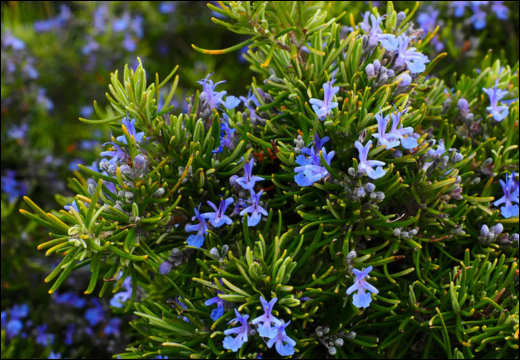
Rosmarinus officinalis (Rosemary) is an aromatic, evergreen perennial shrub belonging to the family Lamiaceae. The plant may grow in an erect form, reaching up to about 1.5–2 m in height, or as a trailing/prostrate shrub. It possesses a fibrous root system and woody, much-branched stems. The leaves are evergreen, linear, and narrow, measuring about 2–4 cm in length, with a leathery texture and revolute (curled) margins. They are sessile and arranged oppositely on the stem; the upper surface is dark green and glossy, while the lower surface is whitish due to dense, short, woolly hairs, giving the plant a greyish-green appearance. Flowers are small, fragrant, and borne in clusters of two to three in the leaf axils, and they are usually pale blue but may also be pink or white. The corolla is bilabiate, with two upper lobes, two lateral lobes, and a prominent lower lip adapted for pollination. The entire plant emits a strong, characteristic pine-like aroma, attributed to the presence of essential oils rich in compounds such as camphor and 1,8-cineole.
Therapeutic Indications Of Rosmarinus Officinalis Linn./ Rosemary
- Appetiser
- Digestive
- Cosmeceutical
- Neurotonic
- Circulatory
- Anti-rheumatic
- Antioxidant
- Antiseptic
- Anti-dandruff
- Analgesic
- Antimicrobial
- Memory-enhancer
- Hepatostimulant
- Hypoglycaemic
Systemic Actions Of Rosmarinus Officinalis Linn./ Rosemary
- External Uses: It is externally applied to hair loss in the form of oil.
Chemical Composition Of Rosmarinus Officinalis Linn./ Rosemary
- Phenolic compounds: Rich in rosmarinic acid, carnosic acid, carnosol, and caffeic acid, which provide strong antioxidant and anti-inflammatory effects.
- Essential oils (terpenoids): Predominantly composed of monoterpenes and oxygenated monoterpenes.
- 1,8-Cineole (eucalyptol): Often the major constituent, responsible for the characteristic aroma and respiratory benefits.
- α-Pinene: A significant monoterpene hydrocarbon with anti-inflammatory activity.
- Camphor: A prominent ketone contributing to the stimulating fragrance and medicinal actions.
- Borneol and bornyl acetate: Alcohols and esters adding to the therapeutic and aromatic profile.
- Other terpenes: Includes camphene, limonene, and myrcene.
- Triterpenes: Contain ursolic acid and betulinic acid with notable biological activity.
Actions and Properties of Various Chemical Constituents of Rosmarinus officinalis Linn./ Rosemary
For Hair Problems
The management of hair problems such as hair loss, dandruff, and scalp inflammation with Rosmarinus officinalis (rosemary) is mainly due to its rich content of phenolic acids, triterpenes, and volatile essential oils. Carnosic acid plays a key role by improving scalp circulation, promoting nerve and tissue repair around hair follicles, and inhibiting 5-α-reductase, thereby reducing dihydrotestosterone (DHT)–induced follicle shrinkage. Rosmarinic acid provides strong antioxidant and anti-inflammatory effects, protecting hair follicles from oxidative stress and soothing scalp irritation. Triterpenes like ursolic and oleanolic acids further reduce inflammation associated with hair loss. Essential oil components such as 1,8-cineole, camphor, and α-pinene enhance blood flow through vasodilation and exert antimicrobial and antifungal actions, helping control dandruff. Additionally, 12-methoxycarnosic acid exhibits anti-androgenic activity, supporting hair regrowth in androgenetic alopecia. Together, these compounds synergistically improve scalp health, nourish follicles, and promote healthy hair growth.
Antilipidemic Effect
The antilipidemic and hypocholesterolemic effects of Rosmarinus officinalis (rosemary) are mainly attributed to its polyphenolic constituents, especially carnosic acid, carnosol, and rosmarinic acid, which regulate lipid metabolism and oxidative balance. Carnosic acid and carnosol act as potent antioxidants that inhibit lipid peroxidation, reduce liver triglycerides and free fatty acids, and help lower total cholesterol and LDL while increasing HDL levels. Rosmarinic acid supports cholesterol homeostasis by enhancing reverse cholesterol transport, increasing hepatic uptake and excretion of cholesterol, and activating AMPK to promote fatty acid β-oxidation. Triterpenoids such as ursolic and oleanolic acids further reduce lipid levels by inhibiting pancreatic lipase, thereby limiting dietary fat absorption. These compounds also suppress fat synthesis by downregulating lipogenic enzymes and stimulating lipid breakdown pathways. Through these combined mechanisms, rosemary effectively improves serum lipid profiles and supports overall cardiovascular and metabolic health.
For Aromatherapy
Rosemary (Rosmarinus officinalis Linn.) essential oil used in aromatherapy derives its therapeutic value from a rich blend of volatile terpenes such as 1,8-cineole, α-pinene, camphor, verbenone, borneol, and camphene, which exert stimulating, clarifying, and circulatory effects through inhalation. These volatile compounds rapidly act on the olfactory system and central nervous system, enhancing mental alertness, respiratory function, and mood while providing mild analgesic and anti-inflammatory benefits. In addition, non-volatile constituents present in rosemary extracts, including rosmarinic acid, carnosic acid, carnosol, and ursolic acid, contribute strong antioxidant and anti-inflammatory actions. These compounds protect skin and cells from oxidative stress and support tissue health when applied topically. The synergistic interaction between fast-acting aromatic terpenes and longer-acting polyphenols allows rosemary to provide both immediate sensory stimulation and sustained therapeutic support. Thus, rosemary oil is valued in aromatherapy for enhancing cognition, circulation, and skin vitality.
Antibacterial and Antifungal Activity
Rosemary (Rosmarinus officinalis Linn.) exhibits strong antifungal and antibacterial activity due to the combined action of its phenolic compounds and essential oil constituents. Phenolic diterpenes such as carnosic acid and carnosol disrupt microbial metabolism and cell integrity, while rosmarinic acid adds potent antibacterial and antifungal effects through antioxidant and enzyme-inhibitory actions. Volatile monoterpenes, including 1,8-cineole, α-pinene, and camphor, readily penetrate microbial cell membranes, increasing permeability and leading to leakage of vital cellular components. Flavonoids like luteolin and apigenin further enhance this activity by inhibiting microbial enzymes and supporting oxidative stress within pathogens. Together, these compounds interfere with cell wall synthesis, enzyme systems, and energy production in bacteria and fungi. Their synergistic action ultimately prevents microbial growth and replication, making rosemary an effective natural antimicrobial agent.
Practical Uses / Health Benefits of Rosmarinus officinalis Linn./ Rosemary
- For digestion and taste: Add fresh or dried rosemary to cooked foods like vegetables, soups, or breads to enhance flavour and support digestion while naturally preserving food.
- For stress and mental fatigue: Inhale steam infused with a few drops of rosemary oil or use it in a diffuser to refresh the mind and improve focus.
- For hair health: Massage diluted rosemary oil or leaf infusion into the scalp to improve blood circulation and support healthy hair growth.
- For skin care: Apply diluted rosemary oil or a cooled leaf decoction to soothe inflamed skin, reduce blemishes, protect against sun damage, and aid minor burn healing.
- As an insect repellent: Apply diluted rosemary oil on exposed skin or use it in sprays to repel mosquitoes and ticks naturally.
Parts Used of Rosmarinus officinalis Linn./ Rosemary
- Stem
- Flower
Conclusion
Rosmarinus officinalis Linn. (Rosemary) is a valuable aromatic and medicinal herb with a long history of use in traditional and modern systems of medicine. It is rich in phenolic compounds, diterpenes, triterpenes, and essential oils, and it exhibits strong antioxidant, anti-inflammatory, antimicrobial, cardioprotective, neuroprotective, digestive, and hair-promoting properties. Traditionally, it is used to enhance memory, stimulate digestion, improve circulation, and relieve pain and inflammation. Rosemary is also widely employed in culinary, cosmetic, and aromatherapy practices. Its broad therapeutic potential, safety in moderate use, and diverse applications highlight rosemary as a versatile plant worthy of continued pharmacological research and clinical validation.
Frequently Asked Questions (FAQ’s)
1. What Is the Hindi Name of Rosemary?
The Hindi name of Rosemary is Rusmari or Gul Mehandi.
2. What Are the Uses of Rosemary?
Rosemary is used to improve digestion, enhance memory, relieve pain and inflammation, support circulation, and promote overall wellness.
3. What Are the Uses of Rosemary Oil?
Rosemary oil is used in aromatherapy for mental clarity, in hair care to promote hair growth and reduce dandruff, and externally for pain relief and skin health.
4. What Is the Common Name of Rosmarinus officinalis?
The common name of Rosmarinus officinalis is Rosemary.
5. What Are the Medicinal Uses of Rosmarinus officinalis?
It is used as an antioxidant, anti-inflammatory, antimicrobial, digestive stimulant, cardioprotective, and neuroprotective herb.
6. What Are the Uses of Rosmarinus officinalis for Hair?
It helps reduce hair fall, stimulates hair growth, improves scalp circulation, and manages dandruff and scalp inflammation.