


Tinea Versicolor – Causes, Symptoms, Treatment & Herbal Remedies
Abstract
Fungal infections of the skin are among the most common dermatological conditions worldwide, affecting individuals of all ages and geographic locations. Superficial mycoses can cause significant cosmetic concerns and impact quality of life. Proper identification, understanding of predisposing factors, and timely intervention are essential to reduce complications and recurrence. Advancements in both topical and systemic antifungal therapies, coupled with preventive measures, have enhanced patient outcomes and minimized treatment-related side effects. In this article we shall be discussing such conditions namely Tinea Versicolor and its management in modern and as well as in the traditional Indian medicinal system of Ayurveda.

Introduction
Tinea versicolor, also known as pityriasis versicolor, is a chronic superficial fungal infection caused by the lipophilic yeast Malassezia species, formerly classified as Pityrosporum. This condition predominantly affects the stratum corneum, skin’s outermost layer, leading to hypopigmented, hyperpigmented, or erythematous macules and patches with fine scaling. Although non-contagious, it is prevalent in adolescents and young adults, particularly in tropical and subtropical climates where high humidity and temperature favor fungal proliferation. The disease is characterized by the interference of fungal metabolism with melanogenesis, resulting in patchy discoloration of the skin. Tinea versicolor commonly involves the trunk, shoulders, upper arms, and neck but can also affect the face and other sebaceous-rich areas. Despite being primarily cosmetic, the condition can cause psychological distress due to visible skin changes.
Epidemiology
Tinea versicolor affects both sexes but is slightly more prevalent in males due to higher sebaceous activity. Its global prevalence ranges from 1% to 5% in temperate regions and up to 40% in tropical zones. Adolescents and young adults between the ages of 15–30 are most commonly affected due to increased sebaceous gland activity, which provides an optimal environment for Malassezia growth. Factors such as hot and humid climates, excessive sweating, oily skin (Seborrhea), immunosuppression, and genetic predisposition contribute significantly to its development. Recurrence is common, with studies reporting rates between 60% and 80% within a year after initial treatment, especially in endemic regions.
Etiology
The primary causative organism is Malassezia, a genus of lipophilic yeasts that are part of the normal skin flora. Under certain conditions, this commensal organism shifts from a saprophytic to a pathogenic state, leading to superficial mycosis. The exact mechanism involves:
- Overgrowth of Yeast: Excess sebum provides fatty acids essential for Malassezia proliferation.
- Altered Skin Barrier: Conditions such as hyperhidrosis, occlusive clothing, or skin maceration enhance fungal colonization.
- Immune Response Dysregulation: Both innate and adaptive immunity may influence susceptibility. Individuals with immunosuppressive conditions, including HIV infection or prolonged corticosteroid use, have a higher risk.
- Genetic Predisposition: Family history and individual variations in skin microbiome composition may influence disease development.
Common species implicated include Malassezia furfur, M. globosa, and M. sympodialis. These species produce azelaic acid and other metabolites that inhibit tyrosinase, the key enzyme in melanin synthesis, causing hypopigmentation in affected areas.
Clinical Features
Tinea versicolor typically presents as:
- Macules and Patches: Round to oval, slightly scaly lesions that may coalesce into larger plaques.
- Color Variations: Lesions can be hypopigmented (common in darker skin), hyperpigmented (frequent in fair skin), or erythematous.
- Texture: Fine scaling is often observed on close inspection or by the “scratch sign,” where gentle scraping reveals scales.
- Distribution: Commonly affects the upper trunk, shoulders, neck, and upper arms. Less commonly, lesions may appear on the face or thighs.
- Symptoms: Mild pruritus may occur, especially with sweating or heat exposure. However, most cases are asymptomatic.
The chronic and recurrent nature of the disease distinguishes it from other superficial mycoses, and the lack of systemic symptoms differentiates it from more invasive fungal infections.
Diagnosis
Diagnosis of tinea versicolor is primarily clinical, supplemented by simple investigations:
- Wood’s Lamp Examination
- Direct Microscopy
- Culture
- Dermoscopy
Management
Effective treatment involves topical or systemic antifungal therapy, coupled with preventive measures to reduce recurrence.
Topical Therapy
Topical agents are first-line for localized or mild infections:
- Azoles
- Selenium Sulfide
- Zinc Pyrithione
- Ciclopirox Olamine
Topical therapy is preferred due to minimal systemic absorption, safety, and good efficacy in mild to moderate cases.
Systemic Therapy
Oral antifungals are indicated in extensive, refractory, or recurrent cases.
Systemic therapy is generally reserved for severe cases, immunocompromised patients, or those with treatment-resistant infections.
Additional Measures
In addition to pharmacological therapy, preventive strategies are essential:
- Hygiene and Sweating Control Regular bathing, avoiding excessive sweating, and using loose, breathable clothing reduce fungal proliferation.
- Sun Exposure Controlled sun exposure can help normalize pigmentation but should be balanced with photoprotection.
- Maintenance Therapy Periodic use of antifungal shampoos or creams on high-risk areas may prevent recurrence.
- Sebum Control Use of non-comedogenic skincare and avoidance of heavy oils can limit fungal substrate.
Complications and Recurrence
Although tinea versicolor rarely leads to serious complications, recurrence is frequent. Factors contributing to relapse include:
- Persistence of Malassezia on the skin despite therapy.
- Continuous exposure to predisposing factors such as heat and humidity.
- Immunosuppression or comorbid metabolic disorders.
Pigmentary changes may persist for weeks to months after successful eradication of the fungus, causing cosmetic concern. Secondary bacterial infections are rare but possible if lesions are excoriated.
Ayurvedic Perspective
In Ayurveda, tinea versicolor can be correlated with Sidhma Kushtha, a skin disorder arising from Vata Kapha vitiation and leads to white and coppery skin discoloration. It is thin and when rubbed, it emits small particles of the skin in the form of dust and resembles flowers of Lagenaria siceraria. It is generally located on the chest, however, it also occurs on other parts of the body. Acharya Sushruta said in this kushtha, the main vitiated dosha is Kapha. And the management of kushtha is to be started with addressing the main dosha and later the other ones. Following are some of the main points that are important.
- Nidan (Causes) Unwholesome food intake, excessive sweating, improper hygiene, oily skin, and climatic factors.
- Samprapti (Pathogenesis) Vitiated Kapha and Vata affect skin microcirculation and sebaceous activity, creating a favorable environment for microbial growth.
- Chikitsa (Treatment) Local application of herbal pastes such as Nimba (Azadirachta indica), Haridra (Curcuma longa), and Sariva (Hemidesmus indicus), along with internal cleansing using herbs like Triphala and Guduchi (Tinospora cordifolia), Manjishtha (Rubia cordifolia), Haridra (Curcuma longa) is recommended.
Herbal Remedies for Tinea Versicolor By Planet Ayurveda
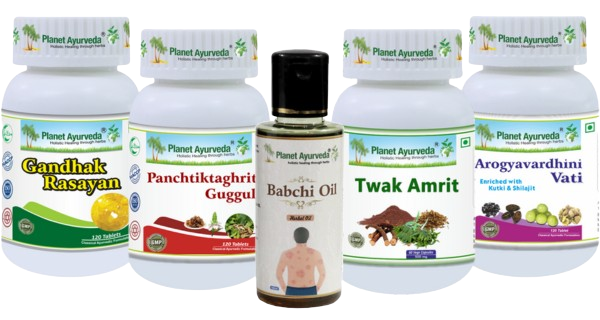
Planet Ayurveda is a globally recognized Ayurvedic healthcare brand dedicated to promoting natural healing through authentic, herbal-based solutions. It is rooted in classical Ayurvedic principles, the organization focuses on restoring health by addressing the root cause of diseases rather than merely suppressing symptoms. Planet Ayurveda emphasizes purity, safety, and efficacy by using standardized extracts, traditional formulations, and modern quality-control practices. Its wide range of herbal supplements is designed to support chronic, lifestyle and metabolic disorders while maintaining harmony between body, mind, and metabolism. With a holistic approach that integrates diet, lifestyle guidance, and herbal therapy, Planet Ayurveda continues to advocate sustainable and natural wellness solutions worldwide. Planet Ayurveda is pleased to present its list of products that are effective in the management of Tinea Versicolor.
Product List
- Gandhak Rasayan
- Panchtiktaghrit Guggul
- Twak Amrit Capsules
- Arogyavardhini Vati
- Babchi Oil
Product Description
1. Gandhak Rasayan
Gandhak Rasayan is a classical ayurvedic formulation that has a number of health benefits. It is beneficial in the management of Tinea Versicolor due to its potent antifungal, anti-inflammatory, and blood-purifying properties. Purified sulphur (Shuddha Gandhak) helps inhibit the growth of Malassezia species responsible for the condition, while relieving associated itching, scaling, and discoloration. By pacifying the aggravated Kapha and Vata doshas and purifying Rakta Dhatu, Gandhak Rasayan addresses the underlying pathology of Sidhma Kushtha. Its Rasayana action enhances skin immunity, promotes tissue repair, improves Agni (digestion), reduces Ama (endotoxins), and helps prevent recurrence, supporting healthier and more uniform skin tone.
Dosage Two tablets twice a day.
2. Panchtiktaghrit Guggul
Panchtiktaghrit Guggul is a classical ayurvedic product for a number of therapeutic usages. With its Kapha–Vata balancing and blood cleansing properties, Panchtiktaghrit Guggul supports effective management of Tinea Versicolor (Sidhma Kushtha). Its bitter herbal components namely neem (Azadirachta indica), kantkari (Solanum xanthocarpum), vasa (Adhatoda vasica), giloy (Tinospora cordifolia) etc processed in medicated ghee help reduce excessive sebaceous activity and create an internal environment unfavorable for fungal overgrowth. The presence of Guggul (Commiphora mukul) enhances detoxification, improves microcirculation, and aids in removing Ama (endotoxins) from Rakta and Mamsa Dhatu. This formulation supports skin nourishment, promotes uniform pigmentation, reduces scaling, and strengthens tissue immunity, thereby helping to minimize recurrence and restore healthy skin appearance.
Dosage Two tablets twice a day.
3. Twak Amrit Capsules
Twak Amrit is a capsule formulation by Planet Ayurveda, which helps purify Rakta Dhatu and pacify aggravated Kapha doshas and supports the management of Tinea Versicolor (Sidhma Kushtha). Its herbs such as Manjistha (Rubia cordifolia), Sariva (Hemidesmus indicus), Neem (Azadirachta indica), and Pitpapda (Fumaria officinalis) help reduce the growth of Malassezia species and inflammation that contribute to discoloration and scaling of the skin. The formulation improves skin microcirculation, supports immunity, and creates conditions unfavorable for fungal persistence. By enhancing detoxification and promoting healthy skin metabolism, Twak Amrit aids in gradual normalization of pigmentation, reduces recurrence, and supports overall skin clarity in chronic or recurrent cases.
Dosage One capsule twice a day.
4. Arogyavardhini Vati
Arogyavardhini Vati is a classical herbomineral ayurvedic medicine indicated in skin conditions. It is known for its blood cleansing, antifungal, anti-inflammatory and skin rejuvenation properties. Arogyavardhini contains ingredients namely Kutki (Picrorhiza kurroa), Shuddha Shilajit (Asphaltum), Shuddha Guggul (Commiphora mukul), Chitrak Mool (Plumbago zeylanica) and others. The formulation removes endotoxins, balances all the doshas and primarily pacifies accumulated Kapha dosha. With all these properties, the condition of Tinea Versicolor can be well managed and the hypopigmentation is also addressed.
Dosage Two tablets twice a day.
5. Babchi Oil
Babchi oil is an oil formulation that contains the goodness of Bakuchi (Psoralea corylifolia). The oil has antifungal, antipruritic and melanogenesis boosting properties. When applied over the affected areas, it works wonderfully and also provides help in getting normal skin in healed cases of Tinea Versicolor.
Direction to Use Take enough quantity of the oil and mix it with coconut oil, then apply to the affected region two times a day.
Conclusion
Tinea versicolor is a common superficial fungal infection that, while not life-threatening, can cause significant cosmetic distress. Early diagnosis and treatment with topical or systemic antifungals effectively control symptoms and improve skin appearance. Understanding the predisposing factors and implementing preventive measures are crucial in reducing recurrence. Integrating lifestyle modifications and where appropriate, herbal therapies can enhance outcomes, providing both symptomatic relief and long-term management. Awareness, patient education, and adherence to treatment are key to achieving optimal results. Above mentioned products by Planet Ayurveda work effectively in managing the condition.