


Urad / Black Lentils / Phaseolus Mungo – Ayurvedic Properties, Indications, Uses, Benefits & Dosage
Abstract
Urad (Phaseolus mungo), commonly known as Black Lentil or Black Gram, is an important pulse described in Ayurvedic classics for its nourishing, strengthening, and Vata-pacifying properties. Urad is especially beneficial in conditions associated with Vata imbalance such as debility, emaciation, joint disorders, nervous weakness, and reproductive tissue depletion. Due to its Snigdha, Guru, and Ushna qualities, it promotes strength, stability, and tissue nourishment, particularly of Mamsa (Muscle Tissue) and Shukra Dhatu (Reproductive Tissue). Classical texts also mention its role in improving vitality, semen quality, and physical endurance. Modern nutritional studies highlight its richness in proteins, dietary fiber, minerals, and bioactive compounds, supporting its traditional use in strengthening digestion, musculoskeletal health, and overall vitality. When used judiciously and properly processed, Urad serves as a valuable dietary and therapeutic substance in Ayurveda for nourishment, strength, and Vata regulation.
Classical Reference Of Urad (Phaseolus Mungo)
Bhavprakash Nighantu Dhanya Varga Page No. 631
Scientific Classification Of Urad (Phaseolus Mungo)
- Kingdom: Plantae
- Subkingdom: Tracheobionta (Vascular plants)
- Superdivision: Spermatophyta (Seed plants)
- Division: Magnoliophyta (Angiosperms)
- Class: Magnoliopsida (Dicotyledons)
- Order: Fabales
- Family: Fabaceae (Leguminosae)
- Genus: Phaseolus
- Species: mungo
Synonyms Of Urad (Phaseolus Mungo)
- Kuruvinda: This name refers to its ability to help hair grow.
- Vrishakara: This means it acts as a natural aphrodisiac to improve virility.
- Mamsala: This synonym describes how it helps increase muscle and body mass.
- Baladhya: This indicates that it is a powerful source of physical strength.
- Pitrajotama: This means it is considered the best or most superior grain for ritual ceremonies.
- Dhanyaveerah: The "hero" or the best among grains (due to its strengthening properties).
- Pittapah: That which increases Pitta (heat/bile).
- Pitrujottamah: The best grain to be used in Shraddha (rituals for ancestors).
Vernacular Names Of Urad (Phaseolus Mungo)
- Sanskrit: Masha, Krishna-Masha
- Hindi: Urad, Kali Dal
- English: Black Gram, Black Lentil
- Tamil: Ulundu
- Telugu: Minumulu, Minappa
- Kannada: Uddina Bele
- Malayalam: Uzhunnu
- Marathi: Udid, Udid Dal
- Gujarati: Adad
- Bengali: Mashkalai Dal
- Punjabi: Maash Dal
- Urdu: Mash
Habitat Of Urad (Phaseolus Mungo)
- Geographical Distribution: It is an ancient pulse crop originating from the Indian subcontinent. Archaeobotanical and genetic studies indicate India as its primary center of origin and domestication. At present, it is widely cultivated across South and Southeast Asia, including India, Pakistan, Bangladesh, Sri Lanka, Myanmar, Thailand, and parts of Indonesia. India remains the largest producer and consumer of Urad globally, with extensive cultivation in central, southern, and northern plains.
- Agro-Climatic Zones: Research data classify Urad as a crop well adapted to tropical and subtropical agro-climatic zones. It is commonly cultivated in semi-arid to sub-humid regions and performs well under rainfed as well as irrigated conditions. Its adaptability allows cultivation in diverse agro-ecological regions, including dryland farming systems.
- Temperature Requirement: Experimental agronomic studies show that Urad requires a warm climate, with an optimal temperature range of 25–35 °C for germination, vegetative growth, flowering, and pod formation. Temperatures below 20 °C delay growth and flowering, while frost conditions severely damage the crop. Hence, it is unsuitable for cold climates.
- Rainfall and Moisture Requirement: Urad grows best under moderate rainfall conditions, ideally 600–1000 mm annually, with well-distributed rainfall during early vegetative and flowering stages. Research indicates that excessive rainfall or prolonged waterlogging negatively affects root respiration, nodulation, and yield. The crop shows moderate drought tolerance due to its short duration and deep root penetration.
- Soil Requirement: Soil science studies indicate that Urad prefers well-drained loamy to sandy-loam soils with good aeration. It can also grow in light black soils but performs poorly in heavy clay and saline soils. The ideal soil pH range is 6.5–7.8. Proper drainage is critical, as water stagnation predisposes the crop to fungal diseases and root rot.
- Topography and Land Use: Urad is mainly cultivated in plains and gently sloping lands. It is frequently grown as a sole crop or as an intercrop with cereals such as sorghum, maize, pearl millet, and cotton. Research highlights its suitability for crop rotation due to its ability to improve soil fertility.
- Growth Duration and Ecological Adaptation: Urad is a short-duration annual legume, completing its life cycle within 70–90 days, making it suitable for multiple cropping systems. It forms a symbiotic association with Rhizobium species, enabling biological nitrogen fixation, which enhances soil nitrogen status and supports sustainable agriculture.
Morphology Of Urad (Phaseolus Mungo)
- Habit and Growth Form: Urad is a short-duration, annual leguminous herb showing erect to semi-erect growth. Depending on cultivar and environmental conditions, the plant generally grows between 30 to 100 cm in height. Scientific field studies report considerable variation in branching pattern, which directly influences canopy structure and yield performance.
- Root System: The plant develops a strong taproot with well-distributed lateral roots. Root nodules are commonly observed due to symbiosis with nitrogen-fixing Rhizobium bacteria. Research highlights that effective nodulation improves nitrogen availability, plant vigor, and soil fertility, making Urad agronomically valuable in crop rotation systems.
- Stem: Stems are cylindrical, green to purplish, and covered with fine hairs. The pubescent surface reduces water loss and provides protection against insect damage. Anatomical studies indicate that stem thickness, internodal length, and branching intensity are positively correlated with biomass accumulation.
- Leaves: Leaves are trifoliate and alternately arranged, a characteristic feature of the Fabaceae family. Each leaf consists of three leaflets that are ovate to rhomboid with pointed tips. The leaf surface is softly hairy, enhancing tolerance to heat and moisture stress. Research links higher leaf area index and chlorophyll content with improved photosynthetic efficiency in Urad plants.
- Inflorescence: Flowers arise in axillary racemes borne on elongated peduncles. Each raceme bears multiple flowers, usually clustered near the upper nodes, which improves reproductive efficiency.
- Flowers: The flowers are small, papilionaceous, and typically yellow to pale green in color. Structural studies confirm that Urad flowers are predominantly self-pollinating, with floral morphology favoring fertilization within the same flower, ensuring genetic stability of the crop.
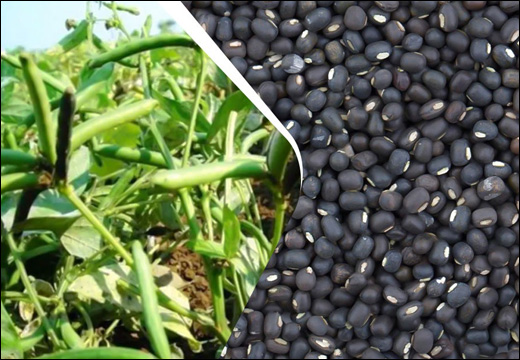
- Fruit (Pod): The fruit is a linear to slightly curved legume pod, measuring approximately 4–7 cm in length. Pods are covered with fine hairs and turn dark brown to black upon maturity. Research shows that pod formation and seed filling are sensitive to temperature and moisture stress.
- Seeds: Seeds are small, oblong to cylindrical, most commonly black in color in Urad varieties. The seed coat is smooth and firm, enclosing nutrient-rich cotyledons. Seed size, color, and testa thickness are important morphological markers used in varietal identification and quality assessment.
- Phenological Characteristics: Flower initiation generally occurs 30–40 days after sowing, while physiological maturity is reached within 70–90 days. Studies indicate that early-maturing varieties show better adaptation to rainfed and stress-prone environments.
Classical Categorisation Of Urad (Phaseolus Mungo)
- Dhanwanthari Nighantu: Suvarnadi Varga
- Bhavprakash Nighantu: Dhanya Varga
- Raj Nighantu: Shalyadi Varga
Ancient Verses For Urad (Phaseolus Mungo)
Verse No. 1
धाल्यमाषस्तु विज्ञेयः कुरुविन्दो वृषाकरः।
मांसलश्च बलाढ्यश्च पित्र्यश्च पितृजोत्तमः।।
स्निग्धोष्णो मधुरो वृष्यो मेदोमांसबलप्रदः।
वातनुद्बृंहणो बल्यो माषो बहुमलो गुरुः।। Dhanwanthari Nighantu / Suvaranadi varga / Verse no. 87-88
Shloka Interpretation
In Verse no. 87, synonyms of Urad are highlighted as below:
- Kuruvinda: This name refers to its ability to help hair grow.
- Vrishakara: This means it acts as a natural aphrodisiac to improve virility.
- Mamsala: This synonym describes how it helps increase muscle and body mass.
- Baladhya: This indicates that it is a powerful source of physical strength.
- Pitrya: This refers to its use as a sacred food in traditional ancestral rituals.
- Pitrajotama: This means it is considered the best or most superior grain for ritual ceremonies.
In Verse no. 88, properties of Urad are mentioned as below:
- Unctuous (Snigdha)
- Hot (Ushna) potency
- Sweet (Madhura) taste
- Acts as a powerful aphrodisiac (Vrishya)
- Highly effective at increasing fat (Medo), muscle (Mamsa), and overall strength (Bala) in the body
- Helps to pacify Vata (Vatanud)
- Promotes nourishment and growth (Brimhano)
- Considered a heavy (Guru) food to digest
- Noted for being nutritive
- Acting as a tonic
- Serving as a laxative (Bahumalo)
Verse No. 2
माषो गुरुः स्वादुपाकः स्निग्धो रुच्योऽनिलापहः ।
स्रंसनस्तर्पणो बल्यः शुक्रलो बृंहणः परः ॥
भिन्नमूत्रमलः स्तन्यो मेदःपित्तकफप्रदः ।
गुदकीलार्दितश्वासपक्तिशूलानि नाशयेत् ॥
कफपित्तकरा माषाः कफपित्तकरं दधि ।
कफपित्तकरा मत्स्या वृन्ताकं कफपित्तकृत् ॥ Bhavprakash Nighantu / Dhanya Varga / Verse no. 41-42
Shloka Interpretation
Properties of Urad (Black Gram)
Urad dal possesses several significant physical and medicinal qualities:
- Guru (Heavy): It is heavy to digest.
- Madhura Vipaka: It has a sweet post-digestive effect.
- Snigdha (Unctuous): It is oily or smooth in nature.
- Ruchikarak: It improves taste and appetite.
- Vata-nashak: It is effective in pacifying Vata dosha.
- Brimhana: It is highly nourishing and helps in increasing body mass and tissues (Dhatus).
- Bal-karak: It provides physical strength.
- Shukra-janak: It promotes reproductive health and increases semen.
Effect on Body Systems
The verse describes how Urad dal interacts with various bodily functions:
- Excretion: It helps in breaking down and clearing urine and feces (laxative effect).
- Lactation: It acts as a galactagogue, increasing breast milk production.
- Dosha Impact: While it balances Vata, it specifically increases Medas (fat), Pitta, and Kapha doshas.
Therapeutic Benefits
Urad dal is recommended to help alleviate the following conditions:
- Gudakila: Piles (Hemorrhoids).
- Ardita Vata: Facial paralysis.
- Shvasa: Breathing difficulties or asthma.
- Pakti-shula: Digestive pain or colic that occurs during digestion.
It is mentioned among Four Primary Substances that Increase Kapha and Pitta
- Black Gram (Urad Dal)
- Curd (Yogurt)
- Fish
- Eggplant (Brinjal)
Verse No. 3
माषस्तु कुरुविन्दः स्याद्धान्यवीरो वृषाकरः ।
मांसलश्च बलाढ्यश्च पित्तपश्च पितृजोत्तमः ।।
माषः स्निग्धो बहुमलकरः शोषणः श्लेष्मकारी वीर्य्येणोष्णो झटिति कुरुते रक्तपित्तप्रकोपम् ।
हन्याद्वातं गुरुबलकरो रोचनो भक्ष्यमाणः स्वादुर्नित्यं श्रमसुखवतां सेवनीयो नराणाम् ।। Raj Nighantu / Shalyadi Varga / Verse no. 80-81
Shloka Interpretation
Various names for Black Gram, each highlighting a specific quality:
- Kuruvinda: This name refers to its ability to help hair grow.
- Dhanyaveerah: The "hero" or the best among grains (due to its strengthening properties).
- Vrishakarah: An aphrodisiac; it enhances reproductive health and vitality.
- Mansalah: Flesh-increasing; it helps in building muscle mass.
- Baladhyah: Rich in strength; provides immense physical power.
- Pittapah: That which increases Pitta (heat/bile).
- Pitrujottamah: The best grain to be used in Shraddha (rituals for ancestors).
Properties
Masa is oily in nature and increases the bulk of stools while reducing excess moisture. It may aggravate Kapha, Rakta, and Pitta doshas. It has hot potency and helps in pacifying Vata. The herb is heavy, nourishing, strength-promoting, tasty, and improves appetite. It has a predominantly sweet taste and is suitable for regular use, especially for those engaged in physical labor or seeking bodily satisfaction.
Ayurvedic Properties Of Urad (Phaseolus Mungo)
- Taste (Rasa): Sweet (Madhur)
- Properties (Guna): Heavy (Guru), Unctuous (Snigdha)
- Potency (Veerya): Hot (Ushna)
- Post Digestion Effect (Vipaka): Sweet (Madhur)
Action On Tridosha Of Urad (Phaseolus Mungo)
Urad is Vata-pacifying, but Pitta- and Kapha-aggravating.
Therapeutic Indications Of Urad (Phaseolus Mungo)
- Parkinson’s disease
- Sciatica
- Erectile dysfunction
- Premature ejaculation
- Asthma
- Heart weakness
- Loss of appetite
- Constipation
- Neurological weakness
- Paralysis / facial paralysis
- General debility
- Vata-related disorders
Systemic Actions Of Urad (Phaseolus Mungo)
Nervous System
- Strengthens nerves and supports coordination.
- Useful in paralysis, sciatica, neurodegenerative disorders.
- Reduces Vata-related nervous weakness.
Reproductive System
- Enhances male sexual health.
- Supports erectile function and sperm quality.
- Helps in premature ejaculation and reproductive debility.
Musculoskeletal System
- Strengthens muscles and joints.
- Alleviates joint pain, arthritis, and Vata disorders.
Digestive System
- Improves appetite and digestion.
- Relieves constipation and weakness due to poor digestion.
Respiratory System
- Supports lungs and breathing.
- Useful in asthma (Shwasa) and respiratory weakness.
Cardiovascular System
- Strengthens the heart and circulation.
- Beneficial in cardiac weakness or post-illness recovery
General Strength & Immunity
- Acts as a tonic, increases vitality and stamina.
- Supports recovery from chronic illness and general debility.
Chemical Composition Of Urad (Phaseolus Mungo)
- Flavonoids: Antioxidant; reduces inflammation and protects tissues from oxidative damage.
- Phenolic Compounds: Cell-protective; helps control inflammation and supports metabolic balance.
- Saponins: Immunomodulatory; supports detoxification and reduces microbial load.
- Phytosterols: Anti-inflammatory; helps regulate lipid metabolism and supports cardiovascular health.
- Alkaloids (trace): Neuromodulatory; supports nervous system function and Vata balance.
- Bioactive Peptides: Tissue-supportive; aids muscle strength, recovery, and metabolic regulation.
- Fiber-derived Bioactives: Gut-protective; supports digestion and improves intestinal health.
- Enzyme-modulating Compounds: Metabolic regulation helps control blood sugar response.
Practical Uses / Health Benefits Of Urad (Phaseolus Mungo)
- Strengthens nerves and reduces Vata-related weakness; useful in paralysis, sciatica, and neurodegenerative conditions.
- Acts as a natural aphrodisiac, supporting erectile function, sperm quality, and male reproductive strength.
- Helps in premature ejaculation and reproductive debility.
- Strengthens muscles and joints; alleviates joint pain, arthritis, and Vata disorders.
- Improves appetite and digestion; relieves constipation and weakness due to poor digestion.
- Supports lungs and breathing; beneficial in asthma and respiratory weakness.
- Nourishes Rasa and Rakta dhatus, indirectly supporting heart strength and circulation; aids post-illness recovery.
- Acts as a tonic, increasing vitality, stamina, and overall strength.
- Supports recovery after chronic illness or general debility.
- Traditionally indicated for Vata disorders, post-illness weakness, and general strengthening (Balya) of the body.
Part Used Of Urad (Phaseolus Mungo)
Seeds
Dosage Of Urad (Phaseolus Mungo)
- Powder (Churna): 3–10 g, 1–2 times daily, taken with honey, milk, or warm water.
- Decoction (Kwath): 10–20 g of seeds boiled in water, 1–2 cups daily.
- Sprouts: 20–30 g daily, can be eaten raw or lightly cooked.
- Paste / Lepa (Topical): Applied externally
- Whole seeds / Dal: As part of diet, 30–50 g daily in cooked form for nourishment and Vata-pacifying effect.
Note: Being Vata-pacifying but Pitta- and Kapha-aggravating, Urad should be moderated in Pitta or Kapha dominant individuals. Proper processing (soaking, sprouting, or boiling) is recommended to enhance digestibility.
Home Remedies With Urad (Phaseolus Mungo)
- Decoction of black gram is traditionally used in Vata disorders such as arthritis, joint pain, fatigue, and weakness.
- Roots of black gram (Masha) are used to support bone health and help with insomnia or poor sleep.
- Hot water extract of black gram leaves is used for brain health, digestive disorders, jaundice, rheumatic pain, and inflammation.
- Flour made from black gram seeds can be used as a skin detoxifying powder, either applied on skin or used in baths, to make skin smooth and healthy.
- Gruel or porridge made with black gram, vegetables, meat, or sesame is used to improve digestion, relieve constipation, and nourish the body.
- Black gram is included in strength-promoting dishes, sometimes cooked with rice, ghee, milk, and vegetables to act as a nervine tonic, aphrodisiac, and general rejuvenator.
- Powdered mixture containing black gram (Phaseolus mungo), Priyangu (Callicarpa macrophylla), and Licorice (Glycyrrhiza glabra) is applied on minor wounds to help stop bleeding.
Contraindications Of Urad (Phaseolus Mungo)
- Loss of skin pigmentation (Vitiligo)
- Gout or Vata-induced joint disorders
- Skin inflammation (Eczema)
- Intestinal worm infections
- Difficulty or pain during urination (Dysuria)
- Disorders caused by impure or vitiated blood
- Psoriasis (Eka Kushta)
- Itchy or irritated skin
- Bleeding disorders (Raktapitta)
- Various other skin-related conditions
Vedhanika – Traditional Black Gram (Phaseolus Mungo) Snack
Ingredients
- Whole black gram (urad dal) – 1 cup (soaked overnight)
- Wheat flour – 1 cup
- Salt – to taste
- Spices – a pinch of black pepper, cumin, or cinnamon (optional)
- Ghee or oil – for frying
Instructions
- Soak the black gram overnight until soft.
- Remove the outer husk and grind the black gram into a smooth paste.
- Mix the black gram paste with wheat flour. Add salt and your chosen spices.
- Shape the mixture into small balls or patties.
- Heat ghee or oil in a pan, and fry the balls/patties until golden brown and crispy.
- Remove from oil, drain excess fat, and let them cool slightly. Serve as a nourishing snack.
Tip: This snack can also be baked for a lighter version.
Classical Products With Urad (Phaseolus Mungo)
- Mahamasha Thailam
- Mashabaladi Kashaya
- Kolakulathadi Choornam
- Marma Gulika
- Mahakukkutamamsa Tailam
- Karpasasthyadi Thailam
- Prasarinyadi Kashayam
- Shatavaryadi Churna
- Ikshuradi Lehyam
Planet Ayurveda’s Products With Urad (Phaseolus Mungo)
Conclusion
Urad (Phaseolus mungo), or Black Gram, is a highly valued pulse in Ayurveda and nutrition science due to its nourishing, strengthening, and Vata-pacifying properties. Rich in protein, dietary fiber, minerals, and bioactive compounds, it supports musculoskeletal health, reproductive vitality, digestion, and general stamina. Classical texts highlight its role in enhancing muscle and Shukra Dhatu (Reproductive), promoting strength, endurance, and vitality, while modern studies confirm its antioxidant, anti-inflammatory, and metabolic benefits. Properly processed seeds, sprouts, or decoctions provide therapeutic advantages in Vata-related disorders, neurological weakness, joint pain, reproductive dysfunctions, and post-illness recovery. Traditional preparations like Vedhanika or gruels enhance digestibility and nourishment, making Urad an important dietary and medicinal pulse for overall health, strength, and rejuvenation.