


Abroma Augusta / Pishacha Karpasa / Devil’s Cotton – Uses, Benefits, Dosage and Properties
Abstract
Abroma augusta, commonly known as Devil’s Cotton and Ulatkambal, is a medicinal plant belonging to the family Malvaceae, formerly classified under Sterculiaceae. It is distributed across South and Southeast Asia, including various regions of India. In traditional medicine, different parts of the plant have been used for menstrual disorders, particularly painful menstruation and absent or irregular menstrual flow. Other traditional uses include the management of diabetes, inflammation, respiratory complaints and certain skin conditions. Phytochemical investigations have identified several bioactive compounds in its roots, root bark, stems and leaves. Experimental studies have reported potential anti-inflammatory, antioxidant and blood-glucose-lowering activities, along with other pharmacological effects. However, most of these findings are based on preliminary laboratory or animal research, and further well-designed human clinical studies are needed to establish its therapeutic efficacy, appropriate dosage, safety and potential adverse effects.
Classical Reference Of Pishacha Karpasa (Abroma Augusta)
Bhavprakash Nighantu Karpooradi Varga Page No. 487
Scientific Classification Of Pishacha Karpasa (Abroma Augusta)
- Kingdom: Plantae
- Order: Malvales
- Family: Malvaceae
- Subfamily: Byttnerioideae
- Genus: Abroma
- Species: Abroma augustum
Classical Synonyms Of Pishacha Karpasa (Abroma Augusta)
- Pishacha Karpasa: Means “Demon’s cotton,” referring to the hairy, cotton-like material inside the fruit.
- Pivari: A traditional Sanskrit name recorded in medicinal-plant references; its literal etymology is uncertain.
- Yoshini / Yoni-pushpa: Interpreted as “flower of the womb” or “female reproductive organ flower,” derived from Yoni (womb or female reproductive organ) and Pushpa (flower).
Vernacular Names Of Pishacha Karpasa (Abroma Augusta)
- English: Devil’s Cotton, Perennial Indian Hemp
- Sanskrit: Pishacha Karpasa, Pivari, Yoshini
- Hindi: Ulatkambal, Sanukapas
- Bengali: Olatkambal, Olatkombol
- Gujarati: Ulak Tambool
- Tamil: Sivapputtuti
- Malayalam: Ulat Kambal
- Kannada: Jumuki Mara
- Unani: Ulat Kambal
Habitat And Distribution Of Pishacha Karpasa (Abroma Augusta)
- Habitat: Found in tropical and subtropical regions, particularly in forest margins, clearings, riverbanks, roadsides, open areas and disturbed habitats.
- Altitude: Grows from low elevations up to approximately 1,100–1,200 metres above sea level, depending on the region.
- Distribution in India: Reported in northeastern, eastern, northern and peninsular India, including Assam, Arunachal Pradesh, Uttar Pradesh, Kerala, Karnataka and Maharashtra.
- Worldwide Distribution: Distributed across parts of South and Southeast Asia, including Nepal, Bhutan, Bangladesh, Myanmar, Thailand, Vietnam, Cambodia, Malaysia, Indonesia, southern China and the Philippines, extending to New Guinea and some Pacific islands.
Morphology Of Pishacha Karpasa (Abroma Augusta)
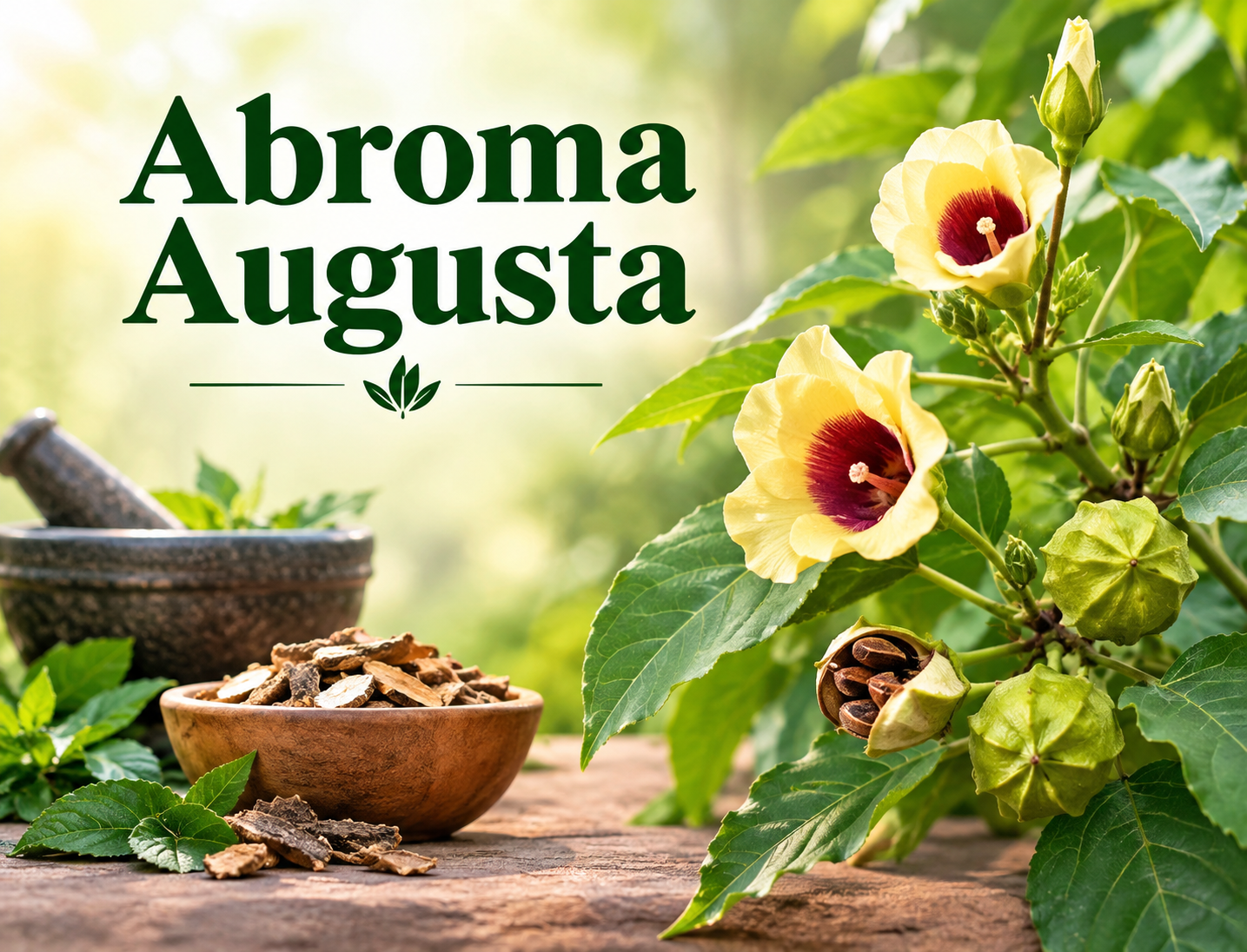
Abroma augusta (L.) L.f. is a tropical shrub or small tree belonging to the family Malvaceae. It may grow up to approximately 10 metres in height under favourable conditions, although cultivated plants are often shorter. The plant is characterized by hairy branches, tough and fibrous bark, highly variable leaves, distinctive pendulous flowers and five-winged capsules containing numerous seeds. Several parts of the plant bear stellate hairs, which may cause skin irritation.
- Stem: The stem is erect, branched and covered with soft or stiff hairs, particularly in young growth. Young stems may have a reddish or purplish appearance. The bark is tough and fibrous and yields bast fibres. Some branches bear stiff, pointed hairs that may cause irritation on contact. The plant may develop multiple shoots from the base, particularly after cutting or coppicing.
- Root: The root system anchors the plant firmly in the soil and supports its growth. The roots are woody, and the root bark is described in traditional medicinal-plant literature. Detailed information about root architecture and internal structure is less consistently documented than the morphology of the above-ground parts. Root characteristics may vary with the age of the plant and growing conditions.
- Leaves: The leaves are simple, alternate and highly variable in shape, a feature known as heterophylly. Two principal forms are commonly observed. Lobed leaves: These are broad and heart-shaped to ovate in outline, usually with three to five lobes. Under favourable conditions, they may reach approximately 30–40 cm in length and width. They generally have long petioles. Unlobed leaves: These are generally ovate to lanceolate, with a heart-shaped base, pointed apex and toothed margins. They tend to have shorter petioles than the larger lobed leaves. The leaf margins are dentate or irregularly toothed. The venation is prominent, with three to seven main veins radiating from the base. Stellate hairs may occur on both leaf surfaces, particularly on the lower surface.
- Inflorescence: The inflorescence is generally a small cyme, usually bearing one to four flowers. Flowers occur opposite the leaves or near the ends of branches. They are borne on relatively slender stalks and characteristically hang downwards. This pendulous arrangement is one of the distinctive features of the species.
- Flower: The flowers are bisexual, generally actinomorphic and pentamerous, meaning that their floral parts are arranged in fives. They are pendulous and typically measure approximately 3–5 cm in diameter. The petals may be dark purple, reddish-purple, maroon or yellow, depending on the specimen and botanical description. Each flower consists of five sepals, five petals, an androecium and a superior ovary.
- Calyx: The calyx consists of five greenish, triangular sepals that are deeply divided almost to the base. The sepals are generally free from one another and may persist around the developing fruit. Their appearance may change slightly as the fruit matures.
- Corolla: The corolla consists of five spoon-shaped petals. Each petal has a concave base that may appear pale or whitish, while the broader blade is often dark purple, reddish or maroon; yellow forms may also be reported. The petal margins or surfaces may bear fine hairs. The petals are free from one another and alternate with the sepals.
- Androecium: The androecium consists of ten staminal structures, comprising five fertile stamens and five sterile structures known as staminodes. The filaments of the fertile stamens are united at the base to form a short staminal tube. The anthers are arranged in groups alternating with the petal-like staminodes. This arrangement is characteristic of the flower’s reproductive structure.
- Gynoecium: The gynoecium consists of a superior ovary, generally divided into five locules, with numerous ovules. The style extends from the ovary and terminates in a stigma. Following fertilization, the ovary develops into the characteristic capsule containing numerous seeds.
- Fruit: The fruit is a dry, dehiscent capsule, generally obconical and approximately 4–5 cm long. It is characteristically five-winged and angular, with numerous seeds enclosed inside. The mature capsule may bear stiff hairs and split open upon maturity to release the seeds. The persistent calyx may remain around the developing fruit.
- Seeds: The seeds are numerous, small, black and cylindrical to obovoid in shape. They are approximately 3–4 mm long and about 2 mm wide, although measurements may vary between specimens. The seeds lack wings and an aril. They contribute to the plant’s natural regeneration, while vegetative regrowth may also occur through basal shoots after cutting.
Botanical note: The dimensions and some morphological characteristics may vary according to the specimen, age and growing conditions. For formal scientific publication, verify exact measurements and reproductive details against a regional flora or herbarium description of Abroma augusta (L.) L.f.
Classical Categorisation Of Pishacha Karpasa (Abroma Augusta)
Bhavprakash Nighantu: Pushpa Varga
Ayurvedic Properties Of Pishacha Karpasa (Abroma Augusta)
- Rasa (Taste): Katu (Pungent), Tikta (Bitter)
- Guna (Properties): Laghu (Light), Rooksha (Dry)
- Vipaka (Post Digestion Effect): Katu (Pungent)
- Veerya (Potency): Ushna (Hot)
Action On Tridosha Of Pishacha Karpasa (Abroma Augusta)
Balances Vata and Kapha Dosha.
Therapeutic Indications Of Pishacha Karpasa (Abroma Augusta)
A. Menstrual Disorders
- Kashtartava (painful menstruation): Traditionally used in preparations for menstrual pain.
- Artava Kshaya (reduced menstrual flow): Traditionally described for complaints involving reduced menstrual flow.
- Amenorrhoea (absence of menstruation): Documented in traditional medicinal use, although the underlying cause requires medical evaluation.
- Oligomenorrhoea (infrequent menstruation): Reported in traditional medicinal literature for menstrual irregularities.
B. Uterine And Reproductive Health
Traditionally described as an emmenagogue, meaning an agent used to promote menstrual flow, and as a uterine stimulant. These traditional properties warrant caution, particularly during pregnancy and when managing fertility-related concerns.
C. Diabetes Mellitus
Traditionally used in some medicinal systems for diabetes. Preliminary laboratory and animal studies have investigated its potential antidiabetic activity, but clinical evidence in humans remains insufficient to establish its safety and effectiveness.
D. Inflammatory And Musculoskeletal Complaints
Traditionally used for rheumatic pain and related musculoskeletal complaints. Preliminary pharmacological research has explored potential anti-inflammatory and antioxidant properties, but clinical benefits in humans have not been established.
Systemic Actions Of Pishacha Karpasa (Abroma Augusta)
- Reproductive system: Traditionally used for menstrual irregularities, dysmenorrhoea and amenorrhoea.
- Endocrine system: Investigated for potential antidiabetic activity.
- Musculoskeletal system: Traditionally used for rheumatic pain and inflammation.
- Respiratory system: Reported in traditional medicine for certain respiratory complaints.
- Urinary system: Traditionally used for some urinary disorders.
- Integumentary system: Investigated for wound-healing activity.
Chemical Composition Of Pishacha Karpasa (Abroma Augusta)
Root
- Abromine: An alkaloidal constituent historically reported in the plant. Its precise pharmacological significance and clinical effects require further investigation.
- Abromasterol: A sterol-related constituent reported in the roots; its specific therapeutic effects in humans are not established.
- Friedelin: A naturally occurring pentacyclic triterpenoid investigated for potential anti-inflammatory and other biological activities.
- Betaine: A naturally occurring compound involved in cellular osmotic balance and methyl-group metabolism.
- Choline: An essential nutrient involved in cell-membrane structure and the synthesis of acetylcholine, a neurotransmitter.
- β-Sitosterol: A plant sterol studied for its potential effects on inflammation and cholesterol absorption.
- Stigmasterol: A plant sterol investigated for antioxidant and anti-inflammatory properties.
- α-Amyrin: A pentacyclic triterpenoid reported in the plant’s root bark and investigated for potential anti-inflammatory activity.
- Maslinic acid: A naturally occurring triterpenoid studied for potential antioxidant, anti-inflammatory and metabolic effects.
These constituents have been reported in phytochemical studies of the roots or root bark of Abroma augusta.
Root Bark
- Maslinic acid: A pentacyclic triterpenoid investigated for potential antioxidant, anti-inflammatory and metabolic activities.
- α-Amyrin: A triterpenoid studied for its potential anti-inflammatory and tissue-protective effects.
- Caffeic acid: A phenolic compound with antioxidant activity that has been investigated for its potential anti-inflammatory effects.
- Vanillic acid: A phenolic acid known for antioxidant activity and studied for potential anti-inflammatory effects.
- Protocatechuic acid: A phenolic compound investigated for antioxidant and anti-inflammatory properties.
- Polysaccharides: Complex carbohydrates reported in the root bark, including fractions containing rhamnose, arabinose, xylose, mannose, galactose, glucose, galacturonic acid and glucuronic acid.
These compounds represent different chemical classes, including triterpenoids, phenolic acids and polysaccharides. Their presence does not by itself establish clinical efficacy.
Stem Bark
- Friedelin: A pentacyclic triterpenoid investigated for potential anti-inflammatory and other pharmacological activities.
- β-Sitosterol: A plant sterol studied for its potential effects on inflammatory processes and cholesterol absorption.
Heartwood
- Friedelin: A naturally occurring triterpenoid with potential biological activities under investigation.
- β-Sitosterol: A plant sterol associated with research into inflammation and cholesterol metabolism.
- 1,28-Octacosanediol: A long-chain aliphatic diol identified in the heartwood and studied primarily as a phytochemical constituent.
Leaves
- Taraxerol: A pentacyclic triterpenoid investigated for potential anti-inflammatory and other biological activities.
- Taraxeryl acetate (taraxerol acetate): An acetate derivative of taraxerol reported in the leaves and studied for its phytochemical properties.
- β-Sitosterol: A plant sterol investigated for potential anti-inflammatory and metabolic effects.
- Lupeol: An additional triterpenoid reported in the leaves and investigated for potential anti-inflammatory and antioxidant activities.
Home Remedies With Pishacha Karpasa (Abroma Augusta)
- Root bark juice: Traditionally used for dysmenorrhoea (painful menstruation) and amenorrhoea (absence of menstruation).
- Leaf juice: Traditionally reported for sinusitis and associated headache.
- Leaf and stem infusion: Traditionally reported in folk medicine for gonorrhoea; clinical safety and effectiveness have not been established.
- Root bark paste: Traditionally applied to abscesses and sores.
Safety note: These are traditional uses, not established clinical treatments. Abroma augusta has reported uterine-stimulating and abortifacient effects. It should not be used during pregnancy or to induce menstruation without qualified medical supervision.
Part(S) Used Of Pishacha Karpasa (Abroma Augusta)
- Root Bark
- Stem Bark
- Leaves
- Roots
Dosage Of Pishacha Karpasa (Abroma Augusta)
- Powder: 1-3 gm
- Fresh Juice: 5-10 ml
Ayurvedic Products With Pishacha Karpasa (Abroma Augusta)
- Ulatkambal Churna
- Ulatkambal Kwatha
Research On Pishacha Karpasa (Abroma Augusta)
Pharmacological research on Abroma augusta (L.) L.f. has investigated its potential antioxidant, anti-inflammatory, antidiabetic, hepatoprotective and cytotoxic properties. The available evidence primarily comes from laboratory experiments, cell studies and animal models. Some published studies have subsequently received an Expression of Concern or been retracted, making careful evaluation of their findings essential. The therapeutic efficacy and safety of this plant in humans remain insufficiently established.
A. Antioxidant And Hepatoprotective Activity
A 2025 study investigated the methanolic stem-bark extract of Abroma augusta using antioxidant assays and experimental models involving HepG2 cells and goat liver homogenate exposed to carbon tetrachloride. The researchers identified 50 phytochemical compounds or features belonging to different chemical classes. The extract demonstrated antioxidant activity in DPPH, FRAP and ABTS assays. The experimental results also indicated reductions in lipid peroxidation and certain markers associated with liver-cell injury, including alanine aminotransferase (ALT), aspartate aminotransferase (AST) and lactate dehydrogenase (LDH). These findings suggest potential antioxidant and hepatoprotective activity in experimental systems; however, further research is required to establish its effectiveness and safety in humans.
B. Antidiabetic And Organ-Protective Activity
A 2015 animal study investigated the methanolic leaf extract of Abroma augusta in rats with experimentally induced type 2 diabetes. The researchers reported reductions in blood glucose and improvements in lipid abnormalities, oxidative-stress markers and inflammatory mediators. Changes in kidney and heart tissue injury markers were also reported. The proposed mechanisms included modulation of inflammatory mediators such as interleukin-1 beta (IL-1β), interleukin-6 (IL-6) and tumour necrosis factor-alpha (TNF-α), along with changes in nuclear factor kappa B (NF-κB) and protein kinase C (PKC) signalling pathways. However, the journal issued an Expression of Concern in 2025 regarding image similarities and the unavailability of original image data. Therefore, these findings must be interpreted cautiously and should not be considered confirmed evidence of antidiabetic or organ-protective efficacy.
C. Anti-Inflammatory Activity
A 2012 study evaluated methanolic extracts from different parts of Abroma augusta using the carrageenan-induced rat paw oedema model, a standard experimental method for investigating inflammation. The researchers reported reductions in experimentally induced paw swelling and suggested that plant constituents, including alkaloids and flavonoids, might contribute to the observed effects. These findings provide preliminary evidence of potential anti-inflammatory activity. Nevertheless, animal-model results cannot establish clinical effectiveness, an appropriate therapeutic dose or safety in humans.
D. Antioxidant And Cytotoxic Activity
A 2020 laboratory study investigated the methanolic bark extract of Abroma augusta for antioxidant, haemolytic and cytotoxic activities. The extract demonstrated free-radical scavenging activity in the DPPH assay, while cytotoxic effects were observed against Ehrlich ascites carcinoma cells. The researchers also reported changes in apoptosis-associated markers, including p53, Bax, NF-κB and Bcl-2. An experimental animal model showed inhibition of tumour-cell growth following extract administration. These findings indicate potential biological activity that warrants further investigation. However, effects observed in cancer cells and animal models do not establish that the plant is an effective or safe treatment for cancer in humans.
Safety & Precautions While Using Pishacha Karpasa (Abroma Augusta)
- Pregnancy: Avoid use during pregnancy because of reported uterine-stimulating and abortifacient effects.
- Breastfeeding: Safety during breastfeeding has not been adequately established. Consult a qualified healthcare professional before use.
- Diabetes: The plant has shown potential blood-glucose-lowering effects in experimental studies. People taking antidiabetic medicines should avoid unsupervised use because of the possibility of altered blood glucose levels.
- Menstrual disorders: Do not use the plant to induce menstruation or treat absent or irregular periods without medical evaluation and supervision.
- Side effects: Comprehensive human safety data are lacking. Gastrointestinal discomfort, allergic reactions and other adverse effects cannot be ruled out.
- Drug interactions: Inform your healthcare provider about all prescription medicines, over-the-counter medicines and herbal products you use, as potential interactions have not been adequately studied.
- Self-medication: Avoid consuming the roots, root bark, stem bark or leaves as home remedies without qualified professional guidance. The safety of different plant parts and preparations has not been adequately established.
Conclusion
Abroma augusta (Ulatkambal) is an important medicinal shrub belonging to the family Malvaceae. It is traditionally used for menstrual disorders, particularly dysmenorrhoea and amenorrhoea. The root bark is one of its important medicinal parts. Preliminary pharmacological studies have indicated potential antidiabetic, anti-inflammatory, antioxidant and antimicrobial activities. However, further scientific research is required to establish its safety and therapeutic efficacy in humans. Therefore, Abroma augusta should be used cautiously under the guidance of a qualified healthcare professional, especially during pregnancy.




