


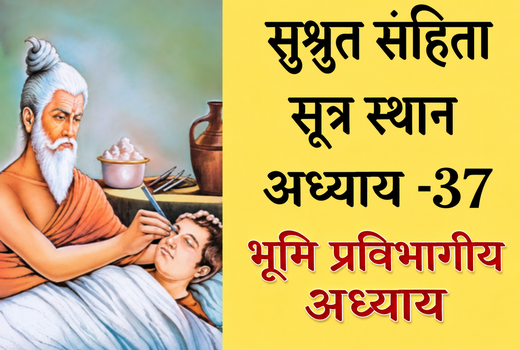
Bhumi Pravibhageeya Adhyaya (Classification Of Geographical Regions) – 37th Chapter of Sushruta Samhita
The 37th chapter of Sutrasthana in Sushruta Samhita is known as Bhumi Pravibhagiya Adhyaya. It describes the classification of different geographical regions based on their soil characteristics, climate, vegetation, and environmental conditions.
अथातो भूमिप्रविभागीयमध्यायं व्याख्यास्यामः ||१||
यथोवाच भगवान् धन्वन्तरिः ||२||
We shall now explain the chapter entitled Bhumipravibhagiya Adhyaya, which deals with the classification of different geographical regions, as taught by the revered Acharya Dhanvantari.
Samanya Bhumi Pariksha: General Assessment Of Soil And Land Characteristics
श्वभ्रशर्कराश्मविषमवल्मीकश्मशानाघातनदेवतायतनसिकताभिरनुपहतामनूषरामभङ्गुरामदूरोदकां स्निग्धां प्ररोहवतीं मृद्वीं स्थिरां समां कृष्णां गौरीं लोहितां वा भूमिमौषधग्रहणाय परीक्षेत |
तस्यां जातमपि कृमिविषशस्त्रातपपवनदहनतोयसम्बाधमार्गैरनुपहतमेकरसं पुष्टं पृथ्ववगाढमूलमुदीच्यां चौषधमाददीतेत्येष भूमिपरीक्षाविशेषः सामान्यः ||३||
Before gathering medicinal plants and herbs, the geographical characteristics of the land should be carefully assessed. The area selected for the growth and collection of medicinal substances must possess the following desirable features. The land should –
Characteristics of Suitable Land for Medicinal Plant Collection-The land selected for cultivating and collecting medicinal plants should possess the following characteristics:
Desirable Features Of The Land:
- Free from burrows, broken pottery, stones and other unwanted materials.
- Level and even, without uneven surfaces or slopes.
- Free from anthills, cremation grounds, slaughterhouses, temples and sand dunes.
- Non-alkaline in nature.
- Firm and not fragile.
- Should have a nearby water source, with water available at a shallow depth.
- Moist and unctuous in nature.
- Rich in naturally growing plant sprouts.
- Possess soft soil.
- Stable and uniform in structure.
- Ideally black, white or red in colour.
Characteristics Of Medicinal Plants:
The medicinal plants growing in such land should have the following qualities:
- Free from insect infestation.
- Undamaged by poison, sharp instruments, excessive sunlight, strong winds, fire, rainwater or roads.
- Possess one predominant taste (Rasa).
- Be healthy, well-nourished and fully developed.
- Have thick, deep-growing roots that spread towards the north.
Method Of Collection:
- Medicinal plants possessing the above-mentioned qualities should be selected for collection.
- The collector should sit facing the north direction while gathering the plants.
General Principle:Proper examination of the land and careful selection of medicinal plants are essential steps in ensuring the quality and therapeutic properties of collected herbs.
Pancavidha Bhumi: Five Types Of Soil And Land Classification
विशेषतस्तु तत्र, अश्मवती स्थिरा गुर्वी श्यामा कृष्णा वा स्थूलवृक्षशस्यप्राया स्वगुणभूयिष्ठा; स्निग्धा शीतलाऽऽसन्नोदका स्निग्धशस्यतृणकोमलवृक्षप्राया शुक्लाऽम्बुगुणभूयिष्ठा; नानावर्णा लघ्वश्मवती प्रविरलाल्पपाण्डुवृक्षप्ररोहाऽग्निगुणभूयिष्ठा; रूक्षा भस्मरासभवर्णा तनुवृक्षाल्परसकोटरवृक्षप्रायाऽनिलगुणभूयिष्ठा; मृद्वी समा श्वभ्रवत्यव्यक्तरसजला सर्वतोऽसारवृक्षा महापर्वतवृक्षप्राया श्यामा चाकाशगुणभूयिष्ठा ||४||
Classification of Land Based on the Predominant Mahabhutas-The characteristics of different land regions can be further classified according to the predominance of the five fundamental elements (Panchamahabhutas), as described below:
Parthiva Bhumi (Land Dominated by Earth Element)-The land predominantly possessing the qualities of Prithvi Mahabhuta exhibits the following features:
- Rocky and firm in nature.
- Stable and heavy in structure.
- Bluish-black or black in colour.
- Abundant in large trees and dense vegetation
Ambu or Jala Bhumi (Land Dominated by Water Element)-The region dominated by Jala Mahabhuta possesses the following characteristics:
- Moist, unctuous and sticky in nature.
- Cool to touch.
- Located near a water source, with water available at a shallow depth below the ground.
- Rich in juicy and succulent plants, grasses and young trees.
- Characterised by white-coloured soil.
Agneya Bhumi (Land Dominated by Fire Element)-The land predominantly influenced by Agni Mahabhuta has the following features:
- Contains numerous small rocks of different colours.
- Supports the growth of small trees, plants and white-coloured sprouts.
- Vegetation is scattered, with considerable space between individual plants and trees.
Anila Bhumi (Land Dominated by Air Element)-The region dominated by Vayu Mahabhuta can be identified through the following characteristics:
- Dry in nature.
- Ash-coloured or resembling the colour of a donkey.
- Contains numerous small, dry plants.
- Vegetation may have hollow spaces or cavities.
- Plants possess very little moisture or juice.
Akashiya Bhumi (Land Dominated by Ether Element)-The land predominantly possessing Akasha Mahabhuta exhibits the following characteristics:
- Soft and even soil.
- Contains pits or depressions in the ground.
- Plants produce tasteless or flavourless juices, and the water is also tasteless.
- Abundant growth of trees lacking sufficient sap.
- Characterised by numerous large mountains and trees.
- Soil is bluish-black in colour.
Ausadhi Sangrahana Kala: Appropriate Season For Collecting Medicinal Plants
अत्र केचिदाहुराचार्याः- प्रावृड्वर्षाशरद्धेमन्तवसन्तग्रीष्मेषु यथासङ्ख्यं मूलपत्रत्वक्क्षीरसारफलान्याददीतेति; तत्तु न सम्यक्, सौम्याग्नेयत्वाज्जगतः | सौम्यान्यौषधानि सौम्येष्वृतुष्वाददीत, आग्नेयान्याग्नेयेषु; एवमव्यापन्नगुणानि भवन्ति |सौम्यान्यौषध्मनि सौम्येष्वृतुषु गृहीतानि सोमगुणभूयिष्ठायां भूमौ जातान्यतिमधुरस्निग्धशीतानि जायन्ते | एतेन शेषं व्याख्यातम् ||५||
Seasonal Guidelines for Collecting Different Parts of Medicinal Plants-According to the opinion of certain authorities, different parts of medicinal plants should be harvested during specific seasons to obtain their desired medicinal properties. The recommended collection periods are as follows:
- Roots (Moola): Pravrit Ritu (early rainy season).
- Leaves (Patra): Varsha Ritu (rainy season).
- Bark (Twak): Sharad Ritu (autumn season).
- Latex or Plant Sap (Ksheera): Hemanta Ritu (early winter season).
- Pith (Sara): Vasanta Ritu (spring season).
- Fruits (Phala): Grishma Ritu (summer season).
Explanation Of The Opposing View
However, this seasonal classification is not considered appropriate in every situation. The entire universe is primarily governed by two fundamental principles: Saumya and Agneya.
- Saumya: Refers to substances possessing cooling, gentle and mild properties, similar to the qualities of the Moon.
- Agneya: Refers to substances possessing heating, intense and strong properties, resembling the nature of Fire.
Therefore, the collection of medicinal plants should be based on their inherent properties rather than following a fixed seasonal schedule.
- Medicines possessing Sheeta Guna (cooling properties) should be collected during Saumya or cooler seasons.
- Medicines possessing Ushna Guna (heating properties) should be collected during Agneya or warmer seasons.
Thus, the appropriate season for harvesting medicinal substances should be determined by considering their dominant qualities and therapeutic characteristics.When medicinal plants are collected according to their inherent properties and suitable seasonal conditions, their natural qualities remain preserved without undergoing any undesirable changes.
Characteristics of Saumya Herbs and Medicines:The following medicinal substances are generally sweet in taste (Madhura Rasa), unctuous (Snigdha) and cooling (Sheeta):
- Herbs naturally possess cooling properties
- Herbs collected during cold or cooler seasons
- Herbs growing in regions characterised by predominantly cool environmental conditions
Characteristics of Agneya Herbs and Medicines:-The properties of Agneya herbs and medicines should be understood in the same manner, considering their inherent characteristics, the season of collection and the nature of the geographical region in which they grow.
Collection Of Emetic And Purgative Medicinal Herbs
तत्र पृथिव्यम्बुगुणभूयिष्ठायां भूमौ जातानि विरेचनद्रव्याण्याददीत, अग्न्याकाशमारुतगुणभूयिष्ठायां वमनद्रव्याणि, उभयगुणभूयिष्ठायामुभयतोभागानि, आकाशगुणभूयिष्ठायां संशमनानि, एवं बलवत्तराणि भवन्ति ||६||
Selection of Medicinal Plants According to Their Therapeutic Actions-
- Medicinal plants should be collected from specific geographical regions based on their therapeutic properties and the predominance of the five Mahabhutas.
- Virechana Dravyas (Purgative drugs): Should be collected from regions dominated by Prithvi (Earth) and Jala (Water) Mahabhutas.
- Vamana Dravyas (Emetic drugs): Should be obtained from regions predominantly possessing Agni (Fire), Akasha (Ether) and Maruta (Air) Mahabhutas.
- Vamana-Virechana Dravyas (Drugs with both emetic and purgative actions): Should be collected from regions exhibiting a combination of the respective elemental properties.
- Shamana Dravyas (Palliative drugs): Should be collected from regions dominated by Akasha (Ether) Mahabhuta.
Importance: Medicinal substances collected according to these principles are considered to possess greater potency and therapeutic effectiveness.
Abhinava Ausadha: Newly Collected Or Fresh Medicinal Drugs
सर्वाण्येव चाभिनवानि, अन्यत्र मधुघृतगुडपिप्पलीविडङ्गेभ्यः ||७||
Guidelines Regarding the Freshness of Medicinal Substances-All medicinal substances should preferably be used in their fresh form, except for the following:-
- Madhu: Honey
- Ghrita: Ghee (clarified butter)
- Guda: Jaggery
- Pippali: Long pepper (Piper longum)
- Vidanga: False black pepper (Embelia ribes)
These substances are exceptions to the general rule of using freshly collected medicinal drugs.
Medicinal Herbs That Retain Their Therapeutic Properties Even When Not Fresh
विडङ्गं पिप्पली क्षौद्रं सर्पिश्चाप्यनवं हितम् |
शेषमन्यत्वभिनवं गृह्णीयाद्दोषवर्जितम् ||८||
Medicinal Substances That Become More Beneficial with Ageing-The following substances are considered more beneficial when used after being stored for some time rather than in their freshly collected form:
- Vidanga (Embelia ribes)
- Pippali (Piper longum)
- Kshaudra: Honey
- Sarpi: Ghee (clarified butter)
All remaining medicinal substances should be used in their fresh form and must be free from defects, damage or any visible impurities.
Sap-Rich Medicinal Plants
(सर्वाण्येव सक्षीराणि वीर्यवन्ति;) तेषामसम्पत्तावतिक्रान्तसंवत्सराण्याददीतेति ||९||
Medicinal plants containing their natural sap are considered more potent and therapeutically effective. If such fresh, sap-rich herbs are unavailable, plants that are not older than one year should be selected for medicinal use.
भवन्ति चात्र-
गोपालास्तापसा व्याधा ये चान्ये वनचारिणः |
मूलाहाराश्च ये तेभ्यो भेषजव्यक्तिरिष्यते ||१०||
Bhesaja Vyakti (Individuals Assisting Physicians)-Individuals who possess practical knowledge of medicinal plants and their collection, and who assist physicians in identifying and obtaining medicinal substances, are known as Bhesaja Vyakti or para-medical assistants.
They include:
- Cowherds.
- Ascetics and hermits.
- Hunters.
- Tribal communities.
- Individuals who travel through forests to collect medicinal roots, herbs and other plant materials.
Appropriate Time For Collecting Medicinal Plants Used In Their Entirety
सर्वावयवसाध्येषु पलाशलवणादिषु |
व्यवस्थितो न कालोऽस्ति तत्र सर्वो विधीयते ||११||
When medicinal preparations require the use of all parts of a plant or tree, as in the preparation of Palasa Lavana, there is no specific season prescribed for collecting the herbs. Such medicinal plants can be collected during any season of the year.
Classification Of Land Based On Its Smell, Colour And Taste
गन्धवर्णरसोपेता षड्विधा भूमिरिष्यते |
तस्माद्भूमिस्वभावेन बीजिनः षड्रसायुताः ||१२||
There are six types of soil, each characterized by a distinct and prominent smell, colour and taste. Medicinal plants and trees growing in these different types of soil develop six tastes according to the specific characteristics of the land.
How Does Water Acquire Its Taste?
अव्यक्तः किल तोयस्य रसो निश्चयनिश्चितः |
रसः स एव चाव्यक्तो व्यक्तो भूमिरसाद्भवेत् ||१३||
Water is naturally tasteless, as its inherent taste remains unexpressed. However, when it comes into contact with the soil of a particular region, it acquires and expresses the taste associated with the characteristics of that soil.
Sadharana Desha: Moderate Or Temperate Region
सर्वलक्षणसम्पन्ना भूमिः साधारणा स्मृता |
द्रव्याणि यत्र तत्रैव तद्गुणानि विशेषतः ||१४||
Sadharana Desha (moderate or temperate region) refers to a geographical area that possesses the characteristics of all types of land. Medicinal plants growing in such regions generally exhibit qualities that reflect the natural properties of their surrounding environment.
Medicinal Substances Suitable For Therapeutic Use
विगन्धेनापरामृष्टमविपन्नं रसादिभिः |
नवं द्रव्यं पुराणं वा ग्राह्यमेवं विनिर्दिशेत् ||१५||
Any medicinal herb or drug that does not exhibit any abnormal smell, taste or other unusual characteristics may be considered suitable for therapeutic use, regardless of whether it is fresh or old.
Collection Of Animal-Derived Medicinal Substances
जङ्गमानां वयःस्थानां रक्तरोमनखादिकम् |
क्षीरमूत्रपुरीषाणि जीर्णाहारेषु संहरेत् ||१६||
Animal-derived substances, such as blood, hair, nails and other body parts, should be collected from animals that are in the middle stage of life (mature age).
Bheshajagara: Medicinal Drug Storage House (Pharmacy)
प्लोतमृद्भाण्डफलकशङ्कुविन्यस्तभेषजम् |
प्रशस्तायां दिशि शुचौ भेषजागारमिष्यते ||१७||
Bhesajagara refers to a pharmacy or storage facility used for preserving medicinal herbs and drugs. It should be constructed in a clean and suitable location, preferably in an auspicious direction. The medicinal substances should be properly covered with clean cloth and stored in earthen pots placed on wooden shelves or suspended using hooks to ensure their proper preservation.
इति सुश्रुतसंहितायां सूत्रस्थाने भूमिप्रविभागीयो नाम सप्तत्रिंशत्तमोऽध्यायः ||३७ ||
Thus concludes the Thirty-Seventh Chapter, titled Bhumipravibhagiya Adhyaya, of the Sutra Sthana of Sushruta Samhita.