


Cytokeratin-18 Fragments (M30 / M65) – What Is It? Why Is It Done? & Ayurvedic Hepatoprotective Herbs
Abstract
Chronic liver diseases are characterized by progressive hepatocellular injury that may culminate in fibrosis, cirrhosis, and liver failure. Traditional laboratory markers such as transaminases indicate hepatocyte injury but do not directly reflect mechanisms of cell death. Differentiating between apoptotic and necrotic injury has important clinical implications because patterns of cell death influence disease progression and treatment response. This article provides a detailed review of the biological basis, laboratory methodology, clinical applications, interpretation, advantages, limitations, and integrative perspectives related to CK-18 fragment testing. Measurement of M30 and M65 offers a non-invasive approach to assessing hepatocellular injury and provides insight into disease activity and progression in chronic liver disorders.
Introduction
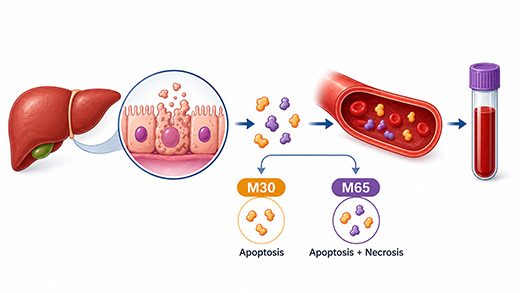
Cytokeratin-18 fragment assays were developed to provide a mechanistic assessment of hepatocyte injury. By quantifying circulating fragments generated during cell death, these biomarkers offer insight into ongoing tissue damage and disease activity. Their clinical relevance has been extensively studied in metabolic liver disease, viral hepatitis, and drug-induced liver injury. Cytokeratin-18 (CK-18) fragments, measured as M30 and M65, are circulating biomarkers that reflect hepatocyte cell death and have gained importance in the evaluation of liver disease, particularly metabolic-associated fatty liver disease and non-alcoholic steatohepatitis. CK-18 is an intermediate filament protein expressed in hepatocytes and other epithelial cells. During cellular injury, apoptotic and necrotic processes generate distinct CK-18 fragments that can be quantified in serum. The M30 assay detects caspase-cleaved fragments released during apoptosis, whereas the M65 assay measures total CK-18 fragments released during both apoptosis and necrosis.
Biological And Molecular Basis
Cytokeratin-18 is a structural protein belonging to the intermediate filament family. It is abundantly expressed in hepatocytes and contributes to cellular architecture, mechanical stability, and intracellular organization.
When hepatocytes undergo programmed cell death (apoptosis), intracellular enzymes known as caspases cleave cytokeratin-18 at specific sites. This process generates characteristic fragments that are released into the bloodstream.
Two Principal Forms Of CK-18 Fragments Are Clinically Measurable
M30 Fragment
The M30 assay detects a neoepitope created by caspase-mediated cleavage of cytokeratin-18. This fragment specifically reflects apoptotic hepatocyte death.
M65 Fragment
The M65 assay measures total cytokeratin-18 fragments released during both apoptosis and necrosis. It therefore reflects overall hepatocellular death regardless of mechanism.
The relationship between M30 and M65 values provides insight into the dominant mode of cell injury. A higher proportion of M30 relative to M65 suggests apoptosis predominance, whereas disproportionate elevation of M65 suggests necrotic injury.
Pathophysiological Significance
Hepatocyte death plays a central role in liver disease progression. Apoptosis contributes to inflammation, fibrogenesis, and tissue remodeling, while necrosis reflects more severe cellular injury. Measurement of CK-18 fragments provides a quantitative indicator of these processes.
In metabolic-associated liver disease, lipotoxic stress, oxidative injury, and inflammatory signaling pathways activate apoptotic cascades. In advanced disease, necrotic injury may become more prominent. CK-18 fragment measurement captures these pathophysiological events in a non-invasive manner.
Test Procedure And Laboratory Methodology
Sample Collection
The test requires a venous blood sample collected in a serum tube. Standard phlebotomy procedures are used, and special preparation is typically not required unless specified by the laboratory.
Analytical Principle
CK-18 fragment measurement is performed using enzyme-linked immunosorbent assay (ELISA) techniques. These assays employ monoclonal antibodies that selectively recognize specific CK-18 epitopes.
- The M30 assay detects caspase-cleaved CK-18 fragments.
- The M65 assay detects both intact and cleaved CK-18 fragments.
Reported Units
Results are generally reported in units per liter (U/L), though reference intervals vary according to the assay platform.
Reference Values And Interpretation
Reference intervals differ between laboratories; however, interpretive patterns rather than absolute cutoffs are often clinically informative.
Low Values
Low M30 and M65 concentrations suggest minimal hepatocellular injury and limited ongoing cell death.
Predominant Apoptosis Pattern
Elevated M30 with proportional M65 elevation indicates apoptosis-dominant hepatocyte injury. This pattern is frequently observed in metabolic-associated liver disease with active inflammation.
Mixed Injury Pattern
Simultaneous elevation of both markers indicates combined apoptotic and necrotic cell death, suggesting more advanced tissue injury.
Predominant Necrosis Pattern
Disproportionate elevation of M65 relative to M30 suggests extensive necrotic damage and severe cellular disruption.
Trend Assessment
Serial measurements provide information about disease activity. Rising levels indicate increasing hepatocellular injury, while declining values suggest improvement or therapeutic response.
Clinical Applications
Evaluation of Metabolic-Associated Fatty Liver Disease
CK-18 fragment measurement has been extensively studied in the differentiation of simple steatosis from steatohepatitis. Elevated apoptosis markers correlate with inflammatory activity and disease severity.
Assessment Of Disease Activity
The biomarkers reflect active hepatocyte injury and provide insight into ongoing pathological processes that may not be evident from conventional liver enzyme tests.
Fibrosis Risk Stratification
Persistent hepatocyte apoptosis contributes to fibrogenesis. Elevated CK-18 fragments are associated with increased risk of disease progression.
Monitoring Therapeutic Response
Changes in CK-18 fragment concentrations over time reflect alterations in hepatocyte injury and may assist in monitoring response to interventions.
Drug-Induced Liver Injury Evaluation
Measurement of apoptosis-related fragments provides insight into mechanisms of hepatotoxicity.
Factors Influencing Test Results
Several biological and clinical variables may influence CK-18 fragment concentrations:
- Degree of hepatic inflammation
- Metabolic stress and insulin resistance
- Obesity-related cellular injury
- Viral infection activity
- Drug-induced hepatocyte toxicity
- Sampling variability
Clinical interpretation requires correlation with overall patient context.
Advantages
- Non-invasive assessment of hepatocyte death
- Differentiates apoptotic and necrotic injury mechanisms
- Reflects disease activity rather than static injury markers
- Useful for monitoring changes over time
- Provides mechanistic insight into liver pathology
Limitations
- Not disease-specific
- Reference ranges vary between assays
- Cannot replace histological evaluation when required
- Interpretation requires integration with clinical findings
- Limited availability in some clinical settings
Relationship With Other Liver Biomarkers
CK-18 fragment assays provide information distinct from traditional liver function tests and tumor biomarkers. While transaminases reflect hepatocyte membrane integrity and tumor markers reflect malignant transformation, CK-18 fragments directly indicate cell death processes. Integration of structural, biochemical, and mechanistic markers provides a more comprehensive understanding of liver disease status.
Supportive Role of Ayurvedic Hepatoprotective Herbs
In Ayurvedic medicine, preservation of hepatic cellular integrity is essential for maintaining metabolic balance and tissue nourishment. Hepatoprotective herbs are described as Pittashamaka (pitta pacifying) and Rasayana (rejuvenation) and are traditionally used to support cellular resilience and regulate metabolic transformation. Modern experimental observations suggest that several such botanicals demonstrate antioxidant and hepatocyte-protective properties that may support liver functional stability.
Bhumi Amalaki (Phyllanthus niruri)
Bhumi Amalaki contains lignans and polyphenols that enhance antioxidant defenses and reduce oxidative stress–mediated cellular injury. Experimental findings indicate stabilization of hepatocyte membranes and modulation of inflammatory signaling pathways.
Kalmegh (Andrographis paniculata)
Kalmegh contains andrographolide, which supports hepatocyte protection through regulation of oxidative stress responses and inflammatory mediators. Experimental studies suggest preservation of cellular enzymatic function.
Kutki (Picrorhiza kurroa)
Kutki contains iridoid glycosides that support hepatocyte membrane stability and antioxidant capacity. Experimental observations indicate modulation of fibrogenic signaling pathways and preservation of hepatic tissue architecture.
Bhringaraja (Eclipta alba)
Bhringaraja demonstrates antioxidant activity and supports hepatocyte regeneration. Bioactive compounds contribute to preservation of cellular integrity under metabolic stress conditions.
Sharpunkha (Tephrosia purpurea)
Sharpunkha exhibits antioxidant and metabolic regulatory properties that support hepatocyte function and tissue homeostasis.
Punarnava (Boerhavia diffusa)
Punarnava supports microcirculatory balance and metabolic regulation. Its bioactive compounds demonstrate antioxidant activity and support tissue health.
Integrative Perspective
Measurement of CK-18 fragments provides insight into mechanisms of hepatocyte injury and disease activity. Strategies that support oxidative balance, metabolic regulation, and cellular stability may contribute to preservation of liver function. Integrative approaches combining modern biomarker assessment with supportive hepatoprotective strategies provide a comprehensive framework for evaluating hepatic health.
Conclusion
Cytokeratin-18 fragments measured as M30 and M65 represent important non-invasive biomarkers of hepatocyte cell death. By distinguishing apoptotic and necrotic injury patterns, these markers provide mechanistic insight into liver disease activity and progression. Their application in metabolic liver disease assessment, therapeutic monitoring, and evaluation of hepatocellular injury highlights their clinical relevance. When interpreted within a comprehensive clinical framework, CK-18 fragment measurement contributes to a deeper understanding of hepatic pathology and supports modern approaches to liver disease evaluation.