


Herbal Remedies For Metachromatic Leukodystrophy (MLD) – Symptoms, Causes & Treatment in Ayurveda
Abstract
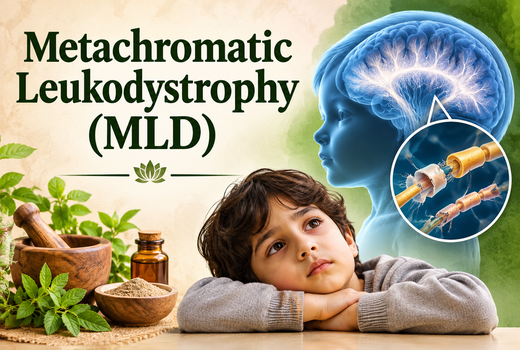
Metachromatic Leukodystrophy (MLD) is a rare genetic disorder that damages the body’s nervous system. To understand MLD, imagine your nerves as electrical wires wrapped in a protective plastic coating called myelin. In MLD, a missing body protein (enzyme) causes natural fats to build up inside nerve cells. This buildup breaks down the protective myelin coating, making it hard for the brain and body to send signals to each other. Depending on when it starts, MLD causes progressive loss of movement, speech, and thinking abilities. While traditional medical care mainly helps manage symptoms, newer treatments like stem cell transplants and gene therapy can slow or stop the disease if caught early. Ayurveda views MLD as a deep imbalance in nerve tissue caused by blocked body channels and offers supportive care to keep patients comfortable.
Introduction
Leukodystrophies are a family of genetic diseases that affect the brain’s white matter—the part containing myelin-coated nerve fibers. Metachromatic Leukodystrophy is one of the most well-known types. It gets its name because the fat deposits that build up in the body stain a different color under a microscope. MLD affects roughly 1 in 40,000 to 1 in 160,000 people worldwide. It is a severe, lifelong condition that gets progressively worse without early treatment. Symptoms can start in early childhood as a sudden loss of walking and speech, or appear much later in adulthood as subtle memory or behavioral changes. Diagnosing MLD early is essential because modern treatments work best before major nerve damage happens.
Causes
MLD is caused by a change (mutation) in specific genes responsible for keeping nerves healthy:
- Missing Enzyme (ARSA gene): Most people with MLD have a mutation in the ARSA gene. This gene tells the body how to make an enzyme called arylsulfatase A. Without this enzyme, the body cannot break down a natural fatty substance called sulfatide.
- Missing Activator (PSAP gene): In rare cases, a person makes the enzyme, but lacks a helper protein called saposin B (coded by the PSAP gene) that allows the enzyme to work.
- Autosomal Recessive Inheritance: A child only gets MLD if they inherit a faulty gene copy from both parents. Parents are usually healthy “carriers” who have no symptoms and may not know they carry the gene until their child is diagnosed.
Pathophysiology
Pathophysiology simply means how a disease alters normal body functions:
- Fat Buildup: Because the cleanup enzyme is missing, unused sulfatide fats accumulate inside the waste-disposal units (lysosomes) of brain cells and peripheral nerves.
- Cell Death: As fat builds up, it overwhelms and damages oligodendrocytes (cells that make myelin in the brain) and Schwann cells (cells that make myelin in the limbs).
- Loss of Myelin (Demyelination): As these cells die, the protective myelin coating around nerves strips away. Without myelin, nerve signals slow down or stop completely.
- Nerve Degeneration: Over time, the naked nerve fibers themselves begin to wither and die, leading to widespread loss of muscle control, sensation, and brain function.
Signs And Symptoms
MLD symptoms vary depending on the age at which the disease begins. Doctors divide MLD into three main forms:
Late-Infantile Form (Most Common)
- Age: Starts between 1 and 2 years old.
- Symptoms: Toddlers who were walking and talking normally start stumbling, falling, and losing balance. Muscles become weak, then stiff (spastic). Children gradually lose the ability to stand, sit, speak, swallow, and see. This form progresses very quickly.
Juvenile Form
- Age: Starts between 4 and 16 years old.
- Symptoms: Early signs include falling school performance, behaviour changes, or clumsiness with hands (like struggling to write). Over time, speech becomes slurred, muscle stiffness increases, and mental abilities decline over several years.
Adult Form
- Age: Starts after age 16 (often in a person’s 20s or 30s).
- Symptoms: Often starts with behavioural or mental health changes—such as mood swings, memory loss, depression, or confusion—which can easily be mistaken for psychiatric conditions. Physical problems like difficulty walking or muscle stiffness develop later and progress slowly over decades.
Diagnosis
To confirm MLD, doctors run targeted tests to evaluate nerve function and look for the missing enzyme:
- Enzyme Test: A simple blood test measures the level of the arylsulfatase A enzyme in white blood cells. Low levels suggest MLD.
- Urine Test: Checks for excess sulfatide fats spilling into the urine.
- Genetic Testing: Confirms the diagnosis by finding the exact mutation in the ARSA or PSAP genes.
- Brain MRI Scan: Detailed images show clear patterns of myelin damage (white matter loss) in the brain.
- Nerve Conduction Test: Measures how fast electrical signals move through the arms and legs, showing slowing caused by nerve damage.
Modern Treatment
Historically, medicine could only offer supportive care—using medications to relieve muscle stiffness, prevent seizures, use feeding tubes for nutrition, and offer physical therapy to keep joints flexible. Today, advanced disease-modifying treatments are changing outcomes:
- Gene Therapy: A breakthrough treatment (such as Atidarsagene autotemcel) takes the patient’s own blood stem cells, inserts a correct copy of the missing gene using a lab vector, and reinfuses the cells back into the patient. These modified cells produce the missing enzyme and protect the brain. It works best when given before major symptoms appear.
- Stem Cell / Bone Marrow Transplant: Healthy donor stem cells are transplanted into the patient to produce the missing enzyme. This is mainly effective in very early or mild stages before significant brain tissue is lost.
Ayurveda Insight
In classical Ayurveda, MLD is understood as a severe imbalance affecting Majja Dhatu (the nervous system and bone marrow tissue):
- Blocked Channels (Srotorodha): Weak tissue digestion (Dhatvagni mandya) creates metabolic waste (Ama), which clogs the fine channels of the body and prevents nutrients from nourishing nerve tissue.
- Vata Imbalance: The blocked channels severely aggravate Vata Dosha (specifically Prana Vata governing brain function and Vyana Vata governing motor movement), leading to nerve wasting, stiffness, and weakness.
In Ayurveda, these supportive therapies aim to improve comfort and quality of life:
- Ama (Toxins)-Clearing Herbs: Gentle bitter herbs to improve metabolic fire and digest internal waste.
- Oil Therapies (Snehana & Swedana): Warm herbal oil massages and gentle steam reduce muscle stiffness, soothe pain, and nourish outer tissues.
- Nasal Therapies (Nasyam): Herbal drops administered through the nostrils to deliver soothing plant properties toward the head and nervous system.
- Rejuvenating Herbs (Rasayanas): Tonic herbs such as Brahmi, Ashwagandha, and Mandukaparni to support brain health, ease stress, and maintain residual nerve strength alongside regular medical care.
Herbal Remedies For MLD By Planet Ayurveda
Planet Ayurveda offers a wide range of Ayurvedic herbal products for various health concerns. These products are prepared using natural herbs and traditional Ayurvedic principles. Each formulation focuses on supporting health and overall well-being. Planet Ayurveda aims to make Ayurveda accessible to people across the world through quality herbal formulations. It combines traditional Ayurvedic knowledge with modern healthcare needs and promotes natural wellness. Here, we will discuss some formulations of Planet Ayurveda for MLD. Let’s start!
- Capsule Neurogenie
- Cap Fev Lo
- Jai Mangal Ras
- Saraswatarisht
- Medhya Churna
- Kalyanaka Ghrit
Herbal Remedies for Metachromatic Leukodystrophy (MLD)
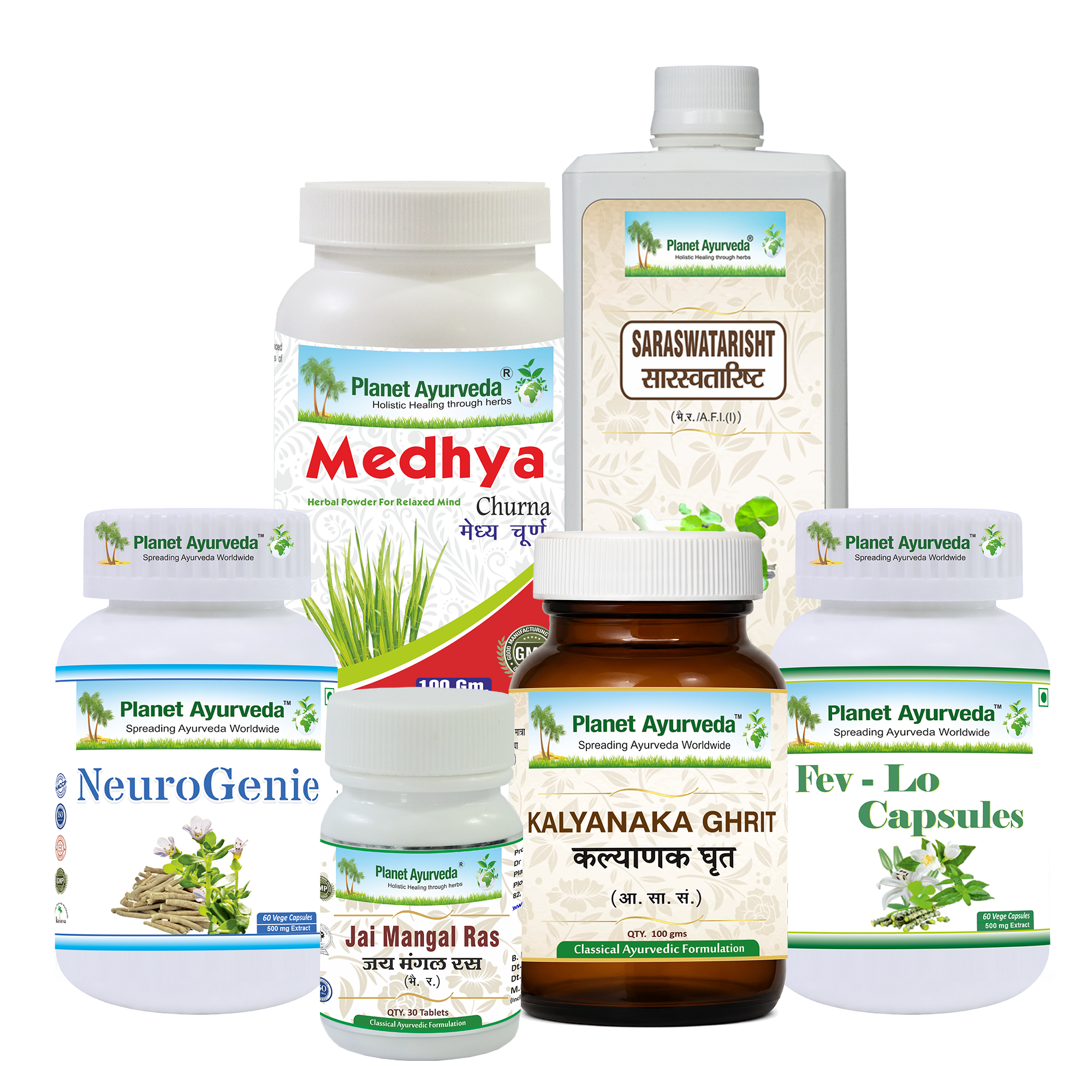

Product Description:
1. Capsule Neurogenie
Neurogenie Capsules by Planet Ayurveda contain Brahmi (Bacopa monnieri) and Ashwagandha (Withania somnifera), two traditionally valued Ayurvedic herbs known for their role in supporting brain and nervous system health. Brahmi is traditionally used to support memory, concentration, mental clarity and cognitive functions, while Ashwagandha is valued for its nourishing and adaptogenic properties. Both herbs have been studied for their antioxidant potential and neuroprotective activities. In the context of Metachromatic Leukodystrophy (MLD), these ingredients may be considered for general neurological wellness and supportive care, particularly in maintaining cognitive health and overall vitality.
Dosage: 1 capsule twice daily after a meal with plain water.
2. Capsule Fev Lo
Fev-Lo Capsule brings together powerful Ayurvedic botanicals and minerals like Sudarshan (Crinum latifolium), Kalmegh (Andrographis paniculata), Giloy (Tinospora cordifolia), Godanti Bhasma (purified gypsum) and Harshringar (Nyctanthes arbor-tristis), which work synergistically to support patients managing Metachromatic Leukodystrophy (MLD). This combination helps clear deep-seated metabolic waste from cellular microchannels, allowing vital nutrients to reach degenerating tissues more effectively. The soothing properties of Harshringar and Godanti Bhasma reduce muscular stiffness, ease nerve discomfort, and calm systemic Vata and Pitta imbalances. Meanwhile, Giloy and Kalmegh enhance metabolic fire (Dhatvagni) and deliver potent antioxidant protection to shield neural structures from oxidative stress. Additionally, Sudarshan supports overall physical resilience and helps regulate internal thermal comfort during periods of physical fatigue.
Dosage: 1 capsule twice daily after a meal with plain water.
3. Jai Mangal Ras
Jai Mangal Ras acts as a powerful Ayurvedic Rasayana and catalyst (Yogavahi) that delivers deep cellular nourishment directly to the nervous system (Majja Dhatu) for individuals managing Metachromatic Leukodystrophy (MLD). The synergistic combination of Kajjali (purified mercury and sulphur) with mineral calces enhances tissue metabolism (Dhatvagni) and carries restorative qualities across complex physiological barriers. Tamra Bhasma and Tankan Bhasma work together to clear accumulated metabolic waste (Ama) from microchannels (Srotas), encouraging unhindered nutrient circulation to nerve sheaths. Concurrently, Vanga Bhasma provides structural tone to degenerating tissues, supporting motor stamina and physical stability. By deeply pacifying aggravated Vata Dosha, this classical formulation helps ease muscular spasticity, soothe chronic nerve discomfort, and maintain functional vitality.
Dosage: 1 tablet once daily after a meal with plain water.
4. Saraswatarishta
It serves as a premier Ayurvedic Rasayana that delivers deep neuro-nourishment, cognitive support, and tissue vitality to individuals navigating complex neurological conditions like Metachromatic Leukodystrophy (MLD). The inclusion of Swarna Bhasma acts as a potent catalytic agent (Yogavahi), carrying active botanical compounds past deep cellular barriers directly into nerve and brain tissues (Majja Dhatu). Together, Brahmi and Ashwagandha work synergistically to maintain cognitive functions, reduce oxidative stress in brain cells, and soothe nerve irritability while supporting muscle tone and physical stamina. Shatavari further enhances this formulation by providing deep tissue-nourishing (Brimhana) properties that help counteract progressive physical weakness and maintain systemic balance. While this classical remedy does not cure underlying genetic mutations or restore lost myelin, its holistic combination of herbs and mineral calx offers vital supportive care. Ultimately, Saraswatarishta (Gold) helps nourish degenerating neural structures, ease systemic stress, and significantly enhance overall comfort and quality of life.
Dosage: 5 ml twice daily after a meal with plain water.
5. Medhya Churna
Medhya Churna is a classical Ayurvedic herbal powder designed to support brain health, cognitive function, and neurological wellness in individuals managing complex conditions like Metachromatic Leukodystrophy (MLD). The formulation features powerful neuroprotective botanicals such as Vacha (Acorus calamus), Ashwagandha (Withania somnifera), Ajmoda (Carum roxburghianum), Shwet Jeerak (Cuminum cyminum), Krishna Jeerak (Carum carvi), Sonth (Zingiber officinale) and many more. Vacha and Ashwagandha work synergistically to nourish the Majja Dhatu (nervous system), enhance mental clarity, and soothe hyperactive nerve responses. Meanwhile, supportive carminative and warming spices like Ajmoda, Shwet Jeerak, Krishna Jeerak, and Sonth help boost digestive fire (Agni), clear metabolic waste (Ama), and improve nutrient delivery to deep tissue microchannels. While this traditional blend does not reverse genetic mutations or rebuild myelin, it offers comprehensive supportive care by reducing oxidative stress, easing neuromuscular tension, and enhancing overall daily well-being.
Dosage: 1/4 tsp twice daily after a meal with lukewarm water.
6. Kalyanaka Ghrit
Kalyanaka Ghrit is a classical Ayurvedic medicated ghee traditionally formulated to support brain health, cognitive function, and neurological stability in complex neurodegenerative conditions like Metachromatic Leukodystrophy (MLD). This therapeutic blend contains key botanical ingredients such as Haritaki (Terminalia chebula), Bibhitaki (Terminalia bellirica), Amalaki (Emblica officinalis), Vishala (Rakta indravaruni), Badi Elaichi (Amomum subulatum) and many more. The classic Triphala combination (Haritaki, Bibhitaki, and Amalaki) delivers rich antioxidant protection, clears cellular metabolic waste (Ama), and rejuvenates tissue matrices. Vishala and Badi Elaichi work synergistically to boost tissue metabolism (Dhatvagni) and keep microvascular channels (Srotas) clear for unhindered nutrient delivery. Because pure cow’s ghee acts as a lipid-soluble catalytic vehicle (Yogavahi), it carries these herbal bio-compounds deep across metabolic barriers into neural tissues (Majja Dhatu). Together, these ingredients soothe aggravated Vata, reduce neuro-systemic stress, and enhance daily physical comfort and vitality for patients undergoing long-term care.
Dosage: 1/2 tsp twice daily after a meal with lukewarm water.
Conclusion
Metachromatic Leukodystrophy is a rare inherited metabolic disorder characterised by deficient arylsulfatase A activity and progressive sulfatide accumulation in the nervous system. It damages the myelin sheath and gradually affects movement, coordination, communication and cognitive abilities. Early diagnosis through biochemical investigations, genetic testing and brain MRI is essential for identifying suitable treatment options. Modern approaches such as gene therapy offer significant opportunities for selected patients, particularly when treatment begins before extensive neurological damage. From an Ayurvedic perspective, MLD can be discussed through Vata Dosha, Majja Dhatu (nervous tissue) and Ojas (vitality and immunity), with emphasis on nourishment and supportive care. However, specialised medical treatment, rehabilitation and multidisciplinary management remain essential for improving patients’ quality of life.




