


Carthamus tinctorius L. / Safflower / Kusum / Bastard Saffron – Uses, Benefits, Dosage and Properties
Abstract
Safflower (Carthamus tinctorius L.), commonly known as Kusum or Bastard saffron , is an important medicinal and oilseed plant belonging to the family Asteraceae. It has been traditionally used in various systems of medicine, including Ayurveda, for its potential therapeutic properties. Different parts of the plant, particularly the flowers and seeds, contain several bioactive constituents, including flavonoids, quinochalcone pigments, and fatty acids. The flowers are rich in natural colouring compounds, such as carthamin, while the seeds are valued for their oil content and nutritional importance. Safflower has traditionally been associated with applications related to skin health, menstrual disorders, and blood circulation. Its phytochemical composition has attracted scientific interest in exploring its antioxidant, anti-inflammatory and other biological activities
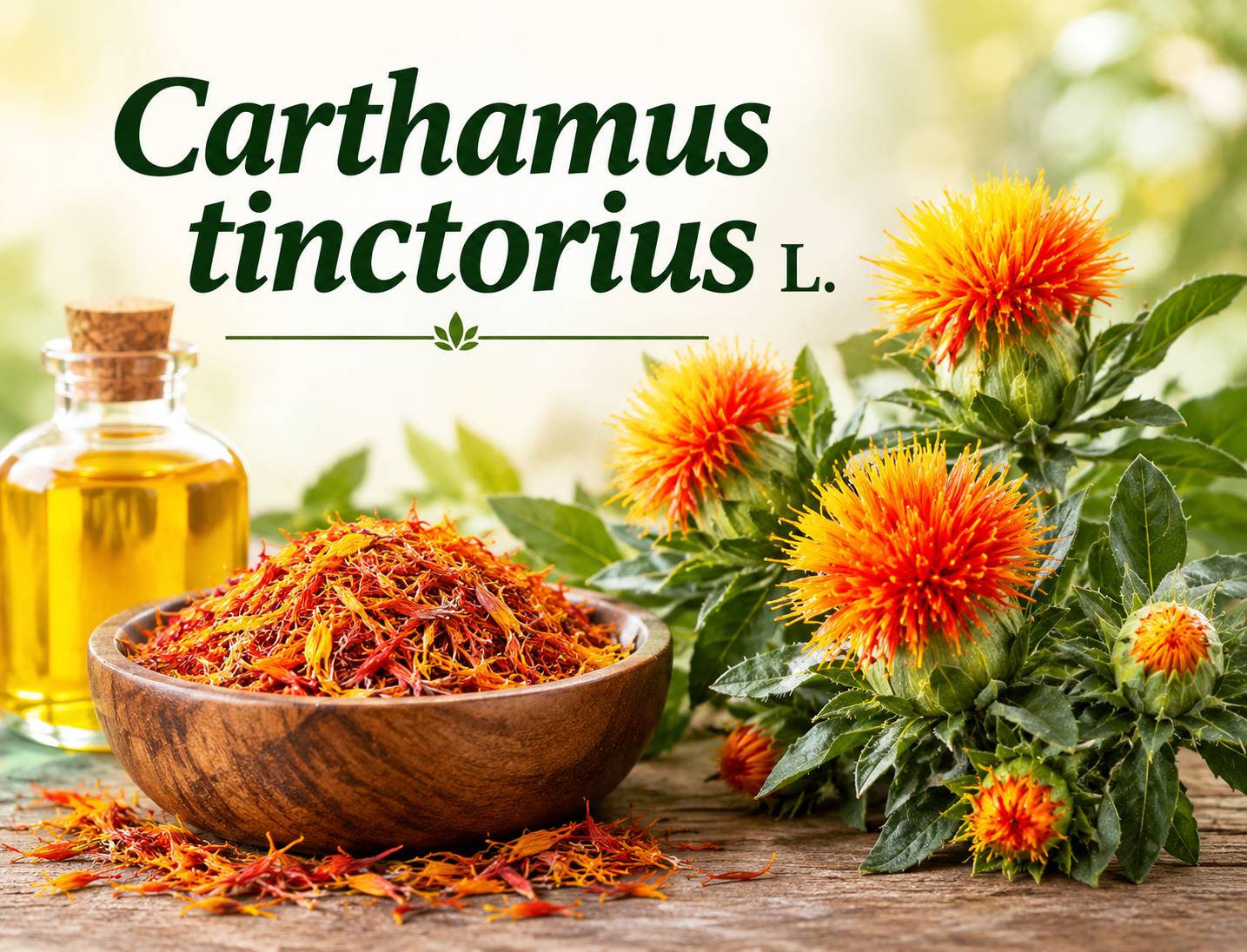
Safflower (Carthamus tinctorius L.) is an annual, erect, branched herb belonging to the family Asteraceae.
- Habit : The plant is erect, annual and branched, usually reaching approximately 40–150 cm in height , depending on the variety and growing conditions.
- Root : It possesses a well-developed taproot with lateral branches. The root system can penetrate deeply into the soil, helping the plant absorb water during periods of limited rainfall.
- Stem : The stem is erect, firm and branched, generally green to pale green. Branches develop in the upper portion of the plant and bear flower heads at their tips.
- Leaves : The leaves are simple, alternate and sessile. They vary from ovate-lanceolate to lanceolate in shape, with margins that may be entire, toothed or spiny. The upper leaves are usually smaller and may partly surround the flower heads.
- Inflorescence : The flowers are arranged in terminal, thistle-like heads known botanically as capitula. Each head contains numerous individual florets surrounded by involucral bracts.
- Flowers : The florets are tubular and generally yellow, orange or reddish-orange. Flower colour may vary with the cultivar and stage of development. The outer bracts are often stiff and spiny.
- Fruit and seeds : The fruit is a dry, one-seeded structure called an achene, generally pale-coloured and oval to angular. A pappus may be absent or present, depending on the variety. The seeds are rich in oil , which is used for food and other commercial purposes.
Synonyms
- Kusumbha (कुसुम्भ) : Traditional Sanskrit name of safflower.
- Vastraranjaka (वस्त्ररञ्जक) : That which colours or dyes clothes; referring to its use as a natural dye.
- Agnishikha (अग्निशिखा) : Flame-like; referring to the bright reddish-orange colour of the flowers.
- Kusuma (कुसुम) : Flower ; a general Sanskrit term for a blossom
Vernacular Names
- Sanskrit : Kusumbha
- Hindi : Kusum, Kusumbha
- Marathi : Kardai, Kardi
- Gujarati : Kasumbo
- Malayalam : Chendurakam
- English : Safflower, Bastard saffron, False saffron
- Urdu : Gul Rang
Historical View
According to Bhavaprakasha Nighantu, Haritakyadi Varga, Kusumbha (कुसुम्भ) is described by
“ स्यात्कुसुम्भं वह्निशिखं वस्त्ररञ्जकमित्यपि।
कुसुम्भं वातलं कृच्छ्ररक्तपित्तकफापहम्॥ १९२॥ ”
Meaning : The first line describes its other names like Kusumbha (The traditional name of safflower) , Vahnisikha(Flame-like, referring to the vivid colour of its flowers) ,Vastraranjaka (That which colours or dyes garments). The second line describes the traditional Ayurvedic properties attributed to Kusumbha, including its effects on Vata, difficult urination (Mutrakrichhra), bleeding disorders associated with Pitta, and Kapha.
According to Dhanvantri Nighantu, Suvarnadi Varga
“ कुसुम्भं वातलं रूक्षं रक्तपित्तकफापहम् ॥१०५॥ ”
Meaning : Kusumbha is described as Vata-provoking, dry in quality and alleviating Raktapitta and Kapha.
Habitat
Kusum or safflower (Carthamus tinctorius L.) belongs to the family Asteraceae and is believed to have originated in the Middle East, with a long history of cultivation in Asia and the Mediterranean region. It is now cultivated in India and other parts of the world, particularly in arid and semi-arid regions. In India, it is grown mainly in Maharashtra, Karnataka, Telangana and other parts of the Deccan Plateau. The plant thrives in sunny conditions, well-drained soils, and areas with low to moderate rainfall. Its deep root system helps it tolerate drought, making it suitable for dryland farming.
Ayurvedic Properties Of Kusum
- Rasa (Taste) : Katu (pungent).
- Guna (Qualities) : Vidahi (sharp and irritating) properties
- Virya (Potency) : Ushna (hot)
- Vipaka (Post-digestive effect) : Katu (pungent).
- Karma (Actions): Reduces Kapha
Pharmacological Activities
- Antioxidant activity : Safflower contains phenolic compounds and flavonoids that may help protect cells against oxidative damage.
- Anti-inflammatory activity : Certain safflower extracts have shown potential to reduce inflammation in experimental studies.
- Analgesic activity: Safflower extracts have demonstrated potential pain-relieving effects.
- Antimicrobial activity : Selected safflower extracts have shown activity against certain microorganisms under laboratory conditions.
- Antithrombotic activity : Some safflower preparations may influence platelet function and blood clot formation.
Bioactive Constituents
- Carthamin : A red pigment found in safflower flowers, mainly responsible for their colouring properties.
- Hydroxysafflor yellow A (HSYA) : A yellow quinochalcone pigment that has been widely investigated for its biological activities.
- Carthamidin : A flavonoid-related pigment present in the flowers.
- Luteolin : A flavonoid studied for its antioxidant and anti-inflammatory potential.
- Kaempferol : A flavonoid with reported antioxidant and other biological activities.
- Quercetin : A polyphenolic flavonoid known for its antioxidant properties.
- Linoleic acid : An essential polyunsaturated fatty acid found abundantly in safflower seed oil.
- Oleic acid : A monounsaturated fatty acid that contributes to the nutritional value of the seed oil.
Classification
- Kingdom : Plantae
- Class : Magnoliopsida
- Family : Asteraceae
- Genus : Carthamus
- Species : Carthamus tinctorius L.
Clinical Uses
- Swedajanana : Safflower flowers are described as promoting sweating in Ayurvedic drug references.
- Deepana : Traditionally associated with stimulating appetite and digestion.
- Mutrakrichh (मूत्रकृच्छ्र) : Difficulty or discomfort during urination.
- Raktapitta (रक्तपित्त) : A traditional disorder involving abnormal bleeding.
- Kapha disorders (कफ विकार) : Conditions associated with excess Kapha.
- Vata aggravation (वात प्रकोप) : Kusumbha is described as Vatala, meaning it may aggravate Vata.
Systemic Actions
- Digestive system (Annavaha Srotas) : Traditionally described as pungent and potentially irritating (Vidahi).
- Urinary system (Mutravaha Srotas) : Classical references mention an association with Mutrakrichhra (difficulty or discomfort during urination).
- Circulatory system (Raktavaha Srotas) : Traditionally associated with effects on blood ; some constituents are being investigated for cardiovascular and platelet-related activities.
- Musculoskeletal system : Extracts have shown potential anti-inflammatory effects in experimental research.
- Integumentary system (skin) : Flower pigments and phenolic compounds are studied for antioxidants and other biological activities.
- Nervous system : Certain constituents have neuroprotective effects.
- Metabolic system : Safflower seed oil provides unsaturated fatty acids that can contribute to dietary lipid management.
Planet Ayurveda Products Containing Safflower
Kumkumadi Anti-Ageing Thailam
Home Remedies
- Kusum seed oil for dry skin : A commercially prepared safflower-oil moisturizer may help soften dry, intact skin. Patch-test first.
- Kusum oil in food : Food-grade safflower oil can be used in ordinary cooking as a source of unsaturated fats. Replacing some saturated fat with unsaturated fat can support a heart-healthy diet.
References
Charaka Samhita : Sutrasthana 27, Annapana-vidhi Adhyaya , verses 98–113 .
Bhavaprakasa Nighantu : Haritakyadi Varga , verse 192 .
Precautions
- Pregnancy: Avoid medicinal doses of Kusum flowers and concentrated extracts during pregnancy unless specifically advised by a qualified clinician.
- Blood-thinning medicines: Consult your doctor before using safflower flower supplements if you take warfarin, aspirin, clopidogrel, or other medicines that affect clotting.
- Allergies: Do not use it if you develop a rash, itching, or swelling. Severe allergic symptoms require emergency care.
- Product quality: Use correctly identified, reputable products. Do not consume ornamental flowers, unidentified plant material, or preparations intended only for external use.
Recent Research
A study published in the Journal of Ethnopharmacology on 10 May 2026 investigated safflower for skin fibrosis associated with systemic sclerosis, a disease that can cause hardening and thickening of the skin. Researchers investigated the plant’s chemical constituents and biological pathways. Experiments in mice and cultured cells suggested reduced fibrosis-related changes. A study published in the Journal of Photochemistry and Photobiology B: Biology, in the January 2026 issue, examined hydroxysafflor yellow A (HSYA), a compound found in safflower. Researchers reported antioxidant and anti-inflammatory effects in experimental models.The compound reduced UV-associated cellular damage and changes linked to premature skin ageing
Parts Used
- Flowers : Traditionally valued for their red-orange pigment.
- Seed oil : used as an edible oil.
Dosage
2- 4 g of flower powder




