


Selaginella Bryopteris / Selaginella Species – Ayurvedic Uses, Benefits, Dosage & Therapeutic
Abstract
There are about 700–750 species of Selaginella, a genus commonly referred to as spikemosses. These are not single herbs in the usual sense but a large group of non-seed vascular plants that thrive in diverse habitats, ranging from tropical forests to arid regions. Members of the family Selaginellaceae represent primitive vascular plants with remarkable ethnomedicinal significance. In Ayurveda, Selaginella is valued for its rejuvenating and adaptogenic properties, often linked with vitality and resilience under stress. Among them, Selaginella bryopteris holds special renown in Indian tradition as the legendary “Sanjeevani Booti,” believed to restore life in the Ramayan. Beyond mythology, modern research highlights their antioxidant, antimicrobial, and stress-protective activities, confirming their importance in both traditional healthcare practices and contemporary medicine.
Introduction
Selaginella species are pteridophytes, often termed “spike mosses,” that display remarkable survival mechanisms such as resurrection under drought. Selaginella, belonging to the family Selaginellaceae, is a close relative of Selaginella bryopteris and is popularly known as the “resurrection plant” for its unique ability to revive and turn green when watered after complete desiccation. Traditionally, it is used in herbal medicine and consumed as an infusion for its antimicrobial benefits, especially in colds and sore throats. Ancient Ayurvedic texts like Charaka Samhita and Sushruta Samhita mention its medicinal value, and it has also been utilised in Chinese medicine for centuries. The plant is endemic to India and Nepal, thriving on warm slopes at 400–1000 m altitude, particularly in the Dronagiri Mountains. In India, its distribution spans across Uttarakhand, Uttar Pradesh, Madhya Pradesh, Chhattisgarh, Bihar, Odisha, Maharashtra, Tamil Nadu, Karnataka, Kerala, and Andhra Pradesh. It is noted for its remarkable drought tolerance; it can survive dry conditions for years, forming a lush green velvety carpet during the monsoon and enduring extreme desiccation in summer.
Historical Background Of Selaginella Bryopteris
In Hindu mythology, Sanjeevani is described as a divine and miraculous herb with the power to heal any ailment and even restore life. The Ramayana recounts that when Lakshmana was struck down by Ravana’s arrow and lay unconscious, the royal physician Sushena instructed Hanuman to bring four specific plants from the Dronagiri Hills—Mritha Sanjeevani (restorer of life), Vishalyakarani (extractor of arrows), Sandhanakarani (healer of wounds), and Savarnyakarani (restorer of skin complexion). Hanuman carried the entire hill as he was unable to distinguish the plants among the many on the mountain, which ultimately saved Lakshmana’s life. This legendary account associates Sanjeevani with rejuvenation and resurrection, implying its ability to revive those on the brink of death or in a comatose state. The Ramayana also notes that the herb glows faintly when slightly moistened and kept in darkness, further symbolising its extraordinary, life-giving qualities.
Scientific Classification
- Kingdom: Plantae
- Division: Lycopodiophyta
- Class: Lycopsida
- Order: Selaginellales
- Family: Selaginellaceae
- Genus: Selaginella
- Species: Selaginella bryopteris L.
Synonyms
- Sanjivani Booti
- Mritsanjivani
Vernacular Names
- Sanskrit: Sanjeevani, Amrita
- Hindi: Sanjeevani Booti
- English: Resurrection Plant, Spike Moss
- Tamil: Jeevani
- Malayalam: Marunnu chedi
- Bengali: Sanjiboni
Habitat
Selaginella bryopteris, commonly known as Sanjeevani booti, is widely distributed in India across Uttarakhand, Uttar Pradesh, Madhya Pradesh, Chhattisgarh, Bihar, Odisha, Maharashtra, and Tamil Nadu, and is also common in the western and central regions of Nepal. The Aravali Mountains provide an ideal habitat for this herb, which thrives as a poikilohydric lithophyte in mountainous areas. It is actively traded in Indian markets, especially in pilgrimage centres such as Rishikesh, Haridwar, and Varanasi. The onset of the monsoon triggers its luxuriant growth, transforming the terrain into a lush green carpet. Renowned for its exceptional drought tolerance, S. bryopteris can survive extreme desiccation during summer, with fronds curling and appearing lifeless—resembling a closed fist—and is sometimes referred to as “punjemariam” or “hathazori” in Unani medicine.
Morphology
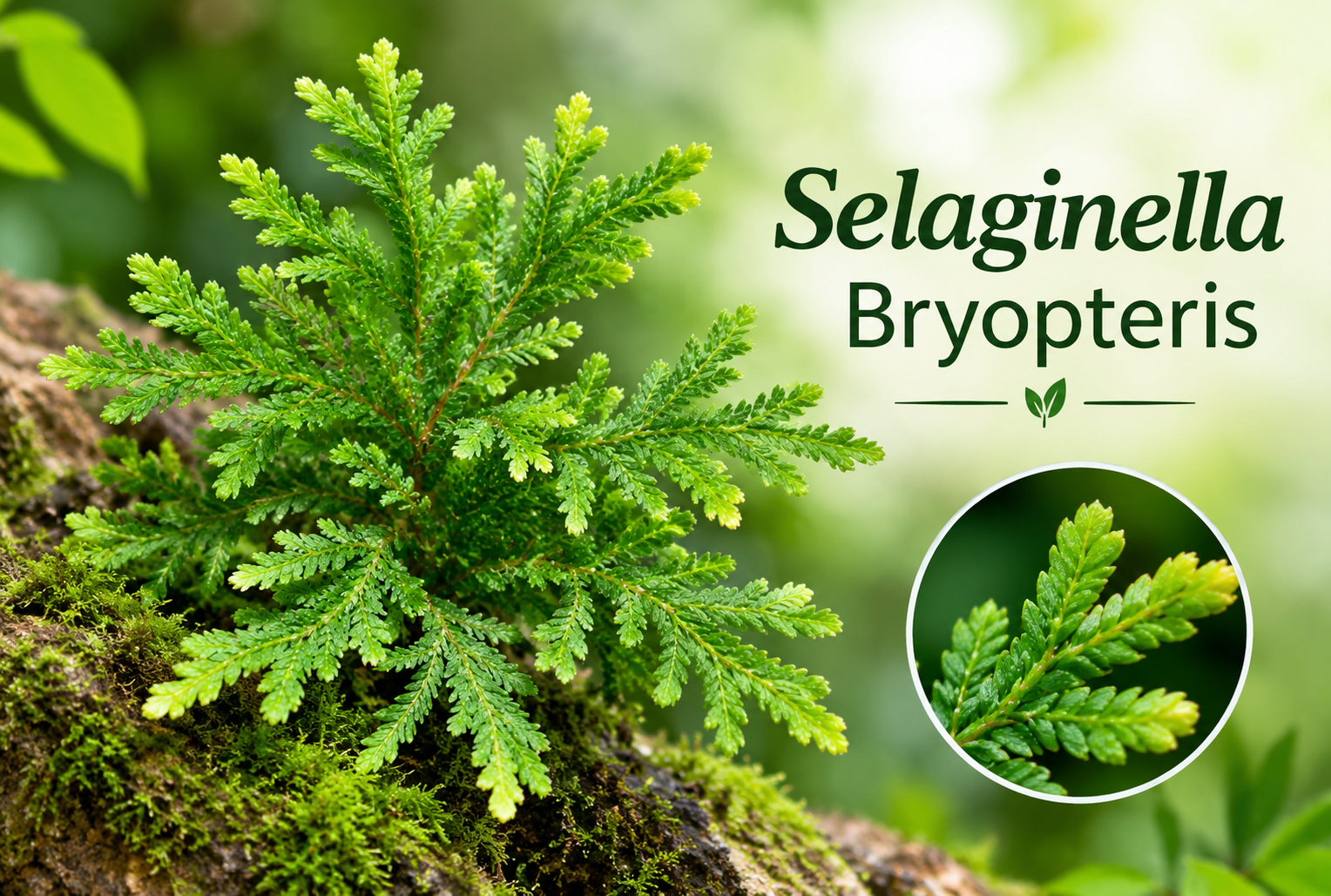
Selaginella bryopteris is a delicate, branched, evergreen herb featuring a prostrate or slightly erect stem with distinct nodes and internodes, from which aerial branches and root-like rhizophores emerge. The plant bears dimorphic leaves—smaller dorsal and larger ventral—arranged in four rows, each equipped with a ligule. Its reproductive structures, strobili, develop at the tips of the branches. Notably, the species exhibits remarkable desiccation tolerance, allowing it to survive extreme dryness.
Therapeutic Properties
- Vatavikar – Vata disorders (e.g., joint & neurological issues)
- Apsmara – Epilepsy / Seizures
- Artava Vikar – Menstrual disorders
- Raktapitta Dhatu Dourbalya – Blood weakness / Anaemia
- Prasuti Roga – Pregnancy & childbirth disorders
- Antiprotozoal activity
- Antihyperglycemic activity
- Antibacterial activity
- Antifungal activity
- Antiviral activity
- Antioxidative / Stress-relieving activity
- Anticancer activity
- Wound healing activity
- Anti-inflammatory activity
- Memory-enhancing activity
- Stomachache relief
Systemic Actions
Internal Uses:
- Reproductive System- It is effective in the management of menstrual disorders, Pregnancy & childbirth disorders.
- Nervous System- It balances Vata dosha, it is very effective in the management of Vata disorders like Epilepsy, Seizures, joint & neurological issues.
- Circulatory System- It is effective in case of Blood weakness and Anaemia.
Chemical Composition
- Flavonoids – Amentoflavone, Apigenin, Luteolin
- Biflavonoids – Bioactive compounds with antioxidant properties
- Alkaloids
- Phenolic Compounds – Gallic acid, Catechin
- Tannins – Polyphenolic compounds with astringent properties
- Steroids – Phytosterols contributing to anti-inflammatory effects
- Saponins – Surfactant-like compounds with immune-modulatory activity
- Carbohydrates – Sugars and polysaccharides
- Other Secondary Metabolites – Essential oils and trace bioactive compounds
Modern Overview
Antiepileptic Activity
Selaginella bryopteris contains amentoflavone, a key bioflavonoid that exhibits strong antiepileptic and neuroprotective actions. It works by enhancing GABAergic transmission, which increases the levels of the inhibitory neurotransmitter GABA, thereby calming excessive neuronal firing that leads to seizures. Additionally, amentoflavone modulates voltage-gated sodium channels, reducing abnormal electrical activity in the brain similar to conventional antiepileptic drugs. It also acts as a potent antioxidant, reducing oxidative stress by increasing glutathione (GSH) and lowering lipid peroxidation (LPO) levels. Through these combined mechanisms—neuroprotection, antioxidant defence, and regulation of neuronal excitability, amentoflavone helps stabilise brain function and manage epilepsy effectively.
For Uterine Health
Selaginella bryopteris demonstrates promising potential in supporting female reproductive health due to its rich composition of flavonoids, alkaloids, tannins, terpenoids, and steroids. Compounds like amentoflavone and hinokiflavone help regulate hormones, reduce inflammation, and support uterine function, which may aid in managing menstrual irregularities and discomfort. Its antioxidant and adaptogenic properties also contribute to overall reproductive well-being.
For Brain Health
Amentoflavone, a key flavonoid found in Selaginella bryopteris, supports memory and brain health through its antioxidant, anti-inflammatory, and neuroprotective mechanisms. It neutralises harmful free radicals, thereby reducing oxidative stress, a major factor in neuronal damage and memory decline. By inhibiting inflammatory mediators like TNF-α and IL-6 it helps prevent neuroinflammation that impairs cognitive functions. Amentoflavone also protects neurons from apoptosis by modulating the Nrf2 signalling pathway, which enhances the brain’s antioxidant defence system. Additionally, it influences GABA receptor activity, promoting neural balance and cognitive stability. Together, these effects help preserve neuronal integrity and improve memory function naturally.
Practical Uses
- Boil 5–6 fresh leaves in water and drink the decoction to reduce fever and fatigue.
- Crush fresh leaves into a paste and apply to wounds for faster healing.
- Mix powdered leaves with honey and take ½ tsp twice daily to relieve cough and throat irritation.
- Prepare an herbal tea from dried leaves and drink daily to support liver detoxification.
- Make a paste with crushed leaves and rose water or aloe vera, and apply on rashes to reduce inflammation.
- Take a small amount of dried leaf powder with warm milk or water to boost energy and vitality.
- Drink the liquid extract orally to aid digestion and regulate menstrual cycles.
- Apply a paste of crushed young leaves, mixed with honey or sugar, on skin ulcers to promote healing.
Part Used
Whole Plant
Dosage
250 mg
Conclusion
Selaginella bryopteris, commonly known as Sanjeevani, is a resilient and highly valued medicinal plant in Ayurveda. It is renowned for its adaptogenic, rejuvenating, and antioxidant properties, and it supports overall health and wellness. It is traditionally used to manage digestive issues, fevers, menstrual irregularities, and skin ailments. The plant also demonstrates potential in modern research for its anti-inflammatory, hepatoprotective, and stress-relieving effects. Its versatility in both oral and topical applications underscores its significance as a natural remedy and highlights the importance of conserving this unique and potent plant species.
FAQs
1. What are the benefits of Selaginella bryopteris?
Selaginella bryopteris, also known as Sanjeevani, provides antioxidant, anti-inflammatory, hepatoprotective, and adaptogenic benefits, supporting overall health, stress relief, and vitality.
2. What are the uses of Selaginella bryopteris?
It is used to manage digestive disorders, menstrual irregularities, fevers, skin ailments, and wound healing, both orally and topically, according to traditional practices.
3. Selaginella bryopteris is found in which habitat?
This plant grows mainly in rocky terrains and dry regions, particularly in the Aravali Mountains, and thrives as a poikilohydric lithophyte in India and Nepal.
4. What is the common name of Selaginella bryopteris?
Common names include Sanjeevani (Sanskrit/Hindi), Resurrection Plant or Spike Moss (English), Jeevani (Tamil), and Marunnu Chedi (Malayalam).
5. What are the medicinal uses of Selaginella bryopteris?
Medicinally, it is used as a rejuvenator, adaptogen, and for managing digestive issues, skin problems, fevers, menstrual irregularities, and as a general health tonic.







