


Setaria Italica Beauv./ Kanguni / Foxtail Millet – Ayurvedic Uses, Benefits, Dosage & Therapeutic
Abstract
Setaria italica Beauv., commonly known as Foxtail Millet, is a nutrient-rich cereal widely cultivated for its grains. It is beneficial in the management of fractures and is beneficial for horses. It has been traditionally valued for its role in promoting digestive health, managing metabolic disorders, and providing energy. It is rich in proteins, fibers, and essential minerals, and it is considered a functional food in both dietary and medicinal contexts. This millet exhibits antioxidant, hypoglycemic, and lipid-lowering properties, making it beneficial for modern health concerns such as diabetes and obesity. Its versatility in preparation and traditional usage emphasises its significance in Ayurveda and ethnomedicine.
Introduction
Setaria italica, commonly known as Foxtail Millet, is one of the oldest cultivated millets and is widely grown across Asia and Africa due to its adaptability to drought and varied soil conditions. It belongs to the Poaceae family, along with corn and sorghum, and is available in a variety of shapes, colours, and sizes. India is the leading producer of foxtail millet, while it is also cultivated in China, Indonesia, Europe, and the Korean peninsula. In Indonesia, it is known by several local names such as ba’tan, jawa, jaba ikur, and tarreang, among others. Traditionally, its processing in regions like West Sulawesi includes porridge, cookies, noodles, and rice substitutes. The grains are commonly used to support digestion, regulate blood sugar, and enhance overall vitality, making Setaria italica an important plant both nutritionally and therapeutically.
Scientific Classification
- Kingdom: Plantae
- Division: Magnoliophyta
- Class: Liliopsida
- Order: Poales
- Family: Poaceae
- Genus: Setaria
- Species: Setaria italica Beauv.
Synonyms
- Kangu
- Priyangu
- Pitatandula
- Chinaka
Vernacular Names
- Sanskrit Name: Kangu
- English Name: Foxtail Millet
- Hindi Name: Kanguni, Kagani, Tanguni
- Bengali Name: Kanguni
- Marathi Name: Kang, Rala
- Telugu Name: Koralu, Korra
- Tamil Name: Thinai, Kavalai, Kambankorai, Nuvanam (millet flour)
- Gujarati Name: Kanga
- Kannada Name: Navane, Navanakki
- Punjabi Name: Kangni
- Malayalam Name: Thina
- Nepali Name: Kaguno
Habitat
Foxtail millet (Setaria italica) thrives in a wide range of soil conditions and is well-suited to tropical and subtropical climates, making it widely cultivated across regions such as Africa and Asia. Foxtail millet is primarily cultivated in China and India. In India, its major growing regions include Haryana, Gujarat, Maharashtra, Uttar Pradesh, Andhra Pradesh, Tamil Nadu, Rajasthan, Karnataka, Madhya Pradesh, and Uttarakhand. Over centuries of cultivation, the crop has adapted well to the arid and semi-arid regions of Asia, North Africa, and both North and South America.
Morphology
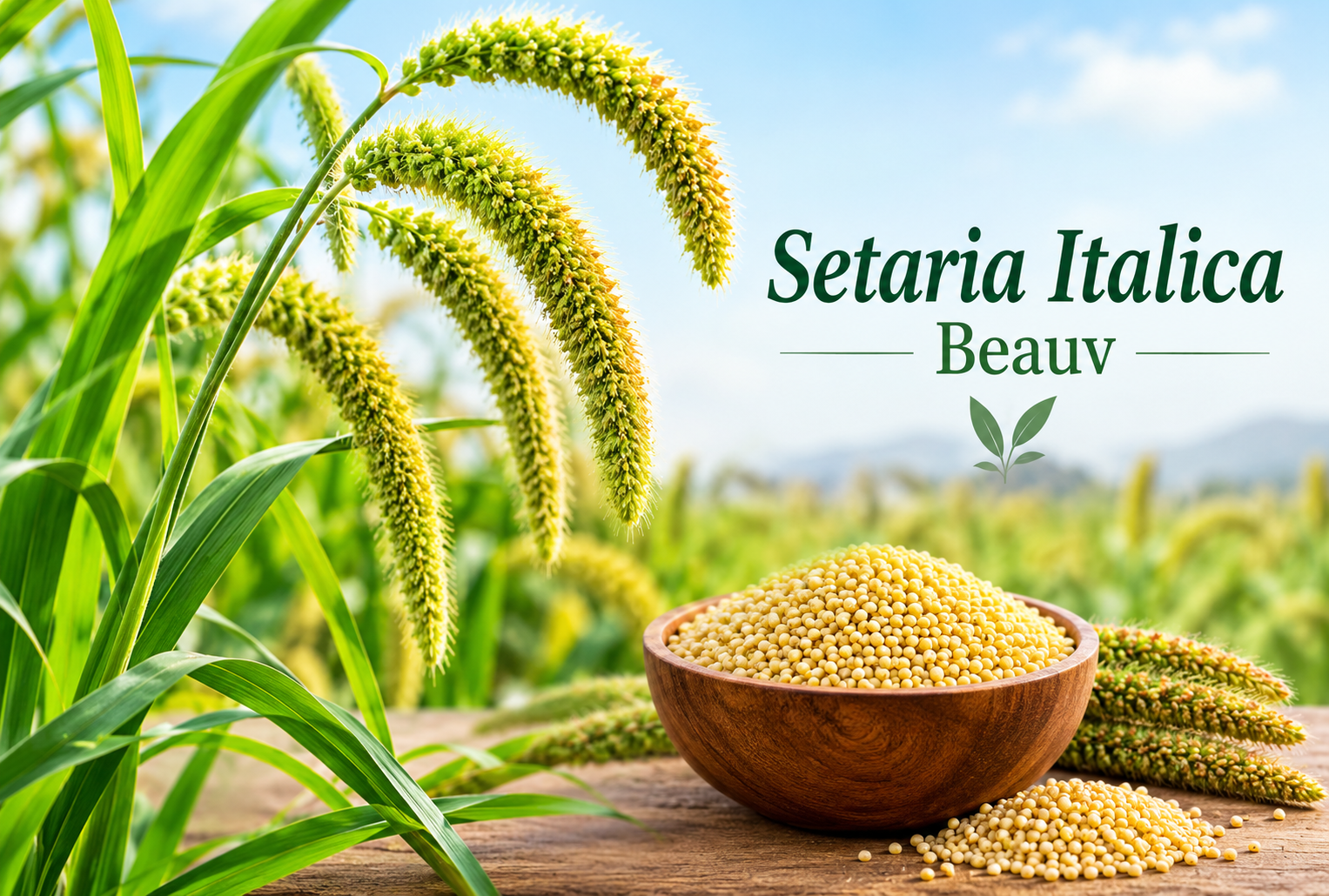
Foxtail millet is an annual grass with slender, upright, and leafy stems that can reach heights between 4 and 6.5 feet. The glumes and seeds display a variety of colours, including white, yellow, orange, brown, red, black, and grey. Being a warm-season crop, it thrives well in arid and semi-arid regions. It can be harvested for green fodder or hay about 70–75 days after sowing, depending on the variety, while grain production typically takes 85–95 days. The plant is self-pollinated and highly resilient, showing strong adaptability to abiotic stresses such as drought and poor soil conditions.
Varieties
- Black Kanguni
- Red Kanguni
- White Kanguni
- Yellow Kanguni –Among all, it is regarded as the superior variety
Classical Categorisation
- According to Bhavaprakash Nighantu – Dhanya Varga
- According to Raj Nighantu – Shalyadi Varga
- According to Dhanvantari Nighantu – Suvarnadi Varga
- According to Kaiyadeva Nighantu – Dhanya Varga
- According to Shodhala Nighantu – Trinadhanya Varga
Ancient Verses
स्त्रियां कङ्गप्रियङ्गु द्वे कृष्णारक्ता सिता तथा ।
पीता चतुर्विधा कङ्घस्तासां पीता वरा स्मृता ॥
कङ्गुस्तु भग्नसन्धानवातकृद् बृंहणी गुरुः ।
रूक्षा श्लेष्महराऽतीव वाजिनां गुणकृद् भृशम् ॥ (Bhavprakash Nighantu Dhanya varga 76-77)
According to the above shloka, Kangu and Priyangu (both feminine in gender) are medicinal plants classified into four types based on colour—black, red, white, and yellow, with the yellow variety being considered the best. Kangu is especially valued for its ability to strengthen and heal broken bones, alleviate Vata dosha, nourish tissues (including plasma and blood), and provide heaviness and dryness. It is highly effective in reducing Kapha and is particularly regarded as beneficial for horses, enhancing their strength and vitality.
Ayurvedic Properties
- Taste (Rasa)– Sweet (Madhur), Astringent (Kashaya)
- Physical property (Guna) – Heavy (Guru), Dry (Ruksha)
- Potency (Veerya )- Cold Potency (Sheet)
- Effect on tridosha– Balance Pitta and Kapha dosha
Therapeutic Properties
- Bhagna Sandhana: Heals fractures
- Brumani: Nourishes the body
- Dahagna: Relieves burning sensations
- Vaajinam: Beneficial for horses
- Emollient: Softens the skin
- Hypoglycemic: Helps control blood sugar levels
- Cholesterol-lowering: Supports heart health
- Anti-inflammatory: Reduces inflammation
- Antioxidant-rich: May provide anti-ageing and anti-cancer benefits
- High resistant starch: Improves digestion and gut health
- Gluten-free: Supports overall digestive wellness
- Improves digestion
- Diuretic
Systemic Actions
External Uses- Local application of its paste is very beneficial in case of Rheumatoid Arthritis.
Internal Uses
Digestive System- Many people used it in place of rice. It also stimulates digestive fire.
Chemical Composition
Macronutrients
- Carbohydrates: Rich in starch (amylose & amylopectin)
- Protein: Contains bioactive peptides
- Fat
- Fiber: High in dietary fiber and non-starchy polysaccharides
Minerals
- Major minerals: Phosphorus, calcium, potassium, magnesium
- Trace minerals: Iron, zinc, copper
Phytochemicals & Bioactive Compounds
- Phenolic compounds: Ferulic acid, chlorogenic acid, p-coumaric acid
- Carotenoids: Natural antioxidants for health benefits
- Tocols: Tocopherols and tocotrienols with antioxidant properties
- Flavonoids: quercetin, kaempferol, apigenin, and luteolin
Volatile Components
- Aldehydes: (E)-2-nonenal, (E,E)-2,4-decadienal (main aroma compounds)
- Ketones & Alcohols: Contribute to aroma and flavor
- Hydrocarbons: Present in small amounts
- Benzene derivatives: Naphthalene, o-xylene (aroma compounds)
Modern Overview
For Fracture
Setaria italica (foxtail millet) aids in fracture management through its rich combination of minerals and bioactive compounds that promote bone healing and regeneration. The minerals calcium, magnesium, phosphorus, and strontium strengthen bone structure, enhance osteoblast activity, and support the formation of hydroxyapatite, the main component of bone tissue. Its polyphenols, flavonoids, and antioxidants help reduce inflammation and oxidative stress, creating an ideal environment for tissue repair. Quercetin, a key flavonoid, contributes to maintaining bone density and preventing bone degradation. Additionally, bioactive peptides from its proteins offer anti-inflammatory benefits that further support recovery.
For Rheumatoid Arthritis
Setaria italica (foxtail millet) helps manage rheumatoid arthritis through its rich bioactive compounds, including flavonoids, phenolic acids, and peptides, which exhibit strong anti-inflammatory and antioxidant effects. These compounds reduce oxidative stress by neutralising free radicals, thereby protecting joint tissues from damage. Flavonoids such as quercetin, kaempferol, apigenin, and luteolin inhibit inflammatory pathways like NF-κB, preventing the release of pro-inflammatory cytokines. Phenolic acids such as ferulic and p-coumaric acid further support this by suppressing inflammation and oxidative damage. Additionally, bioactive peptides derived from foxtail millet proteins modulate immune responses by lowering levels of IL-1β, IL-6, and TNF-α while enhancing anti-inflammatory cytokines like IL-10. Together, these actions reduce joint pain, swelling, and stiffness, improving mobility and overall joint health.
Practical Uses
- Local application of its paste is very useful for the management of Rheumatoid Arthritis.
- It is used in place of rice.
- It can be taken after soaking for 7-8 hours. It helps in aiding digestion.
Part Used
Seeds
Controversy
Priyangu (Callicarpa macrophylla) is a distinct herb, although the names Kangu and Kanguni are sometimes used as its synonyms.
Conclusion
Setaria italica (Foxtail millet) stands out as a highly nutritious and medicinally valuable grain with immense potential in both dietary and therapeutic applications. It is rich in bioactive compounds like flavonoids, alkaloids, and phenolic acids, and it exhibits strong antioxidant, anti-inflammatory, and anti-diabetic activities that contribute to overall health and disease prevention. Its high fiber, low glycemic index, and gluten-free nature make it beneficial for managing metabolic disorders such as diabetes, obesity, and cardiovascular diseases. In Ayurveda, it is appreciated for balancing Kapha and Pitta doshas while enhancing digestion and vitality. Thus, Setaria italica serves as an excellent functional food and a promising natural remedy for promoting holistic health and well-being.
FAQs
1. What is the common name of Setaria italica?
The common name of Setaria italica is Foxtail Millet. It is one of the oldest cultivated millet varieties known for its resilience and high nutritional value.
2. What are the uses of Setaria italica?
Setaria italica is used as a nutritious food grain and as fodder for livestock. It is also utilised in traditional medicine for managing diabetes, inflammation, and digestive disorders due to its therapeutic properties.
3. What is the English name of Setaria italica?
The English name of Setaria italica is Foxtail Millet, referring to the plant’s bushy, fox-tail-like seed heads.
4. What is the family of Setaria italica?
Setaria italica belongs to the Poaceae (Gramineae) family, which includes other cereal grasses like rice, wheat, and barley.
5. What is the Hindi name of Setaria italica?
The Hindi name of Setaria italica is Kangni or Kakun, commonly used in northern and central India as a traditional millet grain.
6. What are the benefits of Setaria italica?
Setaria italica offers numerous health benefits — it helps control blood sugar, supports heart health, aids digestion, and strengthens immunity. Its antioxidant and anti-inflammatory compounds promote overall wellness and disease prevention.




