


Spondias pinnata (syn. Spondias mangifera Willd.) – Properties, Uses & Dosages
Abstract
Spondias mangifera Willd., commonly known as Amora, is a perennial, deciduous, glabrous tree widely used in Ayurvedic medicine and predominantly found in the northeastern regions of India. The plant is characterised by a turpentine-like aroma in its aerial parts and bears mango-like fruits that are acidic, astringent, and highly nutritious, rich in essential macro- and micronutrients as well as vitamins. The root and stem bark are notable sources of phenolic glycosides, which have been extensively studied for their antioxidant, anti-wrinkle, antibacterial, antidiarrheal, anticancer, antiulcer, antidiabetic, and hypolipidemic activities. Unripe fruits exhibit acidic and carminative properties, aid digestion, alleviate anorexia, and are useful in managing diarrhoea and constipation, whereas ripe fruits are aromatic, sweet, cooling, nourishing, and enhance strength and immunity. The characteristic flavour of the fruits is attributed to volatile oils such as 5-methyl-2-furaldehyde, isopropyl myristate, α-pinene, camphene, α- and γ-terpineol, ethyl cinnamate, caryophyllene, isoborneol, and γ-eudesmol, which possess significant antibacterial, antibiotic, and antiviral properties. The lipophilic nature and low molecular weight of these volatile constituents may contribute to their ability to inhibit the growth of infectious viral agents.
Classical references of Spondias mangifera Willd./ Ambansa
- Bhavprakash Nighantu Amradi phala varga
- Raj Nighantu Amradi varga
Scientific Classification of Spondias mangifera Willd./ Ambansa
- Domain: Eukaryotic
- Kingdom: Plantae
- Subkingdom: Viridiplantae
- Division: Tracheophyta
- Infra Division: Angiospermae
- Class: Magnoliopsida
- Superorder: Rosanae
- Order: Sapindales
- Family: Anacardiaceae
- Genus: Spondias
- Species: mangifera
- Synonym: Spondias pinnata
Synonym of Spondias mangifera Willd./ Ambansa
- Markatamra / Kapi Chuta / Kapi Priya – The fruit is highly liked by monkeys in forest regions.
- Madhuramla – The fruit possesses a sweet and sour taste.
- Rasadhya – The fruit is juicy and rich in pulp.
- Amla Vatakah – The fruit has a predominantly sour nature.
- Varsha Paki – The fruit ripens during the rainy season.
- Pittavaksha – The fruit is associated with Pitta-related effects, particularly due to its sour taste.
- Peethana – The fruit exhibits a yellowish colouration when ripe.
- Tanu Ksheera – The plant exudes thin, milky latex.
- Balishaka – The tender parts are nutritious and strengthening.
- Amravata – The fruit resembles a mango in taste or appearance.
- Dusha Phala – The fruit has a distinct, strong or pungent characteristic.
- Kapitana
Vernacular Names of Spondias mangifera Willd./ Ambansa
- Hindi name: Amra, Jungli Aam
- English name: Wild Mango, Hog Plum, Bile Tree
- Bengali name: Amda, Ambra
- Gujarati name: Abeda
- Kannada name: Amatekayi
- Malayalam name: Ambazhanga, Ampalam
- Marathi name: Ambada
- Tamil name: Mampulicci, Ambalam
- Telugu name: Adavimamidi, Avimamadi
- Sanskrit names: Amra, Bhrigiphalla
- Regional names: Heining (Nagaland), Kuki (Manipuri), Taito (Mizo)
Habitat of Spondias mangifera Willd./ Ambansa
It is native to Indo-Malaysia, Southeast Asia, and tropical America. This plant is widely cultivated in India for its edible fruits, particularly in Punjab, Maharashtra, Odisha, West Bengal, and Assam. Apart from India, it is also naturally found in countries such as China, Myanmar (Burma), Sri Lanka, and Thailand.
Morphology of Spondias mangifera Willd./ Ambansa
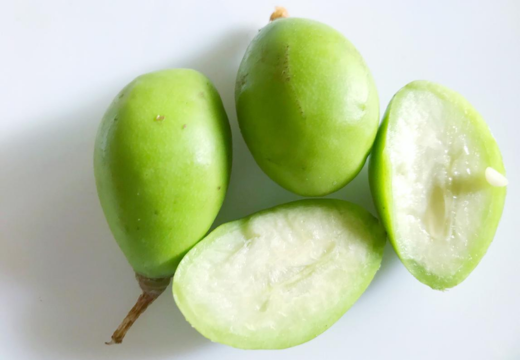
Spondias pinnata is a deciduous tree with a smooth trunk and bark, while the branchlets are rounded and glabrous, and the plant may attain a height of up to about 27 m. The leaves are large, composite, imparipinnate, alternate, and usually clustered towards the ends of branches, measuring approximately 18–50 cm in length with petioles of about 5–15 cm. Each leaf bears 4–5 pairs of leaflets with a petiolule of nearly 1 cm; the leaflets are ovate-oblong to elliptic-oblong in shape, papery and flat on both surfaces, with denticulate margins, and the lamina measures around 6–14 × 5–7 cm. The flowers are white, with triangular sepals, polygamous in nature, and arranged in paniculate inflorescences, bearing both male and bisexual characteristics. The fruit is a fleshy drupe, ellipsoid to elliptic-ovoid in shape, yellowish-green in colour, and measures about 1.5–5 × 1–3.5 cm; it emits a pleasant aromatic fragrance and contains one to three hard seeds enclosed within a fibrous, ridged covering.
Varieties of Spondias mangifera Willd./ Ambansa
According to Bhavprakash Nighantu:
- Desi (Native) Variety: The fruits of the native variety are sour when unripe but become slightly sweet inside while retaining some sourness on the outer part when ripe.
- Vilayati (Exotic) Variety : Spondias dulcis: The fruits of the exotic variety are dark amber in colour, extremely sour, and emit a strong odour resembling that of spoiled mangoes.
According to Raj Nighantu
Golden Apple Variety (Spondias cytherea Sonn.; syn. S. dulcis Soland ex Forst. f., or Great Hog Plum): The fresh ripe fruits of this variety produce a delicious juice, commonly used to prepare refreshing beverages like Sharbats. Unripe fruits are often cooked with meat to help tenderise it. The fruit emits a mango- or pineapple-like aroma, although Chunekar notes it resembles the smell of a decayed mango. According to Bapalal, citing K.D., the fruits are compared to “Bimbaphala” by Charak (Sū. 27/123) and Sushruta (Sü. 46/155), who describe them as aphrodisiac, Kapha-aggravating, and unctuous in nature.
Classical Categorisation:-
- According to Dhanvantari: Amradi Varga
- According to Kaiyadeva Nighantu: Aushadhi Varga
- According to Bhavprakash Nighantu: Amradi phala varga
- According to Raj Nighantu: Amradi varga
Ancient Verse of Spondias mangifera Willd./ Ambansa
आम्म्रातकः पीतनश्च मर्कटानः कपीतनः ।
आनातमम्लं वातघ्नं गुरूष्णं रुचिकृत्सरम् ॥१९॥
पक्वन्तु तुवरं स्वादु रसे पाके हिमं स्मृतम्।
तर्पणं श्लेष्मलं स्निग्धं वृष्यं विष्टम्मि वृंहणम् ।।
गुरु बल्यं मरुत्पित्तक्षतदाहक्षयास्त्रजित् ॥२०॥(Bhavprakash Nighantu Haritakyadi varga 177)
According to the above Shloka, the Sanskrit Names of Ambada (Spondias pinnata) are Amrataka, Pītana, Markatamra, Kapitana, and Amrata. Unripe Fruit is rich in sour taste, and it is Vata-pacifying, heavy, hot, appetising, and nourishing. Ripe Fruit Contains astringent taste, is delicious, sweet in post-digestive effect (vipaka), cooling, satiating, Kapha-increasing, unctuous, aphrodisiac, Vata-stagnating (Vishthambhaka), nourishing, heavy, strength-giving, and helps in alleviating Vata, Pitta, wounds, burning sensations, wasting disorders, and blood-related ailments.
आप्रातकं कषायाम्लमामहत् कण्ठहर्षणम् ।
पक्कन्तु मधुराम्लाढ्यं स्निग्यं पित्तकफापहम् ।।(Raj Nighantu Amradi varga 170)
According to the above shloka, the unripe Amrataka or Amda is sour, astringent, and helps in eliminating ama (toxins). It also soothes the throat. The ripe Amrataka has a sweet and sour taste, is unctuous in nature, and helps pacify both Pitta and Kapha doshas.
आम्रातकफलं वृष्यं पित्तास्त्रकफवह्निकृत्।
शीतं कषायं मधुरं किचिन् मारुतकृद्गुरु ॥ (Dhanvantari Nighantu Amradi varga 10)
According to the above shloka, Amrataka is spermopoietic, can cause bleeding tendencies, and may aggravate Kapha. It acts as an appetiser, is cold, astringent, sweet, slightly Vata-aggravating, and has a heavy nature.
Ayurvedic Properties of Spondias mangifera Willd./ Ambansa
Unripe Fruit
- Taste (Rasa)- Sour (Amla)
- Physical property (Guna)- Heavy (Guru)
- Potency (Veerya)- Hot Potency (Usna)
- Effect on tridosha- Increases Pitta and Kapha dosha balances Vata dosha
Ripen Fruit
- Taste (Rasa)- Sweet (Madhur), Astringent (Kashaya)
- Physical property (Guna)- Unctuous (Snigdha)
- Potency (Veerya)- Cold Potency (Sheet)
- Post-digestion effect (Vipaka)- Sweet (Madhur)
- Effect on tridosha- Balances Vata and Pitta dosha and increases Kapha dosha
Therapeutic Indications of Spondias mangifera Willd./ Ambansa
- Vrushya: Acts as an aphrodisiac and enhances vigour.
- Vishtambhi: Can cause constipation.
- Brimhana: Nourishing and nutritious.
- Balya: Strengthens the body and boosts immunity.
- Daha: Useful in conditions with burning sensations, such as gastritis, neuropathy, and eye burning.
- Kshata: Helps with injuries and bleeding.
- Kshaya: Supports conditions of tissue depletion, weight loss, and tuberculosis.
- Asra: Beneficial in blood disorders, including abscesses, skin diseases, menorrhagia, and nasal bleeding.
- Grahi: Absorbent; useful in diarrhoea and irritable bowel syndrome (IBS).
- Deepana: Enhances digestive strength.
- Rochana: Improves taste and relieves anorexia.
Systemic actions of Spondias mangifera Willd./ Ambansa
External- Local application of the paste of leaves is beneficial in the management of Joint issues. Its juice is also useful in earache management.
Internal use
- Digestive System: It is useful in the management of diarrhoea, anorexia and nausea, and it is also used as pickles and other cuisine.
- Reproductive System : is effective in the management of irregular menstruation.
Chemical composition of Spondias mangifera Willd./ Ambansa
1. Triterpenoids and Steroids
- Present in aerial parts, bark, and fruits
- Major constituents include:
- β-Amyrin
- Oleanolic acid
- β-Sitosterol
- β-Sitosterol glucoside
- Stigmast-4-en-3-one
- 24-Methylenecycloartanone
- Daucosterol
2. Phenolic Compounds and Flavonoids
- Responsible for antioxidant and anti-inflammatory activity
- Important compounds:
- Gallic acid
- Caffeic acid
- Quercetin
- Kaempferol
- Rutin
- Ellagic acid
- Tannin
- Ellagitannins
- Gallotannins
3. Amino Acids (Fruit)
- Fruits are rich in essential and non-essential amino acids:
- Glycine
- Cystine
- Serine
- Alanine
- Leucine
- Contains long-chain fatty acids such as:
- Lignoceric acid
- Fruits are rich in:
- Vitamin A
- Vitamin C
- Essential minerals present include:
- Potassium
- Calcium
- Magnesium
- Iron
- Phosphorus
- Identified volatile compounds:
- Furfural
- Benzoic acid ethyl ester
- α-Terpineol
- Geraniol
- Contains reducing sugars such as:
- D-Galactose
- L-Arabinose
- D-Xylose
- For Anorexia and Nausea: Fresh juice of Amrataka fruit is administered in a dose of 10–20 ml for the management of anorexia and nausea.
- For Earache: Leaf juice of Amrataka is applied locally to relieve an earache.
- For Rheumatism: A paste prepared from the leaves of Spondias pinnata is applied externally over joints affected by rheumatism.
- For Menstrual Irregularities: Bark decoction of the tree is given in a dose of 50–60 ml to help regulate menstrual irregularities in women.
- For Diarrhoea: A decoction of bark and leaves of Spondias pinnata is administered in a dose of 40–50 ml for the treatment of diarrhoea.
- As a Nutritious Food: The ripe fruit is consumed as a nutritious food, while the unripe fruit is commonly used in the preparation of pickles and various culinary dishes.
- For Pittaj Conditions: The fruit juice is given for the management of Pittaj conditions.
- Roots
- Bark
- Leaves
- Juice- 10-15 ml
- Decoction – 40-50 ml
4. Fatty Acids
5. Vitamins
6. Minerals
7. Essential Oils (Volatile Constituents)
8. Carbohydrates
Actions and Properties of Various Chemical Constituents of Spondias mangifera Willd./ Ambansa
Anti-diarrheal Activity
The anti-diarrheal effect of Spondias mangifera is mainly due to specific bioactive compounds acting synergistically on the gastrointestinal tract. Tannins, especially ellagitannins and gallotannins, exert an astringent effect that strengthens the intestinal mucosa and reduces fluid secretion. Flavonoids such as quercetin and kaempferol help inhibit intestinal inflammation, reduce gut motility, and suppress diarrhoea-causing microorganisms. Phenolic acids, including gallic acid and ellagic acid, provide additional antimicrobial and anti-inflammatory action, aiding in the control of infectious diarrhoea. Pectin, a soluble fiber present in the fruit, normalises water absorption and stool consistency. Along with these, triterpenoids like β-amyrin and oleanolic acid support overall intestinal healing and anti-inflammatory activity.
Anti-arthritic Activity
The anti-arthritic action of Spondias mangifera (Ambansa) is mainly mediated by triterpenoids such as β-amyrin, β-sitosterol, and oleanolic acid, which directly target inflammatory pathways involved in rheumatoid arthritis. These compounds act as TNF-α antagonists, reducing the activity of this key pro-inflammatory cytokine responsible for synovial inflammation and joint destruction. They also significantly suppress interleukin-6 (IL-6) levels, helping to control chronic inflammation and immune overactivation. The extract inhibits protein denaturation and protease activity, thereby preventing autoimmune-related tissue damage in joints. Additionally, the presence of phenolic compounds and flavonoids provides strong antioxidant activity, neutralising free radicals that aggravate inflammation and cartilage degeneration.
Aphrodisiac Action
The aphrodisiac action of Spondias mangifera (Ambansa) fruit extract is mainly attributed to triterpenoids and steroids such as β-amyrin, β-sitosterol, and oleanolic acid, which act on key biochemical pathways of sexual function. These compounds inhibit phosphodiesterase-5 (PDE-5), leading to smooth muscle relaxation and enhanced blood flow to reproductive tissues, similar to the mechanism of sildenafil. The extract also increases nitric oxide (NO) levels, improving vasodilation and erectile response. Additionally, it enhances testosterone levels, which supports libido, stamina, and reproductive health. Steroidal constituents like β-sitosterol and saponins further act as precursors for sex hormone synthesis, strengthening the overall aphrodisiac effect.
Practical Uses / Health Benefits of Spondias mangifera Willd./ Ambansa
Parts Used of Spondias mangifera Willd./ Ambansa
Dosage of Spondias mangifera Willd./ Ambansa
Conclusion
Spondias mangifera Willd. (syn. Spondias pinnata), commonly known as Indian Hog Plum, Ambansa, or Amara, stands out as a multifunctional medicinal plant and nutritional resource in Indo-Malaysian regions and classical Ayurvedic literature. The presence of diverse bioactive constituents such as flavonoids, tannins, phenolic acids, saponins, and essential oils across its roots, bark, leaves, and fruits explains its wide spectrum of traditional therapeutic applications