


Yellow Lichens (Parmelia perlata) – Properties, Uses & Dosage
Abstract
Parmelia perlata is a foliose lichen widely distributed across temperate and tropical regions, known for its ecological importance and ethnomedicinal applications. This lichen species plays a vital role in bioindication, nutrient cycling and serves as a host for diverse microbial communities. It has traditionally been used as a food source by the Rai and Limbu communities of eastern Nepal, and also serves as a natural light brown dye for wool. Additionally, it functions as a bioindicator for air pollution, particularly due to its sensitivity to heavy metal contamination. Despite its traditional use in Ayurvedic and tribal medicine, comprehensive scientific documentation remains limited. This article reviews the taxonomy, distribution, ecological significance and potential pharmacological applications of Parmelia perlata.
Introduction
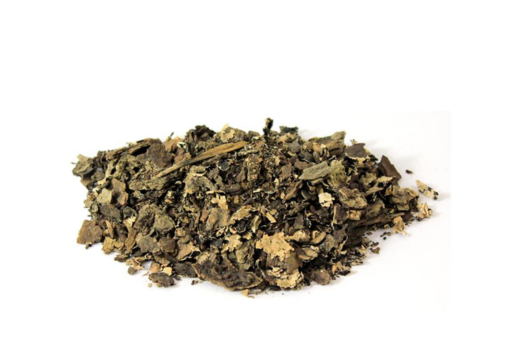
Lichens are complex symbiotic organisms composed of a fungal partner (mycobiont) and a photosynthetic partner (photobiont), typically an alga or cyanobacterium. Among them, the genus Parmelia is one of the most extensively studied due to its widespread distribution and environmental significance. This lichen has garnered attention not only for its ecological role in air quality assessment and habitat formation but also for its traditional use in indigenous medicine systems. Ethnobotanical reports suggest its application in treating wounds, respiratory disorders and skin ailments. It is commonly found across the steep regions of the Himalayas and Northeast India, where it grows among rocks, on tree trunks and across the forest floor. The lichen has a greenish-black and white outer layer, with a thallus that can reach up to 15 cm in diameter and is only loosely attached to the surface it grows on. Its upper surface is smooth, orbicular and greyish-white, while the underside is dark brown to blackish and covered with fine hairs.
Scientific Classification
- Kingdom: Fungi
- Division: Ascomycota
- Class: Lecanoromycetes
- Order: Lecanorales
- Family: Parmeliaceae
- Genus: Parmelia
- Species: perlata
Synonyms
- Shiladadru (Found in rocks)
- Shilapushpa (Flowers are seen in between rocks)
- Kalanusaryakam
- Vriddha
- Sthavira
- Palita
Vernacular Names
- Arabian: Hinna-i-Korisha, Rumman, Barri, Shaibah, Shaibat
- Ayurvedic: Bhuri-charilla, Shaila, Shaileya, Shailaka, Shaileyaka, Shailpushpa, Shilaapushpa, Shilaadaaru, Shilodbhava, Shitashiva, Sthavira, Vrddha
- Bengali: Shailaj
- English: Litho Lichen, Rock Moss, Stone Flower, Yellow Lichen
- Sanskrit: Silapuspa, Silavalka, Sitasiva
- Tamil: Kalpashee
- Telugu: Kallu-pachi, Ratipuvvu
- Unani: Dowala, Charelaa, Hazaz-al-Sakhr
- Urdu: Chhadila, Pariyo, Ushna
- French: Parmelia des murs
- German: Wandschildflechte
- Gujarati: Chhadilo, Ghabilo, Patthar Phool
- Hindi: Chhadila, Charela, Chharila, Pathar ka phool
- Kannada: Kallu-hoovu, Kallu-huvu, Shilapushpa
- Malayalam: Kalppuvu, Sheleyam
- Marathi: Dagad phool
- Persian: Davala
- Punjabi: Ausneh, Chhadila
Habitat
It is commonly found in countries such as India, Sri Lanka and various parts of Southeast Asia, where the humid climate favours its growth.
Morphology
The morphology of Parmelia perlata (now classified as Parmotrema perlatum) is characteristic of foliose lichens, displaying a leafy, loosely attached thallus that can spread widely over the surface it inhabits. The thallus is typically greyish-green to bluish-grey in color, with broad, lobed margins that are often wavy and irregular. The upper surface is smooth and slightly shiny, while the lower surface is usually black with scattered rhizines—root-like structures that help anchor the lichen to its substrate. The margins of the lobes are often lined with cilia (fine hair-like projections), and the thallus frequently exhibits soredia or isidia, which are reproductive structures used for vegetative propagation.
Classical Categorisation
- According to Bhavprakash Nighantu: Karpooradi Varga
- According to Kaiyadeva Nighantu: Dhatu Varga
- According to Dhanvantari Nighantu: Chandanadi Varga
Parpatadi Varga
शैलेयं शीतलं हृद्यं कफपित्तहरं लघु |
कण्डुकुष्ठाश्मरीदाहविषहृद गुदरक्तहृत ||(Bhavprakash Nighantu Karpooradi varga 91)
According to the above shloka, Yellow lichen is light, contains cold potency, good for the heart, balances Kapha and Pitta Dosha. It is effective in the management of itching, leprosy, stones, burning sensation, poisoning and bleeding in the anal region.
Ayurvedic Properties
- Taste (Rasa)- Bitter (Tikta), Astringent (Kashaya)
- Physical Property (Guna)- Light (Laghu), Unctuous (Snigdha)
- Potency (Veerya)- Cold Potency (Sheet)
- Post-digestion Effect (Vipaka)- Katu (Pungent)
- Effect on Tridosha- Balance Pitta and Kapha Dosha
Therapeutic Properties
- Rejuvenative
- Anti-inflammatory
- Blood-purifier
- Tuberculosis
- Anti-poisoning
- Manage stones
- Pacifies burning sensations
- Effective in managing blood in anal region
- Effective against itching and skin conditions
Systemic Actions
External- It is effective in the management of skin disease, burns and pain relief.
Internal use
- Digestive System: Acts as a carminative and absorbent. It is beneficial in conditions like excessive thirst, vomiting, loss of appetite, diarrhoea, and dysentery.
- Circulatory System: Possesses cardioprotective properties, supporting heart health.
- Respiratory System: Helps eliminate aggravated Kapha dosha and is useful in managing cough and breathing difficulties.
- Excretory System: Functions as a diuretic, increasing urine output. It is indicated in urinary disorders such as calculi (Ashmari) and painful urination (dysuria). A decoction of its root, when taken with sugar and cumin powder, is especially effective.
- Tapakrama (Fever Management): Manage fever accompanied by a burning sensation.
- Skin (Tvak) System: Effective in treating skin conditions characterised by burning sensations.
Chemical Composition
- Usnic acid
- Calcium oxalate
- Polysaccharides
- Phenolics
- Sterols
- Volatile oils
- Glycosides
- Triterpenes
Modern Overview
Antidiabetic Effect
The aqueous leaf extract of Parmelia perlata, administered at doses of 200 mg/kg and 400 mg/kg body weight for 60 days, demonstrated significant antidiabetic effects in alloxan-induced diabetic rats when compared to glibenclamide. The extract effectively lowered fasting blood glucose and HbA1c levels, enhanced plasma insulin levels and restored the activity of glucose-metabolising enzymes. Additionally, it improved the lipid profile by reducing serum triglycerides, cholesterol, LDL, VLDL, free fatty acids and phospholipids, while increasing HDL levels in a dose-dependent manner.
Antibacterial Activity
Methanolic, ethyl acetate and acetone extracts of Parmelia perlata have shown significant antibacterial activity against Staphylococcus aureus, as demonstrated using the Kirby-Bauer disc diffusion and Mueller-Hinton agar plate methods. Additionally, the hydro-alcoholic extract exhibited strong antibacterial effects against Bacillus cereus, Pseudomonas aeruginosa, Proteus vulgaris, Staphylococcus aureus, Corynebacterium xerosis, Escherichia coli and Klebsiella pneumoniae using the agar well diffusion method. This potent antibacterial activity is likely attributed to the presence of usnic acid in the extracts.
Practical Uses
- For Cough & Cold– Boil a small amount in water and consume it as herbal tea with honey.
- For Indigestion – Powder it and mix with warm water or buttermilk after meals to aid digestion.
- For Urinary Issues– Decoction of the lichen with sugar and cumin helps relieve dysuria and urinary stones.
- For Skin Diseases – Make a paste with water or coconut oil and apply externally on itching or rashes.
- For Wound Healing– Apply powdered lichen directly or mixed with turmeric on minor wounds or cuts.
- For Fever with Burning Sensation– Prepare a decoction and drink twice daily to reduce heat and discomfort.
- For Mouth Ulcers– Use its decoction as a mouth rinse to soothe ulcers and inflammation.
Part used
- Whole plant
Dosage
- Powder of plant- 2-4 gms
Conclusion
It is a highly significant drug in traditional medicine, known for its wide range of therapeutic properties. While several of these, such as antimicrobial, antidiabetic, antioxidant, antiulcer and hepatoprotective effects, have been scientifically validated, many of its traditional uses, such as analgesic, anti-inflammatory, treatment for male sexual issues, menstrual disorders, blood diseases and heart diseases, remain less explored. Additionally, it contains numerous unique phytoconstituents that may contribute to its pharmacological activities, though many of these are still not fully investigated.