


Yuktaseniya Adhyaya (Qualities of a Physician in the Military) – 34th Chapter of Sushruta Samhita
Abstract
Ayurvedic treatment is based on the coordinated functioning of four major elements, collectively termed Chikitsa Chatushpada. These include the physician (Vaidya), the patient (Rogi), the medicine (Aushadha), and the caregiver (Paricharaka). The Sushruta Samhita describes the essential attributes of each component and explains their significance in achieving effective therapeutic outcomes. A physician should possess sound knowledge and practical skills, while the patient should demonstrate cooperation and self-discipline. Medicines must be appropriate for the disease and administered correctly, and caregivers should provide attentive support while following medical instructions. The combined contribution of these four elements forms a structured approach to disease management. This principle highlights the importance of professional competence, suitable therapeutic measures, patient participation, and compassionate care in the Ayurvedic system of medicine.
Introduction
The management of disease in Ayurveda involves a comprehensive approach that considers the responsibilities of everyone participating in the healing process. Classical Ayurvedic teachings explain that treatment requires the proper coordination of medical expertise, patient involvement, suitable medicines, and effective nursing assistance. These four essential components form the foundation of Chikitsa Chatushpada, a concept discussed in the Sushruta Samhita. Each component has a distinct responsibility. The physician evaluates the patient’s condition and determines the appropriate treatment strategy. The patient contributes through cooperation, discipline, and adherence to medical advice. The medicine serves as the therapeutic agent and should be selected according to the nature of the illness, with attention to its preparation, dosage, and administration. The attendant provides practical assistance, monitors the patient’s needs, and carries out the physician’s directions with care and diligence. The qualities prescribed for these four components illustrate the importance of a balanced and organised treatment process. Their combined efforts support the appropriate delivery of care and emphasise that successful disease management requires more than medication alone. This Ayurvedic principle offers a useful perspective on the relationship between clinical judgement, therapeutic planning, patient responsibility, and caregiver support.
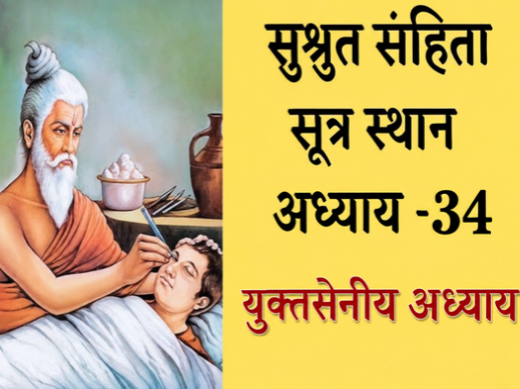
The 34th chapter of the Sutrasthana of the Sushruta Samhita is known as Yuktaseniya Adhyaya. It explains the role, responsibilities, and importance of a physician who accompanies an army during military campaigns.
अथातो युक्तसेनीयमध्यायं व्याख्यास्यामः ||१||
यथोवाच भगवान् धन्वन्तरिः ||२||
We shall now describe the chapter titled Yuktaseniya Adhyaya, which explains the responsibilities of a physician serving alongside an army, as taught by the revered Dhanvantari.
Bhishak Karma: Responsibilities Of The Physician
नृपतेर्युक्तसेनस्य परानभिजिगीषतः |
भिषजा रक्षणं कार्यं यथा तदुपदेक्ष्यते ||३||
विजिगीषुः सहामात्यैर्यात्रायुक्तः प्रयत्नतः |
रक्षितव्यो विशेषेण विषादेव नराधिपः ||४||
पन्थानमुदकं छायां भक्तं यवसमिन्धनम् |
दूषयन्त्यरयस्तच्च जानीयाच्छोधयेत्तथा ||५||
तस्य लिङ्गं चिकित्सा च कल्पस्थाने प्रवक्ष्यते |६|
The physician must make every possible effort to safeguard the king during military expeditions, particularly when the king travels with his army and ministers to defeat his enemies. Since the king may face the risk of poisoning through various means, special attention should be given to his protection. Enemies may contaminate roads, water sources, places of shelter, food, beverages, animal fodder, fuel, and other essential supplies with poisonous substances. Therefore, the physician must be well acquainted with the signs of poisoning in different materials and understand the appropriate methods for detecting and neutralising toxic substances. The symptoms of poisoning and their management are explained in the Kalpa Sthana section of the Sushruta Samhita.
Mrityu Bheda: Classification Of Death
एकोत्तरं मृत्युशतमथर्वाणः प्रचक्षते ||६||
तत्रैकः कालसंयुक्तः [१] शेषा आगन्तवः स्मृताः |७|
According to the Atharva Veda tradition, death is classified into 101 forms. Of these, one is associated with the completion of the destined lifespan, while the other 100 are considered untimely or unexpected deaths, collectively referred to as Agantu Mrityu.
दोषागन्तुजमृत्युभ्यो रसमन्त्रविशारदौ ||७||
रक्षेतां नृपतिं नित्यं यत्तौ वैद्यपुरोहितौ |८|
The physician, skilled in understanding medicinal substances and their tastes, and the priest, knowledgeable in sacred hymns and rituals, should work together to safeguard the king from all possible threats to life. Their efforts should focus on preventing deaths arising from the aggravation of bodily Doshas as well as external factors such as injuries, poisoning, curses, and other harmful influences.
Origin Of Ashtanga Ayurveda: The Eight Branches Of Ayurveda As Revealed By Lord Brahma
ब्रह्मा वेदाङ्गमष्टाङ्गमायुर्वेदमभाषत ||८||
पुरोहितमते तस्माद्वर्तेत भिषगात्मवान् |९|
Ayurveda, comprising eight specialised branches, is traditionally regarded as a body of knowledge revealed by Lord Brahma, the creator of the universe, and associated with the Vedas. Hence, a knowledgeable physician should respect and consider the guidance and teachings of priests, as described in the classical Ayurvedic tradition.
Consequences of the King’s Misdeeds
सङ्करः सर्ववर्णानां प्रणाशो धर्मकर्मणाम् ||९||
प्रजानामपि चोच्छित्तिर्नृपव्यसनहेतुतः |१०|
When a king abandons the path of righteousness and becomes involved in harmful habits, the kingdom may experience social disorder and moral decline. Such conduct can lead to the weakening of ethical values, the disruption of traditional religious and auspicious practices, and the loss of harmony among the people, ultimately bringing suffering and destruction to the kingdom.
Raja As Daivasama: The King Who Resembles God
पुरुषाणां नृपाणां च केवलं तुल्यमूर्तिता ||१०||
आज्ञा त्यागः क्षमा धैर्यं विक्रमश्चाप्यमानुषः |
तस्माद्देवमिवाभीक्ष्णं वाङ्मनःकर्मभिः शुभैः ||११||
चिन्तयेन्नृपतिं वैद्यः श्रेयांसीच्छन् विचक्षणः |१२|
The king and an ordinary person share the same human form, but the king holds a distinguished position because of his authority, generosity, capacity to forgive, and qualities of bravery and courage. Therefore, a learned physician who wishes to earn respect and recognition should maintain noble thoughts, speak graciously, and perform righteous actions. Considering the king’s welfare as an important responsibility, the physician should remain dedicated to protecting the king’s health and serving him with sincerity and care.
Vaidya Sthana: The Physician’s Workplace
स्कन्धावारे च महति राजगेहादनन्तरम् ||१२||
भवेत्सन्निहितो वैद्यः सर्वोपकरणान्वितः |
तत्रस्थमेनं ध्वजवद्यशःख्यातिसमुच्छ्रितम् ||१३||
उपसर्पन्त्यमोहेन विषशल्यामयार्दिताः |
स्वतन्त्रकुशलोऽन्येषु शास्त्रार्थेष्वबहिष्कृतः ||१४||
वैद्यो ध्वज इवाभाति नृपतद्विद्यपूजितः |१५|
Within a large military camp, the physician should be stationed close to the king’s residence and provided with all essential medicines, instruments, and other medical necessities. A physician who demonstrates skill and achieves success in treating patients gains recognition and becomes well known, attracting individuals suffering from injuries caused by foreign objects and various diseases. A competent physician should possess a strong understanding of Ayurveda while also being familiar with other fields of knowledge. Through expertise, practical ability, and dedication to patient care, the physician earns honour and respect from the king as well as from other scholars and practitioners of Ayurveda.
Chikitsa Pada: The Four Components Of Treatment
वैद्यो व्याध्युपसृष्टश्च भेषजं परिचारकः ||१५||
एते पादाश्चिकित्सायाः कर्मसाधनहेतवः |
गुणवद्भिस्त्रिभिः पादैश्चतुर्थो गुणवान् भिषक् ||१६||
व्याधिमल्पेन कालेन महान्तमपि साधयेत् |
वैद्यहीनास्त्रयः पादा गुणवन्तोऽप्यपार्थकाः ||१७||
उद्गातृहोतृब्रह्माणो यथाऽध्वर्युं विनाऽध्वरे |
वैद्यस्तु गुणवानेकस्तारयेदातुरां सदा ||१८||
प्लवं प्रतितरैर्हीनं कर्णधार इवाम्भसि |१९|
According to Ayurveda, successful treatment depends on the coordinated contribution of four essential factors: the physician (Vaidya), the patient (Rogi), the medicine (Bheshaja), and the caregiver or nurse (Paricharaka). When each of these four components possesses the necessary qualities and performs its duties properly, even a serious disease may be managed effectively within a relatively short time. However, the presence of suitable medicines, a cooperative patient, and a competent attendant cannot guarantee successful treatment without the guidance of a skilled physician. This relationship is compared to a Vedic ritual, which cannot be completed properly without the priest responsible for performing its essential procedures. Similarly, a knowledgeable and capable physician plays a vital role in patient care and treatment. Just as an experienced navigator can steer a boat safely through water, a competent physician can guide the treatment process and help protect the patient’s life through appropriate medical knowledge and sound clinical judgement.
Vaidya Guna: Essential Qualities Of A Physician
तत्त्वाधिगतशास्त्रार्थो दृष्टकर्मा स्वयङ्कृती ||१९||
लघुहस्तः शुचिः शूरः सज्जोपस्करभेषजः |
प्रत्युत्पन्नमतिर्धीमान् व्यवसायी विशारदः ||२०||
सत्यधर्मपरो यश्च स भिषक् पाद उच्यते |२१|
A physician is considered the foremost component of the four essential pillars of treatment. An ideal physician should possess comprehensive knowledge of Ayurveda and a clear understanding of its principles. In addition to theoretical learning, the physician must observe therapeutic procedures performed by experienced practitioners and develop practical expertise through personal experience. The physician should have steady hands, maintain personal hygiene, and demonstrate courage and confidence while treating patients. Proper availability of medicines, instruments, and other necessary resources is also essential. Furthermore, a competent physician should be intelligent enough to handle challenging situations, possess innovative thinking, demonstrate technical proficiency, and have a thorough understanding of both theoretical concepts and their practical application. Above all, the physician must remain truthful, ethical, and committed to righteousness while providing healthcare.
Rogi Guna: Characteristics Of An Ideal Patient
आयुष्मान् सत्त्ववान् साध्यो द्रव्यवानात्मवानपि ||२१||
आस्तिको वैद्यवाक्यस्थो व्याधितः पाद उच्यते |२२|
According to Ayurveda, a patient is considered a suitable participant in the treatment process when certain favourable qualities are present. These include having a good life expectancy, mental strength, and a condition that can be treated successfully. The patient should also have sufficient financial resources to manage the treatment, practise self-discipline, maintain faith in a higher power, and follow the physician’s advice and instructions sincerely. These qualities are traditionally regarded as supportive factors that contribute to effective treatment and better health outcomes.
Essential Characteristics Of An Ideal Medicine
प्रशस्तदेशसम्भूतं प्रशस्तेऽहनि चोद्धृतम् ||२२||
युक्तमात्रं मनस्कान्तं गन्धवर्णरसान्वितम् |
दोषघ्नमग्लानिकरमविकारि विपर्यये |
In Ayurveda, medicine is considered an important component of successful treatment when it possesses the appropriate qualities. Medicinal substances should be obtained from suitable locations and collected at the proper time according to traditional guidelines. They must be administered in the correct dosage and should have acceptable colour, aroma, and taste. An ideal medicine should help balance the aggravated Doshas without causing unnecessary weakness or additional discomfort to the patient. It should be suitable for the patient’s condition and given at the appropriate time using the correct method of administration. These characteristics are traditionally regarded as essential for the effective use of medicines in Ayurvedic treatment.
Qualities And Essential Characteristics Of A Caregiver
स्निग्धोऽजुगुप्सुर्बलवान् युक्तो व्याधितरक्षणे |
वैद्यवाक्यकृदश्रान्तः पादः परिचरः स्मृतः ||२४||
According to Ayurveda, a caregiver or nurse (Paricharaka) is an essential part of the treatment process and should possess qualities that support the patient’s care and recovery. The attendant should be kind, compassionate, and willing to provide personal care without hesitation. Physical strength and a sincere commitment to the patient’s well-being are also important. Furthermore, the caregiver should carefully follow the physician’s instructions, perform assigned duties responsibly, and remain patient and dedicated throughout the course of treatment.
इति सुश्रुतसंहितायां सूत्रस्थाने युक्तसेनीयो नाम चतुस्त्रिंशत्तमोऽध्यायः ||३४||
This concludes the 34th chapter of the Sutra Sthana of the Sushruta Samhita, known as Yuktaseniya Adhyaya, which describes the duties and responsibilities of a physician accompanying an army.




