


Acanthopanax senticosus / Eleuthero / Siberian Ginseng – Ayurvedic Properties, Health Benefits & Dosage
Introduction
Acanthopanax senticosus, widely recognized in modern herbalism as Eleuthero or Siberian Ginseng, is a premier adaptogenic shrub native to the taiga regions of Northeast Asia. Unlike "true" ginsengs, this resilient plant belongs to a distinct genus, yet it has been revered for centuries in traditional Chinese and Russian medicine for its profound ability to enhance "Qi" and bolster systemic vitality. In contemporary practice, it is celebrated for its adaptogenic properties, helping the body maintain homeostasis and resilience against physical, chemical, and biological stressors. As the pace of modern life increases, there is a rising global interest in Acanthopanax as a natural solution for combating chronic fatigue, supporting immune health, and sharpening cognitive focus. By bridging ancient restorative wisdom with modern clinical research, Acanthopanax senticosus serves as a vital botanical tool for those seeking to optimize endurance and mental performance in a demanding world.
Scientific Classification
- Scientific Name: Acanthopanax senticosus (Commonly known as Eleutherococcus senticosus)
- Family: Araliaceae (The Ivy or Ginseng family)
- Common Names: Eleuthero, Siberian Ginseng, Ci Wu Jia (in TCM), Many-prickle Acanthopanax.
Plant Description
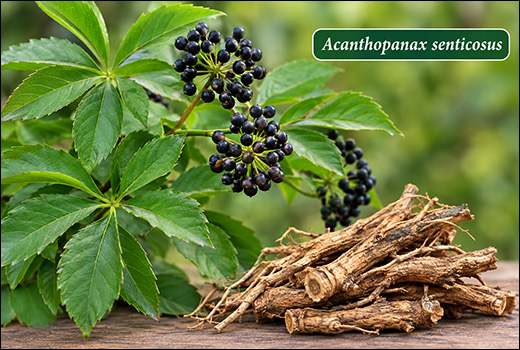
Acanthopanax senticosus is a deciduous, woody shrub that typically reaches heights of 2 to 3 meters, though it can grow up to 6 meters in ideal conditions. Its physical structure is characterized by:
- Stems: The slender, greyish-brown stems are densely covered in fine, needle-like prickles (bristles) that point downward, a key identifying feature.
- Leaves: The plant features palmately compound leaves, usually consisting of five leaflets (occasionally three) with serrated margins. They are arranged alternately along the branches.
- Flowers: Small, globose umbels of flowers appear in mid-summer. The flowers are typically dioecious, with female flowers being yellowish and male flowers often possessing a violet hue.
- Fruit: In late summer and autumn, the plant produces clusters of small, fleshy, black berries (drupes).
Habitat And Ecology
Eleuthero is a remarkably hardy species, evolved to survive the harsh climates of the North.
- Soil and Light: It thrives in mixed and coniferous forests, often forming thickets in the understory. It prefers moist, well-drained loamy soils and is shade-tolerant, though it grows best in partial sunlight.
- Resilience: It is highly resistant to frost and cold, characteristic of its native subarctic environment.
Native Regions And Cultivation
- Native Range: It is indigenous to the Russian Far East (Siberia), Northeast China, Korea, and Japan.
- Cultivation: While a significant portion of the global supply is still wild-harvested from the Siberian and Chinese forests, it is increasingly cultivated in Heilongjiang and Jilin provinces of China to meet international demand for standardized extracts. The medicinal properties are most concentrated in the roots and rhizomes, which are typically harvested in the autumn after the plant has reached 4 to 5 years of maturity.
Traditional And Historical Uses
The historical footprint of Acanthopanax senticosus spans centuries of folk medicine and military research, particularly across Northeast Asia and the former Soviet Union.
Traditional Chinese Medicine (TCM)
In Chinese records, where it is known as Ci Wu Jia, the plant has been utilized for over 2,000 years. It was traditionally categorized as a "Qi-tonifying" herb.
- Vitality and Longevity: It was prescribed to prevent senility, increase "jing" (essence), and strengthen the bones and tendons.
- Respiratory and Digestive Health: Practitioners used it to treat "damp-cold" conditions, including chronic bronchitis and poor appetite associated with digestive weakness.
- Mental Equilibrium: It was often recommended for "restless heart-spirit," addressing symptoms like insomnia, dream-disturbed sleep, and forgetfulness.
Russian And Soviet Research (The Cold War Era)
While its use in China was ancient, the modern global fame of Eleuthero is largely due to Soviet scientists in the 1950s and 60s.
- The "Ginseng Alternative": Seeking a more affordable and abundant alternative to Panax ginseng for their population, Soviet pharmacologists (notably Dr. Israel Brekhman) conducted extensive trials on Acanthopanax.
- The Birth of "Adaptogens": This plant was the primary subject used to define the term "adaptogen"—a substance that increases non-specific resistance to various stressors.
- Strategic Utility: It was famously administered to Soviet Olympic athletes, cosmonauts, and military personnel to enhance stamina, mental focus under pressure, and recovery from extreme environmental conditions.
Indigenous Siberian Traditions
Indigenous groups in the Siberian Taiga traditionally used the leaves and bark as a stimulating tea.
- Physical Resilience: Hunters and gatherers consumed it to withstand the grueling subarctic cold and to maintain energy levels during long expeditions.
- General Prophylactic: It was viewed as a "cure-all" for maintaining general health through long, dark winters.
Phytochemical Composition
The therapeutic efficacy of Acanthopanax senticosus is distinct from other ginseng species because it does not contain ginsenosides. Instead, its biological activity is driven by a complex array of phenylpropanoids, lignans, and polysaccharides known collectively as Eleutherosides.
1. The Eleutheroside Complex
These are the primary active constituents used for the standardization of pharmaceutical-grade extracts.
- Eleutheroside B (Syringin): A phenylpropanoid that plays a major role in the plant’s anti-fatigue and stress-protective effects.
- Eleutheroside E (Syringaresinol diglucoside): A lignan and the most potent marker for adaptogenic activity. It is crucial for modulating the immune response and enhancing physical endurance.
- Eleutherosides B1 and D: Supporting compounds that contribute to the overall synergistic effect of the root extract.
2. Polysaccharides
The roots contain high concentrations of complex carbohydrates (Eleutherans).
- Immune Modulation: These compounds stimulate the activity of macrophages and lymphocytes, enhancing the body’s innate "Vyadhikshamatva" (nonspecific immunity).
- Hypoglycemic Activity: Certain polysaccharides have been observed to help regulate blood glucose levels.
3. Flavonoids And Phenolic Acids
- Quercetin and Kaempferol: Potent flavonoids that provide significant antioxidant and anti-inflammatory protection to the vascular and nervous systems.
- Chlorogenic Acid: A phenolic acid that supports metabolic health and protects cells from oxidative stress.
4. Triterpenoids And Sterols
- $\beta$-Sitosterol: A plant sterol that supports prostate health and helps maintain healthy cholesterol levels.
- Ciwujianosides: Specific triterpenoid saponins found in the leaves and stems that exhibit anti-inflammatory and antiviral properties.
Mechanism Of Action
The mechanism of action for Acanthopanax senticosus is characterized by its systemic "normalizing" effect. Rather than stimulating a specific organ, it works by modulating the body’s fundamental stress-response systems to maintain homeostasis.
1. Modulation Of The HPA Axis
The core of its adaptogenic action lies in the Hypothalamic-Pituitary-Adrenal (HPA) axis.
- Stress Buffering: Eleutherosides help regulate the release of cortisol. During acute stress, it prevents the overproduction of adrenal hormones; during chronic exhaustion, it helps maintain adequate levels, preventing "adrenal fatigue."
- Feedback Sensitivity: It enhances the sensitivity of negative feedback loops, allowing the body to return to a calm state more quickly after a stressful event.
2. Metabolic Efficiency And Energy Production
Acanthopanax improves how the body utilizes fuel during physical exertion:
- Glycogen Sparing: It encourages the mobilization and oxidation of free fatty acids for energy, which spares critical glycogen stores in the liver and muscles.
- Lactic Acid Clearance: It facilitates the more efficient breakdown of lactic acid and blood urea nitrogen (BUN), significantly reducing muscle soreness and shortening recovery time after exercise.
- ATP Synthesis: It supports mitochondrial function, leading to more efficient cellular energy (ATP) production.
3. Immunomodulation
Unlike simple stimulants, it acts as a biogenic force for the immune system:
- Non-Specific Resistance: It increases the production and activity of T-lymphocytes and Natural Killer (NK) cells.
- Cytokine Regulation: The polysaccharides modulate the release of interferon and interleukins, providing a balanced immune response that is neither underactive (leading to infection) nor overactive (leading to autoimmunity).
4. Neuroprotection And Cognitive Influence
- Neurotransmitter Balance: It influences the levels of serotonin, dopamine, and norepinephrine in the brain, which accounts for its ability to improve mood and focus under pressure.
- Anti-Oxidative Shield: Its phenolic compounds cross the blood-brain barrier to scavenge free radicals, protecting neurons from the oxidative stress that contributes to age-related cognitive decline.
Health Benefits
Acanthopanax senticosus (Eleuthero) provides four primary clinical benefits:
- Adaptogenic Resilience: It modulates the HPA axis to normalize cortisol levels, helping the body "adapt" to physical and emotional stress without the crash associated with stimulants.
- Physical Stamina: By promoting fatty acid oxidation and sparing glycogen, it increases endurance and accelerates the clearance of lactic acid to shorten recovery time.
- Immune Defense: It acts as a biological response modifier, increasing the activity of Natural Killer (NK) cells and T-lymphocytes to reduce the frequency and duration of viral infections.
- Cognitive Support: It enhances mental clarity and focus, particularly during periods of fatigue or high-pressure work, by stabilizing neurotransmitter levels in the brain.
Dosage And Its Use
For optimal results, Acanthopanax senticosus should be used consistently but in cycles:
- Standard Dosage: 300–600 mg of extract (standardized to 0.8% eleutherosides) or 1–2 mL of tincture, taken 2–3 times daily.
- Timing: Best consumed in the morning or early afternoon to support daily energy levels and avoid potential sleep interference.
- The "Pulse" Cycle: Take for 6–8 weeks, followed by a 1–2 week break to maintain the body’s sensitivity to its adaptogenic effects.
- Safety Precautions: Avoid use if you have uncontrolled hypertension. Consult a professional if taking blood thinners or diabetes medication, as it may influence blood pressure and glucose levels.
Ayurveda’s Insight!
In the absence of a classical Sanskrit name, Acanthopanax senticosus is understood in Ayurveda through its Dravya Guna (pharmacological properties) and its profound impact on Ojas (vital essence) and Vyadhikshamatva (immunity).
- Rasa (Taste): Tikta (Bitter) and Kashaya (Astringent) – these tastes help clear "Ama" (toxins) and firm up body tissues.
- Guna (Quality): Laghu (Light) and Teekshna (Penetrating) – allowing it to reach deep into the cellular level.
- Virya (Potency): Ushna (Heating) – it stimulates the Agni (metabolic fire) without causing excessive pitta.
- Vipaka (Post-Digestive Effect): Katu (Pungent).
- Dosha Karma (Effect on Tri- energies)-Vata-Kapha Shamaka
It is a potent stabilizer for Vata, addressing the "Vata-Kshaya" (depletion) that leads to chronic fatigue and anxiety. Its heating and drying qualities also help clear excess Kapha (congestion or lethargy) from the system.
It acts as a Medhya Rasayana, nourishing the nervous tissue and improving mental resilience. Traditionally viewed as a "strengthening of tendons and bones," it prevents the wasting of muscle tissue during periods of high physical stress. It improves the quality of the primary nutrient fluid, ensuring better nourishment for all subsequent tissues.
It supports the upward and outward movement of energy, helping to overcome Alasya (laziness) and Daurbalya (weakness). By acting as a Rasayana (rejuvenative), it protects the Ojas, the subtle essence that governs immunity and psychological stability. In modern clinical manuscripts, it serves as a botanical counterpart to Ashwagandha; while Ashwagandha is more grounding (Brimhana), Eleuthero is more mobilizing and energy-enhancing (Prana-Vardhaka).
Conclusion
At last, we can say that Acanthopanax senticosus stands as a quintessential adaptogen, offering a unique pharmacological profile that emphasizes systemic balance over direct stimulation. By modulating the HPA axis and enhancing the body’s non-specific resistance, it provides a scientifically validated solution for combating the modern epidemics of chronic fatigue and stress-induced burnout. From an Ayurvedic perspective, its classification as a Rasayana underscores its ability to protect Ojas and strengthen the Majja Dhatu, making it an invaluable botanical for restoring vitality and “Vyadhikshamatva” (immunity). Whether utilized for athletic performance or cognitive resilience, Eleuthero remains a cornerstone of integrative medicine, harmonizing ancient restorative traditions with contemporary clinical needs.