


Leucas cephalotes Spreng./ Dronapushpi/ Guma/ Droni/ Kubi – Ayurvedic Properties, Health Benefits & Dosage
Abstract
Leucas cephalotes (Roth.) Spreng. (Family: Lamiaceae), commonly known as Dronapushpi in Sanskrit and Kubo or Kubi in the traditional medicine of Gujarat, is an edible annual herb that grows abundantly during the rainy season. Botanically, Dronapushpi is represented by two species of the genus Leucas—Leucas cephalotes (Roth.) Spreng. and Leucas aspera Spreng.—both belonging to the family Lamiaceae. These species are widely distributed throughout India, Bangladesh, Afghanistan, the Philippines, and several other Afro-Asian countries, flowering mainly between October and February. The genus Leucas comprises nearly 100 species distributed across Asia and Africa. Traditionally, Leucas cephalotes is highly valued for its medicinal properties and is used in the management of snakebite, bronchitis, asthma, inflammation, dyspepsia, paralysis, and leucoma. Its leaves are also commonly used to treat fever and urinary disorders, making it an important herb in traditional systems of medicine.
Classical References of Leucas cephalotes Spreng./ Dronapushpi/ Guma/ Droni/ Kubi
- Bhavprakash Nighantu Guduchyadi varga
- Raj Nighantu Parpatadi varga
Scientific Classification of Leucas cephalotes Spreng./ Dronapushpi/ Guma/ Droni/ Kubi
- Kingdom: Plantae
- Subkingdom: Tracheobionta
- Superdivision: Spermatophyta
- Division: Magnoliophyta
- Class: Magnoliopsida
- Order: Lamiales
- Family: Lamiaceae
- Genus: Leucas
- Species: Leucas cephalotes (Roth.) Spreng.
Synonym of Leucas cephalotes Spreng./ Dronapushpi/ Guma/ Droni/ Kubi
- Dronachatra – Flowers are arranged in an umbrella-like (boat-shaped) form.
- Drona – Refers to the characteristic boat-shaped flowers.
- Drona Kurambaka – Named for its clustered, boat-shaped floral arrangement.
- Dronapushpa – Means "boat-shaped flower."
- Kutumbaka – Flowers occur in dense clusters resembling a family or group.
- Kaundinya – Traditional synonym mentioned in Ayurvedic texts.
- Kshavapatra – Leaves possess a strong aroma that induces sneezing.
- Chatrini – The inflorescence resembles a small umbrella (chatra).
- Chitrakshupa – Refers to its attractive and distinctive shrub-like appearance.
- Phalepushpa – Fruits and flowers are borne together on the plant.
- Guma – Traditional regional name.
- Nahula – Classical synonym found in Ayurvedic literature.
- Kumbhayoni – Refers to the pot-like arrangement of flowers.
- Chitrapatrika – Denotes its attractive or variegated leaves.
- Vrushasara – Traditionally regarded as beneficial for strength and vitality.
- Shwasanaka – Useful in respiratory disorders such as cough and asthma.
- Deerghapatra – Possesses long, elongated leaves.
Vernacular Names of Leucas cephalotes Spreng./ Dronapushpi/ Guma/ Droni/ Kubi
- English: Spiderwort
- Sanskrit: Dronapushpi, Dronachatra, Chhatraka, Chitrakshupa, Katumba
- Hindi: Guma, Dhurpi Sag, Deldona, Bishkhapru, Goma Madhupati
- Bengali: Dandakalas, Ghalghasha, Bara Halkasha, Bholghasiya
- Telugu: Pedda Tummi, Tummi
- Tamil: Thumbai, Peruntumpai, Thumbekeera
- Kannada: Tumbe, Tumbe Hoovu, Tumbe Gida
- Malayalam: Tumba, Tumba Poovu
- Marathi: Tumba, Tubari, Deokhumba, Shetvad
- Gujarati: Kubo
- Punjabi: Gomobati, Gumma, Jeem Shaak
- Odia (Oriya): Gaisha, Goyoso
- Assamese: Dronaphool
Habitat of Leucas cephalotes Spreng./ Dronapushpi/ Guma/ Droni/ Kubi
Leucas cephalotes is widely distributed throughout India, where it commonly grows as a weed in cultivated fields, roadsides, grasslands, and wastelands. It thrives from the plains at elevations of approximately 30–100 m above sea level to the Himalayan regions up to about 1,800 m. Beyond India, the plant is naturally found in several Asian countries, including Nepal, Pakistan, Bhutan, Bangladesh, China, and Afghanistan, and is also distributed in Java, the Philippines, Malaysia, and Mauritius.
Morphology of Leucas cephalotes Spreng./ Dronapushpi/ Guma/ Droni/ Kubi
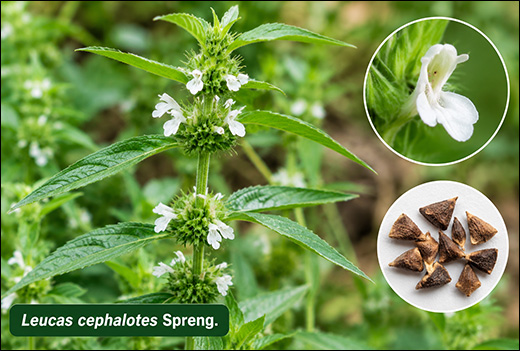
Leucas cephalotes is an erect, aromatic, annual herb that usually grows up to 30–100 cm in height with a quadrangular, branched, and softly hairy stem. The leaves are simple, opposite, lanceolate to oblong-lanceolate, measuring about 4–12 cm long, with serrated margins, an acute apex, and a rough, hairy surface. The flowers are small, white, sessile, and densely arranged in globose axillary whorls surrounded by numerous linear bracts. The calyx is tubular, ribbed, and covered with fine hairs, while the corolla is bilabiate with a hairy upper lip and a three-lobed lower lip. The plant flowers and fruits mainly from October to February. The fruit is a small, dry schizocarp that splits into four smooth, brown nutlets containing the seeds. Its well-developed taproot and profusely branched stem enable it to thrive in fields, roadsides, and other disturbed habitats.
Classical Categorisation of Leucas cephalotes Spreng./ Dronapushpi/ Guma/ Droni/ Kubi
- According to Bhavprakash Nighantu: Guduchyadi varga
- According to Raj Nighantu: Parpatadi varga
Ancient Verse of Leucas cephalotes Spreng./ Dronapushpi/ Guma/ Droni/ Kubi
द्रोणा च द्रोणपुष्पी च फलेपुष्पा च कीर्तिता ।
द्रोणपुष्पी गुरुः स्वादु रूक्षोष्णा वातपित्तकृत् ॥
सतीक्ष्णलवणा स्वादुपाका कट्वी च भेदिनी ।
कफामकमलाशोथतमकश्वासजन्तुजित् ॥
(Bhavprakash Nighantu Guduchyadi varga 282-283)
According to the above shloka, Dronapushpi (Leucas cephalotes) is also known by the names Drona, Dronapushpi, and Phalapushpa. It possesses a heavy (Guru) quality, sweet taste (Madhura Rasa), dry (Ruksha) and hot potency (Ushna Virya), and helps pacify Vata and Pitta doshas. It exhibits sharp (Tikshna), slightly saline (Lavana), and laxative (Bhedana) properties, promoting proper bowel evacuation. The herb is traditionally indicated in the management of Kapha disorders, Ama (metabolic toxins), jaundice (Kamala), oedema (Shotha), cough (Kasa), bronchial asthma (Tamak Shwasa), and intestinal worms (Krimi) due to its cleansing, digestive, and expectorant actions.
द्रोणपुष्पी दीर्घपत्रा कुम्भयोनिः कुतुम्बिका ।
चित्राक्षुपः कुतुम्बा च सुपुष्पा चित्रपत्रिका ॥
द्रोणपुष्पी कटुः सोष्णा रुच्या वातकफापहा ।
अग्निमान्द्यहरा चैव पथ्या वातापहारिणी ॥
(Raj Nighantu Parpatadi varga 137-138)
The above verse describes Dronapushpi (Leucas cephalotes) by mentioning its various synonyms such as Dirghapatra, Kumbhayoni, Kutumbika, Chitrakshupa, Supushpa, and Chitrapatrika, each reflecting distinctive botanical features like its long leaves, attractive flowers, or unique appearance. The herb possesses a pungent (Katu) taste, drying (Shoshana) and light, dry (Ruksha) qualities, making it effective in alleviating Vata and Kapha doshas. It is traditionally indicated in conditions such as polyuria (Atimeha) and is regarded as a wholesome herb that supports the management of Vata-related disorders while promoting overall health.
Ayurvedic Properties of Leucas cephalotes Spreng./ Dronapushpi/ Guma/ Droni/ Kubi
- Taste (Rasa)- Bitter (Tikta), Pungent (Katu), Sweet (Madhur), Salty (Lavana)
- Physical property (Guna) – Heavy (Guru), Dry (Ruksha)
- Potency (Veerya )- Hot Potency (Usna)
- Post-digestion effect (Vipaka)- Sweet (Madhur)
- Effect on tridosha– Balance Kapha dosha
Therapeutic Indications of Leucas cephalotes Spreng./ Dronapushpi/ Guma/ Droni/ Kubi
- Possesses laxative (Bhedana) properties that promote smooth bowel evacuation.
- Helps alleviate Kapha disorders by clearing excess mucus and congestion.
- Aids in eliminating Ama (metabolic toxins) through its cleansing and digestive actions.
- Traditionally used in the management of jaundice (Kamala).
- Beneficial in reducing oedema (Shotha) by supporting fluid balance.
- Effective in relieving cough (Kasa) and bronchial asthma (Tamak Shwasa) due to its expectorant properties.
- Helps expel intestinal worms (Krimi) through its anthelmintic action.
- Traditionally indicated in polyuria (Atimeha) to support healthy urinary function.
- Assists in balancing Vata-related disorders and promotes overall well-being.
- Acts as a wholesome herb with digestive, cleansing, and expectorant properties.
Systemic actions of Leucas cephalotes Spreng./ Dronapushpi/ Guma/ Droni/ Kubi
External Uses
Possesses antimicrobial and anti-poisonous properties, pacifies Kapha dosha, and is used as Nasya in headache and rhinitis, as a wound-cleansing decoction, and as a collyrium in jaundice.
Internal Uses
- Digestive System: Acts as a carminative, promotes proper movement of Doshas, stimulates bile secretion, and exhibits mild laxative and anthelmintic actions; indicated in helminthiasis, liver disorders, abdominal colic, constipation, and indigestion.
- Circulatory System: Functions as a blood purifier and supports healthy blood circulation.
- Respiratory System: Pacifies Kapha dosha and is beneficial in rhinitis, cough, asthma, and other respiratory disorders.
- Reproductive System: Traditionally indicated in amenorrhea and dysmenorrhea.
- Skin: Useful in the management of various skin disorders.
- Fever: Beneficial in Vishama Jwara (intermittent fever) and Vata-Pitta Jwara.
- Anti-toxic Action: Acts as an anti-poisonous herb and is traditionally used in cases of animal poisoning.
Chemical Composition of Leucas cephalotes Spreng./ Dronapushpi/ Guma/ Droni/ Kubi
Leucas cephalotes is rich in diverse bioactive phytochemicals, including diterpenes, triterpenes, sterols, flavonoids, fatty acids, and volatile oils, which contribute to its wide range of pharmacological activities.
- Diterpenes: The plant contains unique labdane, norlabdane, and abietane diterpenes, including leucasdins A, B, and C, known for their medicinal potential.
- Triterpenes: Major triterpenes include oleanolic acid and the protostane-type triterpenes leucastrins A and B, which exhibit antioxidant and anti-inflammatory properties.
- Sterols: The principal phytosterols are β-sitosterol and stigmasterol, along with 7-oxositosterol, 7-oxostigmasterol, 7α-hydroxysitosterol, and 7α-hydroxystigmasterol.
- Flavonoids: Important flavonoids include luteolin, tricin, pillion, cosmosin, gonzalitosin I, anisofolin A, and 5-hydroxy-7,4′-dimethoxy flavone, which contribute to the plant's antioxidant and anti-inflammatory activities.
- Fatty Acids: The seed oil contains laballenic acid (octadeca-5,6-dienoic acid), lauric acid, glutaric acid, tridecanoic acid, and adipic acid.
- Volatile Oils: The essential oils are rich in caryophyllene oxide, menthol, and δ-fenchene, with caryophyllene oxide being one of the predominant constituents responsible for the plant's characteristic aroma and biological activities.
Actions and Properties of Various Chemical Constituents of Leucas cephalotes Spreng./ Dronapushpi/ Guma/ Droni/ Kubi
For Tuberculosis
Leucas cephalotes may support the management of tuberculosis (TB) through its antimicrobial, antioxidant, anti-inflammatory, and immunomodulatory phytochemicals. Oleanolic acid, a major triterpene, has shown promising activity against Mycobacterium tuberculosis by inhibiting essential bacterial proteins while also reducing inflammation. Flavonoids such as luteolin, tricin, and apigenin protect tissues from oxidative stress and help minimise liver damage associated with TB infection and prolonged anti-tubercular therapy. Phytosterols like β-sitosterol and stigmasterol, along with unique diterpenes (leucasdins A, B, and C), contribute antimicrobial and immune-supportive effects that enhance the body's defence against infection. Additionally, laballenic acid and other bioactive constituents strengthen the herb's overall antimicrobial activity, making Leucas cephalotes a valuable supportive medicinal plant in TB management.
For Jaundice
Leucas cephalotes (Dronapushpi) helps in the management of jaundice through its potent hepatoprotective, antioxidant, and anti-inflammatory phytochemicals. Flavonoids, particularly luteolin, protect liver cells by neutralising free radicals, reducing oxidative stress, and lowering elevated liver enzymes and bilirubin levels. Oleanolic acid, a major triterpene, safeguards hepatic tissues from toxin-induced damage and supports the regeneration of injured liver cells. Phytosterols such as β-sitosterol and lupeol further reduce liver inflammation by suppressing inflammatory mediators. In addition, these bioactive compounds enhance the activity of endogenous antioxidant enzymes, including superoxide dismutase (SOD), glutathione (GSH), and catalase, thereby promoting liver detoxification, restoring normal liver function, and accelerating recovery from jaundice.
For Fever
Leucas cephalotes (Dronapushpi) helps manage fever through its antipyretic, anti-inflammatory, and antioxidant phytochemicals. Oleanolic acid, a major triterpenoid, suppresses inflammatory mediators such as TNF-α and IL-1β, thereby helping reduce elevated body temperature. Flavonoids, including luteolin and apigenin derivatives, protect cells from oxidative stress and regulate the immune response during infections. Laballenic acid, a unique fatty acid, inhibits the production of inflammatory substances like nitric oxide and prostaglandins, which are involved in the development of fever. Additionally, β-sitosterol and stigmasterol reduce inflammation, support the body's natural cooling mechanism through mild diaphoretic action, and promote faster recovery from febrile conditions.
Practical Uses / Health Benefits of Leucas cephalotes Spreng./ Dronapushpi/ Guma/ Droni/ Kubi
- For cough and common cold: Prepare a decoction or fresh juice of the whole plant and take it with honey to help relieve cough, cold, and congestion.
- For fever: Drink the fresh juice or decoction of the plant to reduce fever, particularly in intermittent and Kapha-related fevers.
- For sinusitis and headache: Crush fresh leaves to extract the juice and instill 2–3 drops into each nostril as Nasya to relieve sinus congestion and headache.
- For abdominal pain and indigestion: Consume the fresh juice of the plant to improve digestion and ease abdominal discomfort.
- For jaundice: Instill a few drops of fresh leaf juice into the eyes, as traditionally practised for jaundice.
- For skin itching: Apply the fresh leaf juice externally over the affected area to reduce itching and irritation.
- For wounds: Wash wounds with a decoction prepared from the dried plant to promote cleansing and healing.
- For snake or insect bites: Apply a paste or fresh juice of the leaves over the affected area as a traditional first-aid measure.
- For excessive sweating: Apply the fresh juice of the flowers externally to help control excessive perspiration.
- For chills due to cold exposure: Administer Nasya with the fresh juice to help relieve cold-induced shivering.
- For respiratory congestion: Consume the flower juice with honey to support relief from cough and respiratory discomfort.
Parts Used of Leucas cephalotes Spreng./ Dronapushpi/ Guma/ Droni/ Kubi
- Whole Plant
Dosage of Leucas cephalotes Spreng./ Dronapushpi/ Guma/ Droni/ Kubi
- Juice- 5-10 ml
Conclusion
Leucas cephalotes (Dronapushpi) is a valuable medicinal herb widely recognised in Ayurveda and traditional medicine for its broad therapeutic potential. It is rich in bioactive compounds such as flavonoids, triterpenes, sterols, and diterpenes, and it exhibits antioxidant, anti-inflammatory, antimicrobial, hepatoprotective, antipyretic, and immunomodulatory activities. Traditionally, it has been used to support the management of respiratory disorders, liver ailments, fever, digestive complaints, skin diseases, wounds, and poisoning. Its diverse pharmacological actions, combined with its long history of traditional use and emerging scientific evidence, make Leucas cephalotes an important medicinal plant with promising applications in both preventive healthcare and complementary medicine.
FAQs
1. What is the common name of Leucas cephalotes?
The common name of Leucas cephalotes is Dronapushpi. It is also commonly known as Guma in Hindi and Spiderwort in English.
2. What is the Hindi name of Leucas cephalotes?
The Hindi name of Leucas cephalotes is Guma. It is a well-known medicinal herb used in traditional Ayurvedic medicine.
3. What are the uses of Leucas cephalotes?
Leucas cephalotes is traditionally used to manage fever, cough, asthma, bronchitis, jaundice, digestive disorders, skin diseases, wounds, and intestinal worms. It is also valued for its antimicrobial, anti-inflammatory, and hepatoprotective properties.
4. What is the family name of Leucas cephalotes?
Leucas cephalotes belongs to the Lamiaceae (Mint family), a family well known for its aromatic and medicinal plants.
5. What are the benefits of Leucas cephalotes?
Leucas cephalotes helps support respiratory health, liver function, digestion, skin healing, and immune health. It also possesses antioxidant, antimicrobial, anti-inflammatory, antipyretic, and hepatoprotective activities.







