


Chaulai (Amaranthus spinosus): Properties, Indications & Home Remedies
Abstract
Amaranth, commonly known as Chaulai and botanically identified as Amaranthus spinosus, is an important medicinal and nutritional herb widely used in traditional systems of medicine, especially Ayurveda. It belongs to the family Amaranthaceae and is valued for its rich nutritional profile and therapeutic properties. The plant is known for its cooling, digestive, anti-inflammatory, diuretic, and blood-purifying actions. Traditionally, Chaulai is used in managing conditions such as anemia, digestive disorders, urinary problems, inflammation, skin diseases, and bleeding disorders. Different parts of the plant, including leaves, roots, seeds, and stems, are utilized for medicinal purposes. Rich in vitamins, minerals, antioxidants, flavonoids, and essential nutrients, Amaranthus spinosus supports overall health and vitality. Modern scientific studies also suggest its antioxidant, antimicrobial, hepatoprotective, antidiabetic, and anti-inflammatory potential, making it a valuable herb.
Classical Reference Of Amaranth / Chaulai (Amaranthus Spinosus)
Bhavprakash Nighantu Shaka Varga Page No. 654
Scientific Classification Of Amaranth / Chaulai (Amaranthus Spinosus)
- Kingdom: Plantae
- Division: Angiosperms
- Class: Eudicots
- Order: Caryophyllales
- Family: Amaranthaceae
- Genus: Amaranthus
- Species: spinosus
Synonyms Of Amaranth / Chaulai (Amaranthus Spinosus)
- Tandula / Tanduliyaka / Tandulibija / Tanduleraka: The plant’s tiny seeds look like small grains of rice.
- Meghanada / Ghanasvana: It is called this because the plant grows very fast and stays healthy during the rainy season.
- Bhandira: It describes how easily you can spot this plant growing wild.
- Kandera: It refers to the plant having many stems and branches.
- Alpamarisha: It is a smaller, wild type of the common amaranth vegetable.
- Vishaghna: It highlights how the plant is used to clear toxins and poisons from the body.
Vernacular Names Of Amaranth / Chaulai (Amaranthus Spinosus)
- Sanskrit: Tanduliyaka, Marisha
- Hindi: Chaulai, Kantawali Chaulai
- Punjabi: Chaulai
- Bengali: Kata Notey
- Gujarati: Kantalo Danto
- Marathi: Kate Math
- Tamil: Mullukeerai
- Telugu: Mullathotakura
- Malayalam: Mullancheera
- Kannada: Mulludantu
- English: Spiny Amaranth, Prickly Amaranth
Habitat & Distribution Of Amaranth / Chaulai (Amaranthus Spinosus)
Native Origin
Amaranthus spinosus is believed to have originated in tropical regions of the Americas; however, it has become widely naturalized in Asia, Africa, and other tropical and subtropical parts of the world. Due to its adaptability and medicinal importance, the plant now grows abundantly in many countries.
Global Distribution
The plant is commonly distributed across tropical and subtropical regions worldwide, including Asia, Africa, Australia, Central America, and South America. It frequently grows as a wild herb in open lands, roadsides, cultivated fields, grasslands, and disturbed habitats.
Distribution in India
In India, Chaulai is widely distributed throughout plains, agricultural lands, village surroundings, wastelands, and forest margins. It grows abundantly in both rural and semi-urban regions and is commonly found during the rainy and warm seasons.
Climatic Requirements
Amaranthus spinosus thrives best in warm and humid climatic conditions. It prefers tropical and subtropical environments with adequate sunlight and moderate rainfall. The plant tolerates high temperatures and adapts well to seasonal climatic variations.
Soil
The plant grows well in fertile, well-drained soils, especially sandy loam and loamy soil rich in organic matter. However, it can also tolerate poor soils and disturbed land conditions, provided water stagnation is absent.
Ecological Adaptability
Research observations suggest that Chaulai has excellent ecological adaptability and can survive in harsh environmental conditions. It grows rapidly in open sunny areas, tolerates moderate drought, and establishes easily in disturbed soils, roadsides, gardens, and cultivated fields, contributing to its widespread occurrence.
Morphology Of Amaranth / Chaulai (Amaranthus Spinosus)
Plant (Habit)
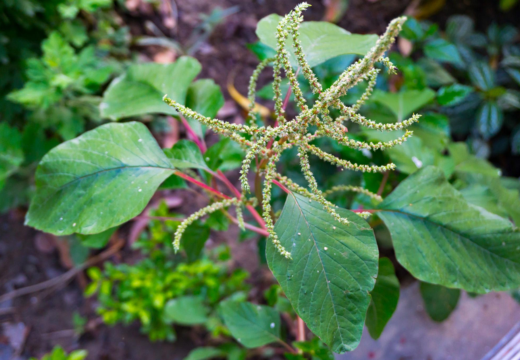
Amaranthus spinosus is an erect, annual herb that commonly grows up to 30 cm to 1 meter in height. The plant has a branched, bushy appearance and is distinguished by the presence of sharp spines at the leaf axils, which serve as a characteristic identifying feature. It grows rapidly under favorable climatic conditions.
Roots
The root system consists of a strong taproot with numerous lateral branches. Roots are slender, light brown, and penetrate deeply into the soil, helping the plant survive under dry environmental conditions.
Stem
The stem is erect, cylindrical, smooth, and green to reddish-green in color. It is branched, somewhat grooved, and often develops a slightly woody texture with maturity. A pair of stiff spines is usually present at the nodes.
Leaves
Leaves are simple, alternate, ovate to lanceolate in shape, and green in color. They possess long petioles and smooth margins with a pointed apex. The leaf surface is generally soft and glabrous (hairless), contributing to active photosynthesis and nutritional value.
Flowers
Flowers are small, greenish, and arranged in dense spikes or clusters at terminal and axillary positions. Male and female flowers are generally present on the same plant. Flowering occurs mainly during warm and rainy seasons.
Fruits
The fruit is a small, dry capsule (utricle) that matures gradually and contains tiny seeds. It develops after successful pollination and remains enclosed within floral structures.
Seeds
Seeds are small, round, smooth, and shiny black or dark brown in color. They are highly nutritious and capable of rapid germination, aiding in the easy propagation of the plant.
Classical Categorisation Of Amaranth / Chaulai (Amaranthus Spinosus)
- Bhavprakash Nighantu: Shaka Varga
- Raj Nighantu: Mulakadi Varga
- Dhanwanthari Nighantu: Karavadi Varga
Ancient Verses For Amaranth / Chaulai (Amaranthus Spinosus)
Verse No. 1
तण्डुलीयो मेघनादः काण्डेरस्तण्डुलेरकः।
भण्डीरस्तण्डुलीबीजो विषघ्नश्चाल्पमारिषः॥
तण्डुलीयो लघुः शीतो रूक्षः पित्तकफास्रजित्।
सृष्टमूत्रमलो रुच्यो दीपनो विषहारकः॥ Bhavprakash Nighantu Shaka Varga Verse No. 12-13
Verse Interpretation
Synonyms of Amaranth
- Tanduliya / Tanduleraka / Tandulibija: The plant’s tiny seeds look like small grains of rice.
- Meghanada: It is called this because the plant grows very fast and is healthy during the rainy season.
- Kandera: It refers to the plant having many stems and branches.
- Bhandira: It describes how easily you can recognize this plant growing wild.
- Alpamarisha: It is a smaller, wild type of the common amaranth vegetable.
- Vishaghna: It highlights how the plant is used to clear toxins and poisons from the body.
Properties and Medicinal Benefits:
- Laghu, Shito, Rukshah: It is light to digest (Laghu), cooling in nature (Shita), and dry (Ruksha).
- Pitta-kapha-asrajit: It balances disorders caused by aggravated Pitta and Kapha doshas, as well as blood-related disorders (Asra).
- Srishta-mutra-malo: It helps in the smooth elimination of urine (Mutra) and stool (Mala), acting as a natural diuretic and mild laxative.
- Ruchyo, Dipano: It improves taste and appetite (Rucya) and stimulates the digestive fire (Dipana).
- Vishaharakah: It acts as an antidotal herb traditionally used to help neutralize toxins and poisons in the body.
Verse No. 2
तण्डुलीयस्तु उद्दिष्टस्तण्डुलस्तण्डुलीयकः ।
भण्डीरस्तण्डुलीबीजो मेघनादो घनस्वनः ॥ Dhanwanthari Nighantu Mulakadi Varga Verse No. 105
Verse Interpretation
Synonyms of Amaranth
- Tandula / Tanduliyaka / Tandulibija: The plant’s tiny seeds look like small grains of rice.
- Meghanada / Ghanasvana: It is called this because the plant grows very fast and stays healthy during the rainy season.
- Bhandira: It describes how easily you can spot this plant growing wild.
Verse No. 3
तण्डुलीयो विषघ्नश्च रूक्षः शीततर शुचिः ।
मधुरो रसपाकाभ्यां रक्तपित्तापघातकः ॥ Dhanwanthari Nighantu Mulakadi Varga Verse No. 106
Verse Interpretation
- Antidote to poisons: It works as a natural remedy traditionally used to help neutralize toxic substances and venom in the body.
- Ruksha: It has a dry property that helps reduce excess moisture or oiliness.
- Excessively cold: It provides a very strong cooling effect on the body system.
- Sweet: It tastes sweet when consumed and also retains a sweet quality after digestion.
- Cures bleeding diathesis: It is traditionally used to help manage bleeding disorders or conditions associated with excessive bleeding.
Verse No. 4
तण्डुलीयकदलं हिमसर्शःपित्तरक्तविषकासविनाशि ।
ग्राहंकं च मधुरं च विपाके दाहशोषशमनं रुचिदायि ॥ Raj Nighantu Mulakadi Varga Verse No. 145
Verse Interpretation
Amaranth has a natural cooling effect on the body. Eating this vegetable helps treat health issues like piles, pitta imbalances, blood disorders, toxins, and cough. The post digestion effect of Amaranth is sweet additionally, it increases hunger, calms burning sensations, and helps prevent extreme weakness or weight loss.
Ayurvedic Properties Of Amaranth / Chaulai (Amaranthus Spinosus)
- Rasa (Taste): Madhura (sweet), Kashaya (astringent)
- Guna (Qualities): Laghu (light), Ruksha (dry)
- Veerya (Potency): Sheeta (cooling)
- Vipaka (Post-digestive Effect): Madhura (sweet)
Action On Tridosha Of Amaranth / Chaulai (Amaranthus Spinosus)
- Vata Dosha: Chaulai may slightly aggravate Vata when consumed in excess due to its Ruksha (dry) property, but when cooked properly with ghee or mild spices, it can be better tolerated.
- Pitta Dosha: It is considered Pitta-pacifying because of its Sheeta Veerya (cooling potency) and Madhura-Kashaya Rasa, helping reduce excess heat, burning sensation, and inflammation.
- Kapha Dosha: Chaulai helps balance Kapha Dosha due to its Laghu (light) and Ruksha (dry) qualities, which reduce heaviness and excessive moisture in the body.
Therapeutic Indications Of Amaranth / Chaulai (Amaranthus Spinosus)
- Raktavikara (Blood disorders)
- Visha (Poisoning / toxins)
- Pitta Vikara (Pitta dosha imbalances)
- Kapha Vikara (Kapha dosha imbalances)
- Sojak (Gonorrhea)
- Raktapradar (Menorrhagia)
- Shwetapradar (Leucorrhea)
- Habitual abortion / miscarriage
- Tumors, cysts, or hard lumps
- Boils / abscesses
- Visarp (Erysipelas / Herpes-like spreading skin diseases)
- Inflammatory skin diseases with a burning sensation
Systemic Actions Of Amaranth / Chaulai (Amaranthus Spinosus)
Digestive System
Chaulai exhibits mild Deepana (digestive stimulant) and Pachana (digestive) properties, helping to improve digestion and gastrointestinal function. Due to its Kashaya (astringent) nature, it is traditionally used in diarrhea, dysentery, and bowel irritation.
Urinary System
Amaranthus spinosus demonstrates Mutrala (diuretic) activity, promoting healthy urine flow and assisting in flushing toxins through the urinary tract. It has been traditionally used in dysuria, urinary discomfort, and burning micturition, while studies indicate supportive effects on urinary health.
Circulatory and Blood System
Chaulai is considered beneficial for Raktashodhana (blood purification) and maintaining healthy circulation. It is traditionally used in bleeding disorders and blood vitiation, while its antioxidant constituents may help protect tissues from oxidative stress.
Integumentary System (Skin)
The herb possesses anti-inflammatory, antimicrobial, and wound-healing properties, making it useful in eczema, skin irritation, ulcers, wounds, and inflammatory skin conditions.
Musculoskeletal System
Amaranthus spinosus exhibits anti-inflammatory and analgesic activities, which may help in reducing joint pain, swelling, muscular discomfort, and rheumatic conditions.
Reproductive System
Chaulai has traditionally been used in gynecological conditions such as menorrhagia (heavy menstrual bleeding) and leucorrhoea, owing to its cooling and astringent properties.
Respiratory System
The plant has shown bronchodilatory and anti-inflammatory effects, indicating supportive potential in respiratory conditions such as cough and airway inflammation.
Chemical Composition Of Amaranth / Chaulai (Amaranthus Spinosus)
- Amaranthine: A major betalain pigment with strong antioxidant activity, helping protect cells from oxidative damage and inflammation.
- Quercetin (Flavonoid): Possesses strong antioxidant and anti-inflammatory properties, helping reduce oxidative stress and inflammation.
- Rutin (Flavonoid): Supports blood vessel health, improves circulation, and exhibits antioxidant activity.
- Gallic Acid (Phenolic Compound): Shows antimicrobial, antioxidant, and anti-inflammatory effects, supporting tissue protection.
- Tannins: Help in diarrhea management, wound healing, and reducing intestinal irritation due to their astringent action.
- Saponins: Contribute to cholesterol reduction, immune support, and antimicrobial activity.
- Beta-carotene: Acts as a precursor of Vitamin A, supporting eye health, immunity, and skin repair.
- Vitamin C (Ascorbic Acid): Helps in immunity enhancement, collagen formation, and wound healing.
- Iron: Supports hemoglobin formation and prevention of iron deficiency anemia.
Practical Uses / Health Benefits Of Amaranth / Chaulai (Amaranthus Spinosus)
- Supports digestive health and may help in indigestion, diarrhea, dysentery, and bowel irritation due to its mild digestive and astringent properties.
- Promotes urinary health through its diuretic activity, helping in urinary discomfort, dysuria, and burning urination.
- Helps reduce body heat, burning sensation, and aggravated Pitta due to its cooling (Sheeta) nature.
- Traditionally used externally to support wound healing, cuts, ulcers, and skin irritation because of its anti-inflammatory properties.
- May help manage joint pain, swelling, and rheumatic discomfort due to its anti-inflammatory activity.
- Supports blood health and circulation, partly due to its iron and antioxidant content.
- Beneficial for eczema, itching, rashes, and minor skin infections due to its soothing and antimicrobial effects.
- Supports liver health and may help protect against oxidative stress due to hepatoprotective properties.
- May help maintain healthy blood sugar balance through its reported antidiabetic activity.
- Provides nutritional support, immunity, and vitality due to its rich vitamin, mineral, and antioxidant profile.
Home Remedies With Amaranth / Chaulai (Amaranthus Spinosus)
- Root decoction along with Cucurbita pepo Linn. is traditionally used to control bleeding following abortion.
- Root decoction is used to relieve piles and diarrhea in children.
- Leaves are used in the management of fever.
- A poultice prepared from the leaves is applied to reduce inflammation, boils, and abscesses.
- Leaves and the whole plant are traditionally used as a remedy for lung disorders.
- Tincture prepared from dried seeds and leaves is used to help prevent flu and common colds.
- Root decoction (Kwath) administered with Mulethi (Glycyrrhiza glabra) and Apamarg (Achyranthes aspera) is used in the management of gonorrhea.
- Root used along with Amla (Phyllanthus emblica), Ashok bark (Saraca asoca), and Daruhaldi (Berberis aristata) is traditionally used in menorrhagia (heavy menstrual bleeding) to reduce pain and control excessive bleeding.
- Root combined with Hirabol is traditionally administered for 3–4 days to women with recurrent miscarriage tendencies and leucorrhea (white vaginal discharge).
- The whole plant (Panchang), cooked with Arhar dal, is used to promote lactation (increase breast milk production) in women and is also fed to animals for the same purpose.
- Paste of the root is applied externally to hasten the ripening of tumors, cysts, or boils.
- Paste prepared from crushed leaves is applied externally to soothe burning sensations associated with erysipelas and other inflammatory skin disorders.
Part(S) Used Of Amaranth / Chaulai (Amaranthus Spinosus)
- Whole plant (Panchang)
- Leaves (Patra)
- Root (Moola)
- Seeds (Beeja)
- Stem
Dosage Of Amaranth / Chaulai (Amaranthus Spinosus)
- Fresh Juice (Swarasa): 10–20 ml
- Powder (Churna): 3–6 g
- Decoction (Kwath): 30–50 ml
- Paste (Lepa): For external application as required
- Fresh leaves/whole plant (as vegetable): Taken in moderate dietary amounts
Research On Amaranth / Chaulai (Amaranthus Spinosus)
Research on Amaranthus spinosus (Chaulai) has shown several pharmacological and nutritional benefits due to the presence of flavonoids, alkaloids, phenolic compounds, saponins, amino acids, minerals, and antioxidants.
- Antioxidant Activity: Studies have reported strong antioxidant properties due to compounds like flavonoids, phenols, and betalains, which help neutralize free radicals and reduce oxidative stress.
- Anti-inflammatory Activity: Experimental research suggests that the plant extract may help reduce inflammation, swelling, redness, and pain, supporting its traditional use in inflammatory skin disorders and boils.
- Antimicrobial Activity: Research has demonstrated antibacterial and antifungal properties against certain microorganisms, indicating its possible usefulness in wound healing and infections.
- Antidiabetic Potential: Animal-based studies have suggested that Amaranthus spinosus may help lower blood glucose levels and improve insulin sensitivity, making it potentially beneficial in diabetes management.
- Hepatoprotective (Liver-Protective) Effect: Scientific studies suggest that plant extracts may help protect liver cells from toxic damage and support healthy liver function.
- Diuretic Activity: Studies indicate mild diuretic action, which may help increase urine output and support urinary tract health.
- Gastroprotective and Anti-diarrheal Activity: Research suggests beneficial effects in managing diarrhea, gastric irritation, and digestive disturbances due to its soothing and protective properties on the gastrointestinal tract.
- Anti-anemic Potential: Due to its high iron and mineral content, Chaulai has been studied for its supportive role in improving hemoglobin levels and nutritional deficiencies.
- Immunomodulatory Activity: Certain phytochemicals present in the plant may help strengthen immune responses and support resistance against infections.
- Wound Healing Activity: Experimental studies have shown that leaf and root extracts may support faster healing of wounds, boils, and abscesses due to antimicrobial and anti-inflammatory actions.
- Analgesic (Pain-Relieving) Effect: Some studies indicate mild pain-relieving properties, supporting its traditional use in painful inflammatory conditions.
- Nutritional Research: Amaranthus spinosus is recognized as a nutrient-rich leafy vegetable containing proteins, dietary fiber, iron, calcium, potassium, vitamin A, vitamin C, and essential amino acids, making it valuable for improving overall nutrition and strength.
Conclusion
Amaranthus spinosus (Amaranth / Chaulai / Prickly Amaranth) is a highly valuable medicinal and nutritional herb widely recognized in Ayurveda and traditional medicine for its diverse therapeutic applications. Rich in essential nutrients, antioxidants, flavonoids, vitamins, and minerals, the plant contributes significantly to maintaining overall health and vitality. Traditionally, it has been used for managing digestive disturbances, urinary disorders, inflammation, skin diseases, bleeding conditions, and reproductive health concerns. Its cooling, digestive, blood-purifying, diuretic, and anti-inflammatory properties make it beneficial in balancing aggravated Pitta and Kapha doshas. Various plant parts, including roots, leaves, seeds, and the whole plant, are utilized in herbal remedies and dietary preparations. Modern scientific research further supports many of its traditional uses by demonstrating antioxidant, antimicrobial, hepatoprotective, antidiabetic, wound-healing, and immunomodulatory effects. Thus, Chaulai stands as an important medicinal herb with promising therapeutic and nutritional significance.