


Vanya Kahu (Lactuca serriola): Ayurvedic Properties, Indications & Home Remedies
Abstract
Vanya Kahu, botanically identified as Lactuca serriola, is a medicinal wild herb belonging to the Asteraceae family and is considered the wild ancestor of cultivated lettuce. Traditionally recognized for its cooling, sedative, digestive, and therapeutic properties, the plant has been used in various traditional systems of medicine for managing nervous disorders, insomnia, cough, respiratory discomfort, digestive disturbances, urinary complaints, and inflammatory conditions. The herb contains a characteristic milky latex known as lactucarium, often referred to as “lettuce opium,” due to its mild calming and analgesic properties. Rich in sesquiterpene lactones, flavonoids, phenolic compounds, vitamins, and minerals, Lactuca serriola exhibits antioxidant, anti-inflammatory, antimicrobial, sedative, and pain-relieving potential. Different plant parts, including leaves, stems, seeds, and latex, are utilized for medicinal purposes. Modern research also suggests its possible role in stress relief, pain management, liver protection, and immune support, making Vanya Kahu an important medicinal herb with promising therapeutic significance.
Classical Reference Of Vanya Kahu (Lactuca Serriola)
Bhavprakash Nighantu Parishisht Varga Page no. 797
Scientific Classification Of Vanya Kahu (Lactuca Serriola)
- Kingdom: Plantae
- Division: Angiosperms
- Class: Eudicots
- Order: Asterales
- Family: Asteraceae
- Genus: Lactuca
- Species: serriola
Vernacular Names Of Vanya Kahu / Lactuca Serriola
- Sanskrit: Vanya Kahu, Kahu
- Hindi: Jungli Kahu, Kahu
- Punjabi: Jungli Kahu
- Bengali: Bon Lettuce / Jungli Lettuce
- Gujarati: Jungli Kahu
- Marathi: Ran Kahu
- Tamil: Kattu Lettuce
- Telugu: Adavi Lettuce
- Malayalam: Kattu Lettuce
- Kannada: Kaadu Lettuce
- English: Wild Lettuce, Compass Plant, Prickly Lettuce
Habitat & Distribution Of Vanya Kahu / Lactuca Serriola
- Native Origin: Research studies identify Lactuca serriola as native to Europe, Western Asia, and North Africa. It is considered the wild progenitor (ancestor) of cultivated lettuce (Lactuca sativa) and has spread extensively through natural dispersal and agricultural activities.
- Global Distribution: Lactuca serriola is widely naturalized across temperate and subtropical regions of the world, including Europe, Asia, North and South America, Australia, New Zealand, and parts of Africa. Botanical surveys report its common occurrence in roadsides, grasslands, disturbed lands, railway tracks, abandoned fields, orchards, riverbanks, and cultivated agricultural zones.
- Distribution in India: In India, the plant is reported from temperate and subtropical regions, particularly in the northwestern Himalayas, Jammu & Kashmir, Himachal Pradesh, Uttarakhand, Punjab, Haryana, and adjoining plains. Floristic studies have documented its growth in crop fields, wastelands, dry open habitats, village surroundings, and roadside ecosystems.
- Climatic Requirements: Research suggests that Lactuca serriola grows optimally in temperate climates with moderate sunlight and dry to semi-dry environmental conditions. The species demonstrates tolerance to heat stress and moderate drought due to its deep taproot system and adaptive leaf orientation, which minimizes excessive water loss.
- Soil: Studies indicate that the plant prefers well-drained loamy or sandy-loam soils with moderate fertility and good aeration. However, ecological reports show that it can also establish in compact, nutrient-poor, rocky, or disturbed soils.
- Ecological Adaptability: Ecological research has shown that Lactuca serriola possesses high invasive and adaptive potential. The species demonstrates efficient seed dispersal, rapid colonization, drought tolerance, and strong survival ability in disturbed habitats, enabling successful establishment in diverse climatic and ecological regions.
Morphology Of Vanya Kahu (Lactuca Serriola)
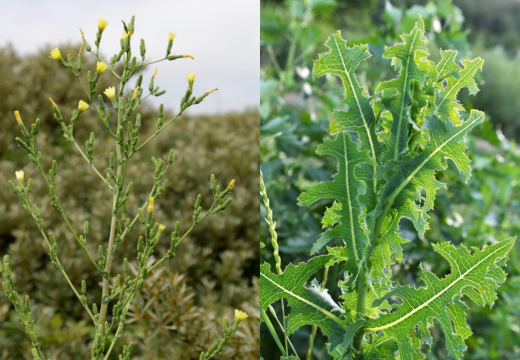
- Plant (Habit): Lactuca serriola is an erect, annual or biennial herb that commonly grows up to 30 cm to 2 meters in height. The plant has a rigid, upright growth habit and exudes a characteristic milky latex when injured. It is commonly recognized by its prickly leaves and tall flowering stalk.
- Roots: The plant possesses a strong and deep taproot system with several lateral root branches. The root helps the plant survive under dry conditions by efficiently absorbing water from deeper soil layers.
- Stem: The stem is erect, cylindrical, hollow, smooth to slightly prickly, and green to pale purplish in color. It becomes branched near the upper region and contains milky latex throughout the tissues.
- Leaves: Leaves are alternate, deeply lobed or pinnatifid, bluish-green in color, and often possess small prickles along the margins and underside of the midrib. Lower leaves are larger and arranged in a rosette, while upper leaves clasp the stem. Research observations report that leaves often orient vertically (north–south direction) to reduce water loss under intense sunlight.
- Flowers: Flowers are small, pale yellow, and arranged in branched clusters (panicles or corymbs). Each flower head resembles small dandelion-like blooms and consists of multiple ray florets. Flowering mainly occurs during warm seasons.
- Fruits: The fruit is a dry, one-seeded achene, narrow and flattened in shape, usually brownish in color. It develops after pollination and aids in propagation.
- Seeds: Seeds are small, elongated, and attached to a white feathery pappus, which helps in wind dispersal. The plant produces abundant seeds with high germination capacity, contributing to its widespread naturalization.
Classical Categorisation Of Vanya Kahu (Lactuca Serriola)
- Bhavprakash Nighantu: Parishisht Varga
Ayurvedic Properties Of Vanya Kahu (Lactuca Serriola)
- Rasa (Taste): Tikta (bitter), Kashaya (astringent), slightly Madhura (sweet)
- Guna (Qualities): Laghu (light), Snigdha (slightly unctuous), Sara (mildly flowing)
- Veerya (Potency): Sheeta (cooling)
- Vipaka (Post-digestive Effect): Madhura (sweet)
Action On Tridosha Of Vanya Kahu (Lactuca Serriola)
- Vata Dosha: May mildly increase Vata in excess due to its bitter nature.
- Pitta Dosha: Helps pacify aggravated Pitta due to its cooling and soothing properties.
- Kapha Dosha: Mildly helps balance Kapha by reducing heaviness and excess mucus.
Therapeutic Indications Of Vanya Kahu (Lactuca Serriola)
- Insomnia
- Pitta-type headache
- Cough
- Respiratory discomfort
- Delirium associated with fever
- Hair fall – external application
- Shukra Kshaya / Shukra Alpata
- Pain and discomfort
- Stress
Systemic Actions Of Vanya Kahu (Lactuca Serriola)
Nervous System
Vanya Kahu exhibits mild sedative and calming properties due to the presence of lactucarium and sesquiterpene lactones, traditionally used in insomnia, restlessness, and nervous irritability.
Respiratory System
The herb is traditionally beneficial in cough (Kasa), mild breathing difficulty (Shwasa), and respiratory irritation, particularly through seed preparations and lactucarium.
Digestive System
Vanya Kahu possesses mild digestive-supportive action and may help soothe internal irritation while supporting appetite and digestion.
Reproductive System
Seeds are traditionally considered beneficial in improving semen quality and thickness (Shukra Vriddhi) and reducing reproductive weakness.
Integumentary System (Skin & Hair)
External application (Lepa) is traditionally used in Pittaja headache and hair fall (Keshapatana), while soothing inflammatory conditions.
Pain and Fever-related Conditions
Lactucarium obtained from the plant is traditionally regarded as mildly pain-relieving (Vedanasthapana/Shamaka) and useful in fever-associated restlessness or delirium.
Chemical Composition Of Vanya Kahu (Lactuca Serriola)
Sesquiterpene Lactones (Primary Active Compounds)
This is the main pharmacologically active group responsible for most therapeutic actions of the plant. They provide central nervous system calming and sedative effects, helping in anxiety, restlessness, and insomnia. They also show analgesic activity, reducing pain in conditions like neuralgia, body ache, and spasmodic pain. Their anti-inflammatory and antispasmodic actions help in reducing swelling, muscle cramps, and gastrointestinal spasms. Overall, they are the key contributors to the plant’s pain-relieving, sleep-promoting, and nerve-calming properties.
Flavonoids & Phenolic Acids (Antioxidant and Anti-inflammatory Support)
These compounds mainly provide cellular protection and tissue healing support. Flavonoids and phenolic acids exhibit strong antioxidant activity, helping to neutralize free radicals and reduce oxidative stress. They also contribute to anti-inflammatory effects, supporting relief in chronic inflammation, vascular irritation, and tissue damage. Additionally, they provide neuroprotective, cardioprotective, and hepatoprotective benefits, supporting overall organ health and long-term tissue stability.
Minor Support Compounds (Alkaloids, Sterols, Coumarins & Bitter Glycosides)
Although present in smaller amounts, these compounds add supportive therapeutic actions. Alkaloids contribute to mild CNS modulation and relaxation, enhancing the calming effect. Sterols like β-sitosterol provide anti-inflammatory and tissue-protective benefits, while coumarins add antioxidant and mild circulatory support. Bitter glycosides improve digestive function by stimulating appetite, bile secretion, and gastric activity. Together, these minor constituents enhance the overall digestive, anti-inflammatory, and supportive systemic effects of the plant.
Practical Uses / Health Benefits Of Vanya Kahu (Lactuca Serriola)
- It is a nutrient-dense green vegetable rich in multiple vitamins and minerals.
- The seeds, seed oil, and plant latex possess natural sleep-inducing and sedative properties.
- It works as a physiological calming agent and helps counter bilious or Pitta-related heat conditions.
- The seeds and latex traditionally support respiratory health and may help relieve coughing and breathing discomfort.
- The seed oil and seed extracts support scalp health and help maintain healthy hair.
- Traditionally, the seeds are considered beneficial for improving semen thickness and reproductive nourishment.
- The extracted seed oil possesses cooling properties and has traditionally been used in fever-related conditions.
- The milky sap or latex of the plant exhibits mild diuretic properties that may help promote urination.
- The plant latex has traditionally been used to help calm extreme restlessness or delirium associated with high fevers.
Home Remedies With Vanya Kahu (Lactuca Serriola)
- A powder made from grinding the seeds is traditionally taken to help relieve coughs.
- A warm decoction prepared from the seeds is traditionally consumed to support restful sleep and help manage sleeplessness.
- A topical paste made from the seeds is applied to the forehead or scalp to help soothe insomnia and Pitta-type headaches.
- The seeds are traditionally ground together with Kuth and applied as a paste to the scalp to support hair health and help reduce hair fall.
- Oil extracted from the seeds is massaged onto the body or scalp to promote relaxation, support sleep, provide cooling effects during fever, and maintain healthy hair.
- The collected milky latex of the plant, traditionally known as Kahu ki Afeem, has been used in specific traditional dosages for severe insomnia, persistent cough, breathing discomfort, and fever-associated delirium under expert supervision.
Part(S) Used Of Vanya Kahu (Lactuca Serriola)
- Leaves
- Seeds
- Seed Oil
- Milky Latex / Sap
Dosage Of Vanya Kahu (Lactuca Serriola)
- Leaf powder: 2–3 grams once daily
- Tea (decoction): 1–2 cups per day
- Fresh juice: 10–20 ml once or twice daily
Research On Vanya Kahu (Lactuca Serriola)
Nervous System Effects
Vanya Kahu (Lactuca serriola) has been studied for its calming and mild sedative properties. Its bioactive compounds, particularly sesquiterpene lactones, are believed to act on the central nervous system, helping reduce stress, nervous tension, anxiety, and promoting better sleep. Traditional and experimental studies also associate the plant with mild analgesic and relaxing effects on the brain and nerves.
Antioxidant Activity
Research indicates that the plant is rich in flavonoids and phenolic compounds, which contribute to its strong antioxidant activity. These compounds help neutralize free radicals, protecting cells from oxidative stress, premature aging, and tissue damage while supporting overall metabolic and cellular health.
Anti-inflammatory and Analgesic Action
Vanya Kahu demonstrates anti-inflammatory effects in experimental studies, primarily due to its sesquiterpene lactones. It may help reduce swelling, inflammation, and pain by influencing inflammatory pathways within the body. This supports its traditional use in mild body aches and inflammatory conditions.
Hepatoprotective Effect
Pharmacological studies suggest that Lactuca serriola possesses liver-protective properties. It may help reduce toxin-induced liver damage and support healthy liver enzyme levels, indicating potential benefits for liver health and natural detoxification processes.
Antimicrobial Potential
Preliminary research has demonstrated mild antibacterial and antimicrobial activity in extracts of Vanya Kahu against certain microorganisms. These findings suggest a potential supportive role in the body’s defense against infections, although further clinical research is needed.
Other Observed Actions
In addition to the above effects, the plant has shown mild antispasmodic and digestive-supportive properties in traditional use. It is also being explored for its potential role in metabolic regulation and overall vitality support due to its bitter tonic characteristics.
Conclusion
Vanya Kahu (Lactuca serriola) is a widely distributed medicinal wild herb belonging to the Asteraceae family, traditionally valued for its cooling, sedative, digestive, and restorative properties. It is rich in bioactive compounds such as sesquiterpene lactones, flavonoids, phenolic acids, sterols, and coumarins, which together contribute to its broad pharmacological actions. Classical and ethnomedicinal references highlight its use in managing insomnia, anxiety, respiratory discomfort, digestive issues, pain, and Pitta-related disorders. Modern research also supports its antioxidant, anti-inflammatory, mild analgesic, hepatoprotective, and antimicrobial potential, indicating its therapeutic relevance beyond traditional use. The presence of lactucarium further explains its calming and sleep-promoting effects on the nervous system. Different parts of the plant including leaves, seeds, latex, and oil are used in various formulations. Overall, Vanya Kahu stands as an important medicinal herb with promising integrative value in traditional and modern herbal medicine systems for nervous, inflammatory, and metabolic health support.