

Blepharis edulis / Utangan Beej / Dakhni Chappar – Uses, Benefits, Dosage and Properties
Abstract
Blepharis edulis, commonly known as Utangan Beej, is an important medicinal plant belonging to the family Acanthaceae. It is traditionally used in various systems of indigenous medicine due to its potential therapeutic properties. The seeds of this plant are particularly valued for their nutritional and medicinal significance and have been used in traditional remedies for general health and wellness. The plant is known for its occurrence in arid and semi-arid regions and is adapted to harsh environmental conditions. The growing interest in medicinal plants has highlighted the importance of investigating Blepharis edulis through systematic pharmacognostic, phytochemical, and pharmacological studies. The present overview aims to highlight the traditional importance and potential medicinal applications of Utangan Beej.
Introduction
Blepharis edulis (familiarly recognized as Utangan seeds) is a drought-tolerant herb indigenous to arid environments stretching across North Africa and South Asia. The plant produces small, flattish, brownish seeds that serve as a foundational element in time-honored botanical practices such as Ayurveda and Unani.
Synonyms
- उटिंगना (Utingana): Name used for the drug in Ayurvedic literature.
- कामवृद्धि (Kamavriddhi): associated with enhancement of sexual desire and reproductive vitality.
- बभ्रु (Babhru): Refers to a brownish or tawny colour.
- शिखी (Shikhi): Means having a crest or tuft-like appearance.
- सुचिपत्र (Suchipatra): Refers to needle-like or pointed leaves.
- कुक्कुट (Kukkuta): Means cock or rooster.
- उष्ट्रकाण्डी (Ustrakandi): A traditional name associated with camel-like characteristics.
- श्वेतावर (Shvetavara): Refers to white or whitish characteristics.
- मेधाकृत (Medhakrita): Traditionally interpreted as promoting intellect or mental functions.
- स्वस्तिक (Svastika): Means auspicious or beneficial.
Vernacular Names
- Sanskrit: Utingana, Uttangana
- Hindi: Utangan, Utingan, Chota Gokhru (regional usage; requires verification)
- English: Blepharis, Desert Blepharis
- Punjabi: Utangan
Description Of Plant
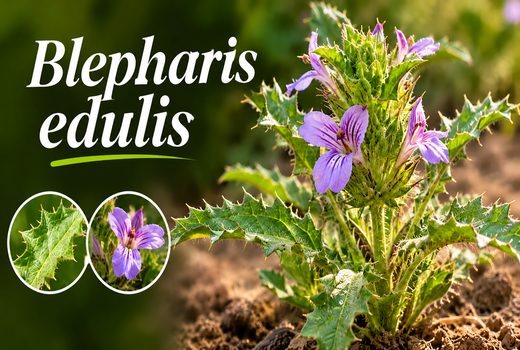
The plant may attain a height of approximately 30–60 cm, with erect or spreading, branched stems covered with fine hairs. The roots are slender and well adapted to dry soil conditions. Stems are branched, rigid and covered with fine hairs. Leaves are simple, sessile and arranged in opposite pairs. Flowers occur in terminal, spike-like clusters surrounded by prominent, spiny bracts. Fruits are dry capsules containing seeds.Seeds are small, flattened, brownish and generally rounded to heart-shaped, with a characteristic hairy surface. They are the principal medicinally used part of the plant.
Habitat
Blepharis edulis is mainly found in arid and semi-arid regions, where the climate is hot and rainfall is limited. It commonly grows in sandy, gravelly and well-drained soils, particularly in open grasslands, dry plains, wastelands and desert margins. The plant is naturally adapted to high temperatures, low soil moisture and prolonged dry conditions. In India, it is predominantly reported from north-western regions, including Rajasthan, Punjab and Haryana.
Pharmacological Properties
- Rasa (Taste): Madhura (Sweet), Tikta (Bitter).
- Guna (Properties): Guru (Heavy), Snigdha (Unctuous), Picchila (Slimy).
- Virya (Potency): Ushna (Hot).
- Vipaka (Post-digestive effect): Madhura (Sweet).
- Karma (actions): Vatahara ( reduces vitiated vata dosha).
Bioactive Constituents
- Phenolic compounds: Catechol, tannic acid, verbascoside and vanillic acid.
- Flavonoids: Apigenin, naringenin and acacetin derivatives.
- Phytosterols: Daucosterol and β-sitosterol glucoside.
- Terpenoids: Lupeol.
- Fatty acids: Oleic acid, linoleic acid, stearic acid and arachidic acid.
Pharmacological Activities
- क्लैब्य (Klaibya): Male sexual dysfunction.
- शुक्रदोष (Shukra Dosha): Disorders related to semen and reproductive health.
- मूत्रकृच्छ्र (Mutrakrichhra): Difficult or painful urination.
- मूत्रदाह (Mutradaha): Burning sensation during urination.
- श्वास (Shwasa): Respiratory difficulty or breathlessness.
- कास (Kasa): Cough.
- शोथ (Shotha): Inflammation and swelling.
- अभिष्यन्द (Abhishyanda): Inflammatory conditions of the eyes.
- कुष्ठ (Kushtha): Various skin disorders.
- श्वित्र (Shvitra): Vitiligo or depigmentation of the skin.
- व्रण (Vrana): Wounds and ulcers.
- प्लीहा रोग (Pliha Roga): Splenic disorders.
- यकृत विकार (Yakrit Vikara): Liver-related disorders.
Systemic Actions
- Reproductive System: Utangan Beej is traditionally considered Vrishya (aphrodisiac) and is used in Ayurvedic practice for supporting reproductive health and vitality. Its traditional indications include Klaibya (male sexual dysfunction) and certain conditions associated with reproductive weakness.
- Urinary System: The seeds are traditionally described as Mutrala (diuretic) and Mutrakrichhra (dysuria)-relieving. They have been used in traditional medicine for urinary discomfort, burning micturition and difficulty in passing urine.
- Respiratory System: The seeds are traditionally used as an expectorant and have been associated with respiratory complaints. Experimental findings also indicate potential bronchodilator activity.
- Digestive System: Traditional medicinal records describe the use of the plant in gastrointestinal complaints. Its reported antispasmodic activity may be relevant to smooth-muscle relaxation in the digestive tract.
- Musculoskeletal System: Traditional uses include application in rheumatic conditions and inflammatory disorders.
Sanskrit Shloka
“ उटंजनस्य बीजं तु गुरु स्निग्धं सुपिच्छिलम्।
मधुरं तिक्तमुष्णं च वृष्यं मूत्रलमुच्यते॥ ”
The seeds of Utangan (Blepharis edulis) are heavy (Guru), unctuous (Snigdha), and slimy (Picchila) in nature. They have a sweet (Madhura) and bitter (Tikta) taste, possess hot potency (Ushna), and are known to promote reproductive health (Vrishya) and increase urine production (Mutrala).
Part Used
Seeds and leaf
Dosage
- 3-6 g powder
- 10-20 ml decoction
Home Remedies
- For reproductive health: Seed powder is traditionally mixed with milk and used in Vajikarana preparations. Its use is associated with reproductive vitality.
- For sexual debility: Utangan seed powder is mentioned in traditional formulations for Klaibya (male sexual dysfunction).
- External traditional applications: Seed paste (Kalka).
Recent Research
Gupta PK and Agrawal AK (2022) investigated the antioxidant and anti-inflammatory properties of Blepharis edulis. In this study, leaf and seed extracts were evaluated for their ability to reduce oxidative damage and exhibit anti-inflammatory effects. The findings indicated promising biological activities, suggesting that Blepharis edulis may have potential medicinal applications and deserves further pharmacological investigation.
Moharram B. et al. (2026) conducted a study to evaluate the wound-healing potential of Blepharis edulis extract formulated as a topical cream, published in Pharmaceutical Fronts. The findings revealed that the plant extract possessed a significant phenolic content of 54.7 mg gallic acid equivalent per gram of extract and demonstrated antioxidant activity with an IC50 value of 23.0 µg/mL. It also exhibited selective antibacterial activity against Staphylococcus aureus. A topical cream containing 1% Blepharis edulis extract was prepared and tested in experimental rats, where it showed promising wound-healing effects. Histopathological examination further indicated improved tissue repair through re-epithelialization, collagen deposition and angiogenesis (formation of new blood vessels). The study suggests that Blepharis edulis may have potential applications in herbal wound-healing formulations.
Conclusion
Scientific evaluation validates Blepharis edulis (Utangan) as a valuable botanical resource whose classical uses are strongly backed by its specialized phytochemical matrix—most notably blepharin, phenolic acids, and benzoxazinoid compounds. Preclinical data highlight its role in modulating reproductive pathways, suppressing oxidative damage, and protecting renal and urinary tissues. Bridging the gap between traditional medicine and modern pharmacology will require standardized phytochemical profiling, isolated bio-assay testing, and robust human clinical trials to establish precise therapeutic protocols.