

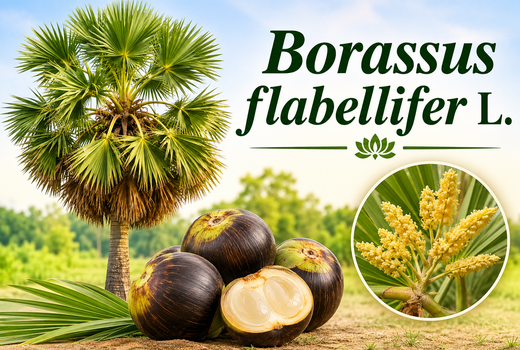
Borassus flabellifer L. / Palmyra Palm / Taad – Uses, Benefits, Dosage and Properties
Abstract
Borassus flabellifer L., commonly known as the Palmyra palm or Taad, is a multipurpose tropical plant belonging to the family Arecaceae.The species holds considerable ecological, economic, nutritional, and cultural importance due to its diverse applications and ability to thrive under challenging environmental conditions. Various parts of the plant, including the roots, stem, leaves, flowers, fruits, and seeds, are traditionally utilized for food, medicine, handicrafts, construction, and other domestic purposes. This review highlights the botanical characteristics, geographical distribution, nutritional significance, traditional uses, phytochemical constituents, medicinal properties, and economic importance of Borassus flabellifer. It also emphasizes the need for further scientific research, sustainable utilization, and conservation strategies to promote the wider application of this valuable palm species.
Reference:- Bhavaprakasha Nighantu Purvakhanda, Amradi Phala Varga, Verses 52-55
Introduction
Borassus flabellifer, is a robust, ecologically vital tree species belonging to the family Arecaceae. Native to South and Southeast Asia, it is often referred to as a “Kalpavriksha” (wishing tree) in traditional agrarian communities because virtually every part of the tree can be utilized.
Synonyms
- ताल (Tala): Palmyra palm; commonly used name.
- तृणराज (Trnaraja): King among grasses.
- लेख्यपत्र (Lekhyapatra): Leaves used for writing.
- महोनत (Mahonnata): Very tall or elevated tree.
- ध्वजद्रुम (Dhvaja-druma): Tree resembling a flagstaff.
- दीर्घस्कन्ध (Dirgha-skandha): Having a long trunk.
- दृढच्छद (Drdhacchada): Having a strong covering.
Vernacular Names
- Sanskrit: Tala (ताल)
- Hindi: Taad (ताड़)
- English: Palmyra palm, Toddy palm, Sugar palm
- Bengali: Taal
- Tamil: Panai
- Telugu: Tati Chettu
- Kannada: Tale Mara
- Malayalam: Panam
- Punjabi: Taari / Taad
- Urdu: Taar
Description Of Plant
Borassus flabellifer Linn., commonly known as Taad or Palmyra palm, is a large, erect, unbranched, dioecious palm belonging to the family Arecaceae. It is a tall, slow-growing and long-lived tree that generally attains a height of about 20–30 metres. The stem is stout, cylindrical, dark grey to blackish in colour and marked with prominent leaf scars. The leaves are approximately 1 – 1.5 metres wide, rigid, leathery and divided into several segments, with long, strong petioles bearing marginal spines. The plant is dioecious, having male and female flowers on separate trees. The immature fruits contain soft, translucent, jelly-like edible endosperm commonly known as ice apple or Taadgola. The mature seeds develop a hard, woody outer covering, while the fibrous pulp is sweet and edible. The root system is extensive and well developed, enabling the plant to withstand relatively dry environmental conditions.
Habitat
Borassus flabellifer commonly grows in dry tropical regions, open grasslands, plains, coastal areas, sandy soils and agricultural landscapes. The plant is well adapted to warm climatic conditions and can tolerate high temperatures, seasonal drought and relatively poor soil conditions. It grows in well-drained sandy, loamy and lateritic soils and is frequently found along roadsides, village boundaries, cultivated fields and open wastelands. In India, it is commonly distributed in states such as Tamil Nadu, Andhra Pradesh, Telangana, Karnataka, Kerala, Odisha, West Bengal, Maharashtra and parts of northern India. Thus, Borassus flabellifer is an ecologically adaptable species of considerable importance in tropical dryland environments.
Pharmacological Properties
- Rasa (Taste): Madhura (Sweet)
- Guna (Qualities): Snigdha (Unctuous), Laghu (Light)
- Virya (Potency): Sheeta (Cold)
- Vipaka (Post-digestive effect): Madhura (Sweet)
- Dosha Karma(Actions): Vatahara-Piittahara action. (Pacifies Vata and Pitta)
Bioactive Constituents
- Flavonoids: Quercetin and other flavonoid compounds.
- Phenolic compounds: Various phenolic substances with antioxidant potential.
- Alkaloids: Alkaloidal constituents identified through phytochemical screening.
- Tannins: Polyphenolic compounds.
- Saponins: Glycosidic compounds.
- Terpenoids: Including triterpenoid constituents.
- Steroids and phytosterols: Plant-derived sterol compounds.
- Glycosides: Different types of glycosidic compounds.
- Carotenoids: Including alpha-carotene.
- Coumarins: Coumarin derivatives.
- Anthraquinones: Anthraquinone-related compounds.
- Betulinic acid and lupeol: Reported triterpenoid constituents.
Pharmacological Activities
- Antioxidant activity: Different fruit and leaf extracts have demonstrated free-radical-scavenging activity, which may help protect cells against oxidative damage.
- Antimicrobial activity: Certain extracts have shown inhibitory effects against selected bacterial and fungal microorganisms in laboratory studies.
- Antidiabetic activity: Certain extracts have demonstrated glucose-lowering potential in experimental models, indicating possible effects on glucose metabolism.
- Antihyperlipidemic activity: Preliminary studies suggest that selected extracts may influence lipid metabolism and improve altered lipid profiles.
- Anthelmintic activity: Some extracts have exhibited activity against selected parasitic worms under experimental conditions.
- Cytotoxic activity: Certain plant extracts and isolated compounds have shown cytotoxic effects against selected cultured cell lines.
- Hepatoprotective activity: Experimental findings suggest that particular extracts may offer protection against chemically induced liver injury.
- Wound-healing activity: Traditional applications and preliminary experimental investigations suggest potential benefits in tissue repair and wound management.
Clinical Uses
- Brimhana (बृंहण): Promotes nourishment and growth of body tissues.
- Balya (बल्य): Helps improve physical strength.
- Vrishya (वृष्य): Traditionally considered beneficial for reproductive health.
- Mutrala (मूत्रल): Promotes urine formation.
- Dahahara (दाहहर): Relieves burning sensation.
- Trishnahara (तृष्णाहर): Helps alleviate excessive thirst.
- Raktapitta (रक्तपित्त): Bleeding disorders.
- Shvasa (श्वास): Respiratory disorders.
- Kshaya (क्षय): Wasting conditions.
- Prameha (प्रमेह): Urinary and metabolic disorders.
- Daurbalya (दौर्बल्य): General weakness.
Systemic Actions
- Gastrointestinal system: The fruit pulp and tender endosperm serve as nutritional foods. Their carbohydrate and dietary components contribute to energy intake and digestive nourishment.
- Urinary system: The fresh fruit and other traditionally used preparations are associated with cooling and urine-promoting effects.
- Cardiovascular system: The nutritional minerals and antioxidant constituents may contribute to cardiovascular health.
- Hepatic system: Experimental studies involving selected extracts indicate possible protective effects on liver tissue under induced experimental conditions.
- Endocrine and metabolic system: Preliminary experimental findings indicate possible involvement in glucose and lipid regulation, suggesting potential metabolic effects.
- Immune system: Phenolic and other bioactive constituents may influence inflammatory and cellular defence pathways.
- Integumentary system: Traditionally, certain plant parts have been used externally for skin-related applications.
Sanskrit Shloka
Bhavaprakasha Nighantu Purvakhanda, Amradi Phala Varga, Verses 52-55
“ तालस्तु लेखपत्रः स्यात्तृणराजो महोन्नतः।
पक्वं तालफलं पित्तरक्तश्लेष्मविवर्द्धनम्।
दुर्जरं बहुमूत्रञ्च तन्द्राभिष्यन्दशुक्रदम्॥ ”
The Palmyra palm is also known by the synonyms Lekhapatra, Trnaraja and Mahonnata. The ripe fruit of Tala increases Pitta, Rakta and Kapha. It is difficult to digest (Durjara), promotes excessive urination (Bahumutra), may cause drowsiness (Tandra) and Abhishyanda, and is considered Shukrada, meaning beneficial for or promoting Shukra.
“ तालमज्जा तु तरुणः किञ्चिन्मदकरो लघुः।
श्लेष्मलो वातपित्तघ्नः सस्नेहो मधुरः सरः॥ ”
The tender pulp or kernel of Tala (Tala-majja) is slightly intoxicating , light to digest , Kapha-promoting, and pacifies Vata and Pitta. It is slightly unctuous , sweet in taste and has a laxative or bowel-clearing action .
“ तालजं तरुणं तोयमतीव मदकृन्मतम्।
अम्लीभूतं तदा तु स्यात्पित्तकृद्वातदोषहृत्॥ ”
The liquid obtained from young Tala is considered markedly intoxicating . When it becomes sour due to fermentation, it is Pitta-promoting and pacifies Vata .
Part Used
Phala (ripe fruit pulp), Majja (kernel), Beeja (seed), Mula (root), Patra (leaves), Pushpa (flowers), and Nira (sap).
Home Remedies
- For nutritional support: Tender endosperm is extracted from immature fruits, washed and consumed directly or added to milk, fruit salads and other food preparations.
- For summer-related fatigue: Fresh tender endosperm may be combined with clean drinking water and consumed as a refreshing seasonal preparation.
- For dietary energy supplementation: Mature fruit pulp can be processed into traditional sweet preparations, such as palm fruit desserts and porridge, providing dietary carbohydrates.
- For skin care: Fresh fruit pulp has been used in some traditional household cosmetic preparations.
Recent Research
Dubey et al. (2025) investigated the nutritional value, phytochemical composition and pharmacological activities of Borassus flabellifer fruits using different solvent extracts. The hydroalcoholic extract demonstrated antioxidant activity through DPPH and ABTS assays. It also showed inhibitory activity against α-amylase and α-glucosidase enzymes, indicating potential relevance to glucose metabolism. The study additionally reported UV-protective potential in an experimental assay.
Shaju et al. (2025) studied the phytochemical composition and antioxidant properties of Borassus flabellifer sprouts. Petroleum ether, ethanol and aqueous extracts were evaluated for phytochemical constituents, total phenolic content and flavonoid content. The investigation highlighted the presence of bioactive phytochemicals and the antioxidant potential of Palmyra sprouts, suggesting their possible nutritional and functional-food applications.
Conclusion
Borassus flabellifer Linn. (Tala) is a valuable traditional plant with remarkable nutritional, medicinal, ecological and economic significance. Its recognition in classical Ayurvedic literature, particularly Bhavaprakasa Nighantu, reflects its longstanding importance in Indian healthcare and daily life. The presence of diverse phytochemicals and emerging pharmacological findings further highlights its potential as a promising natural resource.