


California White Sage (Salvia Apiana) – Indications, Properties & Uses
Abstract
Clinging to the sun-baked, arid slopes of Southern California and Baja California, Salvia apiana stands as a botanical marvel of survival and a profound cultural anchor. Visually striking, its radiant, silver-white leaves act as a defensive mirror, reflecting intense solar radiation while specialized glandular trichomes (plant hairs) lock in precious moisture. To the Kumeyaay, Cahuilla, Luiseño, and Tongva peoples, this perennial shrub is not merely a resource, but a sentient relative. It represents an ancient system of Traditional Ecological Knowledge (TEK), where its thermal, drying energetic signature has been utilized for generations to clear pulmonary stagnation, facilitate postpartum recovery, and purify ceremonial spaces. As modern pharmacological research begins to validate its potent antimicrobial and neuroprotective properties, Salvia apiana emerges as a vital bridge between rigorous ecological science and time-honored indigenous stewardship.
Botanical Identity And Taxonomic Position
Etymological Origin
The species name apiana stems directly from the Latin word apis (bee), naming it the “bee sage” due to its role as a primary nectar source for native pollinators.
Taxonomic Classification
- Family: Lamiaceae (Mint family), characterized by square stems, opposite leaf pairs, and specialized oil glands.
- Genus: Salvia (Sage), the largest genus in the family.
- Subgenus: Audibertia, a distinct evolutionary branch restricted entirely to the arid regions of western North America.
- Species: Salvia apiana Jepson.
Ecology, Habitat, And Geographic Distribution
Salvia apiana is an ecological anchor endemic to the Mediterranean climate zone of western North America, ranging from Santa Barbara County down into northern Baja California. Thriving below elevations of $1500\text{ m}$, it is a foundational species of coastal sage scrub and chaparral ecosystems.
The plant commands hyper-drained, nutrient-poor, gravelly soils derived from decomposed granite and sandstone, operating optimally in a pH range of $6.0\text{ to }8.0$. To survive prolonged summer droughts, it deploys water-soluble allelopathic terpenes into the topsoil to suppress competing vegetation.
Perfectly adapted to pyrogenic (fire-driven) landscapes, mature stands survive intense wildfires via a dual-strategy: they sprout anew from fire-resistant underground lignotubers or utilize heat and smoke cues to trigger a synchronized, high-density seedling explosion from a dormant soil seed bank during the subsequent winter rains.
Morphology
A robust, rounded, semi-woody perennial shrub reaching $1\text{ to }1.5\text{ m}$ ($3\text{ to }5\text{ ft}$) in height and width. Features characteristic square stems that transition from tender green to rigid, grey-barked woody branches over successive seasons.
- Leaf Structure: Lance-shaped (lanceolate) leaves with finely scalloped edges (crenulate), arranged in opposite pairs along the stems.
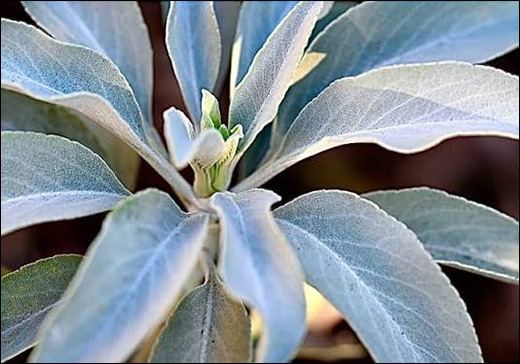
- The Silver Coat: The iconic white-silver coloration is generated by a dense, felt-like layer of simple plant hairs (trichomes).
- Thermoregulation: This trichome layer acts as an optical mirror that reflects intense UV radiation, cools leaf tissue, and traps a micro-layer of humid air over the plant’s breathing pores (stomata) to stop water loss.
Floral Architecture And Pollination
- Inflorescence: In spring, the plant projects massive, arching flower stalks that tower up to $2.5\text{ m}$ ($8\text{ ft}$) above the main foliage canopy.
- Flower Anatomy: Bilabiate (two-lipped) blossoms that are white to pale lavender, featuring a unique, tightly downward-rolled lower petal lip.
- Mechanical Selection: The male pollen-bearing organs (stamens) and female style are dramatically elongated and arch outward. This specific shape bars small insects and relies exclusively on the heavy bodies of native carpenter bees (Xylocopa) to trigger cross-pollination.
The Phytochemical Signature Of White Sage
The biochemical potency of Salvia apiana lies in its highly concentrated secondary metabolites, localized within the plant’s glandular trichomes. Here is its detailed phytochemical signature broken down by chemical class and therapeutic activity:
The Volatile Monoterpene Fraction (Essential Oils)
- 1,8-Cineole (Eucalyptol): The dominant volatile compound (often exceeding 50% of the essential oil profile). It acts as a powerful mucolytic, breaking down mucus bonds to clear respiratory airways, and increases local blood flow when inhaled.
- Camphor & Thujone: These compounds provide the sharp, piercing aroma. They function as potent central nervous system stimulants, mild topical analgesics (pain relievers), and serve as the plant’s primary defense against insect herbivores.
- Camphene & $\alpha$-Pinene: Secondary volatile monoterpenes that contribute to the plant’s overall antimicrobial and decongestant properties.
The Non-Volatile Diterpene Matrix (Resins & Phenolics)
- Carnosic Acid & Carnosol: Powerful abietane diterpenes found in high concentrations within the leaf resin. They are highly efficient free-radical scavengers, protecting both the plant and human tissue from severe oxidative stress.
- 16-Hydroxycarnosic Acid: A specialized diterpene highly characteristic of Salvia apiana. It is actively being studied for its anti-inflammatory properties and its ability to inhibit cellular inflammatory pathways.
Synergistic Pharmacological Actions
- Broad-Spectrum Antimicrobial Activity: The combined action of 1,8-cineole and the surface diterpenes disrupts bacterial and fungal cell membranes, making the plant highly effective against airborne and topical pathogens.
- Natural Antioxidant Preservation: Because carnosic acid preserves fats and oils from oxidizing, extracts of white sage function as highly stable compounds with a long shelf-life, carrying strong implications for natural neuroprotective therapies.
Traditional Importance Of White Sage
Within the framework of Traditional Ecological Knowledge (TEK), Salvia apiana operates as a high-potency, heating, and deeply drying agent. Indigenous nations of the American Southwest and Baja California—including the Kumeyaay, Cahuilla, Luiseño, and Tongva—revere it not as a commodity, but as a sentient relative.
Clinically, its internal and external protocols are highly precise:
- Respiratory Care: Leaf infusions liquefy cold, viscous mucus to resolve deep pulmonary stagnation.
- Postpartum Gynecology: Warm decoctions stimulate uterine smooth muscle tone, aiding post-childbirth recovery.
- Ocular Cleansing: Hydrated, mucilaginous seeds are placed under the eyelid to safely trap and flush out foreign debris.
- Combustive Purification: Burning the resinous leaves releases volatile monoterpenes that physically sterilize airborne pathogens while grounding neurological focus.
Governed by the law of reciprocity, traditional harvesting mandates strict conservation ethics, ensuring wild stands are never over-exploited or stripped of their therapeutic integrity.
Why Does White Sage Have A Strong Aroma?
The intense aroma of Salvia apiana is a highly evolved, chemical defense mechanism driven by its unique environment. To survive the punishing heat and intense herbivore pressure of the California chaparral, the plant’s specialized epidermal structures, called glandular trichomes, synthesize and store an exceptionally concentrated matrix of volatile secondary metabolites. When triggered by heat or physical agitation, these microscopic storage pods rupture, vaporizing a dense aromatic cocktail dominated by 1,8-cineole (eucalyptol), camphor, and thujone. This piercing scent serves a dual purpose: it acts as a potent chemical deterrent against browsing insects and mammals, while simultaneously creating a protective, cooling canopy of vapor that slows water loss from the leaves.
Traditional Uses Of White Sage
Respiratory System Protocols
- Mucolytic Action: Warm leaf infusions are consumed to break up cold, thick mucus, clearing deep pulmonary congestion and soothing chronic coughing.
- Antiseptic Inhalation: Inhaling the vapor or steam from steeped leaves directly treats upper respiratory tract infections.
Maternal And Gynecological Care
- Uterine Tonic: Concentrated warm decoctions (herbal teas) are administered post-childbirth to stimulate smooth muscle contractions, helping the uterus return to its pre-pregnancy size and preventing blood stagnation.
- Thermoregulation: Deployed to balance internal temperature shifts and manage excessive sweating or hot flashes.
Ocular And Topical Applications
- Mechanical Eye Flush: Smooth sage seeds are carefully placed under the eyelid. Upon contact with tears, they form a harmless, slippery gel layer that traps windblown sand and debris, flushing it out safely.
- Tissue Repair: Crushed fresh leaves are applied as a poultice to minor wounds, cuts, and skin irritations to reduce swelling and prevent infection.
Combustive And Ritual Purification
- Air Sanitation: Burning the dried, resinous leaf bundles releases volatile oils that act as a natural fumigant, significantly reducing airborne bacterial pathogens in shared living spaces.
- Neurological Grounding: The sharp, aromatic smoke is utilized in ceremonies to alter the sensory environment, grounding the mind, easing mental fatigue, and sharpening cognitive focus.
Scientifically Studied Benefits Of White Sage
- Antimicrobial Efficacy: Hexane and dichloromethane extracts of Salvia apiana completely inhibit key pathogens, including Staphylococcus aureus, Bacillus subtilis, and Candida albicans, by disrupting cellular membranes.
- Aerobiological Clearance: Combustion of its resinous leaves releases volatile monoterpenes (1,8-cineole) that act as a natural fumigant, significantly reducing airborne bacterial counts.
- Antioxidant & Neuroprotective Action: Rich in abietane diterpenes like carnosic acid and rosmanol, it actively prevents lipid peroxidation and mitigates oxidative cell damage.
- Anti-Inflammatory Pathways: Polar extracts selectively inhibit nitric oxide (NO•) production in activated macrophages, successfully lowering systemic inflammatory markers.
- Enzymatic Modulation: Volatile compounds block acetylcholinesterase (AChE) activity, a mechanism directly linked to enhanced cognitive performance, memory retention, and neuroprotection.
Safety, Precautions, and Side Effects
- Neurotoxicity Risk: Oral consumption of concentrated extracts or the essential oil carries a strict risk of thujone-induced neurotoxicity. Excessive doses block GABA receptors, potentially triggering muscle tremors, vertigo, or dose-dependent grand mal seizures.
- Gestational Contraindications: Uterine-tonic properties mean oral use is strictly contraindicated during pregnancy, as it can stimulate smooth muscle contractions and induce miscarriage.
- Lactation Suppression: Phytochemicals within the leaves can actively diminish breast milk supply, making it unsuitable during breastfeeding unless weaning is intended.
- Respiratory Irritation: While smoke sanitizes air, direct or prolonged inhalation of combustion particulates can irritate hyper-reactive airways, causing acute wheezing in asthma or COPD patients.
Dosage
Internal Administrations
- Dried Leaf Infusion (Tea): Infuse 1 to 2 grams of dried leaf in 240 mL (1 cup) of boiling water. Steep covered for 5–8 minutes to trap volatile oils. Limit intake to a maximum of 2 cups per day for acute respiratory or digestive symptoms.
- Liquid Tincture (1:5 ratio, 60% ethanol): Take 1 to 2 mL (approximately 30–60 drops) diluted in water, up to 3 times daily for systemic antimicrobial support.
- Therapeutic Duration: Limit internal oral use to a short-term window of 10 to 14 consecutive days to prevent the toxic accumulation of thujone in body tissues.
External Use
- Steam Maceration (Vapor Inhalation): Place 3 to 5 grams of whole, crushed leaves into a basin of boiling water. Inhale the aromatic steam for 5–10 minutes with eyes closed to clear deep sinus and pulmonary stagnation.
- Topical Compress / Wash: Simmer 5 to 10 grams of leaves in 500 mL of water. Allow the liquid to cool completely before applying it via sterile cloth to superficial wounds, minor lacerations, or local fungal rashes.
Contraindications
- Pure Essential Oil Prohibition: Undiluted Salvia apiana essential oil should never be ingested. Micro-doses under 1 mL can cross the blood-brain barrier rapidly and trigger acute muscle tremors or grand mal seizures.
- Obstetric & Pediatric Restrictions: Oral dosages are strictly forbidden during pregnancy (due to smooth muscle uterine contractions), lactation (as it dries up breast milk supply), and for all pediatric patients.
Conclusion
At last we can say that Salvia apiana stands as a profound intersection where rigorous botanical science validates thousands of years of empirical indigenous wisdom. From its specialized xeric architecture that thrives in the punishing California chaparral, to its dense, complex phytochemical matrix of antimicrobial monoterpenes and neuroprotective diterpenes, this resilient perennial is far more than a commercial commodity. It is a vital clinical and cultural resource. Protecting its wild populations from the unsustainable pressures of global market poaching is an urgent ecological imperative, ensuring this sacred silver herb continues to serve as an enduring bridge between traditional ecological knowledge and modern pharmacology.