


Chenopodium album Linn. / Bathua / Vastuka / Lambs Quarters
Abstract
Chenopodium album Linn, commonly known as Bathua, is an important edible and medicinal herb belonging to the family Amaranthaceae (formerly classified under Chenopodiaceae). Believed to have originated in Western Asia, the plant is now widely distributed across India, Europe, North America, and other temperate and tropical regions of the world. The genus Chenopodium comprises approximately 250 species and subspecies, many of which are valued as food crops and traditional herbal medicines. C. album is highly adaptable and can thrive under diverse environmental conditions, including low rainfall, high altitudes, intense sunlight, and sub-freezing temperatures. In India, it is commonly cultivated as a leafy vegetable and is also utilised for its nutritional and therapeutic properties. Rich in vitamins, minerals, proteins, and bioactive compounds, the plant has long been used in traditional systems of medicine for the management of various ailments. Owing to its nutritional value, medicinal importance, and environmental resilience, Chenopodium album continues to be recognised as a valuable functional food and medicinal plant.
Classical References
- Bhavprakash Nighantu Shaaka varga
- Raj Nighantu Mulakadi varga
Scientific Classification
- Kingdom: Plantae
- Division: Magnoliophyta
- Class: Magnoliopsida
- Order: Caryophyllales
- Family: Chenopodiaceae
- Genus: Chenopodium
- Species: Chenopodium album Linn.
Synonyms
- Kshaarapatra – "The plant with alkaline leaves," indicating its alkaline nature and medicinal value
- Shaakaraat – "King among leafy vegetables," highlighting its importance as a nutritious green
- Hilamochika – "That which relieves or removes impurities and obstructions"
- Shaakaraaja – "King of vegetables," emphasising its superior nutritional qualities
- Raajashaaka – "Royal vegetable," indicating its esteemed status among edible greens
- Chakravarthi– "Emperor" or "sovereign," symbolising its prominence among leafy plants
- Ksharpatra – Another form of Kshaarapatra, meaning "alkaline-leaved plant"
- Shaakraat – A variant of Shaakaraat, meaning "chief or leader among vegetables"
- Aasthooka
- Vaasthu
- Vaasthukam
Vernacular Names
- Hindi: Bathua
- Sanskrit: Vastukah
- Oriya: Bathua
- Kannada: Kaduoma
- Konkani: Chakvit
- Bengali: Chandanbethu
- Tamil: Paruppukkirai
- Malayalam: Vastuccira
- Telugu: Pappukura
- Arabic: Thanb Alkalb, Rejil Alwaz, Atrah
- Chinese: Li
- Unani: Bathuaa, Baathu
- Spanish: Ceniglo Blanco
- English: Common Goosefoot, Lambsquarters, Lamb’s-quarters, Fat Hen, Marvel Mothi, Pigweed
- Fijian: Marvel Lahan
- French: All-good, Muck-weed, Lamb’s Quarter, Pigweed, Fat Hen, Chenopode Sauvage
- Italian: Farinaccio
- Japanese: Akaza, Iwa-akaza, Shiroza
- Greek Name: Chenopodium, derived from the Greek words "Chen" meaning goose and "Podium" meaning foot, referring to the goose-foot-like shape of the leaves in some species.
Habitat
Chenopodium album is native to Europe and Western Asia and is now one of the most widely distributed plant species in the world. It grows abundantly throughout temperate regions and has naturalised across Asia, Europe, North America, and many other parts of the globe. The plant thrives in cultivated fields, gardens, roadsides, wastelands, grasslands, and disturbed soils. It is highly adaptable and can grow under diverse environmental conditions, including low rainfall, varying temperatures, and nutrient-poor soils. Due to its hardiness and prolific seed production, it is commonly regarded as a weed, although it is also cultivated and consumed as a nutritious leafy vegetable in many regions.
Morphology
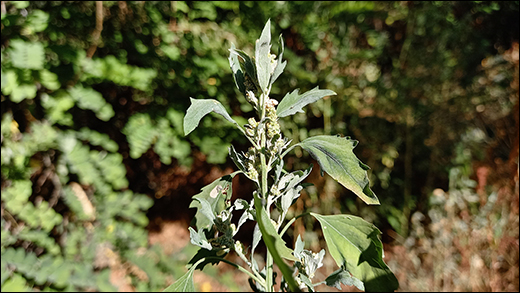
Chenopodium album is an annual herbaceous plant commonly growing between 0.3 and 3.5 meters in height. The plant is erect or occasionally climbing, with a mealy or reddish-green appearance and lacks any characteristic odor. Its stems are slender to moderately robust, angular, and often marked with green, red, or purple stripes. The leaves are highly variable in shape, ranging from oval, rhomboid, deltoid, and lanceolate forms, with margins that may be entire, toothed, or irregularly lobed. They are borne on long, slender petioles and may reach up to 15 cm in length. The flowers are small, greenish, and arranged in dense clusters forming irregular panicles or coarse spike-like inflorescences. The sepals are elliptical-lanceolate, keeled, and enclose the thin, membranous fruit. The seeds are small, about 1.5 mm in diameter, orbicular, flattened, smooth, shiny, and black in colour with a distinct, sharp margin. Young plants, particularly those less than 20 cm tall, are commonly harvested and used as a leafy vegetable.
Classical Categorisation
- According to Bhavprakash Nighantu: Shaaka varga
- According to Raj Nighantu: Mulakadi varga
Ancient Verse
वास्तूकं वास्तुकं च स्यात्क्षारपत्रं च शाकराट्।
तदेव तु बृहत्पत्रं रक्तं स्याद्गौडवास्तुकम्॥
प्रायशो यवमध्ये स्याद्यवशाकमतः स्मृतम्।
वास्तूकद्वितयं स्वादु क्षारं पाके कटूदितम्॥
दीपनं पाचनं रुच्यं लघु शुक्रबलप्रदम्।
सरं प्लीहास्त्रपित्तार्शः कृमिदोषत्रयापहम्॥ (Bhavprakash Nighantu Shaaka Varga 221-223)
Vastuka is also known by the names Ksharapatra and Shakarat. A variety having larger leaves and a reddish colouration is referred to as Gauda Vastuka. Since it commonly grows among barley crops (Yava), it is also known as Yavashaka. Vastuka possesses a sweet taste (Madhura Rasa) and undergoes a pungent transformation after digestion (Katu Vipaka). It kindles the digestive fire (Deepana), improves digestion (Pachana), and enhances appetite and taste perception (Ruchya). The herb is light to digest (Laghu), promotes reproductive health and vitality (Shukra Prada), and enhances physical strength (Balaprada). It has mild laxative properties (Sara) and is beneficial in disorders of the spleen (Pleeha Roga), bleeding conditions (Rakta Pitta), haemorrhoids (Arsha), and intestinal worm infestations (Krimi). Additionally, it helps balance and alleviate aggravation of all three doshas—Vata, Pitta, and Kapha.
वास्तुकं वास्तु वास्तूकं वस्तुकं हिल्मोचिका।
शाकराजो राजशाकश्चक्रवर्तीश्च कीर्तितः॥
वास्तुकं तु मधुरं सुशीतलं क्षारमीषदम्लं त्रिदोषजित्।
रोचनं ज्वरहरं महार्शसां नाशनञ्च मलमूत्रशुद्धिकृत्॥ (Raj Nighantu Mulkadi Varga 122-123)
This Ayurvedic verse highlights the various names and potent healing properties of Vastuka (commonly known as Bathua or Chenopodium album). The text notes that it is recognised by synonyms such as Vastukam, Vastu, Vastukam, Hilmochika, Shakaraja, Rajashaka, and Chakravarti, signifying its elite status among leafy vegetables. Therapeutically, Bathua possesses a sweet taste (Madhura), exerts a highly cooling effect (Sushitalam) on the body, and is slightly alkaline (Kshara) with a touch of sourness (Eshadamlam). It is exceptionally powerful in balancing all three biological humours (Tridosha-jit: Vata, Pitta, and Kapha). Furthermore, it acts as an appetiser (Rochana), alleviates fevers (Jvarahara), effectively cures severe haemorrhoids or piles (Maharshasam nashanam), and functions as an excellent natural detoxifier that purifies and regulates the elimination of faeces and urine (Malamutra-shuddhikrut).
Ayurvedic Properties
- Taste (Rasa)– Sweet (Madhur)
- Physical property (Guna) – Light (Laghu)
- Potency (Veerya )- Cold Potency (Sheet)
- Post-digestion effect (Vipaka)– Katu (Pungent)
- Effect on tridosha– Balance Pitta, Vata and Kapha dosha
Therapeutic Indications
- Pleeha – Beneficial in spleen disorders and enlargement of the spleen
- Raktapitta – Useful in bleeding disorders caused by aggravated Pitta
- Arsha – Helps in the management of piles and haemorrhoids
- Krimi – Effective against intestinal worm infestations and parasitic infections
Systemic Actions
External Uses
The paste of its leaves is beneficial in healing burns.
Internal Uses
- Digestive System: It contains mild laxative properties, which are helpful in managing constipation. It also helps in managing indigestion, piles, spleen disorders and worm infestation.
Chemical Composition
Primary Phytochemicals
- Choline
- Polypodine B
- Alkaloids
- Flavonoids
- Phenolic compounds
- Lignans
- Saponins
- Tannins
- Sterols
- Ecdysteroids
- Phytoecdysteroids
- Secoglycosides
- Phenolic glycosides
- Amides
- Oxalic acid
- Phytic acid
Major Flavonoids
- Quercetin glycosides
- Kaempferol glycosides
- Isorhamnetin glycosides
- Kaempferol-3-O-diglucoside
- Kaempferol-3-O-arabinoglucoside
- Quercetin-3-O-rhamnoglucoside
Phenolic Compounds
- Cinnamic acid
- 4-Hydroxycinnamic acid
- Ferulic acid
- Methyl ferulate
- Sinapic acid
- Vanillyl alcohol
- 4-Hydroxy-3-methoxybenzoic acid
- N-Trans-feruloyl-4-O-methyldopamine
Sterols
- Sitosterol
- Sitostanol
- Stigmasterol
- Avenasterol
- Spinasterol
Ecdysteroids
- 20-Hydroxyecdysone
- β-Ecdysone
- 20-Hydroxy-24-methylene ecdysone
- 20,26-Dihydroxyecdysone
- Poststerone
Essential Oil Constituents
- α-Thujene
- α-Pinene
- β-Pinene
- Camphene
- Sabinene
- Myrcene
- p-Cymene
- Limonene
- 1,8-Cineole
- Linalool
- Citronellal
- Borneol
- Terpinen-4-ol
- α-Terpineol
- Citronellol
- Ascaridole
- Neral
- Geranial
- Thymol
- Carvacrol
- Ethyl cinnamate
- Acetyl eugenol
- Elemicin
- Benzyl alcohol
- Benzyl benzoate
Other Important Compounds
- Chenoalbicine
- Chenoalbuside
- Cryptomeridiol
- 8-α-Acetoxycryptomeridiol
- Pinoresinol
- Syringaresinol
- Lariciresinol
- Polysone
Nutritional Constituents
- Proteins
- Carbohydrates
- Dietary fiber
- Albuminoids
- Potash salts
- Carotene
- Vitamin C
- Vitamin K
- Thiamine
- Riboflavin
- Niacin
- Calcium
- Phosphorus
- Iron
- Zinc
- Iodine
- Fluorine
- Mineral matter
- Nitrogenous compounds
- Essential fatty nutrients
Actions And Properties Of Various Chemical Constituents
Laxative Activity
Chenopodium album exhibits mild laxative properties due to the presence of saponins, flavonoids, dietary fiber, and potassium-rich mineral salts. Saponins help soften stools by enhancing water retention within the intestinal tract and promoting smooth bowel movement. Flavonoid glycosides such as quercetin and kaempferol derivatives support intestinal function by stimulating fluid secretion and maintaining the health of the colonic lining. The high dietary fiber content increases stool bulk, retains moisture, and facilitates regular elimination without causing irritation. Potassium salts further contribute by exerting a gentle osmotic effect that draws water into the intestines, making stools easier to pass. Together, these constituents support healthy digestion, relieve constipation, and promote regular bowel evacuation.
Anthelmintic Activity
Chenopodium album possesses significant anti-parasitic properties attributed to bioactive compounds such as notoginsenoside R2 and 1,6-digalloyl glucose, along with alkaloids, saponins, tannins, and flavonoids. These constituents act on the nervous system of intestinal parasites through GABA-like mechanisms, leading to paralysis of their body muscles and facilitating their removal from the gastrointestinal tract. Saponins and tannins further contribute by disrupting the integrity and metabolism of the parasites, reducing their survival. Flavonoids provide additional support through their antimicrobial and protective effects on the intestinal mucosa. The combined action of these phytochemicals helps eliminate intestinal worms and supports a healthier digestive environment. Therefore, Chenopodium album is traditionally valued for managing helminthic infestations and promoting gastrointestinal health.
Antihemorrhoidal Activity
Chenopodium album is beneficial in the management of piles due to the presence of flavonoids, saponins, phenolic acids, alkaloids, tannins, and dietary fiber. Flavonoids such as quercetin, kaempferol, and isorhamnetin exhibit anti-inflammatory and antioxidant properties that help reduce swelling, strengthen blood vessels, and improve capillary integrity in the rectal region. Saponins and phenolic acids support tissue repair, soothe irritated tissues, and help alleviate pain and discomfort associated with haemorrhoids. The high dietary fiber content promotes regular bowel movements, softens stools, and minimises straining during defecation, which is a major contributing factor in piles. Alkaloids and tannins exert mild astringent effects that help tighten tissues and reduce bleeding. Together, these constituents aid in relieving symptoms of piles and support overall anorectal health.
Practical Uses / Health Benefits
- Bleeding Piles – The leaves of Vastuka (Chenopodium album) are consumed as a vegetable along with goat milk to help manage bleeding piles.
- Stomach Pain – Tea prepared from fresh or dried Bathua leaves is traditionally consumed to relieve stomach pain and abdominal discomfort.
- Burning Sensation and Minor Burns – A paste prepared from the leaves is applied externally to affected areas to soothe burning sensations and provide cooling relief.
Parts Used
- Whole Plant
- Leaves
Conclusion
Chenopodium album Linn, commonly known as Bathua, is a highly nutritious leafy vegetable and an important medicinal herb widely used in traditional systems of medicine. Rich in vitamins, minerals, dietary fiber, flavonoids, saponins, phenolic compounds, and other bioactive constituents, it offers numerous health benefits. The plant is valued for its digestive, laxative, anthelmintic, anti-inflammatory, antioxidant, and haemostatic properties. It is traditionally used in the management of piles, intestinal worms, spleen disorders, bleeding conditions, skin ailments, and various gastrointestinal complaints. Owing to its remarkable nutritional profile, therapeutic potential, and adaptability to diverse environmental conditions, Chenopodium album continues to serve as both a valuable food source and a beneficial medicinal plant for promoting overall health and well-being.
FAQs
1. What is the common name of Chenopodium album?
The common name of Chenopodium album is Bathua, Lamb’s Quarters, or Common Goosefoot.
2. What are the uses of Chenopodium album?
Chenopodium album is used as a leafy vegetable and in traditional medicine for digestive disorders, piles, intestinal worms, spleen disorders, skin diseases, and constipation.
3. What is the Hindi name of Chenopodium album?
The Hindi name of Chenopodium album is Bathua.
4. What is the family name of Chenopodium album?
Chenopodium album belongs to the Chenopodiaceae family, which is now included under the Amaranthaceae family in modern classification.
5. What are the benefits of Chenopodium album?
It supports digestion, promotes healthy bowel movements, helps manage intestinal worms and piles, provides antioxidant protection, and serves as a rich source of vitamins and minerals.