


Fractional Exhaled Nitric Oxide Test (FeNO) – What Is It? Why Is It Done? How Can Ayurvedic Herbs Help?
Abstract
Asthma represents one of the most common chronic respiratory diseases worldwide, affecting over 300 million people and causing substantial morbidity through recurrent wheezing, breathlessness, chest tightness, and cough, primarily triggered by allergens, infections, exercise, or irritants. It arises from complex interactions between genetic predisposition and environmental factors like air pollution and tobacco smoke, leading to eosinophilic airway inflammation in Th2-high phenotypes, bronchial hyperresponsiveness, and reversible airflow obstruction. Early diagnosis remains challenging as symptoms overlap with COPD or rhinitis, and conventional markers like spirometry show variability while lacking direct inflammation insight.
Fractional exhaled nitric oxide (FeNO) testing addresses these gaps as a simple, non-invasive breath analysis that quantifies airway inflammation at a standardized 50 mL/s exhalation flow, confirming steroid-responsive asthma, guiding ICS therapy, and predicting exacerbations with >80% sensitivity in untreated cases. In this article, we will discuss the FeNO test procedure, interpretation, clinical applications, and targeted herbs that improve test results by reducing eosinophilic inflammation and optimizing readings.
Introduction
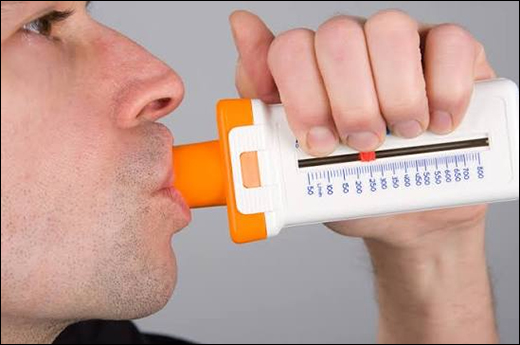
Fractional exhaled nitric oxide (FeNO) is a specialized breath analysis using a portable device with electrochemical sensor (range 5-400 ppb) inserted orally, providing real-time nitric oxide measurement from lower airways during controlled exhalation. This captures Type 2 inflammation markers (eosinophilic, steroid-responsive), superior to symptom scores or basic spirometry alone.
This advanced breath test measures fractional exhaled nitric oxide concentration using portable electrochemical analyzers like NIOX VERO, enabling real-time assessment at standardized 50 mL/s exhalation flow.
Key Advantages
- Diagnostic Accuracy: >85% sensitivity for eosinophilic asthma vs. 60-70% spirometry; flow-standardized reduces variability.
- Safety Profile: Effort-independent, non-invasive; complication rate <0.1% (e.g., dizziness).
- Efficiency: Instant results; repeatable in clinic for titration.
Procedure Overview (Key Steps)
Preparation Steps
- Sit comfortably and relax
- Avoid nitrate-rich foods (e.g., spinach, beets), caffeine, exercise, and smoking for 1-2 hours prior.
- Use nose clips to prevent nasal NO contamination and a new mouthpiece/filter for hygiene.
Test Performance Steps
- Fully exhale to empty lungs.
- Place the mouthpiece in mouth, forming a tight seal.
- Inhale deeply through the device (NO-scrubbed air) to total lung capacity.
- Exhale steadily and continuously for 10 seconds (6 seconds for young children), maintaining 50 mL/s flow via device biofeedback (visual needle/sound cues).
- Repeat 2-3 times; device averages valid readings after analysis phase.
Post-Test
Results display immediately in ppb; no recovery time needed.
Clinical Indications
- Asthma diagnosis in atypical/symptomatic cases (e.g., normal spirometry).
- Monitoring ICS response/adherence; exacerbation risk stratification.
- Type 2 inflammation confirmation (e.g., biologics candidates).
- Differentiating asthma-COPD overlap (ACOS); allergic rhinitis evaluation.
FeNO Report Reference Values and Interpretation
Ranges Per ATS/ERS Guidelines (ppb at 50 mL/s)
- Low/Negative → <25 adults/<20 children (no eosinophilic inflammation; NPV 90-95%).
- Intermediate/Atypical → 25-50 adults/20-35 children (clinical correlation needed).
- High/Positive→ >50 adults/>35 children (eosinophilic; 80% ICS-responsive).
- Non-Diagnostic → Failed flow/technique; repeat test.
Clinical Interpretation
- Negative Results – Rules out steroid-responsive asthma (NPV >90%); Pursue non-Type 2 workup (e.g., neutrophilic). Correlate with FeNO <25 ppb + normal spirometry; no trial needed.
- Atypical Results – Indeterminate; repeat post-abstinence or with history. Malignancy/exacerbation risk ~30%; integrate with blood eosinophils/FeNO trends.
- Positive Results – Confirms Th2 asthma; initiate/escalate ICS. Persistent high → biologics (anti-IL5/IL4R); track quarterly.
Ayurvedic View
In Ayurveda, elevated FeNO in asthma aligns with eosinophilic airway inflammation as Kaphaja Swasa (Kapha-dominant dyspnea) or Tamaka Swasa Roga in Pranavaha Srotas (respiratory channels), primarily due to Kapha-Vata Pradhan Tridoshaja Dushti with Rasa-Ama Dushya (vitiated circulatory fluid-endotoxins), causing Srotorodha (channel obstruction) and Sthanasamshraya (localization) in bronchial linings.
Ayurvedic Pathophysiology
High FeNO reflects Kapha-Ama margavrodha (pathway blockade) akin to bronchial Shotha (edema) or Utklesha (mucus hypersecretion), obstructing Pranavaha (respiratory channel) extensions; chronic cases evoke Pitta involvement for oxidative stress.
Management Principles
Focus on mild detoxification therapies according to the strength and disease severity of the patient. Vamana (emesis), Virechana (purgation), and Nasya (nasal therapy) for Shodhana (purification), alongside Rasayana (rejuvenation therapy) for bronchodilation and anti-inflammatory support adjunct to Fractional exhaled nitric oxide (FeNO)-guided inhaled corticosteroid (ICS) therapy.
Recommended Herbs
Key herbs target Kapha-Ama pachana (digestion), Srotoshodhana (channel clearance), and Swasahara (anti-asthmatic) to normalize FeNO by reducing eosinophilic inflammation for adjunctive asthma control.
1. Tulsi (Ocimum sanctum)
Tulsi’s eugenol and ursolic acid reduce bronchial eosinophilic infiltration in asthma by suppressing IL-13/IL-5 pathways and dissolving fibrous mucus capsules around inflamed airways. These compounds break apart inflammatory granulomas through targeted eosinophil clearance while stabilizing mast cell degranulation in allergic attacks. The leaf extracts clear mucus plugs from lung passages, widen bronchial airways, improve oxygen exchange, and lower FeNO levels for accurate asthma phenotyping.
2. Pippali (Piper longum)
Pippali’s piperine and bronchodilatory alkaloids penetrate bronchial linings, dissolving inflammatory granulomas and halting eosinophil chemotaxis. These compounds break apart mucus clusters through targeted immune cell clearance while normalizing airway tissue structure in chronic asthma. The root extracts clear mucus plugs from lung passages, widens bronchial airways, improves airflow regulation, and strengthens lung tissues for sustained FeNO reduction.
3. Haridra (Curcuma longa)
Haridra’s curcumin blocks NF-kB/Th2 signaling in eosinophilic asthma, shrinking bronchial inflammatory swellings. It activates alveolar macrophages for granuloma clearance, clears lung passages, widens airways, boosts detoxification processes, and lowers FeNO via anti-histaminic action.
4. Vasaka (Adhatoda vasica)
Vasaka’s vasicine relaxes bronchial smooth muscle in asthma, expelling mucus plugs and reducing eosinophilic exudates. Alkaloids enhance mucociliary clearance, balance airway function, open lung passages for better airflow, and normalize nitric oxide via expectorant bronchodilation.
5. Ashwagandha (Withania somnifera)
Ashwagandha’s withaferin A reduces pulmonary eosinophilia and IL-25 production in allergic asthma by modulating Type 2 inflammation pathways and stabilizing mast cell degranulation. These compounds decrease peribronchial inflammation through targeted eosinophil clearance while enhancing airway tissue resilience in chronic cases. The root extracts clear inflammatory exudates from lung passages, widen bronchial airways, improve oxygen flow, and sustain low FeNO levels post-therapy.
6. Giloy (Tinospora cordifolia)
Giloy’s berberine quenches eosinophilic inflammation via AMP-activated protein kinase, dissolving bronchial inflammatory granulomas. Polysaccharides boost immunity, clear fluid pathways in lung tissues, improve oxygenation, and strengthen airway resilience for chronic asthma FeNO control.
7. Talispatra (Abies webbiana)
Talispatra’s alpha-pinene expectorates thick mucus from lung passages, reducing eosinophilic mucus hypersecretion. It bronchodilates via beta-2 mimicry, clears airway obstructions, balances inflammation pathways, and stabilizes FeNO through anti-spasmodic demulcent action.
Conclusion
Fractional Exhaled Nitric Oxide Test (FeNO) provides critical precision in asthma phenotyping and management, achieving >85% accuracy for eosinophilic inflammation via standardized breath analysis. The seven targeted herbs reverse high FeNO via specific mechanisms, eugenol suppresses Th2 cytokines, piperine clears Ama plugs, curcumin blocks NF-kB, vasicine bronchodilates, withaferin A stabilizes immunity, berberine quenches radicals, and pinene expectorates mucus. Pre-FeNO herbal protocols optimize readings, post-test use supports inhaled corticosteroid (ICS) therapy tapering alongside conventional care. This integrative model enhances airway patency, reduces exacerbations, and advances respiratory diagnostics through synergistic modern-Ayurvedic precision.