


Nenua / Sponge Gourd (Luffa aegyptiaca Mill.) – Properties, Uses & Dosages
Abstract
Luffa is a genus of tropical and subtropical climbing plants belonging to the family Cucurbitaceae, commonly cultivated as annual vines. In common usage, the term luffa or loofah generally refers to the fruits of Luffa aegyptiaca and Luffa acutangula. The genus name originated from the fibrous mature fruit, widely used in the manufacture of natural bath sponges, scrubbers, and household products. The plant was first introduced into Western botanical literature by Johann Vesling in the 17th century, and the genus Luffa was formally established by Joseph Pitton de Tournefort in 1706. Although the exact origin of ridge gourd remains uncertain, Luffa is considered an Old World plant with significant diversity in the Indo-Burma region, and its cultivation is believed to have originated in India. The young fruits, shoots, leaves, and flowers are consumed as vegetables in tropical Asia, while mature fruits are valued for their fibrous sponge. Seeds yield edible oil, and the residual oil cake is utilised as animal feed or fertiliser, highlighting the plant’s nutritional, economic, and utilitarian importance.
Dhamargava is one of the nineteen Phalini Dravyas described in Charaka Samhita, Sutra Sthana (1/82). It is also indicated in Pakvashaya Shodhana Basti (Colon Cleansing Enema) as mentioned in Charaka Samhita, Siddhi Sthana (10/25–37), and is used in Vamana (Emesis) as well as Asthapana Basti therapies according to Charaka Samhita, Sutra Sthana (1/85). According to Gautama Rishi, Dhamargava is regarded as the best drug due to its Kapha–Pitta Nashaka property (Charaka Samhita, Siddhi Sthana 11/7). Maharshi Atreya has described Dhamargava as the most effective drug in the management of Pandu Roga (anaemia) (Charaka Samhita, Siddhi Sthana 11/12).
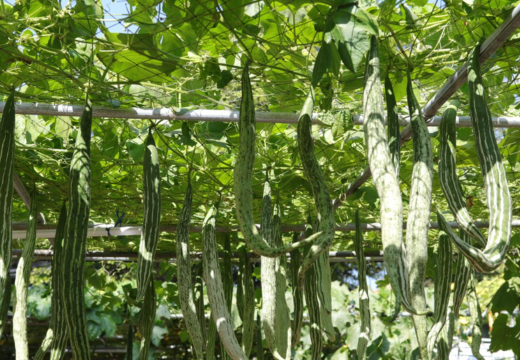
Classical references of Luffa aegyptiaca Mill./ Nenua/ Spong Gourd
- Bhavprakash Nighantu Shaaka varga
- Raj Nighantu Mulakadi varga
Scientific Classification of Luffa aegyptiaca Mill./ Nenua/ Spong Gourd
- Kingdom: Plantae
- Phylum: Tracheophyta
- Class: Magnoliopsida
- Order: Cucurbitales
- Family: Cucurbitaceae
- Genus: Luffa
- Species: Luffa aegyptiaca Mill.
Synonym of Luffa aegyptiaca Mill./ Nenua/ Spong Gourd
- Raja Koshataki / Mahakoshataki – Indicates that the fruit is larger in size compared to the common Koshataki variety.
- Mahajalini – Refers to the presence of an abundant fibrous network inside the fruit.
- Sapitaka / Pitapushpika – Denotes the plant bearing yellow-colored flowers.
- Koshaphala / Mahaphala – Signifies that the fruit is elongated and large in shape.
- Dhamargava – Suggests the plant’s use in cleansing and detoxifying therapies in Ayurveda.
- Hastiparnika – Implies that the leaves resemble the shape of an elephant’s ear.
- Karkotaki – Refers to the rough or ridged surface of the fruit.
- Hastighosha – Indicates the hard, fibrous structure of the mature fruit.
- Kritvedhana – Suggests the plant’s ability to penetrate and clear bodily channels.
Vernacular Names of aegyptiaca Mill./ Nenua/ Spong Gourd
- Hindi name: Nenua
- English name: Smooth luffa, Sponge luffa, Vegetable sponge
- Assamese name: Bhul
- Bengali name: Dundul
- Gujarati name: Galkan
- Kannada name: Tuppa Heerekayi
- Konkni name: Gossale
- Marathi name: Ghosale
- Malayalam name: Kattupechal
- Tamil name: Meeyuk Peerakanakai
- Telugu name: Guttibeera
Habitat of Luffa aegyptiaca Mill./ Nenua/ Spong Gourd
Luffa aegyptiaca (smooth luffa or sponge gourd) is a tropical and subtropical climber that grows best under full sunlight, warm temperatures ranging from 20–38°C, and a long frost-free season. It is native to the Indian subcontinent and Southeast Asia (from Burma to the Philippines) and is now widely cultivated and naturalised throughout pantropical regions, including Asia, Africa, the Americas, and areas of Europe and the USA with Asian populations. The plant prefers a warm, humid climate, though it can be grown in temperate regions with adequate summer heat. Optimal growth occurs in fertile, well-drained soils rich in organic matter, particularly sandy loams with a pH of 6.5–7.5, while waterlogging—especially during flowering and fruiting—should be avoided. Adequate irrigation is essential, but excessive rainfall can adversely affect fruit development. Being a vigorous climber, the plant requires trellises or supports such as bamboo or ropes. It is commonly found under cultivation in gardens and farms and occasionally occurs wild or escaped along roadsides, grasslands, thickets, and tropical woodlands.
Morphology of Luffa aegyptiaca Mill./ Nenua/ Spong Gourd
Luffa aegyptiaca is a fast-growing, warm-season, annual climbing vine belonging to the family Cucurbitaceae, commonly cultivated in tropical and subtropical regions. The plant possesses a glabrous, ribbed stem that can attain a length of up to 9–10 m, supported by branched tendrils (3–5 branched), which help the vine climb on trellises. The leaves are alternate, palmately lobed, broadly ovate to ovate in shape, measuring 7.5–15 cm in length and 5–12.5 cm in width, with 3–7 rounded or obtuse lobes, serrated margins, acute lobes, and a generally hairless surface; petioles are 2.5–7.5 cm long. The plant is monoecious, bearing separate male and female flowers on the same plant. Male flowers are arranged in elongated racemes containing 10–16 yellow to orange flowers, while female flowers occur singly. The flowers are showy, measuring 5–7.5 cm in diameter. Following pollination, the plant develops smooth, cylindrical, green fruits resembling squash, which are harvested at the immature stage for vegetable use. On full maturity, the fruit becomes fibrous and inedible, yielding the characteristic sponge. The seeds are numerous (30 or more per fruit), elliptic, smooth to slightly rugose, white when immature and dark brown to black at maturity, completing the botanical profile of Luffa aegyptiaca.
Special Note
There are three species belonging to the genus Luffa, namely:
- Luffa acutangula – Commonly known as angled luffa, ridged luffa, or vegetable gourd.
- Luffa aegyptiaca / Luffa cylindrica – Known as smooth luffa, Egyptian luffa, dishrag gourd, or gourd loofah.
- Luffa operculata – Commonly referred to as wild loofah or sponge cucumber.
Classical categorisation of Luffa aegyptiaca Mill./ Nenua/ Spong Gourd
- According to Charaka Samhita: Vamana (emetic drugs used in Vamana Panchakarma) and Phalini (fruit-bearing medicinal plants) Varga
- According to Kaiyadeva Nighantu: Aushadhi Varga
- According to Sushruta Samhita: Urdhvabhagahara (emetics) Varga and Ubhayatobhagahara Varga (useful in both Vamana and Virechana therapies)
- According to Bhavprakash Nighantu: Shaaka varga
- According to Raj Nighantu: Mulakadi varga
- According to Dhanvantari Nighantu: Guduchyadi Varga
Ancient Verse of Luffa aegyptiaca Mill./ Nenua/ Spong Gourd
महाकोशातकी प्रोक्ता हस्तिघोषा महाफला ॥
धामार्गवो घोषकश्च हस्तिपर्णच स स्मृतः।
महाकोशातकी स्निग्धा रक्तपित्तानिलापहा ॥(Bhavprakash Nighantu Shaaka varga 65-66)
According to the above shloka, the Sanskrit names of Nenua are Mahakoshataki, Hastighosha, Mahaphala, Dhamargava, Ghoshaka, and Hastiparna. Nenua is unctuous in nature and is known to help pacify Vata dosha and disorders of Rakta-Pitta (bleeding disorders).
धाराकोशातकी ग्निग्धा मथुरा कफपित्तनुत्त् ।
ईषद्वातकरी पथ्या रुचिकृद् बलवीर्य्यदा ।।(Raj Nighantu Mulkadi varga 172)
According to the above Shloka, it possesses an unctuous and sweet nature, helps alleviate Kapha and Pitta, and slightly aggravates Vata. It acts as a wholesome and appetising substance, while also enhancing general vitality and seminal strength.
कफे च कण्ठवक्त्रस्थे कफसंचयनेषु च ।
अन्या स्वादुत्रिदोषघ्नी ज्वरस्यान्ते हिता स्मृता ॥ (Dhanvantari Nighantu Guduchyadi varga 189)
According to the above shloka, Dhamargava is bitter in taste and hot in potency, acts as a laxative, and is useful in managing cough, abdominal tumours, abdominal disorders, and poisoning, while helping to pacify aggravated Kapha. Hastakoshataki, on the other hand, is sweet in taste, balances Vata, Pitta, and Kapha, and is beneficial in the treatment of fever.
Ancient Verse of Luffa acutangula/ Angled Luffa
राजकोशातकी शीता मधुरा कफवातकृत्।
पितप्नी दीपनी श्वासज्वरकासकृमिप्रणुत् ॥(Bhavprakash Nighantu Shaaka varga 68)
According to the above Shloka, Angled Luffa has cold potency, sweet taste and increases Kapha and Vata. It helps in the management of Pitta, asthma, fever, cough and worm infestation.
Ayurvedic Properties of Luffa aegyptiaca Mill./ Nenua/ Spong Gourd
- Taste (Rasa)- Bitter (Tikta)
- Physical property (Guna)- Light (Laghu), Dry (Ruksha), Sharp/Penetrating (Tikshna)
- Potency (Veerya)- Hot Potency (Usna)
- Post-digestion effect (Vipaka)- Katu (Pungent)
- Effect on tridosha- Balance Kapha and Pitta dosha
Therapeutic Indications of aegyptiaca Mill./ Nenua/ Spong Gourd
- Kasa: Cough and cold
- Shwasa: Asthma and chronic respiratory disorders
- Jwara: Fever
- Krimi: Worm infestation
- Gulma: Abdominal tumours or masses
- Udara: Ascites and abdominal enlargement
- Kantharoga: Disorders of the throat and voice
Systemic actions of Luffa aegyptiaca Mill./ Nenua/ Spong Gourd
- Digestive System – Induces emesis and purgation. Indicated in ascites, phantom tumours, and related abdominal disorders.
- Circulatory System – Acts as a blood purifier and helps reduce oedema. Indicated in blood-borne diseases.
- Respiratory System – Eliminates aggravated Kapha dosha. Indicated in cough, asthma, and hoarseness of voice.
- Satmikarana – Exhibits anti-poisonous (antitoxic) activity.
Chemical composition of Luffa aegyptiaca Mill./ Nenua/ Spong Gourd
- Triterpenoid Saponins: A major group of constituents including lucyosides (A–H), aegyptin A and B, oleanolic acid, echinocystic acid, and ginsenosides. These compounds are responsible for the characteristic bitterness of the drug.
- Flavonoids and Phenolic Compounds: Includes apigenin, luteolin, quercetin, p-coumaric acid, chlorogenic acid, and caffeic acid, which exhibit antioxidant and anti-inflammatory activities.
- Proteins: Seeds contain ribosome-inactivating proteins (RIPs), such as luffin P1, known for their anti-tumor and antiviral properties.
- Fatty Acids: The seed oil is rich in unsaturated fatty acids, with linoleic acid being predominant, accounting for approximately 30–50% of total fatty acids.
- Other Constituents: Carotenoids, chlorophylls, alkaloids, tannins, and cardiac glycosides are present in varying proportions in different parts of the plant.
Proximate and Nutritional Composition (per 100 g of Fresh Fruit)
- High moisture content with low caloric value
- Carbohydrates: ~14.34 g
- Protein: ~0.66 g
- Fat: ~0.34 g
- Dietary Fiber: ~2.9 g
- Vitamins: Rich in vitamin A, vitamin C, thiamine (B₁), riboflavin (B₂), niacin (B₃), and vitamin B₆.
- Minerals: Contains potassium (~453 mg), magnesium, phosphorus, calcium, iron, manganese, and zinc.
Structural Fiber Composition (Mature Dried Fruit / Loofah Sponge)
- Cellulose: 57–90%
- Hemicellulose: 8–30%
- Lignin: 1–23%
- Ash and Other Components: Up to 12.8%
Actions and Properties of Various Chemical Constituents of Luffa aegyptiaca Mill./ Nenua/ Spong Gourd
Anti-Tumour Activity
The anti-tumour activity of Luffa aegyptiaca (sponge gourd / nenua) is mainly attributed to its rich content of ribosome-inactivating proteins, flavonoids, and triterpenoid saponins. Seed-derived ribosome-inactivating proteins such as luffin and luffacylin exert potent anti-cancer effects by inactivating ribosomes, thereby inhibiting protein synthesis and inducing apoptosis in tumour cells; recombinant α-luffin has shown dose- and time-dependent inhibition of tumour cell lines. Flavonoids, including apigenin, luteolin, quercetin, and kaempferide, present in the leaves and fruits, act synergistically to suppress cancer cell proliferation and promote programmed cell death. Additionally, triterpenoid saponins such as oleanolic acid, echinocystic acid, and lucyosides exhibit cytotoxic activity against malignant cells. These bioactive compounds also demonstrate antioxidant properties, reducing oxidative stress linked to carcinogenesis, and have shown activity against cancer stem cells, thereby helping to limit tumour growth, recurrence, and metastasis.
Anti-pyretic Properties
The antipyretic (fever-reducing) activity of Luffa aegyptiaca is mainly attributed to its flavonoids, phenolic compounds, and triterpenoid saponins. Flavonoids such as apigenin and luteolin, along with phenolic acids, exert strong antioxidant and anti-inflammatory effects, helping to suppress inflammatory mediators and reduce oxidative stress associated with fever. Triterpenoid saponins, including lucyosides and oleanolic acid derivatives, further contribute by inhibiting pro-inflammatory pathways, thereby supporting normalisation of elevated body temperature.
Anti-asthmatic Activity
The anti-asthmatic activity of Luffa aegyptiaca (sponge gourd) is mainly attributed to its rich content of triterpenoid saponins and flavonoids, which exhibit strong anti-inflammatory and bronchodilatory effects. The saponin fraction, including lucyin A, lucyosides (G, N, O, P, Q, R), and aegyptinins A and B, helps modulate immune responses and reduce airway inflammation, thereby improving bronchial patency. Flavonoids such as apigenin, luteolin, and quercetin derivatives suppress the release of inflammatory mediators like histamine and prostaglandins, which play a key role in asthma pathogenesis. Additionally, oleanolic acid, a triterpenoid present in the fruit, enhances the anti-inflammatory action.
Practical Uses / Health Benefits of Luffa aegyptiaca Mill./ Nenua/ Spong Gourd
- For Panchakarma (Shodhana Karma): The fruit of Dhamargava is mainly used in Panchakarma practice to induce emesis and purgation as a part of Shodhana Karma.
- For Asthma and Skin Diseases: Shodhana therapy with Dhamargava is indicated in conditions such as asthma and skin diseases to expel vitiated Kapha and Pitta dosha from the body.
- For Ingested Poisoning: The fruit of Luffa aegyptiaca is used in cases of ingested poisoning; the fruit juice (15–20 ml) is administered to induce emesis.
- For Swelling and Inflammation: A paste prepared from the leaves is applied locally to manage swelling and inflammation.
- For Intestinal Worm Infestation: The leaf juice, given in a dose of 10–15 ml, is used in the treatment of intestinal worm infestation.
- As a Blood Purifier: Regular consumption of the juice of the leaves or the whole plant in a dose of 5–10 ml acts as a blood purifier.
- For Ascites and Constipation: The fruit juice of Dhamargava, administered in a dose of 10–15 ml, is used to induce purgation and to treat conditions such as ascites and constipation.
- For Swellings, Nodules, or Lumps: In conditions such as swellings, nodules, or lumps, a paste made from the leaf juice mixed with jaggery, lime, or red lead (sindoor) is applied locally for therapeutic benefit.
- For Wounds: An ointment prepared from the leaf juice is beneficial in the treatment of all types of wounds.
Parts Used of Luffa aegyptiaca Mill./ Nenua/ Spong Gourd
- Fruits
- Leaves
- Seeds
Dosage of Luffa aegyptiaca Mill./ Nenua/ Spong Gourd
- Powder- 3-6 gms
- Fresh Juice- 10-20 ml
Conclusion
Luffa aegyptiaca is a versatile medicinal plant with wide therapeutic relevance in both classical Ayurveda and traditional medicine. It is especially valued for its role in Shodhana therapies, where the fruit is used to induce emesis and purgation for the elimination of vitiated Kapha and Pitta dosha. The plant exhibits diverse pharmacological activities, including anti-inflammatory, antipyretic, anti-asthmatic, anthelmintic, antitoxic, blood-purifying, and wound-healing properties, which are attributed to bioactive constituents such as triterpenoid saponins, flavonoids, phenolic compounds, and ribosome-inactivating proteins. Its internal and external applications in conditions like asthma, skin diseases, ascites, poisoning, and inflammatory swellings highlight its holistic therapeutic potential.