


Yellow Cotton Tree (Cochlospermum religiosum) – Properties, Uses & Dosages
Abstract
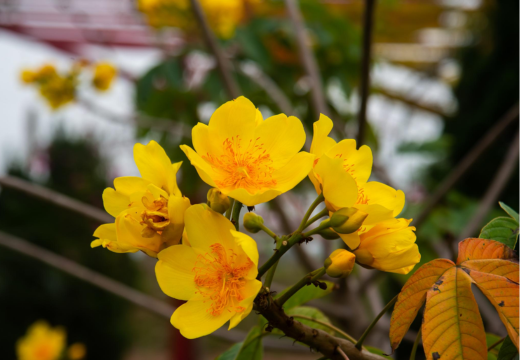
Cochlospermum religiosum (L.) Alston, commonly known as the silk cotton tree or yellow silk-cotton tree, is a deciduous tree native to tropical and subtropical regions of South and Southeast Asia. Widely recognised for its bright yellow flowers and cultural significance, the species belongs to the family Bixaceae. Traditionally used in Ayurveda and folk medicine, various parts of the plant—such as the bark, roots and flowers—have been employed for their therapeutic properties, including anti-inflammatory, antimicrobial, and antioxidant activities. Cochlospermum religiosum plays an ecological role in dry deciduous forests and is valued in horticulture for its ornamental appeal. This review highlights the botanical characteristics, ethnomedicinal uses, phytochemistry and pharmacological activities of Cochlospermum religiosum.
Introduction
Cochlospermum religiosum is recognised as one of the most valuable gum-yielding tree species. Its bark produces a natural exudate known as gum katira or kondagogu, which is classified among the most significant non-timber forest products. This gum is typically harvested by blazing or stripping the tree’s bark. Characterised by its pale colour, semi-transparency and sweet taste, the gum is non-toxic, cost-effective and exhibits high water-absorption capacity, making it safe for consumption and suitable as a food additive. Chemically, it contains several bioactive elements with notable health benefits. Industrially, the gum is utilised in the production of ice cream, pastes and cigars. Medicinally, it has been traditionally used as a sedative, stomachic and coolant, and is applied in the treatment of various ailments, including asthma, cough, diarrhoea, dysentery, throat infections, eye disorders, gonorrhea and syphilis.
Scientific Classification
- Kingdom: Plantae
- Class: Magnoliopsida
- Order: Malvales
- Family: Bixaceae
- Genus: Cochlospermum
- Species: religiosum
Synonym
- Yellow silk cotton
- Buttercup tree
- Torchwood
- Silk cotton tree
- Golden silk cotton tree
Vernacular Names
- English: Yellow silk cotton tree, Golden silk cotton tree
- Hindi: Galgal
- Tamil: Kattupparutti
- Malayalam: Cempanni
- Kannada: Arasinaburuga
- Telugu: Konda gogu
- Bengali: Sonalisimul
- Marathi: Ganeri
Habitat
Cochlospermum religiosum is commonly found in dry forests and rocky regions of Central and South India, Sri Lanka, Nepal, Myanmar and Thailand.
Morphology
Cochlospermum religiosum is a small deciduous tree characterised by a smooth, ash-colored stem. The bark exudes a gum that is of economic importance. Its leaves are broadly orbicular, measuring 7–20 cm across and are palmately 3–5 lobed with a cordate base; the undersurface is tomentose and the leaves display 5–7 basal nerves. The petiole can extend up to 25 cm in length. Flowering occurs after the leaves have fallen, with large, cup-shaped flowers up to 8 cm or more in diameter appearing in terminal racemes or loosely branched panicles. Each flower comprises five deciduous, imbricate sepals and five bright golden-yellow petals that are contorted in the bud stage. The stamens are numerous and free, while the ovary is typically one-celled or incompletely divided into 3–5 chambers. The fruit is a large, obovoid capsule measuring 9–13 cm in length, containing brown, reniform seeds covered with woolly hairs.
Classical Categorisation
- Bhavprakash Nighantu, page no. 795
Ayurvedic Properties
- Taste (Rasa)- Sweet (Madhur)
- Physical property (Guna)- Heavy (Guru), Unctuous (Snigdha)
- Potency (Veerya)- Cold potency (Sheet)
- Post-digestion effect (Vipaka)- Sweet (Madhur)
- Effect on tridosha- Balance Vata and Pitta Dosha
Therapeutic Properties
- Demulcent
- Anti-inflammatory
- Antimicrobial
- Sedative
- Stomachic
- Coolant
- Expectorant
- Antidiarrheal
- Wound-healing
- Antioxidant
Systemic Actions
External
It is used for wound healing, soothing irritated skin, treating eye disorders, improving scalp health, treating burns and skin infections and in cosmetic products for its emollient properties.
Internal
- Digestive System: Soothes gastrointestinal irritation, improves digestion and helps treat conditions like diarrhoea and dysentery.
- Respiratory System: Acts as an expectorant, clearing mucus and relieving symptoms of asthma, cough, and throat infections.
- Circulatory System: Acts as an anti-inflammatory, reduces bleeding, potentially reducing blood vessel inflammation and supporting cardiovascular health.
- Excretory System: Its diuretic and cooling effects may support kidney function and help regulate body temperature.
Chemical Composition
- Sterols
- Saponins
- Triterpenes
- Alkaloids
- Tannins
- Flavonoids
- Phenols
- Glycosides
- Coumarins
- Anthocyanins
- Phytosterols
Modern overview
Hepatoprotective activity
The in vitro hepatoprotective activity of various extracts of Cochlospermum religiosum was evaluated on the BRL3A rat liver cell line, assessing its effectiveness against paracetamol-induced toxicity. The MTT assay (3-(4, 5-dimethylthiazole-2-yl)-2,5-diphenyltetrazolium bromide) was used to determine the cytotoxicity of the plant extracts on the liver cell line. Among the different extracts tested, the ethanolic extract of Cochlospermum religiosum showed the most promising results in terms of cell viability.
Antioxidant activity
A bioactive flavonoid compound, Isorhamnetin-3-glucoside, isolated from the leaves of Cochlospermum religiosum, demonstrated a concentration-dependent scavenging effect on superoxide radicals. Additionally, the kondagogu gum exhibited weaker inhibitory activity against DPPH radicals, with a scavenging activity of 11.6% at a 1% w/v concentration.
Practical Uses
- Cough and Asthma: Gum or leaf extract is used to soothe the throat and relieve cough or asthma symptoms.
- Diarrhoea and Dysentery: The gum is consumed to help reduce diarrhoea and dysentery due to its anti-inflammatory properties.
- Skin Infections: The gum or leaf paste is applied to wounds, cuts, and burns for faster healing.
- Eye Irritation: Leaf extracts are used as a wash for irritated or inflamed eyes.
- Digestive Issues: The gum acts as a stomachic, promoting digestion and relieving discomfort from indigestion.
- Cooling Agent: The gum is used to cool the body and reduce heat during fever or hot weather.
Parts Used
- Gum
- Leaves
Dosage
- Powder- 1-3 gm
Conclusion
Cochlospermum religiosum stands out as a versatile plant with significant medicinal, industrial and ecological value. Its various parts, particularly the gum and leaves, have proven therapeutic properties, supporting its use in treating a range of health conditions, from digestive disorders to respiratory ailments. The plant’s potential in traditional medicine, combined with its non-toxic and easily accessible nature, makes it an important resource in rural healthcare systems. Additionally, its role in the food, cosmetic and craft industries further emphasises its practical utility.