


Wormwood (Artemisia absinthium Linn.) – Properties, Uses & Dosages
Abstract
Artemisia absinthium Linn. (commonly known as Wormwood) is a significant perennial shrub from the Artemisia genus, which includes over 500 species widely distributed across temperate regions of the world. In India, it is primarily found in the Himalayan belt. The plant holds an esteemed place in traditional medicine systems such as Ayurveda, Homoeopathy, Unani and Siddha. Beyond its medicinal value, wormwood has also been utilised as a feed additive in livestock, contributing to improved nutrient absorption and overall animal performance. Historically revered since the time of the ancient Greeks, wormwood has been employed in folk medicine for its antiseptic, anthelmintic, antipyretic, antimalarial, antioxidant, hepatoprotective and neuroprotective properties. This review highlights its phytochemical composition, therapeutic applications and pharmacological findings, while also exploring its emerging role in animal nutrition.
Introduction
Artemisia absinthium Linn., commonly known as wormwood, is a botanically and pharmacologically significant plant recognised for its intense aroma and bitter flavour. Revered across various cultures, it has been a key ingredient in traditional herbal formulations as well as in the preparation of liqueurs like absinthe. Its distinct phytochemical profile, rich in essential oils, lactones and flavonoids, has drawn increasing scientific interest for its potential therapeutic applications. As global demand for plant-based remedies grows, wormwood stands out not only for its historical relevance but also for its adaptability to modern integrative health approaches. Its applications extend beyond human medicine into veterinary science, food preservation, and even pest management, making it a versatile species with broad practical value.
Scientific Classification
- Kingdom: Plantae
- Phylum: Tracheophyta
- Class: Magnoliopsida
- Order: Asterales
- Family: Asteraceae
- Genus: Artemisia
- Species: Artemisia absinthium Linn.
Synonym
- Afsanteen
Vernacular Names
- English: Yellow silk cotton tree, Golden silk cotton tree
- Hindi: Galgal
- Tamil: Kattupparutti
- Malayalam: Cempanni
- Kannada: Arasinaburuga
- Telugu: Konda gogu
- Bengali: Sonalisimul
- Marathi: Ganeri
Habitat
Artemisia absinthium is commonly found in North Asian regions such as Kashmir, Nepal, and the mountainous areas of India at elevations ranging from 5000 to 7000 feet. Its natural habitat also extends to Afghanistan and stretches westward to the Atlantic, covering a wide geographic range. Additionally, it is distributed throughout Europe, the Northeastern and Midwestern United States, the Great Plains, and Canada.
Morphology
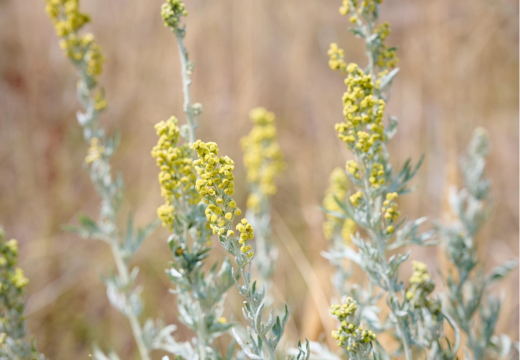
The stem of Artemisia absinthium is erect, angular, ribbed and covered with fine hairs, measuring between 0.3 to 0.9 meters in height. Its leaves are ovate to obovate, irregularly divided two to three times into spreading linear or lance-shaped blunt segments, with both surfaces covered in a hoary texture and measuring 2.5 to 5 cm long. The flower heads are about 8.6 mm in diameter, containing approximately 40 florets. These flowers are heterogamous, having female florets on the outer row and bisexual or male florets inside. The yellow flowers produce numerous, loosely packed nuts and the ray florets broaden near their base.
Classical Categorisation
- According to Bhavprakash Nighantu, page number 791
Ayurvedic Properties
- Taste (Rasa)- Bitter (Tikta), Astringent (Kashaya)
- Physical property (Guna)- Light (Laghu), Dry (Ruksha)
- Potency (Veerya)- Hot Potency (Usna)
- Post-digestion effect (Vipaka)- Katu (Pungent)
- Effect on tridosha- Balance all three doshas
Therapeutic Properties
- Hepatoprotective/ Liver tonic
- Anti-inflammatory
- Analgesic
- General tonic
- Diuretic
- Appetizer
- Antipyretic
- Brain tonic
- Antidepressant
- Diaphoretic
- Antiseptic
- Anthelmintic
- Digestive tonic
- Laxative
- Carminative
- Insecticidal
Systemic Actions
External
It is used as an antiseptic in poultices for wounds and insect bites and reduces inflammation and relieves localised pain or swelling.
Internal
- Nervous system- It mildly calms the nerves and improves mental alertness.
- Digestive system- It stimulates appetite and enhances digestive secretions and acts as a carminative and helps expel intestinal worms.
- Reproductive System- It stimulates menstrual flow and may relieve menstrual discomfort.
Chemical Composition
- Artemisinin
- Thujone
- Isothujone
- Camphor
- Sabinene
- Myrcene
- α-Pinene
- β-Pinene
- Cineole
- Cadinene
- Quercetin
- Rutin
- Tannins
- Absinthin
- Anabsinthin
- Resins
Modern overview
Antiparasitic activities
Artemisia absinthium has been investigated for its potential antiparasitic effects. The plant extract contains sesquiterpene lactones, including α-santonin and ketopelenolide-A. Among these, α-santonin is known for its antiparasitic properties. Additionally, the ethanolic extract of Artemisia absinthium has demonstrated significant anti-implantation activity in rat models.
Anthelmintic activities
An aqueous extract of fresh Artemisia absinthium leaves has been shown to exhibit anthelmintic activity. When administered with a sugar solution on an empty stomach for 8–10 days, the extract effectively expelled roundworms. Additionally, the flavonoid artemisinin, isolated from the plant, demonstrated significant antitumor activity against melanoma B16 cells.
Practical Uses
- For Expelling Worms: Drink wormwood tea on an empty stomach for 7 days to expel worms.
- For Improving Digestion: Take a mild infusion before meals to improve digestion and reduce bloating.
- For Liver Detox: Combine with fennel tea to aid liver detox.
- For Regulating Menstruation: Drink a weak infusion before periods to help regulate menstruation.
- For Wound Care: Apply cooled decoction as a compress on wounds for antiseptic action.
- For Mild Fever: Sip wormwood and tulsi tea mix to lower a mild fever.
Parts Used
- Bark
- Fruit
Dosage
- Powder- 250-500 mg
- Juice- 5-10 ml
- Decoction- 30-50 ml
Conclusion
Artemisia absinthium has strong flavours, thus has very powerful actions in animals, including ruminants and should be used with care because elevated doses can stimulate undesirable side effects. Improving the feeding value of animal diets through supplementation of bioactive and high-nutritional herbal plants such as wormwood is a viable proposition to enhance the nutrient utilisation efficiency for augmenting productivity as well as product quality to have sustainable livestock production, particularly where the feeding of low-grade roughages is indispensable. However, it is more essential to evaluate its potential on modern scientific lines through phytochemical, pharmacological studies and clinical and nutritional trials.