

Top 19 Panchkarma Oils – Indications, Usage & Brief Guide
Musculoskeletal, Neurological, and General Body Oils
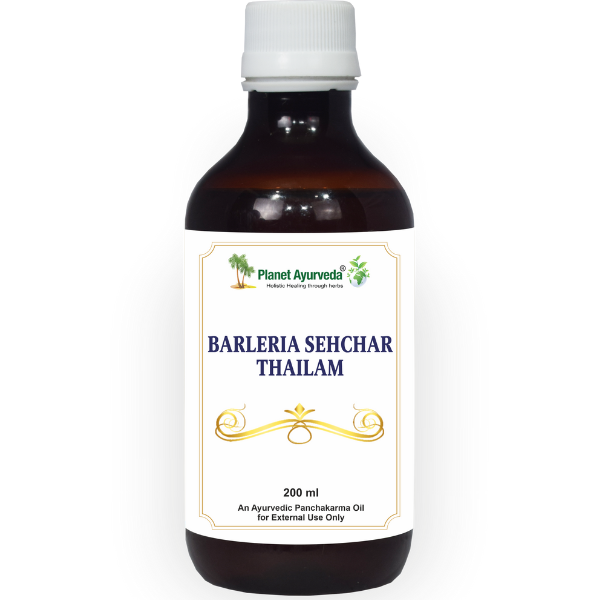
1. Barleria Sehchar Thailam
Barleria Sehchar Thailam (Sahacharadi Taila) is a traditional Ayurvedic formulation specifically formulated for conditions affecting the lower portion of the body (adhah-kāya). Its composition features a sesame oil and milk base blended with Sahacara (Barleria prionitis), the complete Daśamūla root group, Lac, and supporting botanicals such as Devadāru, Manjiṣṭhā, and Uśīra. The energetic profile is predominantly Vāta-Pitta pacifying. Sahacara possesses tikta-kaṣāya (bitter-astringent) tastes and uṣṇa (warming) heating potency with a direct affinity for the lower extremities. The Daśamūla herbs contribute strong śothahara (anti-inflammatory) and vātānulomana (restoring normal direction of Vāta) properties, while Lac and sesame oil provide essential snigdha (unctuous) qualities necessary for thorough snehana (oleation) therapy.
In clinical Panchakarma and preparatory pūrvakarma practice, Barleria Sehchar Thailam is selected for lower-body afflictions. It serves as the primary oil for Kaṭi Basti (lumbar oil pooling) and deep localized Abhyanga of the lower back, hips, and legs. Primary indications include sciatica (gṛdhrasī) with pain radiating down the leg, lumbago, severe lumbar stiffness, coxarthrosis, and degenerative hip or knee arthrosis. It is also indicated for chronic leg pain exacerbated by cold weather. Warm application helps relieve deep-seated Vāta rigidity, though practitioners should avoid its use on acute, red, or hot burning joints, opting for cooling formulations like Pinda Oil instead.
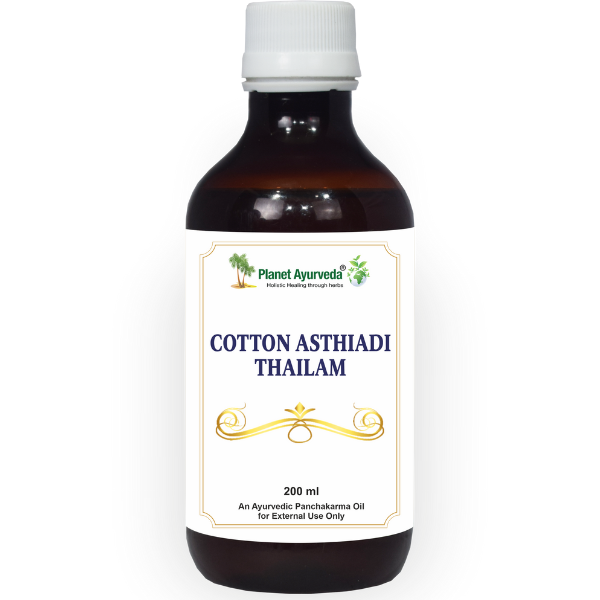
2. Cotton Asthiadi Thailam
Cotton Asthiadi Thailam (Karpāsāsthyadi Taila) is the classical formulation indicated for Vāta disorders located above the clavicle (ūrdhva-jatrugata vāta). Built on a base of sesame oil and goat’s milk (Caprae Lac), its key active component is Karpāsa-asthi (cotton seed), combined with Bala, Kulattha, Devadāru, and sharp digestive spices such as Śūṇṭhī (ginger), Sarṣapa (mustard), Pippalī, and Cavyā. The overall energetic effect is Vāta-pacifying and warming. The inclusion of pungent, penetrating herbs enables the oil to break stubborn stiffness and local Kapha-Vāta stagnation in the cervical region, while goat’s milk and Bala supply nourishing (bṛṁhaṇa) properties to degraded structural tissues.
In clinical procedures, Cotton-Asthiadi Thailam is the principal choice for Grīva Basti (cervical oil pooling) and targeted Abhyanga of the head, neck, shoulders, and upper back. Indications cover cervical spondylosis, torticollis, chronic stiff neck, frozen shoulder, upper back pain, and Vāta-type headaches originating from cervical tension or spine degeneration. Practitioners should note that karpāsa-asthi refers specifically to cotton seed rather than bone tissue, correcting the misconception that it is used for bone fracture repair. Due to its warming, spice-infused nature, exposure times should be carefully monitored on sensitive skin.
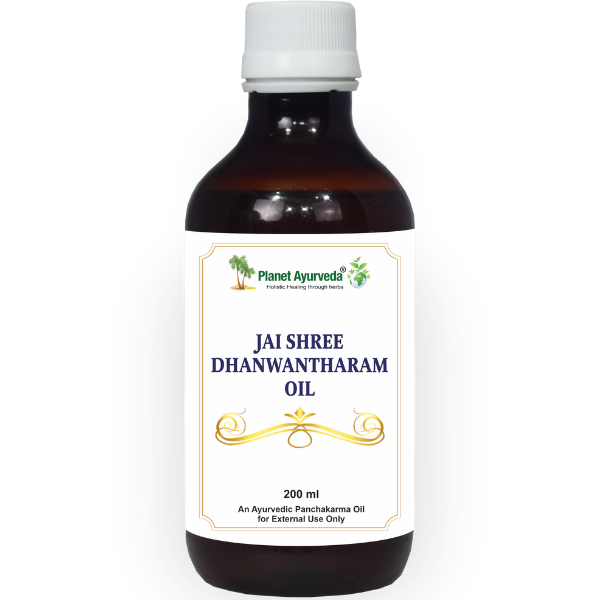
3. Jai Shree Dhanwantharam Oil
Jai Shree Dhanwantharam Oil (Dhanvantaram Taila) is widely regarded as one of the most comprehensive and versatile formulations in Ayurvedic medicine. Containing a blend of 41 ingredients built on the classical Daśamūla, Aṣṭavarga, and Caturjāta groups within a sesame oil and Lac base, it exerts a powerful Vāta-pacifying, bṛṁhaṇa (nourishing), and balya (strength-promoting) effect. Its intricate botanical assembly allows it to address complex, systemic Vāta imbalance, multi-tissue depletion, and mixed clinical pictures without aggravating other doṣas when properly applied.
Classically, Dhanwantharam Oil is the premier sūtikā (postpartum) recovery oil, used extensively for post-delivery maternal rehabilitation and systemic rejuvenation. In clinical pūrvakarma and Kerala Upakarma procedures, it is utilized for full-body Abhyanga, Pizhicil (medicated oil stream massage), and local oil pooling (Kaṭi, Grīva, or Jānu Basti). Indications include general rheumatic pain of the joints and back, neurological pains, general post-traumatic debility, convalescence, and advanced degenerative musculoskeletal disease. Though classically utilized as a base for internal mātrā basti, externally registered preparations are applied warm over the body to restore tone, strength, and structural integrity.
4. Kottamchu Thailam
Kottamchu Thailam (Kottamcukkodi Taila) is the most intensely warming and dispersing oil in the range, formulated specifically to treat pain associated with coldness, swelling, and āma (toxic metabolic accumulation). Formulated in a base of sesame oil, fermented milk, and tamarind leaf extract, it features highly potent, uṣṇa-tīkṣṇa (hot and penetrating) herbs including Śūṇṭhī (dry ginger), Vacā (sweet flag), Śigru (moringa bark), Laśuna (garlic), and mustard seed. This combination acts as a powerful local āmapācana (digester of metabolic toxins) and śothahara (anti-edema agent). Unlike restorative oils, Kottamchu Thailam is strictly a dispersing and unblocking formulation.
Clinically, Kottamchu Thailam pacifies Vāta and Kapha. It is indicated for rheumatoid arthritis in the chronic, non-inflamed phase, cold and swollen joints (particularly the knees), acute sports injuries with cold swelling, overuse injuries, and rheumatic pain aggravated by cold, damp environments. Practical applications include local joint Abhyanga, Picu (oil compress), and Lepa. Because of its high concentration of irritating, warming botanicals (such as garlic and mustard), it must never be used under occlusive dressings, on broken skin, or on hot, red, Pitta-inflamed joints. Treatment sessions should begin with a conservative retention time of 30 to 60 minutes.
5. Nirgujati Oil
Nirgujati Oil combines two classical Ayurvedic preparations—Nirgundi Taila (77% Vitex negundo) and a minor fraction of Jātyādi Taila—in a sesame oil base. Nirguṇḍī is kaṭu-tikta (pungent-bitter), uṣṇa (heating), and laghu (light), recognized in classical texts as an exceptional śothahara (swelling reducer) and vedanāsthāpana (analgesic). The Jātyādi portion contains Jāti, Nimba, Haridrā, Dāruharidrā, Manjiṣṭhā, Lodhra, and Sārivā, establishing a secondary clinical identity focused on vraṇa-śodhana (wound cleansing) and vraṇa-ropaṇa (wound healing).
This dual action makes Nirgujati Oil suitable for both acute soft-tissue trauma and chronic ulcerations. For musculoskeletal applications, it is applied via targeted local massage to manage acute joint swelling, severe muscle spasms, post-injury stiffness, sprains, and contusions. For dermatological and anorectal applications, it is applied locally (often after a sitz bath) to manage non-healing wounds (duṣṭa vraṇa), anal fissures, perianal fistulas (bhagandara), and sinus tracts (nāḍī vraṇa). Nirgujati Oil serves primarily as a symptom-relieving and healing agent rather than a deep tissue-nourishing oil.
6. Pind Oil
Pind Oil (Pinda Taila) is the primary cooling formulation used for acute Pitta-inflammatory joint disorders, particularly Vātarakta (gouty arthritis). Built on a castor oil (Ricinus communis) base, it contains beeswax (Madhoochhiṣṭa), Sarjarasa (Vateria indica resin), Manjiṣṭhā, Sārivā, and Yaṣṭimadhu. It is specifically Vāta-Pitta pacifying, with śīta-vīrya (cooling potency), dāhapraśamana (burning-sensation relieving), and raktapraśamana (blood-purifying) properties. The dense castor oil vehicle works in synergy with the cooling, astringent herbs to calm superficial heat, purify the blood tissue (rakta dhātu), and ease localized joint inflammation.
In clinical procedures, Pinda Oil is applied through gentle, cooling local Abhyanga or topically as a Lepa over acutely inflamed areas. Its primary indications include gout, acute rheumatoid arthritis presenting with redness and heat, burning sensations in the joints, burning feet (pāda-dāha), and painful cracked heels (pādadārī). It serves as the direct inverse to warming oils like Kottamchu Thailam. Practitioners should inform clients of its thick, heavy texture due to the castor oil and beeswax base.
7. Kshirabala Taila
Kshirabala Taila is a simple classical formulation composed of just three ingredients: sesame oil, milk (Lac), and Bala (Sida cordifolia). Despite its brief ingredient list, it possesses potent madhura (sweet), śīta (cooling), snigdha (unctuous), balya (strength-giving), and bṛṁhaṇa (nourishing) properties. It is uniquely suited for conditions where Vāta and Pitta are simultaneously aggravated, acting as the primary Vāta-pacifying oil that remains distinctly cooling in temperature and energetic effect.
Kshirabala Taila is the reference oil for neuropathic pain, nerve exhaustion, and Pitta-type Vāta disorders. It is utilized in Śirodhārā (continuous head oil-pouring), full-body Abhyanga, and targeted head and facial massage. Clinical indications include trigeminal neuralgia, shooting or burning sciatica, Pitta-type headaches, migraines, insomnia, severe anxiety, and psychological stress. Its soothing qualities calm the central nervous system, nourish nerve pathways, and reduce burning symptoms without inducing sluggishness.
8. Sida Withania Thailam
Sida Withania Thailam (Balāśvagandhādi Taila) combines Bala (Sida cordifolia) and Aśvagandhā (Withania somnifera) in a sesame oil and whey base, supported by Manjiṣṭhā, Uśīra, Devadāru, Haridrā, and cooling water lily extracts. Bala strengthens māṁsa dhātu (muscle tissue) while Aśvagandhā acts as a premier vātahara rasāyana (rejuvenative for Vāta) for the nervous system. The addition of cooling botanicals prevents the formulation from generating excess heat, resulting in a balanced Vāta-pacifying profile.
This oil is clinically selected for stress-driven Vāta imbalances affecting both the physical musculature and the mind. Applied through full-body Abhyanga, Śirodhārā, or grounding evening massage, it addresses stress-induced muscle spasms, physical fatigue arising from psychological tension, nervous exhaustion, insomnia, and generalized dhātu-kṣaya (tissue depletion). It effectively bridges bodily rigidity with mental overactivity, offering a stabilizing, restorative effect for overworked constitutions.
9. Mahamash Oil
Mahamash Oil (Mahāmāṣa Taila) is a heavy, highly nourishing formulation designed for severe neurological deficits and muscle wasting. Its composition features a high concentration of pulse extract (Vigna radiata / mungo) alongside sesame oil, milk, Daśamūla, Gokṣura, Aśvagandhā, and Citraka. Māṣa is madhura (sweet), guru (heavy), snigdha (unctuous), and uṣṇa (heating), serving as a dedicated bṛṁhaṇa drug for māṁsa (muscle) and majjā (nerve/marrow) tissues.
Mahamasha Taila acts as a nutritive rather than a quick-acting analgesic; its therapeutic benefits build over weeks of consistent application. It is applied via therapeutic Abhyanga, Pizhicil, and local Basti (oil pooling) over weakened limbs. Primary indications include hemiplegia and paralysis (pakṣāghāta), facial palsy (ardita), tremors, muscular dystrophy, muscle atrophy, and severe limb weakness. Because it contains Citraka (Plumbago zeylanica), which can act as a skin vesicant, it should not be applied to broken skin.
10. Maha Narasimha Thailam
Maha Narasimha Thailam (aligned with classical Mahānārāyaṇa Taila) is a rich formulation containing 45 ingredients. Built on a base of sesame oil, goat’s milk, Śatāvarī (6.25%), Daśamūla, Aṣṭavarga, Aśvagandhā, Bala, and Punarnavā, it is enriched with aromatic cooling notes from Jaṭāmāṁsī, Tagara, Musta, and Kuṅkuma (saffron). This creates a Vāta-Pitta pacifying, bṛṁhaṇa-rasāyana (nourishing-rejuvenative) profile meant for systemic exhaustion rather than isolated pain management.
This oil is clinically indicated for vitality loss, chronic fatigue syndrome, recovery from debilitating illness, muscular atrophy, and systemic tissue degeneration. It is also applied via Śiro-abhyanga (head massage) for diffuse hair fall occurring alongside general physical depletion. Procedures include rejuvenating full-body Abhyanga and head massage. It provides restorative support for depleted patients requiring deep tissue nourishment.
11. Lakshadi Thailam
Lakshadi Thailam (Lakṣādi Taila) is a mild, gentle formulation designed for sensitive constitutions, children, and elderly patients. Its composition is built on an 84% fermented rice water (Lactobacillus/Oryza sativa ferment) base with 13% sesame oil, 1% Shellac (Lākṣā), Haridrā (turmeric), and Manjiṣṭhā. Lākṣā is madhura-kaṣāya (sweet-astringent) and śīta (cooling), recognized in classical pediatric medicine (Bālaroga) as asthi-saṁdhānīya (promoting bone and tissue unity).
This Tridoṣic oil is primarily used for delicate skin and pediatric care. Applied via gentle Abhyanga, it supports healthy growth in infants and children, eases growing pains, remedies pediatric muscular weakness, and supports muscle regeneration during convalescence. It is equally suitable for fragile, thin, or easily irritated skin in elderly individuals. Although too mild for acute adult joint disorders, its soothing fermented-rice base makes it an excellent choice for daily gentle maintenance.
Hair And Scalp Oils
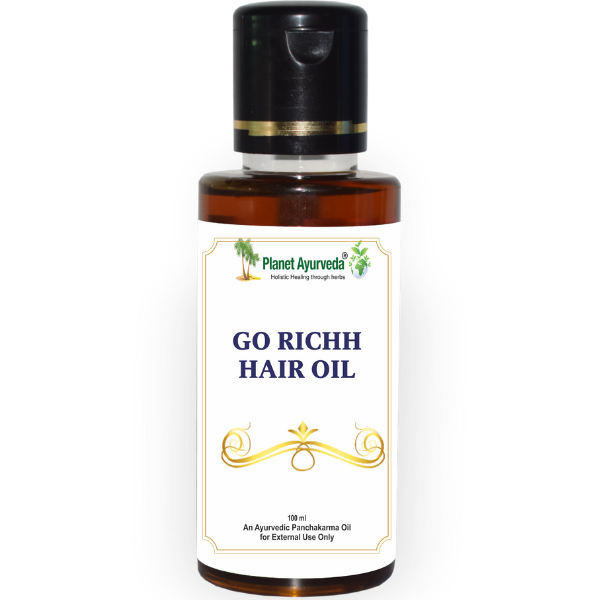
12. Go Richh Hair Oil
Go Richh Hair Oil is a general-purpose, Tridoṣic hair and scalp formulation built around a classical Bhṛṅgarājādi architecture. Its base blends sesame, coconut, sunflower, corn, and flaxseed oils with botanicals including Bhṛṅgarāja (Eclipta prostrata), Āmalakī, Brāhmī, Jaṭāmāṁsī, Palāśa, Śikākāī, and Mehendī. Bhṛṅgarāja acts as a premier keśya (hair-nourishing herb), Āmalakī provides rasāyana properties to prevent premature aging, and Brāhmī with Jaṭāmāṁsī delivers a calming medhya (mind-soothing) effect to the scalp.
Clinically, Go Richh Hair Oil is used for daily scalp maintenance, hair follicle fortification, dandruff control, and the prevention of premature greying across all skin and hair types. Applied via Śiro-abhyanga (scalp massage), it should be left on the scalp for 30 minutes up to overnight before washing out. It balances all three doṣas at the head, promoting healthy hair growth while soothing mental stress.
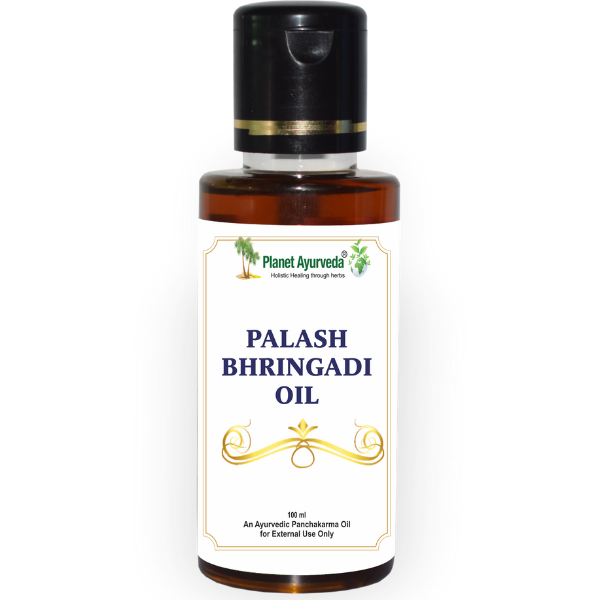
13. Palash Bhringadi Oil
Palash Bhringadi Oil is a cooling, Pitta-pacifying hair formulation designed specifically for hair loss accompanied by scalp heat, redness, and inflammation. While retaining the core Bhṛṅgarāja-Āmalakī structure, it shifts cool through a higher coconut oil ratio, Palāśa (Butea monosperma), Candana (sandalwood), and Yaṣṭimadhu (licorice). This combination targets localized Pitta imbalance (bhrājaka pitta) in the scalp.
It is indicated for Pitta-type hair loss, seborrheic dermatitis, burning or itching scalp, and premature greying associated with systemic heat or stress. Applied through cooling Śiro-abhyanga, it draws out excess heat, calms inflamed hair roots, and restores the scalp microenvironment. It serves as the primary alternative to general hair oils when a client presents with a noticeably “hot head” or active scalp irritation.
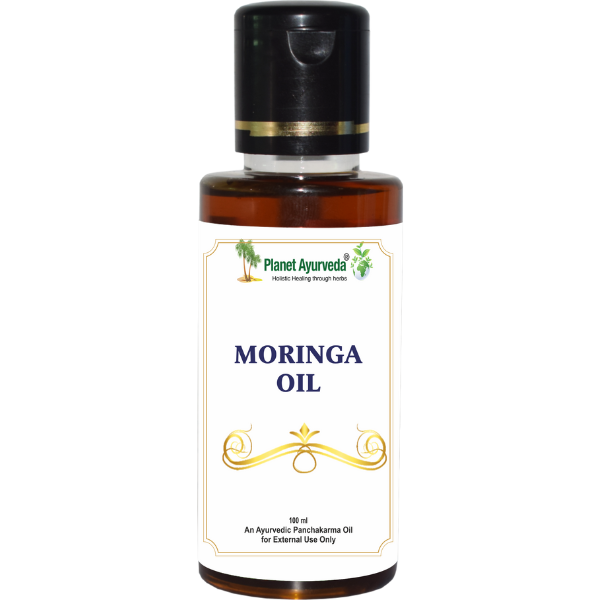
14. Moringa Oil
Moringa Oil (Śigru Taila) is a 100% pure, cold-pressed seed oil derived from Moringa oleifera. As the only single-ingredient product in the range, it possesses unique Ayurvedic properties: Śigru is kaṭu-tikta (pungent-bitter), uṣṇa (heating), laghu (light), and rūkṣa (dry), providing kaphahara and lekhana (scraping/clearing) actions on the scalp while remaining emollient as a fixed oil. High in oleic and behenic acids, it offers high oxidative stability and deep cutaneous absorption.
This unique dual nature makes Moringa Oil suitable for the clinical presentation of dry hair lengths paired with an oily, congestion-prone scalp. It clears excess Kapha sebum from hair follicles while moisturizing dry strands. Beyond scalp care, it functions as a lightweight facial cosmetic oil for dry skin. Free of sesame oil, it is also an ideal alternative for clients with sesame allergies.
Skin And Facial Oils
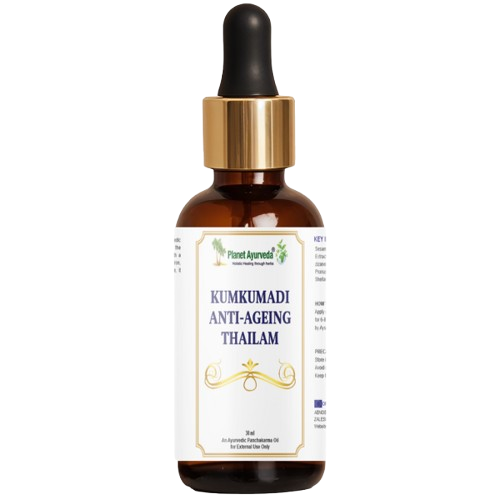
15. Kumkumadi Anti-Ageing Thailam
Kumkumadi Anti-Ageing Thailam is a traditional facial serum centered on Saffron (Kuṅkuma, 4.8%), Pattanga, Manjiṣṭhā, Uśīra, Nāgakeśara, and Lotus extracts in a sesame oil base. Classically categorized as varnya (complexion-brightening) and tvacya (skin-supporting), it acts on bhrājaka pitta and rakta dhātu—the structural levels where Ayurveda categorizes skin pigmentation, tone, and luster. The cooling flower extracts balance the active, circulation-stimulating herbs.
Kumkumadi Thailam is applied in small quantities (a few drops) during Mukha Abhyanga (facial massage) or as an overnight facial treatment. Its primary indications include fine lines, loss of skin elasticity, hyperpigmentation, uneven skin tone, post-acne scarring, and dull complexion. It is designed as a concentrated serum rather than a general body massage oil.
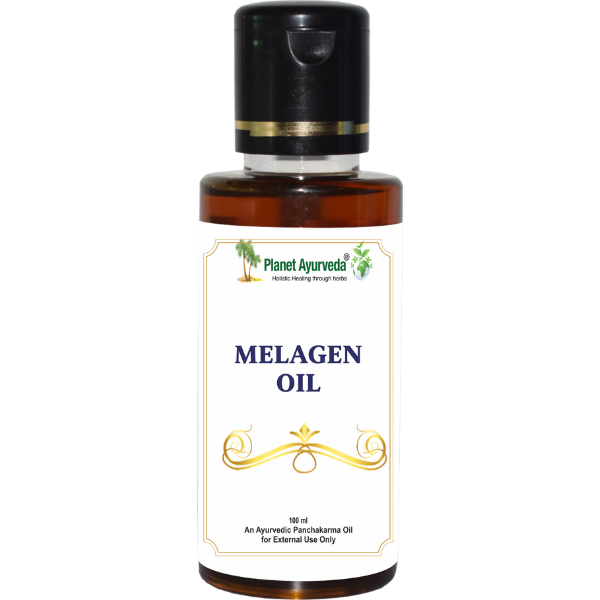
16. Melagen Oil
Melagen Oil is a specialized, targeted formulation based on the classical Bākucyādi principle for treating localized depigmentation. Formulated in a coconut oil base, it contains equal parts Bākuci (Psoralea corylifolia) and Śvetakutaja (Wrightia tinctoria). Bākuci is kaṭu-tikta (pungent-bitter), uṣṇa (heating), and tīkṣṇa (penetrating), acting as a primary śvitraghna (vitiligo-destroying) herb that pacifies Kapha and Vāta while stimulating localized bhrājaka pitta.
The furocoumarins (psoralens) in Bākuci induce photosensitization, which is central to its clinical mechanism for stimulating skin repigmentation. Indicated specifically for vitiligo (śvitra) and localized pigment loss, Melagen Oil is applied strictly to depigmented patches. Patients must follow a controlled, supervised light-exposure protocol, as uncontrolled sun exposure carries a risk of burning. It should never be used on broken, inflamed skin or applied as a full-body massage oil.
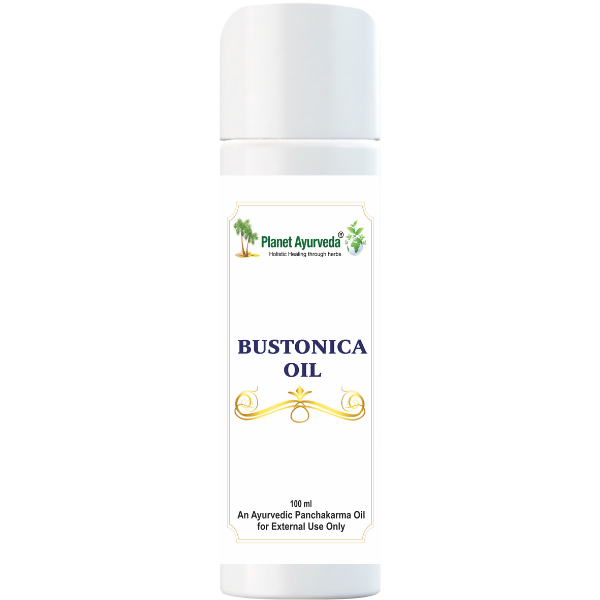
17. Bustonica Oil
Bustonica Oil is a topical formulation engineered to support skin elasticity and firmness around the breast and décolleté areas. Its composition features classical stanya (lactation/breast tissue supporting) and bṛṁhaṇa herbs—including Śatāvarī, Jīvantī, Gambhārī, Pāṭhā, and Gokṣura—in a lightweight base of flaxseed, sunflower, and sesame oils. The energetic profile is Vāta-Pitta pacifying, providing hydration and structural support to delicate cutaneous tissues.
Clinically, Bustonica Oil is indicated for loss of skin tone, sagging, and diminished elasticity in the breast and décolleté area following pregnancy, lactation, or menopause. It is applied externally in small amounts (around 20 drops per side) using gentle, upward circular strokes after bathing or at bedtime. It is strictly a cosmetic firming preparation and is not intended for underlying breast pathology.
Nasal Procedures (Panchakarma)
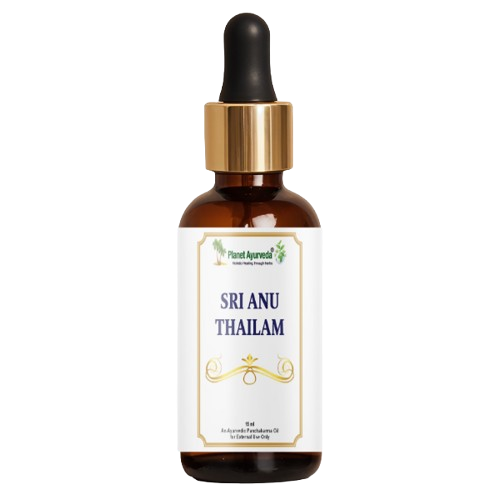
18. Sri Anu Thailam
Sri Anu Thailam (Anu Taila) is the reference pratimarśa nasya oil described in the Aṣṭāṅga Hṛdaya. Formulated in a faithful base of 40% goat’s milk and 10% sesame oil, it contains a complex blend of Jīvantī, Bala, Uśīra, Devadāru, Musta, Dāruharidrā, Yaṣṭimadhu, Śatāvarī, Bilva, and Bṛhatī. It is the only product in this 19-oil range utilized in a true Panchakarma procedure (Nasya). It clears Kapha stagnation from the head while strengthening the sense organs (indriya-baḷa).
Sri Anu Thailam is indicated for chronic rhinitis, allergic sinusitis, nasal congestion, sinus headaches, and as a daily preventive pratimarśa nasya (2 drops per nostril every morning) within dinacaryā (daily routine). Administered nasally, it lubricates the nasal passages, clears head congestion, and protects the upper clavicular region (ūrdhva-jatrugata). It is contraindicated during acute febrile illnesses, purulent sinus infections, or immediately after nasal surgery.
Abdominal And Pre-Panchakarma Oils
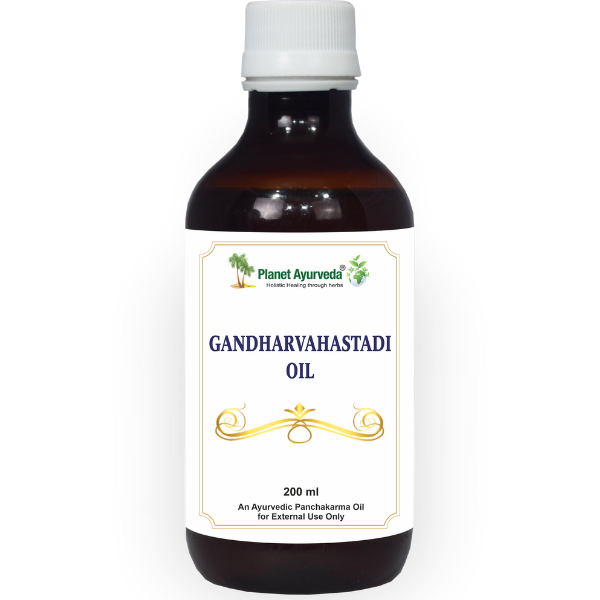
19. Gandharvahastadi Oil
Gandharvahastadi Oil (Gandharvahastādi Taila) is a classic Eraṇḍa (castor root and oil) formulation enriched with Yaṣṭimadhu, Sarjarasa, and a 32% milk (Lac) base. Eraṇḍa is madhura-kaṭu (sweet-pungent), uṣṇa (heating), and katu-vipāka, functioning as a classic vātānulomana agent that redirects erratic Apāna Vāyu downward. While classically taken internally as a mild purgative (mṛdu virecana), external cosmetic registrations utilize it as an abdominal and lower back massage oil.
In external clinical practice, Gandharvahastadi Thailam pacifies Vāta and Kapha. It is indicated for abdominal bloating, flatulence, sluggish digestion, lower back pain associated with digestive stasis, and for preparing the abdomen during local snehana prior to Virecana (purgation therapy). Applied via gentle, clockwise abdominal massage, it mechanically and energetically supports peristalsis and relieves trapped Vāta gas without producing internal laxative effects.