


Wheat (Triticum sativum Lam.) – Properties, Varieties, Composition & Dosages
Abstract
Triticum sativum Lam., commonly known as wheat, is one of the most widely cultivated cereal crops in the world and a staple food in many cultures. Beyond its nutritional value, wheat also holds significance in Ayurveda for its strengthening, nourishing and rejuvenating properties. This article explores its classical Ayurvedic context, vernacular names, botanical details, therapeutic uses and formulations.
Introduction
Wheat (Triticum sativum Lam.) belongs to the Poaceae family and is considered a vital grain for human nutrition. In Ayurveda, it is traditionally known for improving strength, increasing fertility, and pacifying Pitta doshas. With increasing attention on natural and traditional remedies, wheat has regained interest not only as a food grain but also as a therapeutic agent.
Scientific Classification
- Kingdom: Plantae
- Clade: Angiosperms
- Clade: Monocots
- Order: Poales
- Family: Poaceae
- Genus: Triticum
- Species: T. sativum Lam.
Synonym
- Godhuma
- Suman
- Bahudugdha
- Arupa
- Yavaka
- Hudumba
- Girija
- Rasika
Vernacular Names
- Sanskrit: Godhuma
- Hindi: Gehun
- Marathi: Gahu
- Gujarati: Gehu
- Tamil: Godhumai
- Telugu: Godumalu
- Kannada: Godhi
- Bengali: Ghum
- Malayalam: Gothambu
- Urdu: Gandum
- Punjabi: Kanak
- English: Wheat
Habitat
Triticum sativum is cultivated extensively in temperate regions across the globe. In India, it is primarily grown during the Rabi season in states like Punjab, Haryana, Uttar Pradesh, Madhya Pradesh, and Rajasthan. It thrives in well-drained loamy or clay loam soils under cool and dry climatic conditions.
Morphology
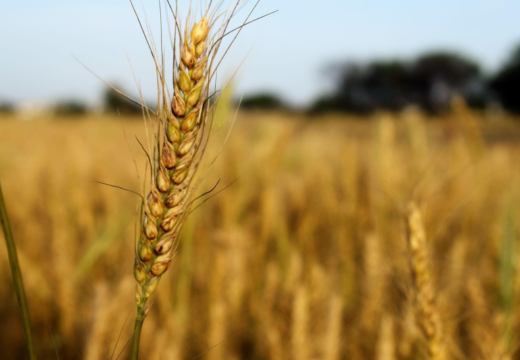
Wheat is an annual grass characterised by simple, upright culms that are either hollow or filled with pith, growing up to 1.2 meters in height. The leaves are flat and narrow, measuring approximately 20–38 cm in length and about 1.3 cm in width. The flowering structure consists of long, slender spikes that are dorsally compressed and somewhat flattened. The rachis is firm and does not break apart from the spikelet at maturity. Each spike features 2 to 5 flowers per spikelet, which are spaced relatively far apart along the stem, slightly overlapping and closely pressed to the rachis in an almost erect posture. The glumes are smooth, firm and keeled in their upper half and are shorter than the lemmas.
Varieties
It has three varieties, which are as follows:
- Mahagoudhuma- It is mainly found in the western sides of India (eg, Punjab)
- Madhuli- Its grains are comparatively small and found in mid-India (Agra and Mathura)
- Deerghagoudhuma- It’s also known as Nandimukha in various places, and it is spineless.
Classical Categorisation
- According to Bhavprakash Nighantu- Dhanya Varga
Ancient Verses
गोधूम मधुरः शीतो वातपित्तहरो गुरुः।
कफशुक्रप्रदो बल्यः स्निग्धः सन्धानकृत्सरः॥
जीवनो बृंहणो वर्ण्यो व्रण्यो रुच्यः स्थिरत्वकृत्॥(Bhavprakash Nighantu Dhanya varga 33-34)
According to the above shloka, Wheat has a sweet taste, cold potency, increases Kapha Dosha, Aphrodisiac, enhances the strength of the body, is unctuous, manages fractures and wound healing. It balances Vata and Pitta dosha, appetising and enhances skin complexion.
Ayurvedic Properties
- Taste (Rasa)- Sweet (Madhur)
- Physical property (Guna)- Heavy (Guru), Unctuous (Snigdha)
- Potency (Veerya)- Cold Potency (Sheet)
- Post-digestion effect (Vipaka)- Sweet (Madhur)
- Effect on tridosha- Balance Vata and Pitta dosha
Therapeutic Properties
- Madhura – Sweet taste
- Vrushya – Aphrodisiac, boosts vigor
- Guru – Heavy to digest
- Snigdha – Oily, unctuous
- Hima – Cooling effect
- Sara – Promotes mobility, relieves constipation
- Jeevana – Enlivens, supports vitality
- Brimhana – Increases body weight
- Varnya – Enhances skin tone and complexion
- Balya – Improves strength and immunity
- Ruchiprada – Enhances taste/appetite
- Sthairyakrut – Promotes stability and endurance
- Sandhana Krut – Aids healing of wounds and fractures
Chemical Composition
-
Tocopherols (Vitamin E)
- Total tocopherols – 1897 mcg/g
- Alpha-tocopherol – 62% in wheat germ oil
- Epsilon-tocopherol – 68% in bran oil
- Alpha-tocopherol – 11% in bran oil
- Ergosterol (Provitamin D)
- Minerals
-
Proteins
- Lysine (an essential amino acid)
- Haemagglutinating factors
- Antipyretic factors (destroyed by toasting)
- Hemoproteins with peroxidase activity
-
Lipids
- Gluten lipids
- Linoleic acid
Practical Uses
- Staple Food Use: Wheat powder is widely used to make bread and various other food items.
- Upanaha Sweda (Poultice Therapy): Used in Ayurvedic treatment for arthritis, inflammation, and localised pain by mixing wheat powder with pain-relieving herbs.
- Aphrodisiac Use: Combined with herbs like Kapikacchu, Ashwagandha, and milk to form a paste for regular consumption to enhance vigor.
- Gout (Vatarakta) Treatment: An external ointment made of ghee, wheat powder, and goat’s milk is applied to relieve symptoms.
- Lactation Support: Wheat powder is mixed with rice powder, barley powder, and cow’s milk to improve milk quality and quantity in lactating women.
- Wound Healing: Wheat powder is blended with turmeric, Manjistha, and Lodhra powder and sprinkled over fresh wounds to control bleeding.
Parts Used
- Grains
Dosage
- Grain Powder-50-100 gm
Planet Ayurveda Medicines
Conclusion
Wheat has been described in Ayurvedic texts for centuries as one of the important grains. It is utilised in the treatment of conditions such as gout and in aphrodisiac therapies. As a dietary ingredient, wheat is valued for its ability to enhance body strength and provide nourishment. Additionally, it is used in various Ayurvedic procedures, including Panchakarma and Upakarma (supportive therapies).